What Is Threat Modeling as a Service in 2026?
Date
Authors
Tony UcedaVélez
Follow Us


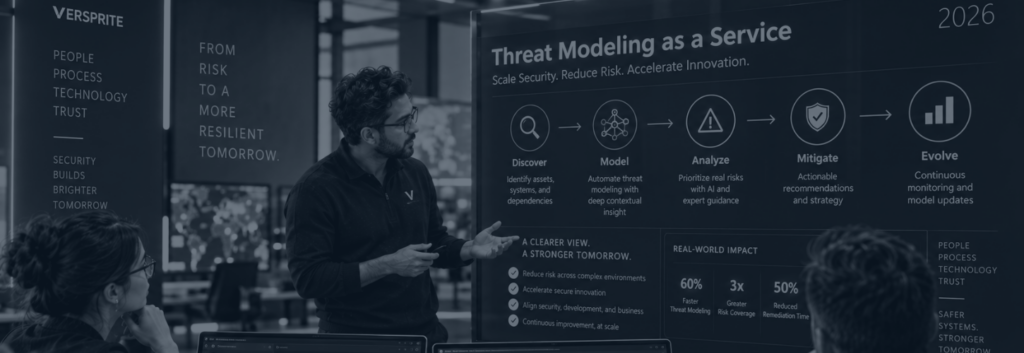
Threat Modeling as a Service (TMaaS) is a managed, on-demand security offering that identifies, analyzes, and prioritizes threats to applications, APIs, and cloud systems delivered by an external team of specialists using defined methodology and platform tooling, rather than built as a dedicated internal capability. For regulated enterprises, TMaaS exists to solve a specific problem: security teams that are outnumbered by the systems they’re responsible for, held to compliance frameworks that assume rigor they don’t have the headcount to sustain.
That’s the short answer. The longer answer what it actually covers, how it’s delivered, and why regulated industries specifically have moved toward it in 2026 is below.
How TMaaS Works: Platforms, Methodology, and Expertise
TMaaS isn’t a single tool or a single deliverable. It’s a service model built on three components working together:
A defined, risk-centric methodology. Without a consistent methodology, threat modeling output varies by whoever’s running the workshop. VerSprite’s TMaaS is built on PASTA (Process for Attack Simulation and Threat Analysis), the seven-stage methodology co-created by VerSprite’s CEO, which ties every technical finding back to a business objective and forward to a quantified impact.
Specialist expertise on demand. Rather than hiring and retaining a dedicated internal threat modeling function, TMaaS gives organizations access to security professionals who model threats as their primary discipline, engaged continuously or on a project basis, scaled to however many applications and systems actually need coverage.
Platform tooling to make it scale. Manual, workshop-based threat modeling caps out around whatever a small internal team can review in a quarter. Threat modeling platforms, whether used directly by the TMaaS provider or made available to the client’s own teams, correlate business context, threat intelligence, and vulnerability data automatically, which is what makes continuous coverage across a large application portfolio realistic instead of aspirational.
Why Regulated Enterprises Are Moving to TMaaS in 2026
Three pressures are pushing this shift specifically for regulated industries:
Compliance frameworks assume continuous rigor. PCI DSS, HIPAA, FISMA, FedRAMP, and SOC 2 all expect evidence that security controls are current, not evidence that they were current at the last audit. A threat model built once a year satisfies the letter of a checklist while missing the point of the requirement.
Attack surface is growing faster than internal review capacity. APIs, cloud migrations, and third-party integrations expand faster than most internal security teams can model them. That gap is where risk actually accumulates, not usually in the systems that get reviewed, but in the ones that ship between review cycles.
Business and clinical/mission impact has to be explainable. A finding that can’t be translated into financial exposure, patient safety, or mission risk doesn’t get budget. TMaaS engagements are structured to produce that translation as a standard deliverable, not an afterthought.
This is why TMaaS shows up consistently across financial services, healthcare, and government and public sector organizations specifically, three industries where the cost of an unmodeled threat is measured in more than just downtime.
What TMaaS Covers: Applications, APIs, and Cloud Systems
A TMaaS engagement scoped narrowly to a single application misses most of where risk actually lives in a modern enterprise. Comprehensive coverage spans:
- Applications: the traditional threat modeling target: architecture, data flows, trust boundaries, and design-level attack paths mapped to real threat actors and business impact.
- APIs: the connective tissue between systems, and increasingly where attackers find the path of least resistance, particularly in environments with heavy third-party integration.
- Cloud platforms and infrastructure: configuration, identity and access management, and the shared-responsibility gaps that show up when an organization assumes the cloud provider covers more than it actually does.
- Connected and legacy systems: IoT devices, connected medical equipment, and legacy infrastructure mid-modernization, which traditional, application-only threat modeling programs routinely exclude because they don’t fit the standard template.
How TMaaS Fits Into Secure Software Development
Threat modeling only reduces risk if it happens early enough to change a design decision, not after code is already in production and remediation means a rewrite instead of a revision. TMaaS is structured to integrate into the software development lifecycle at the design and architecture stage, surfacing threats before they’re built into the system rather than testing for them afterward.
For organizations releasing continuously, a point-in-time engagement still leaves gaps between reviews. Fork extends the same PASTA-based methodology into a continuously updated model one that reflects the application as it actually exists in production, not as it existed at the last scheduled review.
TMaaS and Compliance: Turning Security Work Into Audit-Ready Evidence
Every regulated framework eventually asks the same underlying question: can you prove your security program is working, not just that it exists? TMaaS is built to answer that question as a byproduct of the work itself. Findings map to regulatory and risk management requirements as they’re generated, which means the evidence an auditor or examiner asks for already exists instead of being reconstructed under deadline pressure, whether the framework in question is PCI DSS for a payments platform, HIPAA for a healthcare system, or FISMA and FedRAMP for a government cloud environment.
How to Evaluate a TMaaS Provider
Not every TMaaS offering is built the same way, and the differences matter more than the pitch decks suggest. A few questions worth asking before signing:
Is the methodology consistent, or does it vary by consultant? If the same finding would get ranked differently depending on who reviewed it, the program isn’t actually risk-based; it’s opinion-based with better formatting.
Does the provider validate findings, or just theorize them? An attack path that’s been tested against the live environment is worth more than one that’s diagrammed but unconfirmed. Ask whether the engagement includes adversarial validation or stops at modeling.
Can findings be traced to business, clinical, or mission impact? If a report hands you a severity score without a business justification attached, you’ll still be doing the translation work yourself before it’s useful in a budget conversation.
Does remediation guidance account for your operational constraints? A healthcare system can’t take a clinical application offline the way a SaaS company might test in a staging environment; a government agency under continuous monitoring has different constraints than a startup. Generic remediation guidance that ignores this isn’t actually actionable.
