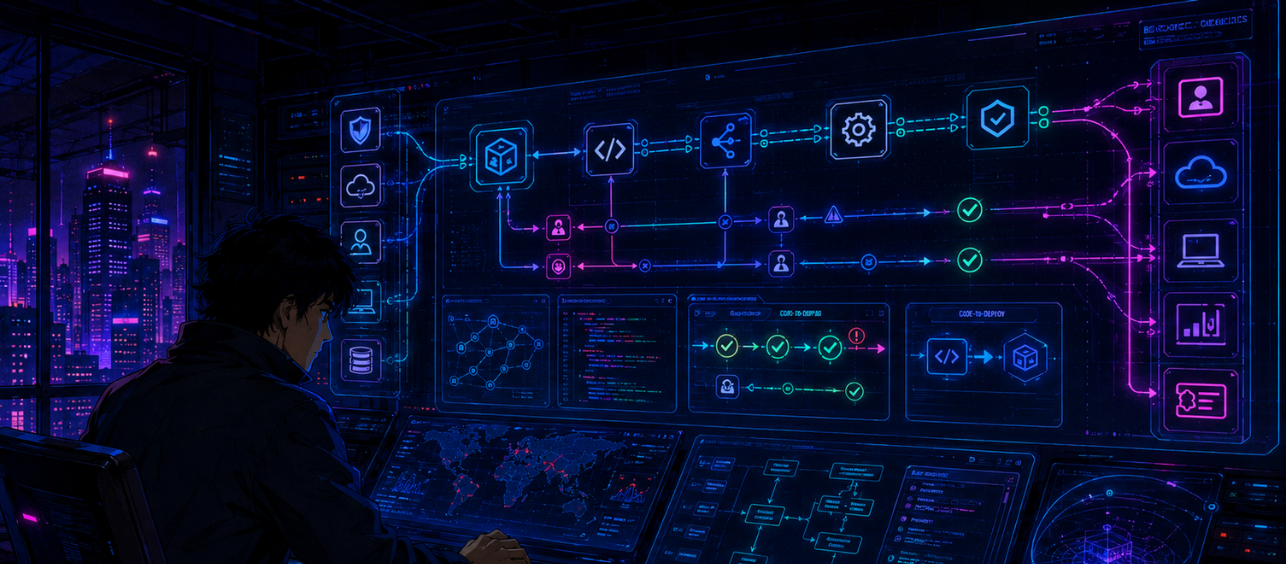
Security Automation & Engineering
Remove the manual work that should not require a human
Build a Tailored Engagement or Service Model Today- /
- /
- /
- /
- /
- /
- /
- /
- /
- /
- /
- /
- /
- /
- /
- /
- /
- /
- /
- /
- /
- /
Security teams do not fail to scale because they lack effort. They fail to scale because too many critical processes still depend on manual action.
An alert needs triage. A ticket needs routing. A user needs provisioning. A detection needs validation. A report needs assembly. A response workflow needs coordination across tools that were never designed to work together cleanly.
Every manual handoff creates delay. Every analyst-dependent step becomes a bottleneck. Under pressure, those bottlenecks compound.
VerSprite’s Security Automation & Engineering practice helps organizations remove unnecessary manual work from security operations, detection engineering, response workflows, reporting, and tool integration. We design and build automation around your existing environment, then deliver it with documentation, runbooks, and knowledge transfer so your team can own what we build.
What Is Security Automation & Engineering?
Security Automation & Engineering is the design, development, integration, and operationalization of automated workflows that improve security team efficiency, consistency, and response quality.
This service is not about forcing generic playbooks into your environment. It is about engineering automation that fits the tools, processes, people, and risk priorities already present in your organization.
VerSprite helps security teams automate the work that slows them down, including triage, enrichment, routing, provisioning, validation, reporting, detection deployment, and response coordination.
The result is a security program that operates with less friction, stronger consistency, and better use of analyst time.
Why Security Automation Matters
Modern security teams operate under constant pressure. Alerts continue to grow. Attack paths evolve. Cloud and identity environments change quickly. Compliance and executive reporting demands increase. Meanwhile, security teams are expected to respond faster, prove coverage, and support the business without adding unnecessary drag.
Manual workflows make that difficult.
Manual processes often create:
- Slow alert triage
- Inconsistent response actions
- Duplicated analyst effort
- Delayed escalation
- Tooling gaps between detection and response
- Incomplete enrichment
- Repetitive reporting work
- Unclear ownership between teams
- Missed steps during high-pressure incidents
- Difficulty measuring process effectiveness
Automation reduces these weaknesses when it is engineered with precision. It helps teams standardize repeatable work, preserve analyst focus for higher-value decisions, and create security workflows that can scale under pressure.
- /
- /
- /
- /
- /
- /
- /
- /
- /
- /
- /
- /
- /
- /
- /
- /
- /
- /
- /
- /
- /
- /
VerSprite’s Approach
VerSprite approaches security automation as an engineering discipline.
We begin by understanding the operating reality of your security team: the tools in use, the workflows that matter, the handoffs that cause friction, the risks that require priority, and the level of control your team needs after delivery.
We then design automation that is practical, maintainable, measurable, and aligned to your environment.
Our approach is built around four principles:
- Automate repeatable work without removing necessary human judgment.
- Integrate with the tools and workflows your team already uses.
- Build with documentation, maintainability, and ownership in mind.
- Validate automation before it affects production operations.
What Makes VerSprite Different
Built for Your Environment, Not Templates
Generic automation playbooks rarely survive first contact with a real enterprise environment.
Your tools, data fields, identity structures, approval chains, escalation paths, and operational constraints are specific to your organization. VerSprite designs automation around that reality.
We build for your stack, your workflows, your security priorities, and your team structure. The goal is not to deliver a library of theoretical playbooks. The goal is to deliver automation that works in your environment and can be maintained by your team.
MCP-Integrated Engineering
VerSprite designs automation using Model Context Protocol, or MCP, where it reduces integration complexity and improves workflow usability.
MCP can enable AI agents to interact with elements of a security toolchain through controlled, natural language interfaces rather than brittle one-off scripts. When used appropriately, this can simplify how teams query systems, trigger approved workflows, retrieve context, and coordinate actions across platforms.
VerSprite applies MCP carefully, with security, governance, access control, and auditability in mind. It is not used as a shortcut around engineering discipline. It is used where it can reduce friction while preserving control.
Detection-as-Code Discipline
Detection engineering should be consistent, testable, and auditable.
VerSprite applies detection-as-code practices to help organizations develop, test, peer review, version control, and deploy detection rules through structured pipelines. This reduces undocumented changes, improves collaboration, and gives teams a stronger foundation for continuous detection improvement.
Detection-as-code can support:
- Version-controlled detection logic
- Peer review before deployment
- Testing against sample data or known behaviors
- Deployment pipelines
- Rollback procedures
- Documentation linked to detection intent
- Audit-ready change history
Handoff-Ready Delivery
Automation should not create a dependency that the client cannot maintain.
Every engagement includes documentation, runbooks, and knowledge transfer. VerSprite delivers what we build in a way that your team can understand, operate, and improve.
You own the automation. You own the workflows. You own the operational knowledge.
- /
- /
- /
- /
- /
- /
- /
- /
- /
- /
- /
- /
- /
- /
- /
- /
- /
- /
- /
- /
- /
- /
Security Automation Use Cases
VerSprite can support a wide range of security automation and engineering use cases, including:
Alert Triage and Enrichment
Automate the collection of context around alerts, including user details, asset information, threat intelligence, vulnerability data, identity signals, endpoint status, and recent activity.
Incident Routing and Escalation
Route incidents to the right team, queue, or workflow based on severity, asset criticality, business unit, detection type, or response requirements.
Detection Engineering Pipelines
Build and improve detection-as-code workflows that allow detection logic to be reviewed, tested, deployed, and tracked with engineering discipline.
Security Reporting Automation
Reduce manual reporting effort by automating recurring metrics, dashboards, executive summaries, control evidence collection, and operational reporting workflows.
Identity and Access Workflows
Automate repeatable identity and access security tasks such as access review support, user provisioning checks, entitlement validation, suspicious login enrichment, and approval workflow support.
Vulnerability and Exposure Workflows
Connect vulnerability findings to ownership, prioritization, ticketing, validation, exception handling, and remediation tracking.
Cloud Security Automation
Automate cloud control checks, misconfiguration triage, resource tagging validation, policy enforcement workflows, and security event enrichment.
SOAR and Workflow Engineering
Improve or build security orchestration workflows across existing tools, helping teams connect detection, enrichment, decisioning, response, and documentation.
MCP-Based Security Toolchain Interfaces
Where appropriate, design MCP-enabled interfaces that allow approved AI agents to interact with security systems through governed workflows and natural language task execution.
- /
- /
- /
- /
- /
- /
- /
- /
- /
- /
- /
- /
- /
- /
- /
- /
- /
- /
- /
- /
- /
- /
What We Engineer
Depending on the engagement, VerSprite may design and build:
- Security automation workflows
- Detection-as-code pipelines
- SOAR playbooks
- MCP servers or MCP-enabled integrations
- API-based security tool integrations
- Alert enrichment pipelines
- Ticketing and routing logic
- Reporting automation
- Response runbooks
- Data normalization workflows
- Detection validation workflows
- Workflow documentation
- Operational dashboards
- Security engineering repositories
- Testing and deployment processes
Every build is scoped around business need, technical feasibility, security control requirements, and operational ownership.
- /
- /
- /
- /
- /
- /
- /
- /
- /
- /
- /
- /
- /
- /
- /
- /
- /
- /
- /
- /
- /
- /
Engagement Lifecycle
VerSprite’s Security Automation & Engineering engagements are designed to move from discovery to usable, maintainable automation.
1. Workflow Discovery
We identify the workflows, handoffs, tasks, and operational pain points that are slowing the security team down.
2. Tool and Integration Review
We review the relevant tools, APIs, data sources, permissions, logging, workflows, and integration constraints.
3. Automation Opportunity Mapping
We identify where automation can provide the most value, reduce the most friction, and improve security outcomes without introducing unnecessary risk.
4. Engineering Design
We define the automation architecture, workflow logic, data handling requirements, access model, testing approach, and operational handoff plan.
5. Build and Integration
VerSprite engineers the automation using the selected tools, platforms, APIs, pipelines, or MCP-enabled interfaces.
6. Testing and Validation
Automation is tested before production use. This may include sample event testing, failure-path testing, approval-path validation, logging review, and stakeholder acceptance.
7. Documentation and Knowledge Transfer
We deliver documentation, runbooks, architecture notes, operational guidance, and knowledge transfer so your team can maintain and improve what was built.
8. Continuous Improvement Support
For organizations that need ongoing support, VerSprite can continue to refine workflows, expand automation coverage, improve detections, and adapt automation as the environment evolves.
Key Outcomes
VerSprite’s Security Automation & Engineering service helps organizations:
- Reduce repetitive manual work
- Improve triage speed and consistency
- Standardize response workflows
- Reduce analyst bottlenecks
- Improve detection deployment discipline
- Connect tools that currently operate in silos
- Improve reporting accuracy and reduce reporting effort
- Increase process consistency during incidents
- Improve ownership and routing
- Strengthen auditability through documented workflows
- Enable safer use of AI-assisted security operations
- Transfer maintainable automation back to the client team
Who This Service Is For
Security Automation & Engineering is designed for organizations that need to scale security operations without simply adding more manual effort.
This service is especially useful for:
- Security operations teams with repetitive triage or routing tasks
- Detection engineering teams moving toward detection-as-code
- CISOs seeking operational efficiency from existing tools
- Cloud security teams managing high-volume control findings
- Identity teams handling recurring access and entitlement workflows
- Compliance teams spending too much time assembling evidence
- Organizations with SOAR platforms that are underused or poorly customized
- Teams exploring safe, governed AI agent integration with security tools
- Enterprises that need automation but also need documentation and ownership
Why VerSprite
VerSprite brings together adversarial thinking, application security depth, engineering discipline, and practical security operations experience.
We understand that automation must do more than execute a task. It must support the way security teams actually work. It must respect business context, operational constraints, data sensitivity, and control requirements. It must also be maintainable after the engagement ends.
Our Security Automation & Engineering practice helps clients remove friction from the security program without giving up control.
We build the automation. We document it. We transfer the knowledge. You own what we build.
- /
- /
- /
- /
- /
- /
- /
- /
- /
- /
- /
- /
- /
- /
- /
- /
- /
- /
- /
- /
- /
- /
Engineer the Work Out of the Workflow
Manual security work has a cost. It slows response, increases inconsistency, and forces skilled professionals to spend time on tasks that should already be automated.
VerSprite’s Security Automation & Engineering practice helps your team remove that friction with automation that is practical, secure, documented, and built for your environment.
Contact VerSprite to discuss Security Automation & Engineering for your security program.
Frequently Asked Questions

We’re Not a Vendor
We’re Your Security Partner
- Risk-centric security
- True extension of your team
- Executive-level experience
