Retail & E-Commerce
Security Solutions
Safeguard Your Retail Operations with Holistic Cybersecurity Across Every Channel
- /
- /
- /
- /
- /
- /
- /
- /
- /
- /
- /
- /
- /
- /
- /
- /
- /
- /
- /
- /
- /
- /
What Is Retail & E-Commerce Cybersecurity?
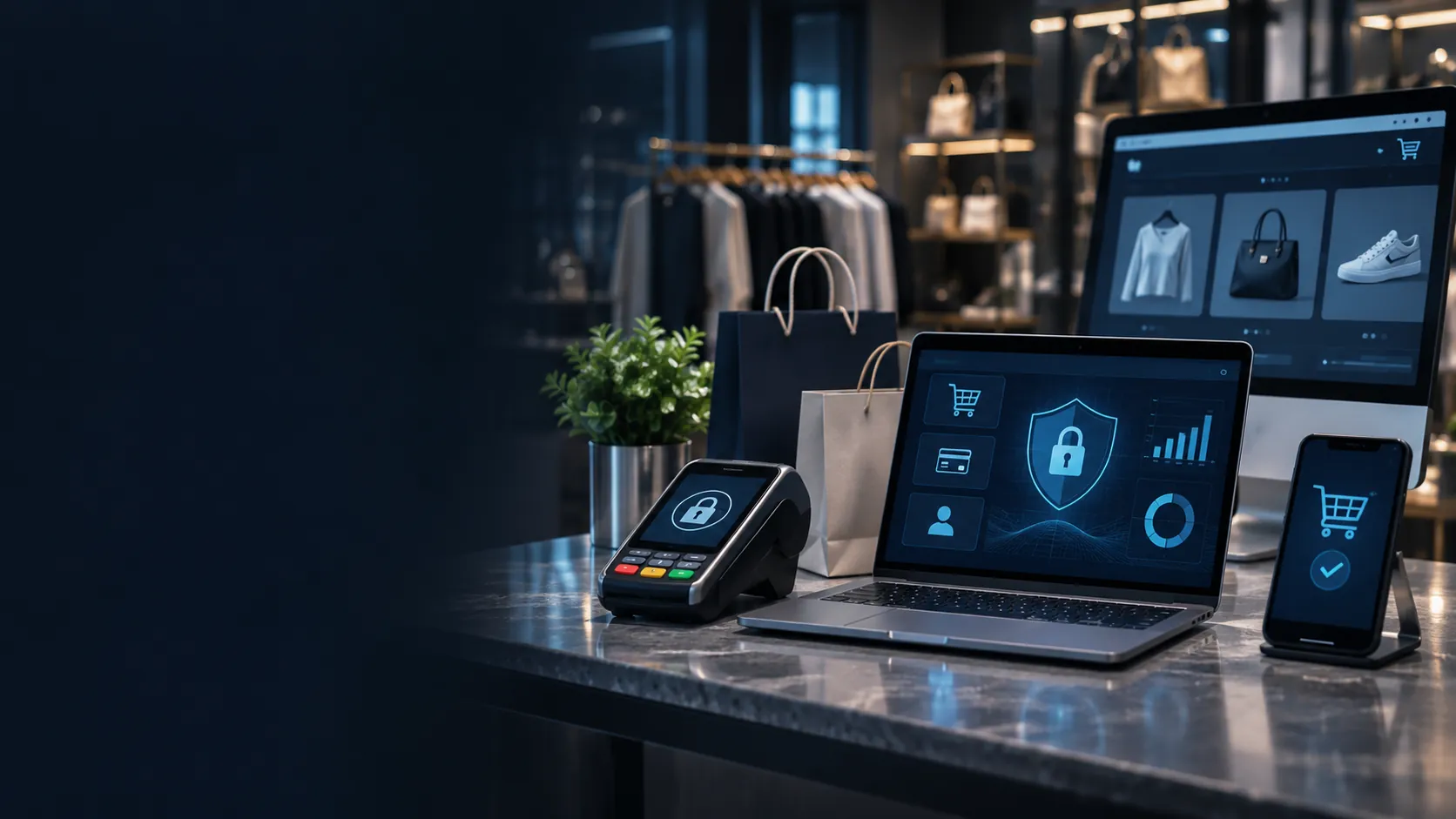
Retail and e-commerce cybersecurity is the practice of protecting customer data, payment systems, and digital storefronts from cyber threats across both online platforms and in-store systems. Because modern retail is omnichannel — web, mobile, POS, and third-party integrations all processing payment and personal data — effective retail security has to defend a far larger attack surface than a traditional IT environment, while meeting payment-industry obligations like PCI DSS. It combines threat modeling, POS and payment security, e-commerce application testing, and supply-chain risk management to keep transactions safe and operations running.
- /
- /
- /
- /
- /
- /
- /
- /
- /
- /
- /
- /
- /
- /
- /
- /
- /
- /
- /
- /
- /
- /
The Retail Threat Landscape
Retail is now one of the most-targeted sectors online:
- ~93% of confirmed retail breaches stem from just three patterns — system intrusion, social engineering, and basic web application attacks (Verizon 2025 Data Breach Investigations Report).
- Commerce was the most-targeted industry for web attacks in 2025, drawing nearly three times the volume of the next-closest sector (Akamai, 2025).
- Stolen credentials drove 88% of basic web application attacks, and credential abuse was behind 22% of all breaches (Verizon 2025 DBIR).
- Bad bots accounted for roughly 39% of retail web traffic, with 64% of retail bot attacks targeting API business logic (Imperva/Thales 2025 Bad Bot Report).
- ~$3.48 million — the average cost of a retail data breach in 2025; retail was among the sectors whose costs rose even as the global average fell (IBM Cost of a Data Breach Report 2025).
- /
- /
- /
- /
- /
- /
- /
- /
- /
- /
- /
- /
- /
- /
- /
- /
- /
- /
- /
- /
- /
- /
Advanced Threat Simulation & Attack Modeling
VerSprite helps retail clients simulate probable cyber attacks using sophisticated threat modeling methodologies. While protections like EMV cards provide baseline security for in-store transactions, cybercriminals continuously adapt, shifting focus to exploit new vulnerabilities across omnichannel retail environments. Our threat simulation services include:
RAM-Scraping Attack Simulation
Testing point-of-sale (POS) systems against memory-scraping malware that targets payment card data.
Omnichannel Security Assessment
Evaluating attack vectors across online, mobile, and in-store customer touchpoints.
Social Engineering Testing
Assessing employee susceptibility to phishing and pretexting attacks targeting sensitive customer information.
Supply Chain Security Analysis
Identifying vulnerabilities in third-party integrations and vendor relationships.
By understanding potential attack scenarios and their business impact, retail organizations can implement targeted defenses and develop effective incident response plans.
- /
- /
- /
- /
- /
- /
- /
- /
- /
- /
- /
- /
- /
- /
- /
- /
- /
- /
- /
- /
- /
- /
PCI-DSS Compliance & Data Security Standards
Since the establishment of the PCI Security Standards Council, VerSprite has been a trusted partner for merchants and service providers navigating the Payment Card Industry Data Security Standard (PCI-DSS). Our regulatory compliance services ensure your organization meets evolving requirements while maintaining operational efficiency.
External & Internal Penetration Testing
Network vulnerability assessments, application security testing for e-commerce platforms, wireless network security evaluations, and social engineering assessments. → Penetration Testing
Network Segmentation Testing
Cardholder data environment (CDE) isolation validation, network architecture security reviews, firewall rule effectiveness testing, and VLAN configuration assessments.
Compliance Operationalization & Automation
Automated compliance monitoring, continuous security control validation, policy and procedure development, and risk-assessment automation frameworks.
Secure Development Training Programs
Developer security-awareness training, secure coding workshops, application security testing methodologies, and DevSecOps implementation guidance. → Security Training
File Integrity Monitoring (FIM) Implementation
Critical system file monitoring, change detection and alerting, compliance reporting automation, and integration with existing security infrastructure.
Web Application Security Testing
Dynamic (DAST), static (SAST), and interactive (IAST) application security testing, plus API security assessments for retail platforms. → Web Application Security
- /
- /
- /
- /
- /
- /
- /
- /
- /
- /
- /
- /
- /
- /
- /
- /
- /
- /
- /
- /
- /
- /
Point-of-Sale (POS) Security Solutions
RAM-scraping malware remains one of the most significant threats to retail payment systems. VerSprite’s specialized research team has analyzed prevalent POS malware families and developed detection methodologies to protect merchant environments.
Malware Threat Intelligence
Analysis of emerging POS malware variants, compromise-indicator extraction and correlation, threat-landscape monitoring, and custom signature development.
Zero-Day Vulnerability Research
Proprietary security testing for POS devices, custom exploit development for penetration testing, vendor coordination for responsible disclosure, and security-control validation. → Research as a Service
POS Environment Hardening
System configuration security reviews, access-control implementation, network isolation strategies, and EDR deployment.
Incident Response & Forensics
POS compromise investigation, memory-dump analysis and malware extraction, timeline reconstruction and impact assessment, and regulatory notification support. → Compromise Assessment & Digital Forensics
- /
- /
- /
- /
- /
- /
- /
- /
- /
- /
- /
- /
- /
- /
- /
- /
- /
- /
- /
- /
- /
- /
E-Commerce Platform Security
Modern e-commerce platforms face unique challenges, from sophisticated web application attacks to customer data breaches. VerSprite provides security services tailored to online retail:
Shopping Cart Security Testing
Comprehensive assessment of payment-processing workflows.
Customer Data Protection
Implementation of data encryption and tokenization solutions.
API Security Assessment
Testing of mobile app and third-party integrations.
Cloud Security Review
AWS, Azure, and GCP security configuration validation. → Cloud Security
- /
- /
- /
- /
- /
- /
- /
- /
- /
- /
- /
- /
- /
- /
- /
- /
- /
- /
- /
- /
- /
- /
Industry-Leading Research & Case Studies
VerSprite’s research team has conducted extensive analysis of point-of-sale security vulnerabilities, revealing critical concerns in payment application development. Our research contributes to industry-wide security improvements and helps retailers understand emerging threats.
Featured Research — Point-of-Sale Insecurities Revealed: Our case study examines multiple POS security vulnerabilities and provides actionable recommendations for retail organizations. → View the Case Study
- /
- /
- /
- /
- /
- /
- /
- /
- /
- /
- /
- /
- /
- /
- /
- /
- /
- /
- /
- /
- /
- /
Why Choose VerSprite for Retail Security?
Proven Expertise in Retail Cybersecurity
- Industry experience — extensive background working with major retailers and payment processors.
- Compliance leadership — involvement with PCI Security Standards Council initiatives.
- Research-driven approach — threat intelligence and vulnerability research.
- Comprehensive solutions — end-to-end security services from assessment to remediation.
- Regulatory knowledge — deep understanding of retail compliance (PCI-DSS, GDPR, CCPA).
- /
- /
- /
- /
- /
- /
- /
- /
- /
- /
- /
- /
- /
- /
- /
- /
- /
- /
- /
- /
- /
- /
Retail and E-Commerce Cybersecurity Solutions FAQs
What are retail and e-commerce cybersecurity solutions? Retail and e-commerce cybersecurity solutions are specialized services designed to protect customer data, payment systems, and digital storefronts from cyber threats. These solutions secure both online platforms and in-store systems to ensure safe transactions and uninterrupted business operations.
Why is cybersecurity important for retail and e-commerce businesses? Retail businesses process large volumes of sensitive customer and payment data, making them a prime target for cyberattacks. Cybersecurity helps prevent data breaches, financial fraud, and operational disruptions that can impact revenue and customer trust.
What is included in retail cybersecurity solutions? Retail cybersecurity solutions typically include threat modeling and attack simulation, point-of-sale (POS) security and malware detection, e-commerce application security testing, payment system protection and PCI-DSS compliance, API and mobile application security, and supply chain and vendor risk assessments.
What is PCI-DSS compliance in retail? PCI-DSS (Payment Card Industry Data Security Standard) is a set of security requirements designed to protect cardholder data. Retailers must comply with PCI-DSS to securely process, store, and transmit payment information and avoid regulatory penalties.
What is point-of-sale (POS) security? POS security focuses on protecting in-store payment systems from threats such as RAM-scraping malware and unauthorized access. Securing POS environments is critical to preventing credit card theft and fraud.
What are the most common cyber threats in retail? Common threats include payment card skimming and POS malware, ransomware attacks targeting retail systems, web application attacks on e-commerce platforms, phishing and social engineering targeting employees, and third-party and supply chain vulnerabilities.
What is omnichannel security in retail? Omnichannel security protects all customer interaction points, including online stores, mobile apps, and physical locations. It ensures consistent security across the entire retail ecosystem, reducing attack surfaces.
How does e-commerce security protect customer data? E-commerce security uses encryption, tokenization, secure coding practices, and application testing to protect customer data during online transactions and prevent unauthorized access.
How does threat modeling improve retail security? Threat modeling simulates real-world attack scenarios across retail environments, helping organizations identify vulnerabilities in payment systems, applications, and customer touchpoints before attackers exploit them.
What makes VerSprite’s retail security solutions different? VerSprite uses a risk-based approach and advanced threat modeling to simulate realistic attacks across omnichannel retail environments. Its methodology prioritizes vulnerabilities based on business impact, helping retailers protect revenue, customer trust, and operations.
What is the difference between retail cybersecurity and general cybersecurity? Retail cybersecurity focuses specifically on protecting payment systems, customer data, and omnichannel environments, while general cybersecurity applies broader protections across IT systems and infrastructure.
When should retail businesses invest in cybersecurity solutions? Retail businesses should invest in cybersecurity when launching e-commerce platforms, processing payment data, expanding omnichannel operations, or facing increasing threats such as ransomware and fraud.
What are the risks of poor cybersecurity in retail? Poor cybersecurity can lead to payment data breaches, financial fraud, regulatory penalties, operational downtime, and loss of customer trust, directly impacting revenue and brand reputation.

We’re Not a Vendor
We’re Your Security Partner
- Risk-centric security
- True extension of your team
- Executive-level experience
