Application Threat Modeling Services
Risk-Based Application Threat Modeling to Identify Real Attack Paths and Business Impact
Build a Tailored Engagement or Service Model Today- /
- /
- /
- /
- /
- /
- /
- /
- /
- /
- /
- /
- /
- /
- /
- /
- /
- /
- /
- /
- /
- /
There’s more to threat modeling than mapping a handful of threat categories to a data flow diagram. VerSprite models the threats that actually matter to your business — who would attack your application, how, and what it would cost you — using PASTA, the risk-centric methodology our CEO co-created. The result is a prioritized, evidence-based view of real attack paths, not a checklist of theoretical issues.
- /
- /
- /
- /
- /
- /
- /
- /
- /
- /
- /
- /
- /
- /
- /
- /
- /
- /
- /
- /
- /
- /
What Is Application Threat Modeling?
Application threat modeling is a structured process for identifying, analyzing, and prioritizing the security threats to an application before they can be exploited. It examines the application’s architecture, data flows, trust boundaries, and likely threat actors to determine which attacks are credible and what business impact they would cause. Done well, it shifts security left — surfacing risk during design and development rather than after deployment — and focuses remediation on the threats that matter most to the business.
- /
- /
- /
- /
- /
- /
- /
- /
- /
- /
- /
- /
- /
- /
- /
- /
- /
- /
- /
- /
- /
- /
PASTA: VerSprite’s Risk-Based Threat Modeling Methodology
VerSprite uses PASTA (Process for Attack Simulation and Threat Analysis), the risk-centric threat modeling methodology co-created by VerSprite CEO Tony UcedaVélez and Marco M. Morana, and documented in their book Risk Centric Threat Modeling: Process for Attack Simulation and Threat Analysis (Wiley, 2015). PASTA integrates business impact, inherent application risk, trust boundaries, correlated threats, and the attack patterns that exploit identified weaknesses.
Before PASTA, most application threat models didn’t seriously consider real-world threats. Threat-categorization mnemonics like STRIDE are useful for beginners, but product owners and their leadership need to know which threats are actually relevant to their business, product, and platform — and a fixed handful of categories rarely captures what adversaries are really planning. PASTA is evidence-based: VerSprite correlates real threats to your application’s attack surface, validates them through exploitation testing to confirm they’re probable, and ties viability to sustained business impact.
- /
- /
- /
- /
- /
- /
- /
- /
- /
- /
- /
- /
- /
- /
- /
- /
- /
- /
- /
- /
- /
- /
Industries We Serve
VerSprite delivers application threat modeling across industries where security failures translate directly into financial loss, safety risk, or regulatory exposure:
Financial Services & FinTech
Model fraud, account takeover, and transaction-manipulation scenarios; analyze APIs, third-party integrations, and cloud dependencies against regulatory and financial risk tolerance.
Healthcare & Life Sciences
Model threats to applications processing ePHI and clinical workflows; analyze trust boundaries across EHR systems, connected devices, and partners, aligned to HIPAA.
SaaS & Technology Providers
Map attack surfaces across cloud-native and microservices environments; model threats to authentication flows, APIs, tenant isolation, and CI/CD pipelines.
Retail & E-Commerce
Model threats to checkout, payment processing, and account management; analyze integrations with payment processors and logistics providers.
Manufacturing & Critical Infrastructure
Model threats across IT/OT convergence and production systems; identify attack paths that could impact operational technology and physical processes.
- /
- /
- /
- /
- /
- /
- /
- /
- /
- /
- /
- /
- /
- /
- /
- /
- /
- /
- /
- /
- /
- /
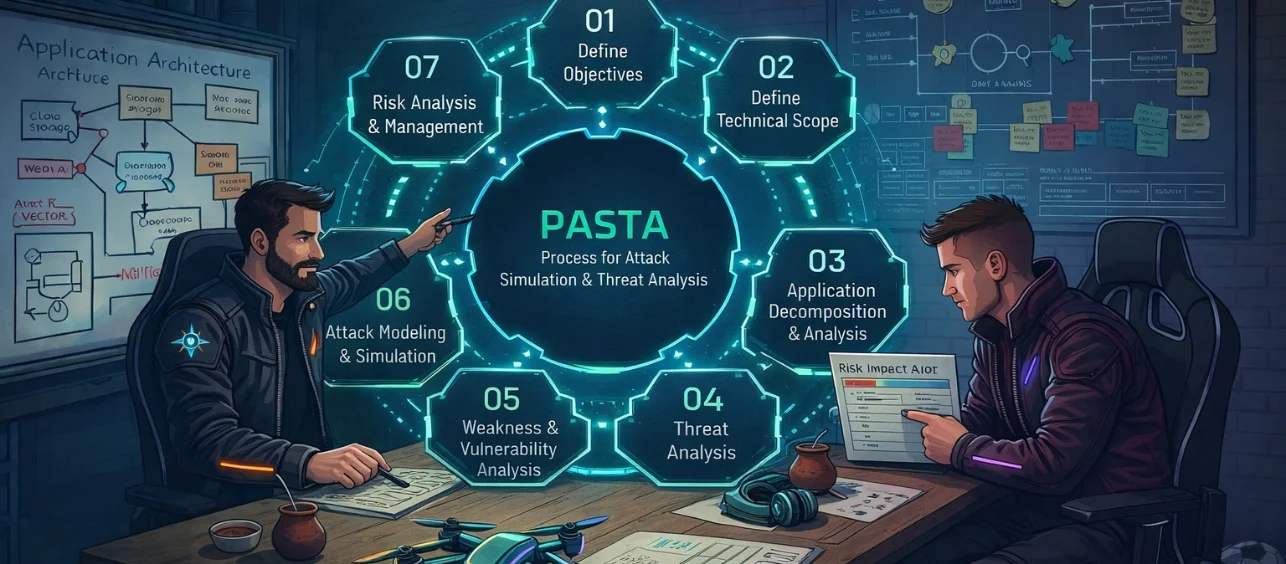
The 7 Stages of PASTA Threat Modeling
Stage 1 — Define Objectives
Establish the business and security objectives for the analysis, including the application’s inherent risk profile and any regulatory or compliance requirements, early in the SDLC (or for a given sprint).
Stage 2 — Define Technical Scope
Decompose the technology stack and infrastructure supporting the application components that deliver those business objectives. You can’t protect what you don’t know exists.
Stage 3 — Application Decomposition
Map the data flows among application components and services, identifying assets, interfaces, trust boundaries, and access controls.
Stage 4 — Threat Analysis
Develop threat assertions from environmental data and relevant industry threat intelligence, tied to the application’s services, data, and deployment model.
Stage 5 — Vulnerability & Weakness Analysis
Identify the vulnerabilities and weaknesses in the application’s design and code, and correlate them against the threat assertions from the prior stage to see which are actually supported.
Stage 6 — Attack Modeling
Emulate the attacks that could exploit the identified weaknesses, using attack patterns and attack trees to determine threat viability in practice.
Stage 7 — Risk & Impact Analysis
Quantify the business risk of the validated threats and prioritize remediation — addressing countermeasures for non-accepted risks and providing remediation alternatives based on impact, likelihood, and cost of implementation.
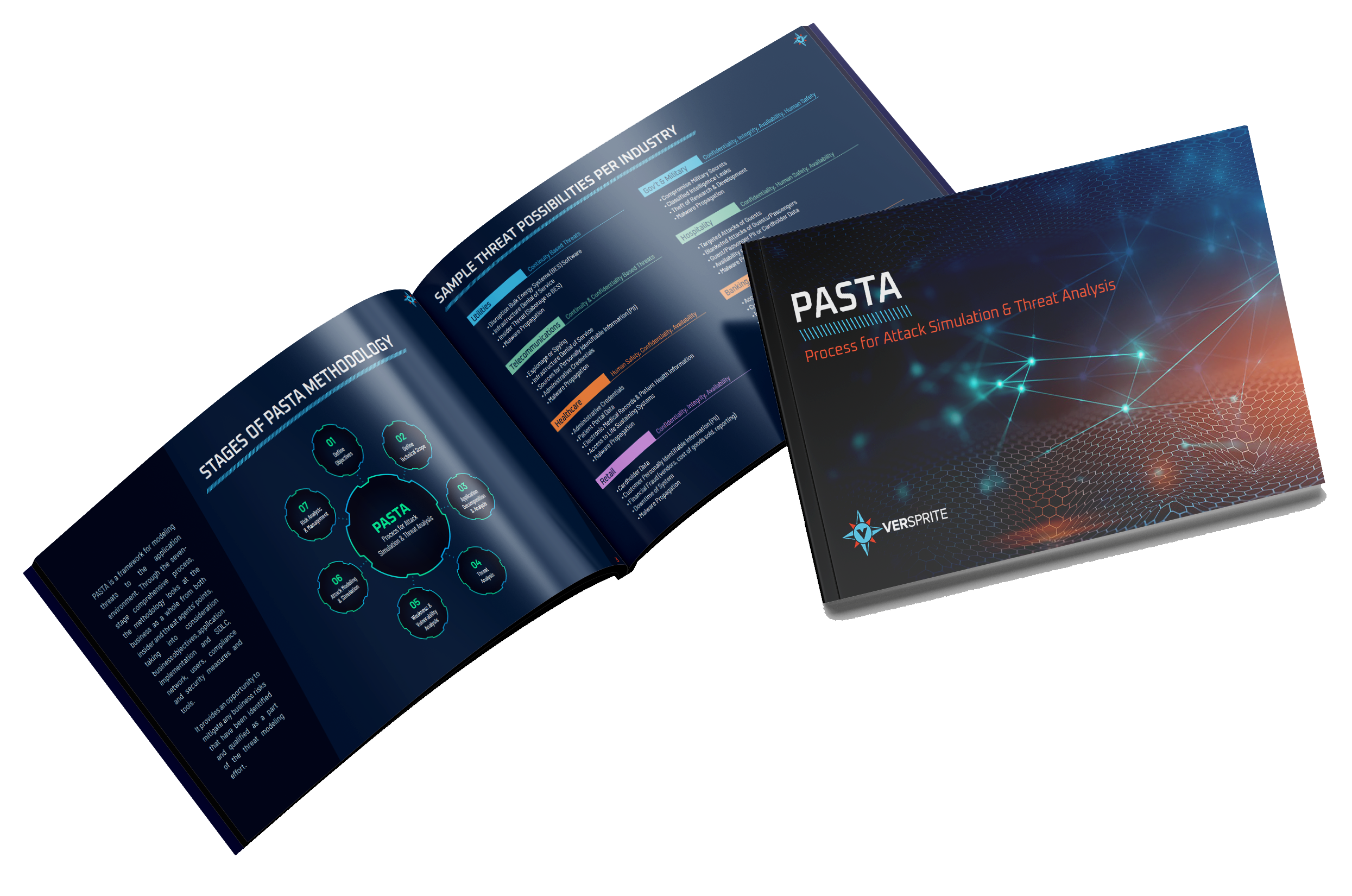
The PASTA Threat Model eBook Risk-Based Threat Modeling
The Process for Attack Simulation and Threat Analysis (PASTA) provides businesses a strategic process for mitigating cybercrime risks by looking first and foremost at cyber threat mitigation as a business problem. The process provides the tactical steps that can be followed to provide effective countermeasures for mitigating existing vulnerabilities by analyzing the attacks that can exploit these vulnerabilities and mapping these attacks to threat scenarios that specifically focus on the application as a business-asset target.
PASTA Threat Modeling for Cybersecurity, a Threat Modeling Example
- /
- /
- /
- /
- /
- /
- /
- /
- /
- /
- /
- /
- /
- /
- /
- /
- /
- /
- /
- /
- /
- /
Explore More
The Process for Attack Simulation and Threat Analysis (PASTA)
a strategic process for mitigating cybercrime risks by looking first and foremost at cyber threat mitigation as a business problem.
Learn More
PASTA Threat Modeling – One Day Training
This presentation walks through PASTA Threat Modeling, the Process for Attack Simulation on Risk Analysis, presented at AppSec California
Learn More
Threat Models as Blueprints for Security Offense & Defense
Learn how to use risk-centric threat models methodology to apply greater strategy to both defensive and offensive security measures.
Learn More
Modeling Threats for Applications
This talk provides 3 use cases of IoT, E-Commerce, and Mobile Applications.
Learn More
Threat Modeling Blogs
Explore the latest insights and stay informed on evolving digital threats
Learn More
Learn the PASTA Threat Modeling Process
learn the PASTA process and go through key exercises that related to application decomposition including but not limited to data flow diagramming, attack tree build outs, and countermeasure development.
Learn More
Addressing Cybercrime via PASTA Threat Modeling
This presentation addresses cybercrime via a risk centric approach with PASTA Threat Modeling.
Learn More
PASTA Threat Modeling Free eBook
Identify attack paths, prioritize threats by business impact, and turn threat modeling into actionable risk reduction.
Learn More
API Testing with PASTA Free eBook
This eBook walks you through a real-world, offensive security approach to API testing using a fictional web app, DevNet, as a case study.
Learn More
Frequently Asked Questions
- /
- /
- /
- /
- /
- /
- /
- /
- /
- /
- /
- /
- /
- /
- /
- /
- /
- /
- /
- /
- /
- /
Resources









We’re Not a Vendor
We’re Your Security Partner
- Risk-centric security
- True extension of your team
- Executive-level experience
