Enterprise Threat Modeling
at Scale
Build Your Enterprise Threat Modeling Program
- /
- /
- /
- /
- /
- /
- /
- /
- /
- /
- /
- /
- /
- /
- /
- /
- /
- /
- /
- /
- /
- /
Build a Repeatable, Risk Based Threat Modeling Program Across Your Enterprise
Enterprise threat modeling helps organizations identify, prioritize, and manage application security risk across growing portfolios of software, cloud environments, APIs, AI systems, and digital products.
VerSprite helps security and engineering teams move threat modeling beyond isolated workshops and point in time assessments. Our enterprise threat modeling services combine the PASTA threat modeling methodology, experienced security practitioners, scalable operating models, and continuous threat modeling technology through Fork.
The result is a repeatable threat modeling capability that connects technical threats with business impact while fitting the way your organization designs, develops, and maintains software.
- /
- /
- /
- /
- /
- /
- /
- /
- /
- /
- /
- /
- /
- /
- /
- /
- /
- /
- /
- /
- /
- /
What Is Enterprise Threat Modeling?
Enterprise threat modeling is a structured approach for applying threat modeling consistently across multiple applications, product teams, business units, and technology environments.
Instead of producing one threat model for one application, an enterprise program establishes a common methodology, governance model, workflow, risk language, and supporting technology that can be reused across the organization.
An effective enterprise threat modeling program helps organizations:
- Establish a repeatable process across application portfolios
- Prioritize risks according to technical severity and business impact
- Improve collaboration between security, engineering, architecture, product, and risk teams
- Maintain threat models as applications and attack surfaces change
- Integrate threat modeling into software development and governance workflows
- Produce consistent, defensible security decisions
- Scale security expertise without requiring a threat modeling specialist on every product team
The goal is not to create more diagrams or security documentation. The goal is to give decision makers a reliable view of how applications could be attacked, what those attacks could affect, and which countermeasures should be prioritized.
- /
- /
- /
- /
- /
- /
- /
- /
- /
- /
- /
- /
- /
- /
- /
- /
- /
- /
- /
- /
- /
- /
Why Threat Modeling Becomes Difficult at Enterprise Scale
Threat modeling is often introduced through a workshop, security review, or architecture assessment. That approach may work for a small number of critical applications, but it becomes difficult to sustain across an enterprise portfolio.
Common challenges include:
Inconsistent Methodologies
Different teams may use different frameworks, scoring models, terminology, and documentation formats. The resulting threat models are difficult to compare or govern consistently.
Limited Security Expertise
Central application security teams rarely have enough capacity to lead detailed threat modeling exercises for every application, release, and architecture change.
Point in Time Assessments
Threat models often become outdated after the workshop ends. New services, APIs, data flows, cloud components, third party integrations, and AI capabilities may never be reflected in the original model.
Weak Business Context
Many threat models identify technical threats without explaining their potential operational, financial, regulatory, or customer impact.
Disconnected Security Findings
Threat models, vulnerability data, penetration testing findings, architecture reviews, and control decisions often remain separated across different tools and documents.
Difficulty Measuring Program Progress
Security leaders may struggle to determine which applications have current threat models, which risks remain unresolved, and where threat modeling is influencing engineering decisions.
Enterprise threat modeling requires more than selecting a software tool. It requires an operating model that combines methodology, people, process, governance, and technology.
- /
- /
- /
- /
- /
- /
- /
- /
- /
- /
- /
- /
- /
- /
- /
- /
- /
- /
- /
- /
- /
- /
How VerSprite Scales Threat Modeling Across the Enterprise
VerSprite helps organizations design and implement enterprise threat modeling programs around their application portfolio, development practices, security maturity, and risk priorities.
Our approach can include the following components.
1. Enterprise Threat Modeling Strategy
We evaluate your current threat modeling practices, application portfolio, security workflows, governance requirements, and internal capabilities.
The resulting strategy defines:
- Program objectives
- Application selection criteria
- Threat modeling methodology
- Roles and responsibilities
- Governance and approval workflows
- Risk scoring and prioritization
- Required integrations
- Reporting and success metrics
2. A Standardized PASTA Based Methodology
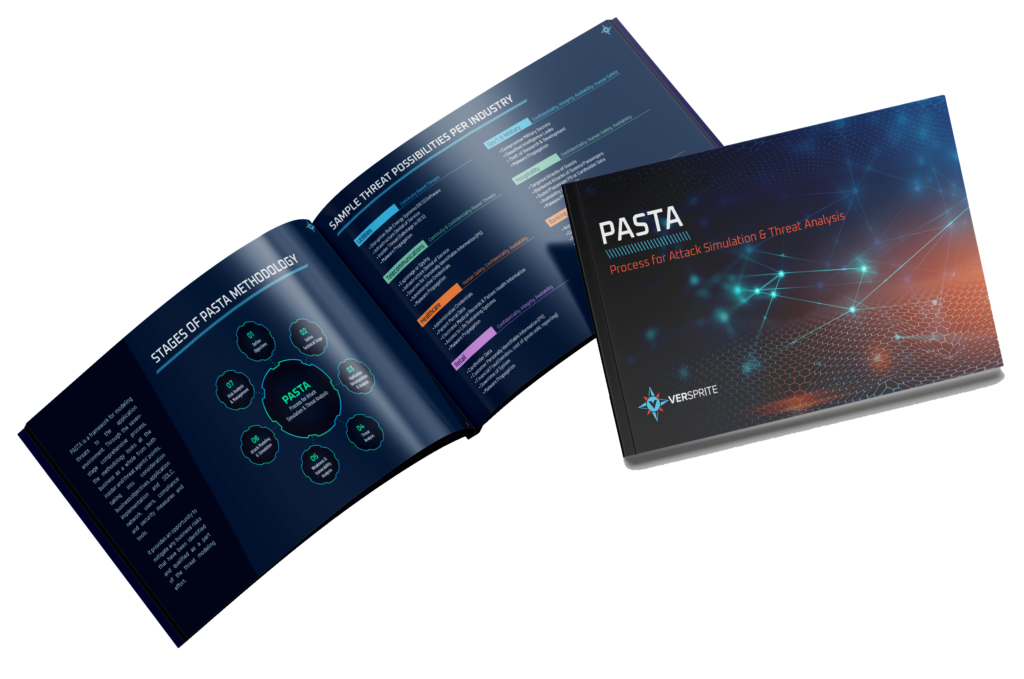
VerSprite applies the Process for Attack Simulation and Threat Analysis, known as PASTA, to connect technical threats with realistic attack scenarios and business impact.
PASTA provides a structured seven stage process:
- Define business and security objectives
- Define the technical scope
- Decompose the application
- Analyze relevant threats
- Identify weaknesses and vulnerabilities
- Model and simulate attacks
- Analyze residual risk and required countermeasures
This risk centric approach helps teams move beyond generic threat lists by considering how an application supports the business, how a capable adversary might attack it, and what the consequences could be.
3. Portfolio Prioritization
Not every application requires the same depth of analysis.
VerSprite helps organizations classify applications according to factors such as:
- Business criticality
- Sensitive or regulated data
- Internet exposure
- Revenue dependency
- Customer impact
- Architecture complexity
- Change frequency
- Threat exposure
- Regulatory obligations
- Existing security findings
This enables organizations to apply the appropriate level of threat modeling to each application instead of treating every system identically.
4. Repeatable Threat Modeling Workflows
We develop repeatable workflows that can be applied during:
- Product planning
- Architecture design
- Software development
- Major application changes
- Cloud migrations
- AI implementation
- Acquisition integration
- Preproduction security reviews
- Regulatory or customer assessments
- Incident response improvement
Threat modeling becomes part of how software risk is evaluated rather than an additional exercise performed after development.
5. Threat Modeling Governance
A scalable program requires clear ownership and decision making.
VerSprite can help define:
- Central and distributed threat modeling responsibilities
- Security champion participation
- Review and escalation criteria
- Model approval requirements
- Risk acceptance workflows
- Countermeasure ownership
- Model refresh triggers
- Executive and operational reporting
This creates a federated model in which security establishes the methodology and governance while product and engineering teams contribute the application context needed to produce accurate results.
6. Training and Knowledge Transfer
VerSprite helps security, engineering, architecture, and product teams understand how to contribute to and use threat models.
Training can cover:
- Risk based threat modeling principles
- The seven stages of PASTA
- Application decomposition
- Trust boundary analysis
- Threat intelligence selection
- Attack path development
- Risk scoring
- Countermeasure development
- Threat model review and maintenance
The objective is to build sustainable internal capability rather than create permanent dependence on external workshops.
7. Continuous Threat Modeling With Fork
Fork is VerSprite’s continuous application threat modeling platform built around the PASTA methodology.
Fork helps organizations maintain structured threat models as applications evolve while giving security, engineering, and product stakeholders a shared view of application risk.
Organizations can use Fork to support:
- Repeatable PASTA based threat modeling workflows
- Application and business context collection
- Technology and architecture documentation
- Threat and weakness analysis
- Attack scenario development
- Risk prioritization
- Countermeasure tracking
- Role based collaboration
- Threat model maintenance
- Portfolio level visibility
- Auditable risk decisions
Fork complements VerSprite’s expert led threat modeling services by providing the technology needed to standardize and maintain threat modeling across a larger application portfolio.
Learn About Fork Threat Modeling
- /
- /
- /
- /
- /
- /
- /
- /
- /
- /
- /
- /
- /
- /
- /
- /
- /
- /
- /
- /
- /
- /
How Automation Works at Enterprise Scale
Automation is what makes threat modeling sustainable across a large application portfolio — it’s the difference between a one-time workshop and a program that stays current as hundreds of applications change every week.
At enterprise scale, Fork automates:
- Continuous ingestion. Fork pulls in findings from SAST, DAST, SCA, and manual penetration testing as they’re generated, instead of waiting for a scheduled review to update the model.
- Attack tree trimming. Fork’s AI narrows the attack tree for each application, filtering out theoretical noise so analysts focus on the attack paths that are actually viable given the application’s architecture and exposure.
- Residual risk recalculation. When new test results or vulnerability data come in, Fork automatically recalculates residual risk rather than requiring a manual re-scoring pass.
- Model refresh triggers. Threat models update when architecture, dependencies, or threat intelligence change, so portfolio-wide models don’t silently go stale between review cycles.
What stays human: validating business context, confirming which attack scenarios matter to the organization, and making the risk-acceptance and remediation-prioritization calls. Automation removes the manual bottleneck of re-running an assessment from scratch — it doesn’t replace judgment about what the business can tolerate.
This is what lets a security team apply PASTA-based, risk-centric analysis across dozens or hundreds of applications without proportionally growing headcount.
- /
- /
- /
- /
- /
- /
- /
- /
- /
- /
- /
- /
- /
- /
- /
- /
- /
- /
- /
- /
- /
- /
Enterprise Threat Modeling Services and Software
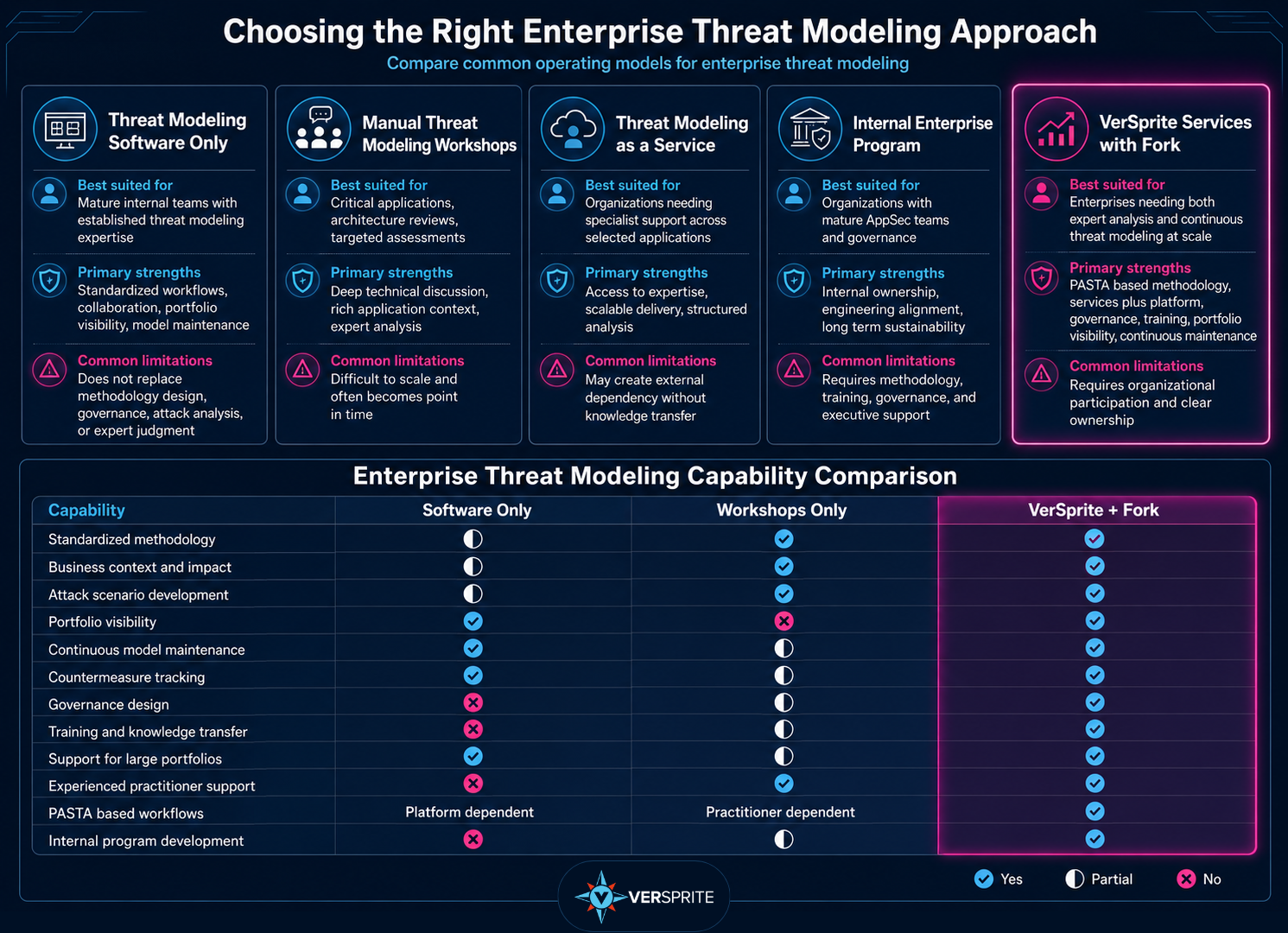
Enterprise threat modeling programs commonly require both experienced practitioners and supporting technology.
Software can improve consistency, collaboration, workflow management, and visibility. However, technology alone does not establish the methodology, governance, risk criteria, application context, or organizational adoption required for a successful program.
VerSprite combines two complementary capabilities.
VerSprite Threat Modeling Services
Our practitioners help organizations establish the methodology, operating model, governance, application prioritization, attack analysis, training, and program support needed to scale threat modeling.
Fork Continuous Threat Modeling
Fork provides a shared platform for creating, managing, maintaining, and reviewing risk based application threat models across teams.
Together, VerSprite and Fork help organizations move from isolated threat modeling exercises toward a sustainable enterprise capability.
- /
- /
- /
- /
- /
- /
- /
- /
- /
- /
- /
- /
- /
- /
- /
- /
- /
- /
- /
- /
- /
- /
- /
- /
- /
- /
- /
- /
- /
- /
- /
- /
- /
- /
- /
- /
- /
- /
- /
- /
- /
- /
- /
- /
Enterprise Threat Modeling Use Cases
Large Application Portfolios
Establish consistent threat modeling across dozens or hundreds of applications without treating every system as a separate manual project.
Regulated Organizations
Connect application threats, business impact, security controls, and risk decisions in a structured process that supports governance and audit preparation.
Financial Services
Analyze threats to banking applications, payment systems, customer data, APIs, identity workflows, and third party financial technology integrations.
Healthcare Organizations
Model threats involving patient data, clinical systems, connected medical environments, identity services, healthcare applications, and supporting cloud infrastructure.
Government Agencies
Apply structured threat modeling to public services, mission systems, sensitive data, cloud modernization initiatives, and complex supplier environments.
Cloud Native Development
Evaluate trust boundaries, identities, APIs, services, containers, event driven workflows, data stores, and infrastructure dependencies across cloud architectures.
AI Systems and AI Agents
Identify risks related to model access, prompt injection, sensitive data exposure, excessive permissions, external tools, autonomous actions, and AI supply chain dependencies.
Mergers and Acquisitions
Create a repeatable process for understanding application and technology risk across newly acquired environments.
DevSecOps Transformation
Integrate risk based threat analysis into product planning, architecture, development, testing, and release decisions.
- /
- /
- /
- /
- /
- /
- /
- /
- /
- /
- /
- /
- /
- /
- /
- /
- /
- /
- /
- /
- /
- /
What to Look for in an Enterprise Threat Modeling Solution
Organizations evaluating enterprise threat modeling tools and services should consider whether the solution provides:
Risk Based Prioritization
The solution should distinguish between theoretical threats and realistic risks that could materially affect the organization.
Business Context
Threat analysis should consider business purpose, sensitive data, revenue impact, regulatory exposure, users, and operational dependencies.
Methodological Consistency
Teams should be able to follow a repeatable process without producing completely different results for similar systems.
Portfolio Visibility
Security leaders should be able to understand threat modeling coverage, unresolved risks, and program progress across multiple applications.
Collaboration
Security, engineering, architecture, product, compliance, and business stakeholders should be able to contribute relevant context and decisions.
Continuous Maintenance
Threat models should be updated when architectures, components, data flows, integrations, threats, and business requirements change.
Countermeasure Tracking
The process should connect risks to recommended controls, responsible owners, implementation status, and residual risk.
Flexible Deployment
The operating model should support centralized security teams, distributed product teams, security champions, or a hybrid structure.
Expert Support
Organizations should have access to experienced threat modeling practitioners when applications, attack scenarios, or risk decisions require deeper analysis.
Integration With Existing Workflows
Threat modeling should complement development, architecture, vulnerability management, penetration testing, governance, and risk management processes.
- /
- /
- /
- /
- /
- /
- /
- /
- /
- /
- /
- /
- /
- /
- /
- /
- /
- /
- /
- /
- /
- /
Compare Enterprise Threat Modeling Platforms
Portfolio visibility, governance, continuous maintenance, and countermeasure tracking vary widely across platforms. See how the leading options compare against the criteria above:
- Enterprise Threat Modeling Tools: platforms evaluated for scale, governance, and portfolio-level risk
- Fork vs. ThreatModeler
- Fork vs. IriusRisk
- IriusRisk vs. ThreatModeler
- /
- /
- /
- /
- /
- /
- /
- /
- /
- /
- /
- /
- /
- /
- /
- /
- /
- /
- /
- /
- /
- /
Why Organizations Choose VerSprite
Created Around Risk Based Threat Modeling
VerSprite has helped shape modern risk based threat modeling through the development and continued advancement of the PASTA methodology.
Attacker Centric Analysis
Our approach considers realistic adversary objectives, attack paths, weaknesses, and potential business consequences rather than relying only on generic threat categories.
Services and Technology
Organizations can combine VerSprite’s threat modeling expertise with Fork’s continuous application threat modeling capabilities.
Business and Technical Alignment
PASTA connects technical analysis with application objectives, business impact, operational dependencies, and residual risk.
Flexible Engagement Models
VerSprite can support individual critical applications, prioritized application portfolios, fully managed Threat Modeling as a Service programs, or broader enterprise threat modeling transformations.
Sustainable Program Development
Our objective is to help organizations build a threat modeling capability that can be repeated, governed, measured, and maintained.
- /
- /
- /
- /
- /
- /
- /
- /
- /
- /
- /
- /
- /
- /
- /
- /
- /
- /
- /
- /
- /
- /
Enterprise Threat Modeling Outcomes
A mature enterprise threat modeling program can help your organization:
- Identify application risk earlier
- Prioritize remediation according to business impact
- Reduce dependence on isolated security reviews
- Improve communication across security and engineering
- Create consistent threat analysis across application teams
- Maintain security context as applications change
- Connect threat models with testing and remediation
- Support risk acceptance and governance decisions
- Improve portfolio level security visibility
- Make threat modeling part of normal software development
- /
- /
- /
- /
- /
- /
- /
- /
- /
- /
- /
- /
- /
- /
- /
- /
- /
- /
- /
- /
- /
- /
Scale Threat Modeling Without Losing Context
Threat modeling at scale should not mean generating larger volumes of generic findings.
A scalable program must preserve the application context, business impact, adversary perspective, and technical depth needed to make meaningful risk decisions.
VerSprite combines PASTA based methodology, enterprise program design, experienced security practitioners, and continuous threat modeling through Fork to help organizations build a threat modeling capability that grows with their application portfolio.
Talk to an Enterprise Threat Modeling Expert
Explore Fork
Frequently Asked Questions
- /
- /
- /
- /
- /
- /
- /
- /
- /
- /
- /
- /
- /
- /
- /
- /
- /
- /
- /
- /
- /
- /