Choosing Advanced Threat Modeling Methods for Architecture

Date
Authors
Tony UcedaVélez
Follow Us


Selecting among named threat modeling methodologies is often framed as a matter of preference or familiarity. This paper argues the choice is better made along two dimensions that vary systematically across methods: how much business-risk context a methodology incorporates, and how well it scales across a large application portfolio versus a single, deep review. We position seven commonly cited methodologies along these dimensions, based on how they are documented in practitioner and vendor literature, and derive concrete selection criteria for security architects choosing an approach for a specific architecture context. This paper focuses on selection criteria specifically; for general descriptions of what each methodology does, we point to existing comparative resources rather than repeating them here.
1. Introduction
A security architect choosing a threat modeling approach is rarely choosing in the abstract. The choice is shaped by a specific system’s architecture, a specific team’s size and available time, and a specific business context’s tolerance for depth versus speed. Most published comparisons of threat modeling methodologies, including a prior comparative overview of PASTA against STRIDE, VAST, DREAD, OCTAVE, and attack trees, describe what each methodology is designed to do. This paper takes that description as a starting point and asks a narrower, more operational question: given a specific architecture context, which method actually fits, and why?
Section 2 proposes two dimensions that meaningfully distinguish these methodologies for this purpose. Section 3 positions seven commonly cited methods along those dimensions. Section 4 translates that positioning into concrete selection guidance by architecture context; Section 5 addresses why organizations rarely rely on a single method in practice. Section 6 states this paper’s limitations, including an important one about the evidentiary basis for Section 3’s positioning. Section 7 concludes.
2. Two Dimensions That Actually Distinguish These Methods
The dimension most often used to compare threat modeling methodologies, whether they are “risk-centric” or “checklist-based,” is useful but incomplete for a selection decision. A more operational pair of dimensions is business-risk context depth, how directly a methodology ties technical findings to business objectives and impact, and portfolio scalability, how well a methodology’s process holds up when applied consistently across many systems rather than one.
These dimensions are largely independent of each other. A methodology can incorporate deep business context while remaining impractical to run across a hundred applications, and a methodology can scale easily across a large portfolio while incorporating comparatively little business-specific reasoning at each system. Advanced threat modeling, in the sense examined in prior work, generally requires depth on the first dimension; the second dimension is what determines whether that depth is achievable consistently across everything an organization needs modeled, not just the one system that gets the most attention.
3. Positioning Seven Methodologies
Based on how each methodology is described in practitioner and vendor documentation, seven commonly cited methods can be positioned along the two dimensions from Section 2.
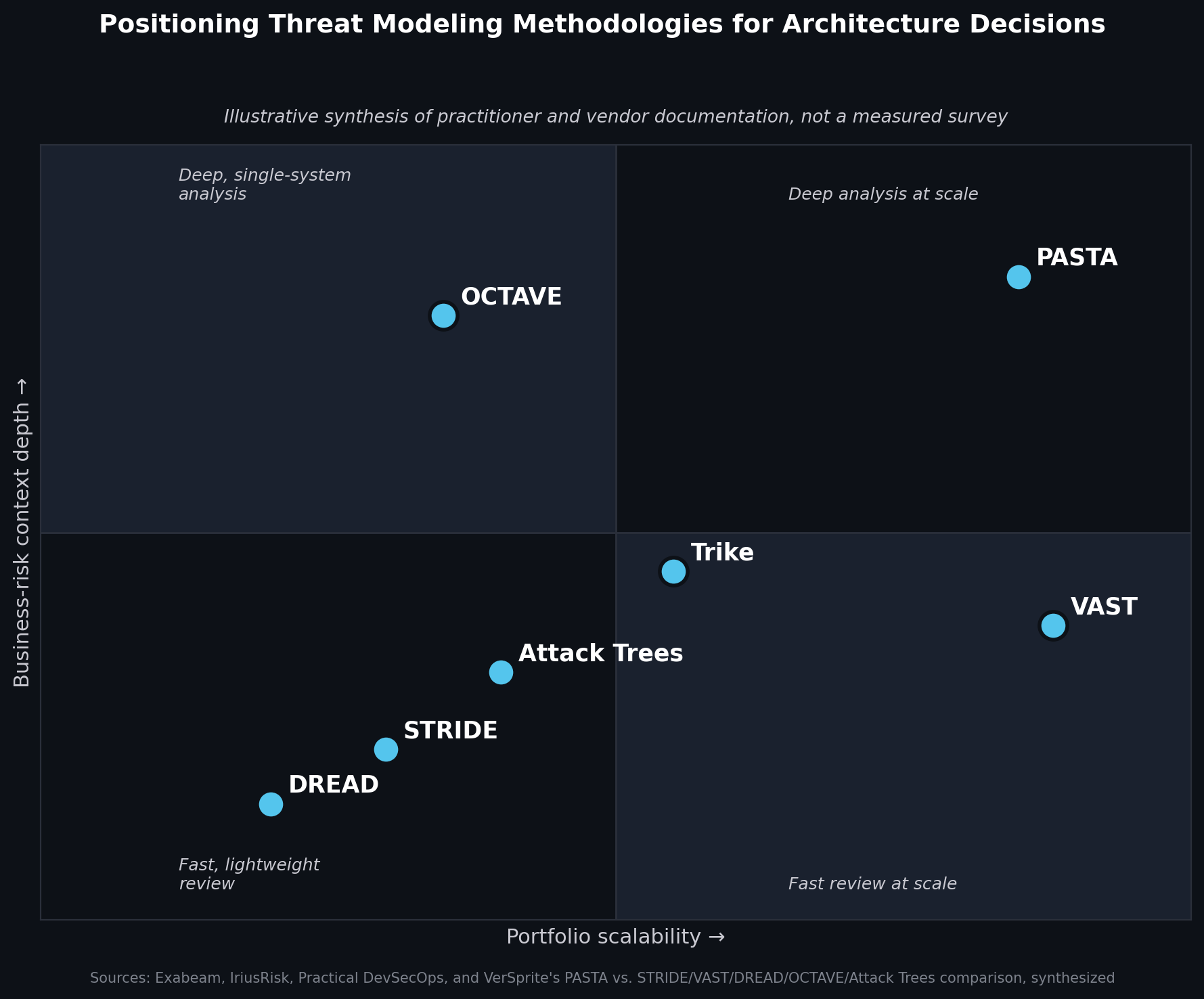
STRIDE and DREAD sit toward the fast, lightweight end of both dimensions: STRIDE efficiently categorizes threat types, and DREAD provides a quick severity ranking, but neither is documented as incorporating deep business-impact analysis or as being specifically designed for consistent application across a large portfolio. Attack trees sit slightly higher on business-risk depth, since they force explicit reasoning about attacker goals, but remain most practical for single, well-understood systems rather than portfolio-wide use. OCTAVE is documented as strong on enterprise-level business and mission context but is not a technical, per-system methodology, placing it high on context depth without being designed for the same kind of systematic per-application scalability. VAST is explicitly documented as designed to operationalize threat modeling at scale across a large number of systems, placing it high on portfolio scalability, though with comparatively less emphasis on deep, system-specific business context than PASTA. PASTA is documented as incorporating business objectives, technical scope, and validated attack scenarios into a single sequential process, positioning it high on business-risk depth; its scalability across a large portfolio depends heavily on whether it is supported by consistent methodology and tooling, a point prior work on this methodology has raised as a genuine limitation rather than an automatic strength.
4. Selection Guidance by Architecture Context
This positioning translates into concrete guidance. A single, high-value system undergoing a major architecture change, a core payment processing service, or a new identity provider integration, benefits from a methodology positioned high on business-risk depth even at some cost to speed: PASTA or attack trees, potentially combined, are a reasonable fit. A large portfolio of microservices under continuous deployment, where the priority is consistent coverage rather than maximum depth on any single service, is better served by a methodology positioned toward portfolio scalability, VAST or a lightweight, tooling-supported STRIDE process, accepting less per-system business nuance in exchange for consistent application everywhere. An enterprise risk register informing security investment decisions across business units, rather than a specific application’s design, is a better fit for OCTAVE’s mission-level framing than for any of the application-specific methodologies. A regulated system requiring both compliance mapping and deep technical analysis, the case examined in prior work on threat modeling for financial institutions and government secure SDLC, generally requires PASTA’s combination of business and technical depth, since compliance frameworks in those sectors tend to demand exactly the business-to-technical traceability PASTA is documented as providing.
5. The Combination Problem: Why Organizations Rarely Use Just One
Practitioner literature consistently describes these methodologies as complementary rather than mutually exclusive in practice. Attack trees are frequently combined with STRIDE, PASTA, or CVSS rather than used standalone. DREAD is typically paired with STRIDE, using STRIDE to identify threats and DREAD to rank them. A small qualitative study of eleven practitioners working on cyber-physical systems found that while most participants used a known method as a starting point, STRIDE was among the most common; several elaborated further using additional techniques based on individual experience rather than a second named methodology.
This suggests the practical selection decision is less “pick one methodology” and more “pick a primary methodology suited to the architecture context described in Section 4, and identify which specific gap needs a supplementary technique.” A team running VAST for portfolio-wide scalability, for example, may still need an attack-tree exercise for the small number of systems where a single vulnerability could cause outsized business impact.
6. Limitations and Open Questions
Section 3’s positioning is a synthesis of how these methodologies are described in practitioner and vendor documentation, not a measured empirical survey of actual usage, actual time investment, or actual outcomes by methodology. To this paper’s knowledge, no large-sample, rigorously conducted public study measures threat modeling methodology adoption by percentage, correlates methodology choice with architecture type or team size, or compares outcomes across methods systematically. This is itself worth noting as a gap in the field’s evidence base: guidance on methodology selection, including the guidance in Section 4, currently rests on documented design intent and practitioner consensus rather than controlled comparison.
The small qualitative study cited in Section 5, eleven practitioners in one domain, illustrates that some empirical work exists, but at a scale too small to generalize confidently. This paper’s selection criteria should be read as a reasoned framework for narrowing options, not as a claim backed by the kind of large-sample data used elsewhere in this series for claims about, for example, breach cost or attack surface exposure.
7. Conclusion
Choosing among threat modeling methodologies is better approached as a fit question than a preference question: which methodology’s documented strengths on business-risk context depth and portfolio scalability match the specific architecture, team, and business context at hand. STRIDE and DREAD suit fast, lightweight reviews; PASTA and attack trees suit deep, high-stakes single-system analysis; VAST suits portfolio-wide consistency; OCTAVE suits enterprise-level risk framing. In practice, most organizations combine a primary methodology with supplementary techniques rather than relying on one exclusively. This selection framework is a reasoned synthesis of documented practice, not a validated empirical model, and the absence of large-scale comparative data in this specific area is a real limitation of the field, not just of this paper.
References
- VerSprite. PASTA vs. STRIDE, VAST, DREAD, OCTAVE, and Attack Trees.
- Exabeam. Threat Modeling: 5 Steps, 7 Techniques, and Tips for Success.
- IriusRisk. 5 Threat Modeling Methodologies: Pros & Use Cases Explained.
- Practical DevSecOps. 10 Types of Threat Modeling Methodology To Use in 2026.
- arXiv. Threat Modeling of Cyber-Physical Systems in Practice (qualitative study of 11 practitioners).
- UcedaVélez, T., and Morana, M.M. Risk-Centric Threat Modeling: Process for Attack Simulation and Threat Analysis. Wiley, 2015.
