
Financial Services & Banking
Security Solutions
Financial institutions are among the most
targeted organizations in the world
- /
- /
- /
- /
- /
- /
- /
- /
- /
- /
- /
- /
- /
- /
- /
- /
- /
- /
- /
- /
- /
- /
Threat actors ranging from organized cybercrime syndicates (FIN7, FIN8, Carbanak) to nation-state APTs actively target banks, credit unions, payment processors, and FinTech platforms for financial gain, data theft, and fraud. At the same time, regulators continue to increase scrutiny, with examinations becoming more technically rigorous each year.
VerSprite partners with financial institutions to build security programs that anticipate real attacker behavior—not just check compliance boxes.
Financial-Specific Threats We Help You Defend Against
Our engagements focus on the attack patterns actually used against financial institutions:
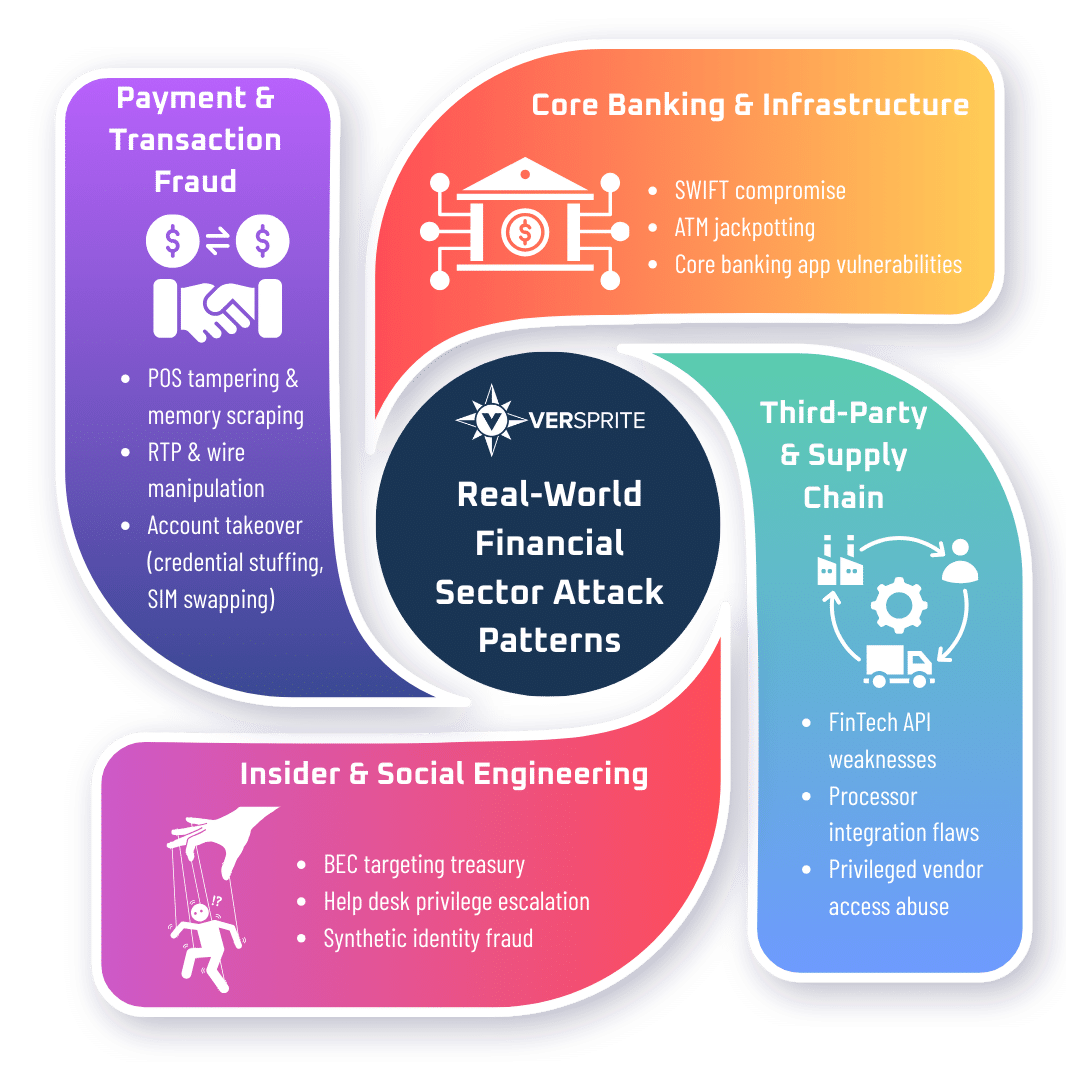
Payment & Transaction Fraud
- Point-of-sale (POS) application tampering and memory scraping
- Real-time payment (RTP) and wire transfer manipulation
- Account takeover through credential stuffing and SIM swapping
Core Banking & Infrastructure Attacks
- SWIFT and interbank messaging system compromise
- ATM logical attacks and jackpotting
- Core banking application vulnerabilities
Third-Party & Supply Chain Risk
- FinTech API security weaknesses
- Payment processor integration vulnerabilities
- Vendor access and privileged credential abuse
Insider Threats & Social Engineering
- Business email compromise targeting treasury and wire operations
- Privilege escalation through help desk and IT support
- Fraudulent account creation and synthetic identity schemes
- /
- /
- /
- /
- /
- /
- /
- /
- /
- /
- /
- /
- /
- /
- /
- /
- /
- /
- /
- /
- /
- /
How We Work with Financial Institutions
PASTA Threat Modeling for Financial Services
Our PASTA (Process for Attack Simulation and Threat Analysis) methodology was built to align security with business risk—making it ideal for financial services environments where regulators and executives need to understand threats in business terms.
We apply PASTA to:
- Digital banking platforms — Identify abuse cases before attackers do
- Payment applications — Model fraud scenarios across the transaction lifecycle
- M&A and integration security — Assess acquired FinTech and legacy system risks
- Open Banking & API ecosystems — Evaluate OAuth flows, consent management, and data exposure
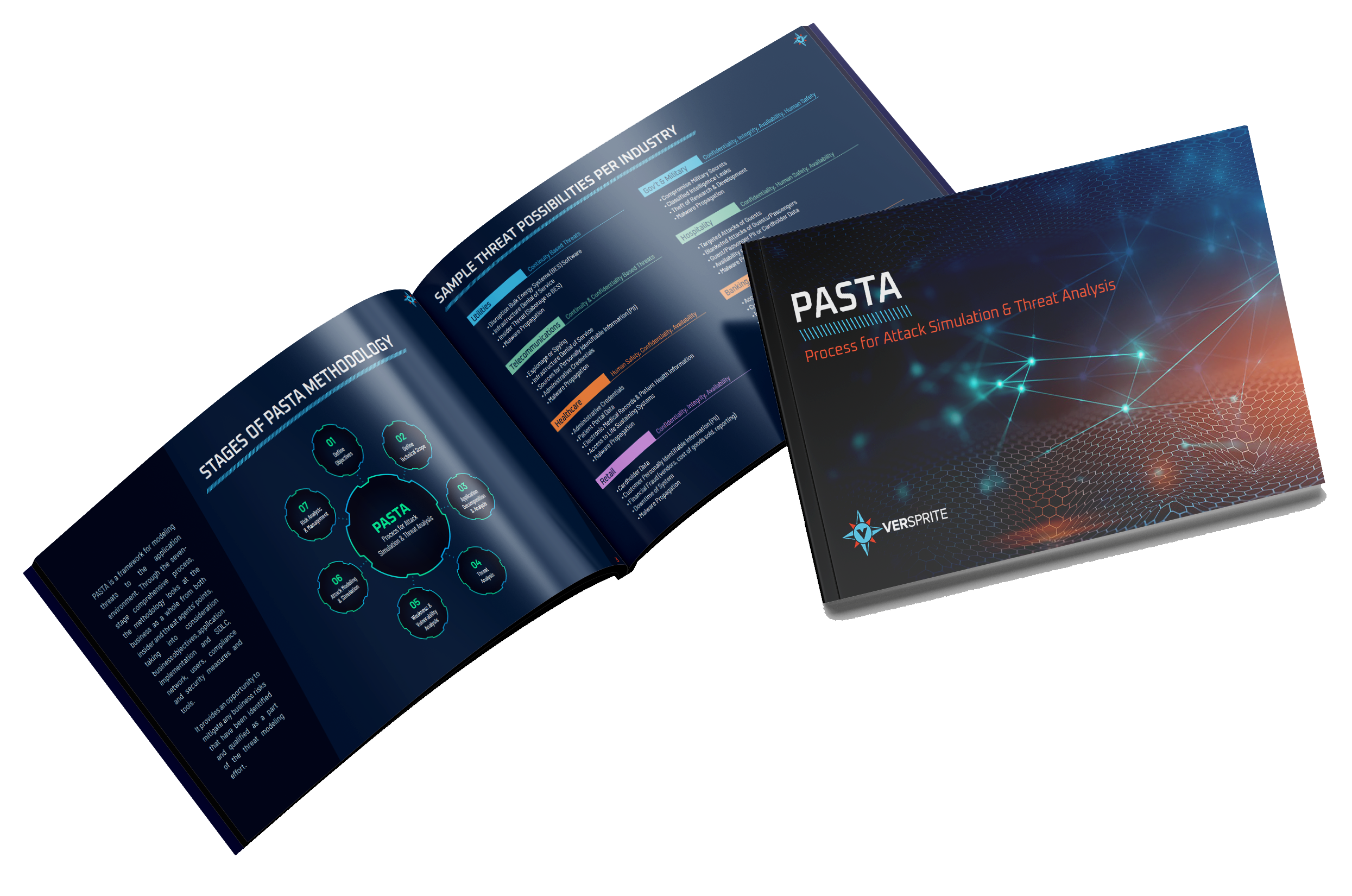
VerSprite’s Risk-Based PASTA Threat Model Incorporates Business Impact Analysis
This threat modeling methodology is geared towards organizations that wish to align threat modeling with strategic business objectives and centers around cyber threat mitigation as a business problem.
Read the PASTA eBook Now →
- /
- /
- /
- /
- /
- /
- /
- /
- /
- /
- /
- /
- /
- /
- /
- /
- /
- /
- /
- /
- /
- /
Our Financial Services Experience:
Mercury Financial
Zero Trust Strategy & Implementation
Transformed security architecture to support rapid consumer growth
Read Now →

CreditShop (FinTech)
Red Teaming & Adversary Simulation
Identified gaps beyond PCI compliance; evolved security program
Read Now →

OH The POSsibilities: Point of Sale System Security
Understanding Point of Sale System Security & Insecurities
Given the delicate nature of POS systems, security standards have been created to protect consumers from malicious actors.
Read Now →
- /
- /
- /
- /
- /
- /
- /
- /
- /
- /
- /
- /
- /
- /
- /
- /
- /
- /
- /
- /
- /
- /
Compliance as a Byproduct, Not the Goal
We help financial institutions meet regulatory requirements—but we do it by building genuinely secure environments, not by optimizing for audit artifacts.
Regulatory frameworks we support:
- PCI DSS (including scope reduction and segmentation validation)
- SOX IT controls and access management
- GLBA safeguards and privacy requirements
- FFIEC CAT and cybersecurity maturity assessments
- State privacy laws (CCPA, NYDFS 500, state breach notification)
- AML/KYC program security controls
Our approach: translate regulatory requirements into actionable security controls, automate evidence collection, and ensure your security program satisfies examiners while actually reducing risk.
- /
- /
- /
- /
- /
- /
- /
- /
- /
- /
- /
- /
- /
- /
- /
- /
- /
- /
- /
- /
- /
- /
Services for Financial Institutions
Service |
What We Do |
|---|---|
| PASTA Threat Modeling | Risk-centric threat analysis for banking applications and platforms |
| Red Teaming | Adversary simulation using financial sector attack patterns |
| Penetration Testing | Application, network, and API security testing |
| Cloud Security | AWS, Azure, GCP assessments for cloud-native financial applications |
| Vendor Risk Assessments | Third-party security evaluation for FinTech and processor relationships |
| Virtual CISO | Fractional security leadership for growing financial institutions |
| Regulatory Compliance | PCI, SOX, GLBA, FFIEC, NYDFS readiness and audit support |
- /
- /
- /
- /
- /
- /
- /
- /
- /
- /
- /
- /
- /
- /
- /
- /
- /
- /
- /
- /
- /
- /
Start the Conversation
Whether you’re preparing for an FFIEC examination, evaluating a FinTech acquisition, or testing your fraud detection capabilities, we can help.
Contact Us →
- /
- /
- /
- /
- /
- /
- /
- /
- /
- /
- /
- /
- /
- /
- /
- /
- /
- /
- /
- /
- /
- /
Financial Services and Banking Cybersecurity Solutions FAQs
What are financial services cybersecurity solutions?
Financial services cybersecurity solutions are specialized security services designed to protect banking systems, financial data, and transaction environments from cyber threats. These solutions help prevent fraud, secure digital banking platforms, and ensure regulatory compliance across financial institutions.
Why is cybersecurity critical for financial institutions?
Cybersecurity is critical in financial services because cyberattacks can lead to direct financial loss, fraud, regulatory penalties, and loss of customer trust. Financial institutions are prime targets due to high-value assets and sensitive data.
What types of threats affect banks and financial services?
Common threats include:
- Account takeover and credential stuffing
- Payment fraud and transaction manipulation
- Phishing and social engineering attacks
- Ransomware targeting financial systems
- API and FinTech integration vulnerabilities
- Insider threats and third-party risk
What is included in financial cybersecurity solutions?
Financial cybersecurity solutions typically include:
- Threat modeling for banking and payment systems
- Penetration testing of applications, APIs, and networks
- Red teaming and fraud simulation
- Cloud and infrastructure security assessments
- Vendor and third-party risk management
- Regulatory compliance and audit readiness (PCI, GLBA, FFIEC, SOX
What is PCI-DSS compliance in banking?
PCI-DSS (Payment Card Industry Data Security Standard) ensures that financial institutions securely process, store, and transmit cardholder data. Compliance helps reduce fraud risk and avoid regulatory penalties.
What is GLBA and why is it important?
The Gramm-Leach-Bliley Act (GLBA) requires financial institutions to protect customer financial information and implement safeguards for data privacy and security.
What is FFIEC cybersecurity guidance?
The Federal Financial Institutions Examination Council (FFIEC) provides guidelines and assessment tools to help financial institutions evaluate and improve their cybersecurity maturity and resilience.
How does cybersecurity support fraud prevention?
Cybersecurity solutions detect and prevent fraudulent activity by monitoring transactions, identifying suspicious behavior, and securing authentication mechanisms across banking systems.
How does threat modeling improve banking security?
Threat modeling identifies attack scenarios such as account takeover, fraud schemes, and API abuse. It helps financial institutions prioritize risks based on real-world attacker behavior and business impact.
What makes VerSprite’s financial security solutions different?
VerSprite uses a risk-based approach driven by PASTA threat modeling to simulate real-world financial attacks. Their methodology aligns cybersecurity efforts with fraud risk, regulatory requirements, and business impact to deliver measurable risk reduction.
What is the difference between banking cybersecurity and general cybersecurity?
Banking cybersecurity focuses on protecting financial transactions, fraud prevention, and regulatory compliance, while general cybersecurity focuses on broader IT systems and data protection.
When should financial institutions invest in cybersecurity solutions?
Financial institutions should invest when launching digital banking platforms, integrating FinTech services, migrating to cloud environments, or responding to increased fraud and regulatory pressure.
What are the risks of poor cybersecurity in financial services?
Poor cybersecurity can lead to financial fraud, regulatory fines, data breaches, operational disruption, and reputational damage, directly impacting customer trust and business stability.

We’re Not a Vendor
We’re Your Security Partner
- Risk-centric security
- True extension of your team
- Executive-level experience
