Managed Detection and Response Providers for Healthcare and Fintech
What the Detection-Speed Data Shows
Date
Authors
Tony UcedaVélez
Follow Us


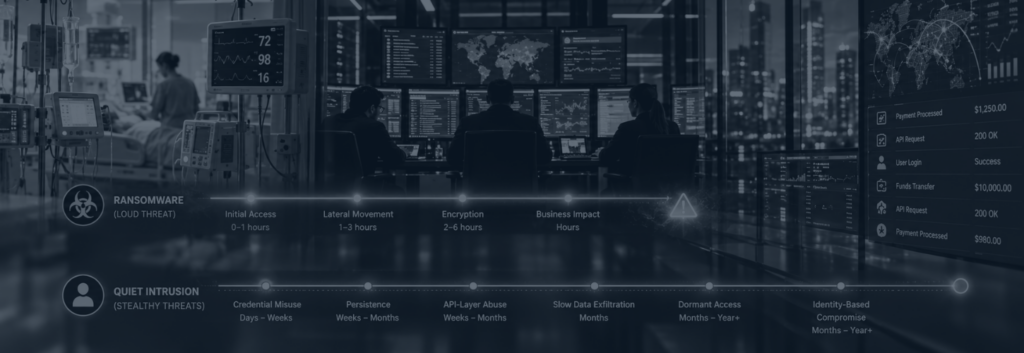
Managed detection and response is typically marketed on the strength of continuous, 24×7 coverage, but the actual case for that coverage depends heavily on what kind of threat is being detected. This paper examines current data on ransomware dwell-time compression, a specific and substantial detection gap between loud, self-announcing threats and quiet intrusions in healthcare, and a documented inconsistency in headline breach-cost figures circulating in current secondary reporting. Together, this data supports a narrower and more specific claim than “24×7 monitoring matters”: detection speed varies enormously by threat type, and coverage built primarily to catch loud, obvious incidents leaves the slower, quieter intrusions, the ones a determined attacker is more likely to use, substantially underprotected.
Introduction
The general case for managed detection and response is rarely disputed: continuous monitoring should, in principle, catch threats faster than periodic review. What’s less often examined is how much that speed advantage actually varies depending on what’s being detected. Ransomware is loud; it announces itself by design, once encryption begins. Other forms of intrusion, credential theft, quiet data exfiltration, dormant access maintained for later use, generate no equivalent alarm, and the detection-speed data available for 2025 and 2026 shows those two categories are found at dramatically different rates.
This paper is organized around that gap. It examines dwell-time trends, a specific healthcare detection-speed comparison between loud and quiet threats, and recovery-outcome data, before addressing a genuine problem with the underlying evidence base: several widely cited cost and lifecycle figures for healthcare breaches conflict across current secondary sources, in ways worth naming directly rather than picking whichever number sounds most compelling.
Ransomware Dwell Time Is Compressing, But Unevenly
Industry-wide, the median time between initial access and encryption has fallen sharply: from roughly 11 days in 2023 to a current median of 4 to 5 days, corroborated across several independent 2026 reports.
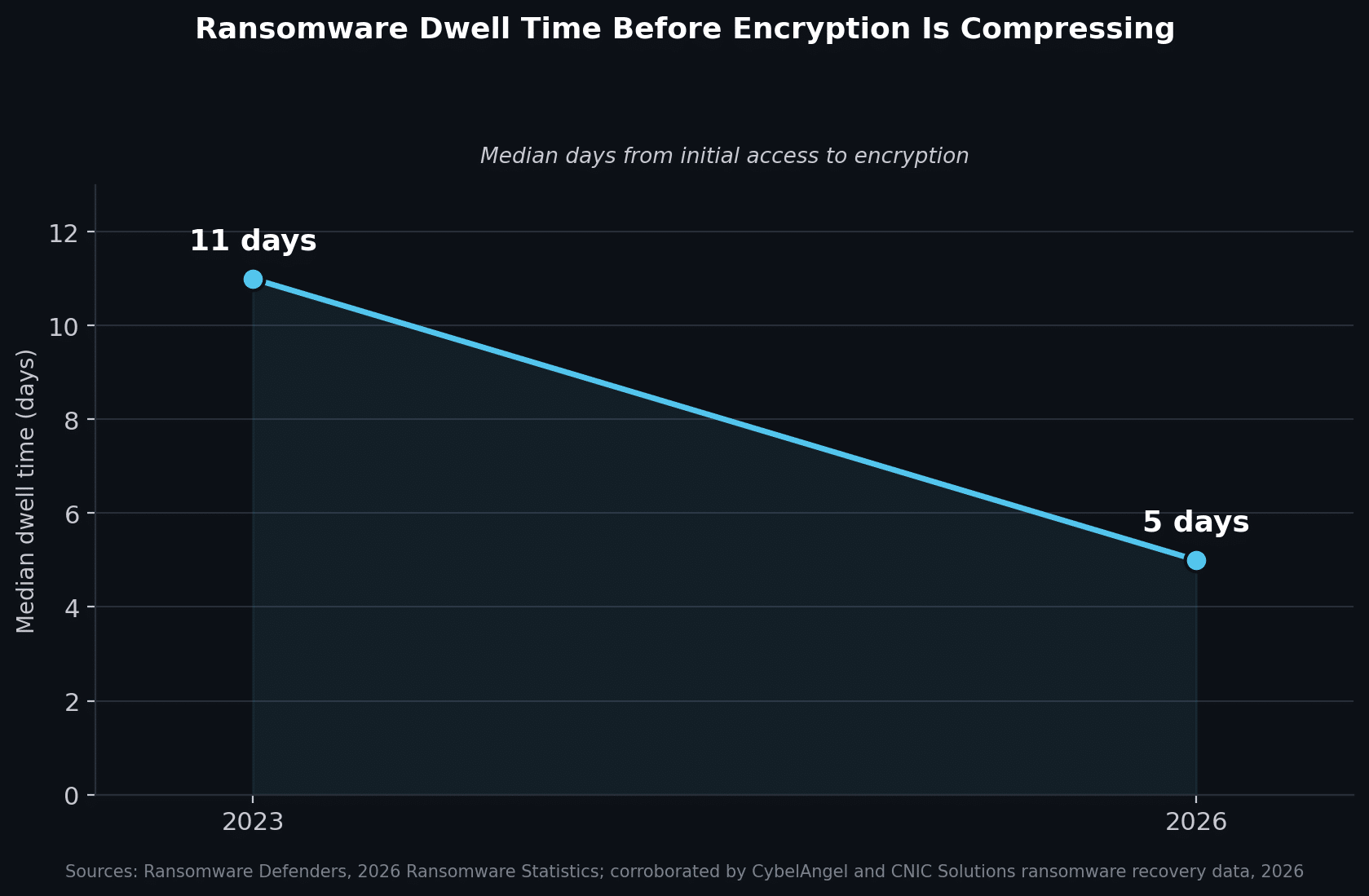
This compression is a genuine improvement in defender capability industry-wide, largely attributed to better endpoint visibility and faster identity-based detection. But it describes only the loud half of the threat landscape. Ransomware compresses toward detection specifically because encryption is a visible, disruptive event that forces a response. Threats that don’t include an equivalent trigger event don’t benefit from the same pressure toward faster detection, a distinction the next section examines directly.
The Loud-vs-Quiet Detection Gap in Healthcare
A 2026 study of healthcare cybersecurity response times found a stark divergence in detection speed by threat type: ransomware was detected in a median of 19 days, while other intrusions, those without an encryption event to force discovery, took a median of 93 days to detect, nearly five times longer.
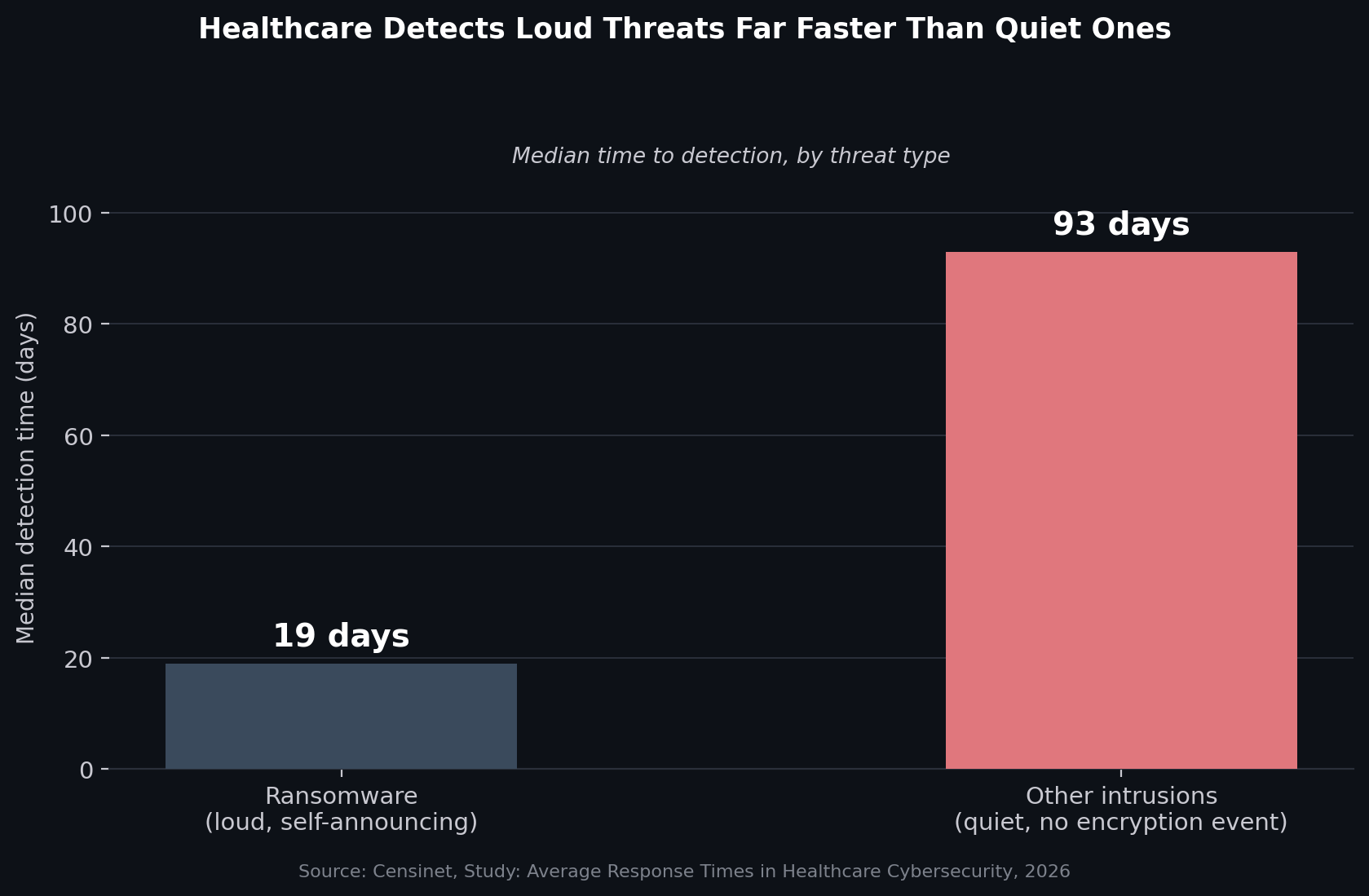
This gap matters more than the industry-wide dwell-time trend in Figure 1, because it isolates the variable that actually determines whether continuous monitoring changes an outcome. A threat that’s going to announce itself within days regardless, ransomware, benefits from faster response but was never going to go undetected for months. A threat with no equivalent trigger event, sustained credential misuse, slow data exfiltration, dormant access, depends entirely on active, continuous monitoring to be caught at all in anything close to the 19-day range rather than the 93-day one. The same study attributes the healthcare-specific version of this gap to third-party dependencies, legacy systems, connected medical device blind spots, and staffing gaps that compound specifically when detection isn’t continuous.
Recovery Outcomes Are Improving, But Unevenly Distributed
The share of ransomware victims who fully recovered within one week rose from 35 percent in 2024 to 53 percent in 2025, a meaningful improvement in resilience broadly.
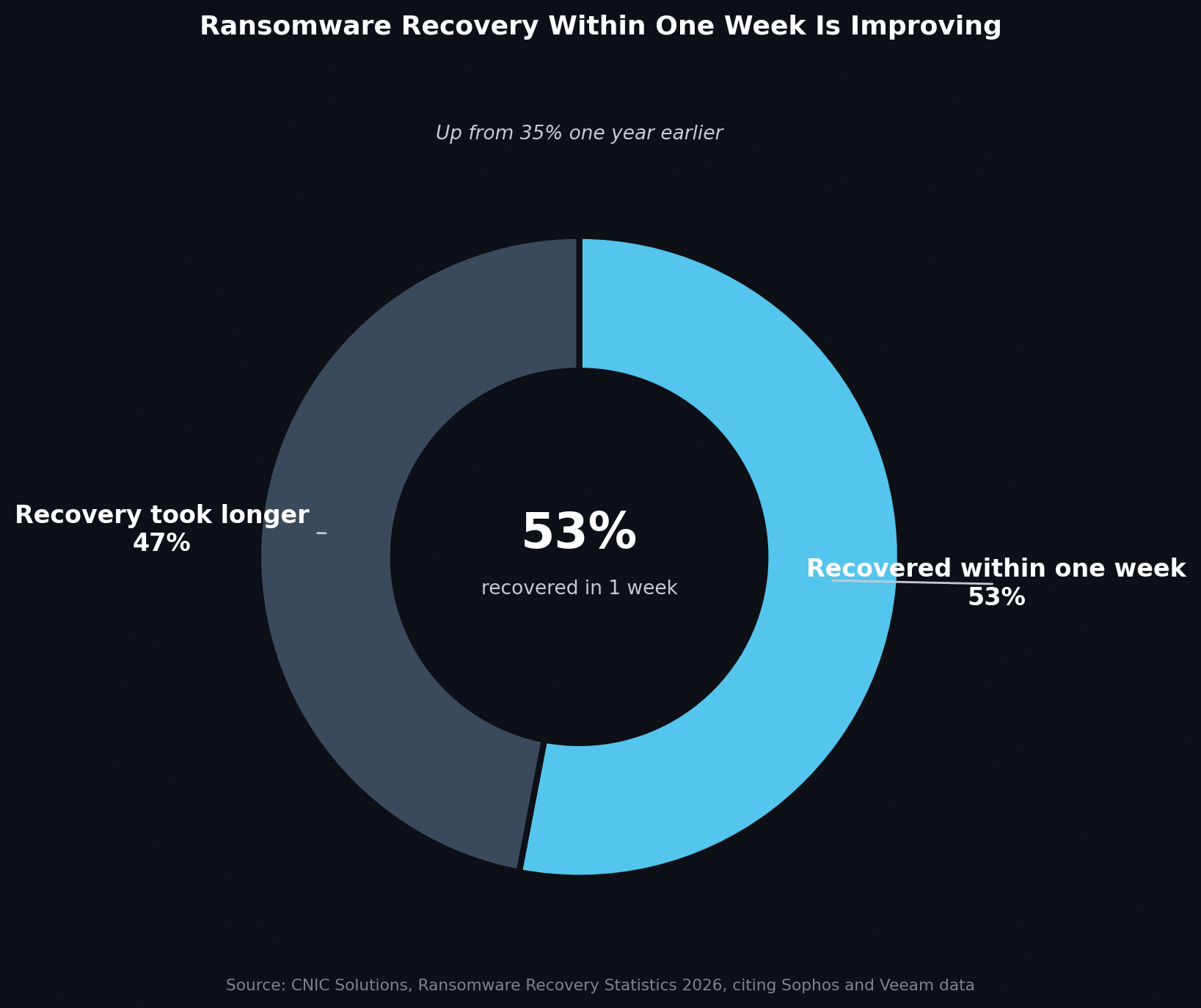
Even with that improvement, close to half of victims still take longer than a week to recover, and separate research finds that organizations with compromised backup repositories, which occurs in roughly three-quarters of attempted compromises, face recovery costs several times higher than those with intact backups. Recovery speed and detection speed are related but distinct problems: faster detection reduces how much damage occurs before containment, while recovery speed depends on backup integrity and incident response preparedness that operate somewhat independently of how quickly the intrusion was initially caught.
A Note on Conflicting Headline Figures
Current secondary reporting on healthcare breach costs and detection lifecycles is genuinely inconsistent in ways worth flagging rather than smoothing over. Some sources report the average healthcare data breach cost at $7.42 million with an average 279-day identify-and-contain lifecycle; others, citing what they describe as the same underlying IBM research, report $11.2 million and a 241-day lifecycle. The 241-day figure, notably, matches the global cross-industry average from the same reporting period in other citations, which suggests at least one secondary source has conflated a healthcare-specific figure with a global one somewhere in the citation chain.
This paper does not resolve which figure is correct, because doing so would require access to the primary report’s exact methodology and year-over-year framing rather than secondary summaries of it. The more useful takeaway is methodological: aggregate cost and lifecycle figures drift substantially as they pass through secondary cybersecurity reporting, while the detection-speed comparisons in Figures 1 and 2, drawn from sources measuring a narrower, more specific claim, show much tighter agreement across independent reports. Readers evaluating vendor or industry claims in this space should weight specific, corroborated comparisons more heavily than large aggregate figures that are harder to trace to a single, verifiable methodology.
What This Means for Healthcare and Fintech Monitoring
The loud-versus-quiet detection gap in Figure 2 has a direct implication for what continuous monitoring needs to prioritize in healthcare specifically: detection tuned primarily around ransomware and other self-announcing threats will show good results on exactly the threat category that was already trending toward faster detection industry-wide, while doing comparatively little for the quieter intrusions where the 93-day gap actually lives. Connected medical devices compound this problem, since a large share of hospitals manage devices with known, exploitable vulnerabilities that frequently can’t run standard monitoring agents at all, creating blind spots that a loud-threat-oriented detection posture won’t surface.
Cloud-native fintech environments face a structurally different version of the same underlying problem: detection built primarily around endpoint telemetry, the traditional locus of “loud” threat activity, misses the API-layer and identity-based activity where quiet compromise in a cloud-native environment is more likely to originate. In both sectors, the practical implication is the same: 24×7 coverage matters most not because every threat needs fast response, but because the threats least likely to announce themselves are the ones where continuous, rather than periodic, monitoring is the only mechanism capable of catching them within a reasonable window at all.
Where Continuous Monitoring Alone Isn’t Sufficient
The data in this paper does not establish that continuous monitoring alone resolves the detection gap it describes. The 93-day median for quiet intrusions in Figure 2 represents current industry outcomes, which already reflect whatever mix of continuous and periodic monitoring healthcare organizations in the underlying study were actually using; it is not a baseline representing organizations with no monitoring at all, and the study does not isolate how much of that 93-day figure would improve under continuous coverage specifically versus other factors like staffing, tooling quality, or third-party dependency management, all of which the same research identifies as contributing causes independent of monitoring cadence.
Limitations and Open Questions
Several limitations bound this paper’s argument. First, the dwell-time and detection-speed figures in Figures 1 and 2 come from different studies with different methodologies and sample populations; the paper treats them as directionally consistent rather than as a single coherent dataset, since no single source measured both simultaneously. Second, as discussed directly above, none of the cited research isolates monitoring cadence as an independent variable from other factors known to affect detection and recovery speed, including staffing levels, tooling maturity, and third-party and vendor dependency chains, all of which the underlying studies identify as contributing factors. Third, the healthcare-specific loud-versus-quiet comparison in Figure 2 has not, to this paper’s knowledge, been replicated with an equivalent study specific to fintech or cloud-native environments; the extension of that finding to fintech in the prior section is a reasoned inference based on structural similarity, not a directly measured parallel finding. Fourth, the conflicting cost and lifecycle figures discussed above illustrate a broader evidentiary problem in this space that this paper flags but does not fully resolve, given the inability to audit the original primary methodology behind each conflicting secondary citation.
Conclusion
The strongest evidence-based case for managed detection and response in healthcare and fintech environments is narrower than “24×7 coverage matters” as a general claim. It is that detection speed for loud, self-announcing threats has been improving industry-wide regardless of monitoring approach, while a substantial and specific gap, healthcare intrusions without an encryption event take roughly five times longer to detect than those with one, remains largely unaddressed by defenses tuned primarily around the threats that were already trending toward faster detection. Continuous monitoring is the only mechanism structurally suited to closing that specific gap, though the available research does not yet isolate exactly how much of the gap monitoring cadence alone would close versus the staffing, tooling, and third-party factors that current studies identify as contributing causes alongside it.
References
- Ransomware Defenders. Ransomware Statistics 2026: Trends, Costs, and Predictions.
- Censinet. Study: Average Response Times in Healthcare Cybersecurity. 2026.
- CNIC Solutions. Ransomware Recovery Statistics 2026: Timelines, Costs & Backup Data, citing Sophos and Veeam research.
- CybelAngel. Ransomware in Healthcare 2026: The Attack Timeline.
- ORDR. Healthcare Cybersecurity Statistics 2026: Breach Costs.
- StationX. Cyber Security Breach Statistics 2026: Key Facts & Data.
- Swif. Healthcare Cybersecurity Statistics for 2026.
- IBM Security / Ponemon Institute. Cost of a Data Breach Report 2025 (cited inconsistently across secondary sources 6 and 7; see discussion above).
