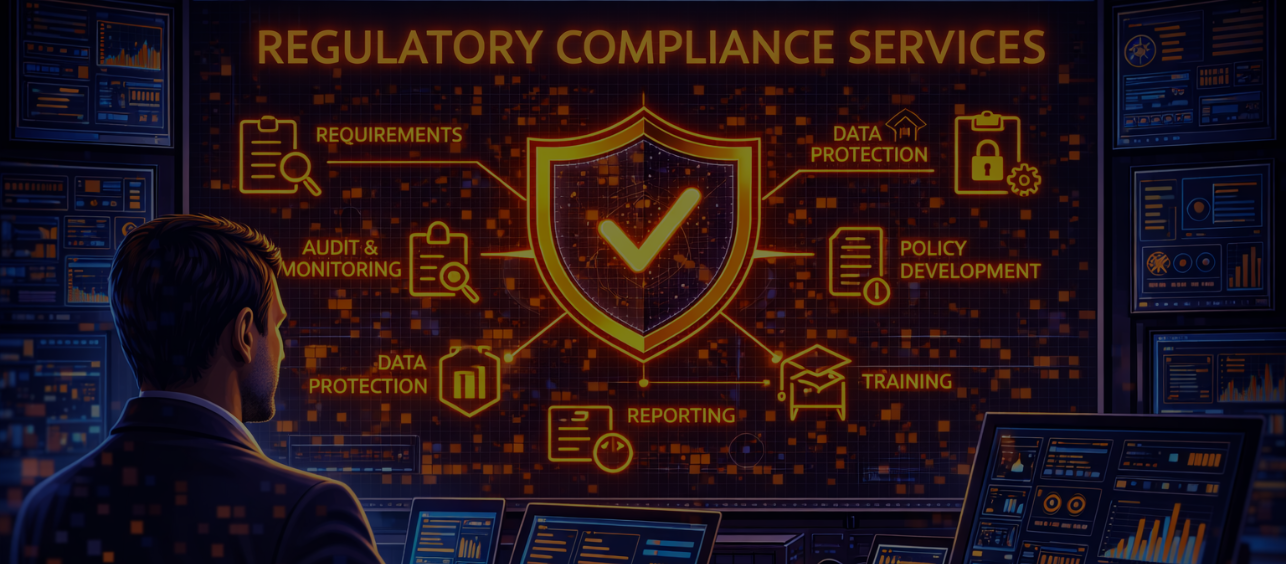
Regulatory Compliance Services
Regulatory compliance services that integrate security controls, automate evidence collection, and align your security program with evolving industry and legal requirements
Build a Tailored Engagement or Service Model Today- /
- /
- /
- /
- /
- /
- /
- /
- /
- /
- /
- /
- /
- /
- /
- /
- /
- /
- /
- /
- /
- /
Operationalize Regulatory Compliance Efforts into a Security Program
VerSprite understands regulatory compliance challenges and we are the only firm that has the vision to operationalize compliance efforts into a security program. Why run compliance efforts apart from security efforts if you can align the two to both save money and not let a compliance-driven program be your security defense strategy?
Via its tailored, managed service offerings, VerSprite has been able to operationalize both regulatory and control framework requirements across PCI-DSS, FISMA, FedRAMP, HIPAA’s Security Rule, NERC CIP, ISO 27001, NIST CSF, HITRUST CSF, EI3PA, CJIS, FFIEC, FINRA, NCUA, FDIC, GLBA, and SOX.
Our SecOps and GRC teams work to automate baselining techniques and map client controls to existing technological and process-based controls. Through this integrated method, VerSprite has helped clients reduce the burden of compliance audits on technology groups and the overall business. By focusing on real security, VerSprite will help you demonstrate how those controls fulfill regulatory obligations
Come to know Evolved Security Services via additional details around prominent compliance standards and laws.
Regulatory compliance is a cornerstone of business operations, obligating organizations to abide by laws, regulations, and industry standards. It comprises a spectrum of rules and guidelines that companies must conform to uphold legal and ethical practices.
VerSprite delves into many crucial factors:
- The significance of regulatory compliance
- Obstacles that organizations confront in achieving regulatory compliance
- Variances in compliance prerequisites across industries and strategies for ensuring compliance within organizations
- The pivotal role of data security in regulatory compliance
- /
- /
- /
- /
- /
- /
- /
- /
- /
- /
- /
- /
- /
- /
- /
- /
- /
- /
- /
- /
- /
- /
Threat Modeling for Compliance
Regulatory frameworks increasingly point to threat modeling by name, not just by implication. PCI DSS 4.0.1, FDA’s medical device premarket guidance, and IEC 62443-4-1 each create an expectation — some explicit, some structural — for a documented threat model tied to the system or product in scope. VerSprite’s PASTA methodology, delivered through Threat Modeling as a Service (TMaaS) and maintained continuously through Fork, produces exactly that artifact.
- PCI DSS 4.0.1 — Requirement 6.2.4 calls for a defined process addressing common software attacks in bespoke and custom software. A PASTA-based threat model, risk-ranked per Requirement 6.3.1, is a direct way to satisfy it.
- FDA Premarket Submissions — FDA’s current guidance names threat modeling as a specific component of the security risk management report for medical devices with cybersecurity risk.
- IEC 62443-4-1 — Requirement SR-2, titled “Threat model,” makes a documented threat model a standalone requirement for industrial automation and control system product suppliers.
Across all three, the pattern is the same: regulators and standards bodies are asking for evidence of a repeatable process, not a one-time document. Threat modeling supports compliance activity — it does not replace the rest of a regulatory framework’s control set, and VerSprite does not represent that any threat model guarantees a compliance outcome. What it provides is documented, risk-ranked evidence that can be pointed to when an assessor, reviewer, or certification body asks how a specific clause is being met.
- /
- /
- /
- /
- /
- /
- /
- /
- /
- /
- /
- /
- /
- /
- /
- /
- /
- /
- /
- /
- /
- /
What Makes Regulatory Compliance Essential?
Regulatory Compliance
is instrumental in preserving business integrity. It mandates that organizations comply with laws, regulations, and industry standards governing their operations. By adhering to these regulations, businesses exhibit their dedication to ethical practices and responsible behavior.
Non-Compliance
can lead to severe ramifications, affecting both reputation and financial stability. When a company fails to fulfill regulatory obligations, it risks tarnishing its reputation as customers, investors, and stakeholders lose faith in its capacity to operate ethically and responsibly. This loss of trust can result in a drop in business opportunities, investor confidence, and partnerships.
Conversely, fostering a culture of accountability through regulatory compliance and security, we set up a framework that encourages employees to act responsibly and make ethical decisions to protect the company from mistakes. This cultivates a culture of accountability, where employees comprehend their duties and take responsibility for their actions.
At VerSprite, we recognize the significance of regulatory compliance and its influence on businesses. Our exhaustive array of compliance services assists organizations in navigating complex regulatory landscapes, ensuring they fulfill all necessary obligations.
- /
- /
- /
- /
- /
- /
- /
- /
- /
- /
- /
- /
- /
- /
- /
- /
- /
- /
- /
- /
- /
- /
Obstacles in Attaining Regulatory Compliance
Risk Assessments
Security converges on process and technological controls. Our risk assessments evaluate your security program to the requirements set forth by HHS and OCR. Our GRC groups are well versed in the Administrative, Technical, Physical, and Operational control domains reflected by HIPAA’s Security Rule. Our audits apply to both covered entities as well as business associates who serve the needs of covered entities and who are also in the scope of HIPAA compliance.
A comprehensive compliance regulatory risk assessment can both uncover control gaps that would benefit from varied remediation patterns presented by our team and a well-defined and clear roadmap for an entity in moving forward with a security roadmap.
Risk assessments can encompass more than just a review of security processes and IT controls, but also include security exercises such as red team exercises, social engineering exercises, or penetration tests.
Technical Audits on EMR Systems
VerSprite can provide targeted engagements for covered entities who are most concerned about their technical security posture versus some of the other controls they may have around operational, physical, or administrative controls.
Our SecOps team supports our GRC practice by creating specific technical checks that evaluate the configuration of EMR systems. The scope of our expertise includes infrastructure assets like firewalls, wireless routers, servers, mobile client devices, databases, and endpoint devices. Our checks help to address the compliance of those systems as well as the security resiliency of your network.
Handling regulatory compliance across multiple industries and jurisdictions is another significant challenge. Each industry has its own set of regulations. Businesses operating in multiple sectors must navigate through a labyrinth of compliance prerequisites.
A critical challenge in attaining regulatory compliance is striking a balance between compliance and operational efficiency. Compliance measures often involve additional administrative tasks, increased documentation, and stricter processes. While these measures are necessary to meet regulatory compliance obligations, they can sometimes impede operational efficiency and productivity.
At VerSprite, we comprehend the challenges organizations face in attaining regulatory compliance. Our experienced team of compliance professionals can guide you through the complexities of regulatory frameworks, managing compliance across industries and jurisdictions, and striking the ideal balance between compliance and operational efficiency. With our comprehensive solutions and tailored strategies, we aid businesses in achieving and maintaining regulatory compliance while optimizing their operations.
- /
- /
- /
- /
- /
- /
- /
- /
- /
- /
- /
- /
- /
- /
- /
- /
- /
- /
- /
- /
- /
- /
FedRAMP Authorization
 Explore how the GSA’s FedRAMP 20x initiative is revolutionizing cloud security assessments with enhanced automation, adaptive monitoring, and innovative technologies. Learn how VerSprite’s IRM and DevSecOps teams are leading the way in achieving and maintaining Federal Authorization to Operate (ATO) with cutting-edge compliance solutions.
- /
- /
- /
- /
- /
- /
- /
- /
- /
- /
- /
- /
- /
- /
- /
- /
- /
- /
- /
- /
- /
- /
Variations in Regulatory Compliance Across Industries and Nations
Regulatory compliance is a vital element of business operations, obligating organizations to adhere to specific laws and regulations governing their industry. However, it’s significant to recognize that compliance requirements can differ markedly based on industry sectors and countries.
One of the key variations in compliance requirements is based on industry sectors. Different industries have unique characteristics and face distinct risks, which necessitate tailored compliance frameworks.
For example, heavily regulated sectors such as finance, healthcare, and energy often have more stringent compliance standards compared to other industries.
- /
- /
- /
- /
- /
- /
- /
- /
- /
- /
- /
- /
- /
- /
- /
- /
- /
- /
- /
- /
- /
- /
Health Insurance Portability Accountability Act (Security Rule)
In the U.S., healthcare records continue to evolve to electronic format as electronic medical records (EMR). EMR records and more specifically, protected health information (PHI) represent data that is used operationally by insurance providers, hospitals, pharmacies, dental groups, and healthcare technology groups.
VerSprite has worked with HHS, OCR, insurance companies, large healthcare systems, private practices, and 1000+ bed hospitals (collectively known as covered entities). Throughout the years, we’ve come to understand much more than just regulatory compliance gaps in HIPAA’s Security Rule. VerSprite will work with you to help address such gaps in the context of the business operations that you operate. We are not auditors – we are security professionals who understand risk and compliance.
- /
- /
- /
- /
- /
- /
- /
- /
- /
- /
- /
- /
- /
- /
- /
- /
- /
- /
- /
- /
- /
- /
Industries We Serve
VerSprite delivers Regulatory Compliance across industries where security failures translate directly to financial loss, safety risk, or regulatory exposure.
Financial Services & FinTech
-
Assess security controls against GLBA, FFIEC, PCI DSS, SOX, and other financial regulations
-
Identify compliance gaps across banking platforms, payment systems, and cloud environments
-
Support audit readiness with structured documentation and evidence collection
-
Align security programs to reduce regulatory exposure and enforcement risk
Healthcare & Life Sciences
-
Assess security and privacy controls against HIPAA, HITECH, and healthcare regulatory frameworks
-
Identify compliance gaps impacting ePHI, clinical systems, and research environments
-
Support audit preparation, risk assessments, and remediation planning
-
Align governance and technical safeguards to reduce breach and penalty risk
SaaS & Technology Providers
-
Assess security programs against SOC 2, ISO 27001, GDPR, and industry-specific requirements
-
Identify compliance gaps across cloud-native, multi-tenant, and development environments
-
Support audit readiness through policy development, control mapping, and evidence collection
-
Strengthen compliance posture to meet enterprise customer and partner expectations
Retail & E-Commerce
-
Assess compliance with PCI DSS, GDPR, CCPA, and consumer data protection regulations
-
Identify control gaps across payment systems, customer data platforms, and third-party integrations
-
Support audit preparation and remediation planning
-
Align security governance to reduce regulatory fines and reputational risk
Manufacturing & Critical Infrastructure
-
Assess compliance with NIST, CMMC, ISO, and industry-specific regulatory frameworks
-
Identify control gaps across IT and operational technology environments
-
Support audit readiness and structured remediation programs
-
Strengthen governance to reduce operational, regulatory, and contractual risk
Payment Card Industry Data Security Standard (PCI-DSS)
Card security today evolved to include key countermeasures against fraudulent transactions. Yet, there are key misses in security architecture, implementation, security configuration, and internal fraud that continue to wreak losses and liabilities for companies of all sizes. VerSprite is not a QSA but we do perform the heavy lifting when it comes to readiness and remediation. We go beyond project managing your PCI-DSS responsibilities but extend into helping clients operationalize security controls into their technological procedures.
- /
- /
- /
- /
- /
- /
- /
- /
- /
- /
- /
- /
- /
- /
- /
- /
- /
- /
- /
- /
- /
- /
Penetration Testing and Network Segregation Testing:
The Card Data Environment (CDE) needs proper isolation from other IT components which may not have the same level of security as those handling payment card systems. Our goal is to provide assurance that CDEs are properly architected and fully patched, hardened, and secured. VerSprite achieves this via both network security audits and penetration testing services. VerSprite’s AppSec and SecOps teams perform manual penetration tests for all types of merchants (Level 1 to Level 4). Our GRC teams help define the proper scope to ensure that you are not either over-scoped or under-scoped for meeting the latest PCI-DSS standard.
Point-of-Sale Security Testing:
Specific to point of sale environments, VerSprite has developed a SaaS based offering that allows for greater assurance of POS systems across merchant locations. Our GRC team will also work with our SecOps to ensure POS systems across merchant locations. Our GRC team will also work with our SecOps to ensure POS systems are not just measured for exploitable vulnerabilities but also provide checks for the presence of POS malware kits that continue to evolve into new POS malware strains.
PCI-DSS Audit Readiness & Remediation Guidance:
Many organizations and CISOs today are exploiting their own C-Levels and board members by making them think that CapEx expenses across the latest network, application, endpoint tools will equate to improved compliance posture. Over the years, many companies, fully invested in the latest security tools, have fallen short of actual security and even compliance. VerSprite understands the The InfoSec industry still has not learned from these case studies of compliance inadequacies, however, we are here to be a trusted partner.
Our approach to PCI-DSS audit readiness revolves around the following:
- A thorough understanding of the latest requirements and addendums issued by the PCI Council.
- Official member of the PCI organization in order to stay abreast of ongoing changes in the regulation; this translates to direct readiness efforts that we apply to our client engagements
- Scoping – Our expertise in how and what controls to apply based upon the card data flow and lifecycle within client environments.
- Audit Checks – We provide both automated and manual controls checks to infrastructure components in order to ensure proper depth of coverage.
- Operationalizing security controls with client DevOps teams. VerSprite’s SecOps teams can also help to automate controls via programmatic scripts that we’ve authored in OnPrem and Cloud environments.
- Providing technical guidance to control gaps identifeid by our point in time audits or ongoing audit checks supported by various VerSprite’s managed service offerings.
VerSprite’s Point-of-Sale security research has revealed a multitude of concerns regarding the secure development of payment applications.
For assistance with HIPAA’s Privacy Rule, view our Data Privacy section.
Vendor Risk: Product vs. Custom Managed Services
When it comes to vendor risk, what are the pros and cons of product and custom managed services? Which is better for your organization? In this guide we discuss which KPIs are most important and how each type of service stacks up.
Download the guide to learn what to consider in your decision process to determine which solution best fits your organization. Get the Guide →
Frequently Asked Questions

We’re Not a Vendor
We’re Your Security Partner
- Risk-centric security
- True extension of your team
- Executive-level experience
