What Is Deepfake as a Service in 2026?
Date
Authors
Tony UcedaVélez
Follow Us


Deepfake as a Service (DFaaS) refers to two different things in 2026, and the overlap in naming is genuinely confusing. On dark-web marketplaces, it means synthetic voice, video, and identity documents rented or sold to fraudsters on a subscription basis, no technical skill required. In offensive security practice, the same term describes a controlled adversarial simulation a red team building consented synthetic voice and video of a real person and running it against an organization’s own verification workflows to see what actually holds up.
Both senses point at the same underlying fact: the technology to convincingly fake a face or a voice is no longer scarce, and the processes built around “I recognize that voice” or “I can see it’s really them” were never designed to survive that. What follows is a look at what breaks when that assumption gets tested either by a criminal or by someone deliberately checking before a criminal gets the chance.
Two Things People Mean by “Deepfake as a Service”
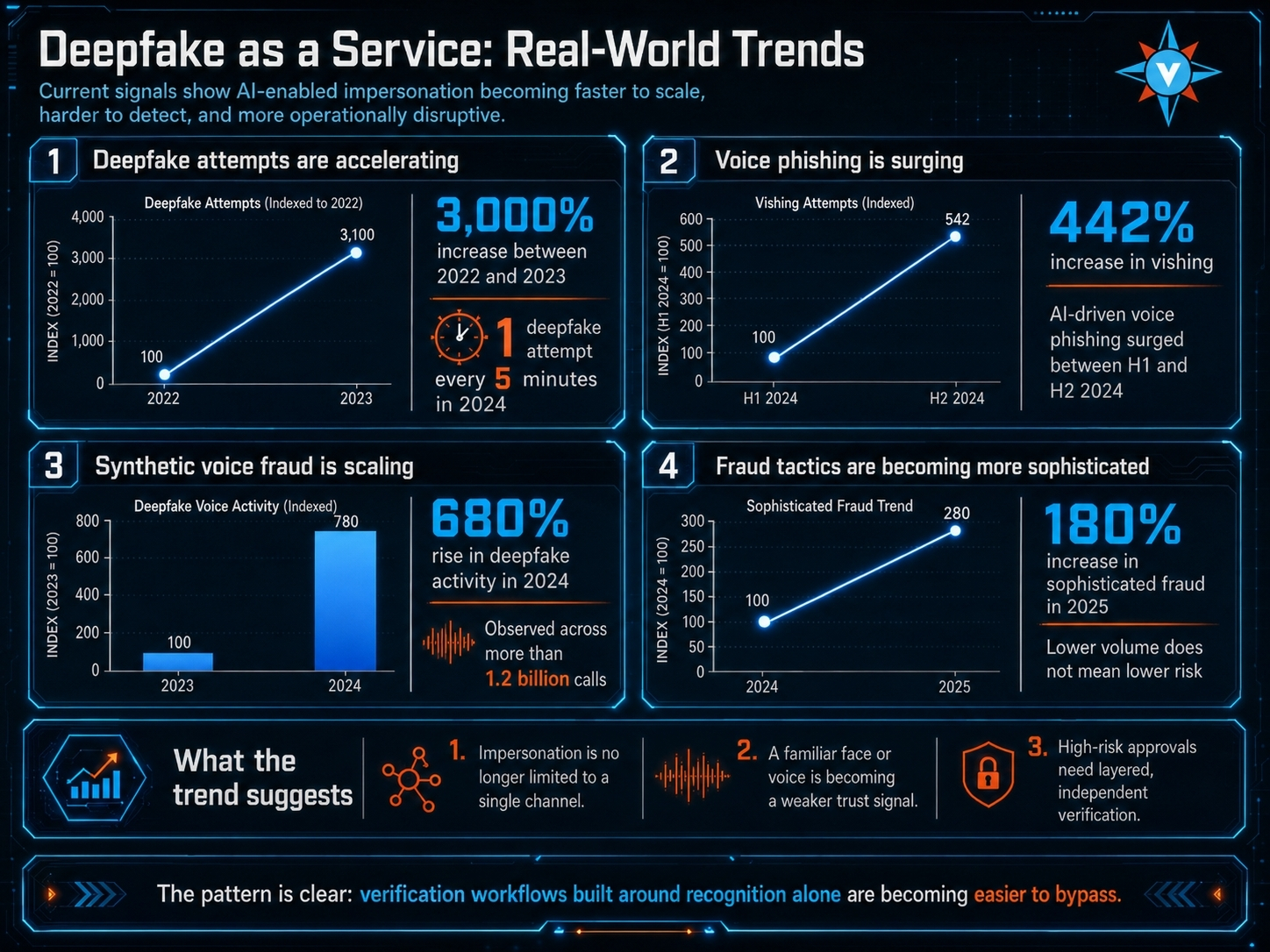
The criminal sense. Dark-web intelligence trackers have logged a marked rise in marketplace activity explicitly branded around deepfake-as-a-service in 2026, with vendors offering cloned executive voices, real-time face-swapped video, and fabricated identity documents as an on-demand product, priced like any other subscription. The barrier that used to separate “wants to commit fraud” from “can convincingly impersonate someone” has mostly collapsed.
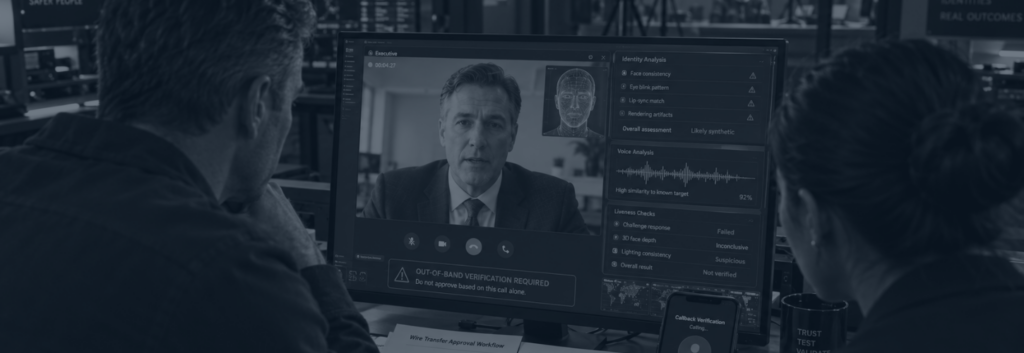
The security-testing sense. The same term is used by offensive security teams for a deliberately adversarial exercise: build a synthetic voice or face of a real, consenting person inside the organization, then run it against actual approval workflows, wire transfer sign-off, help desk credential resets, executive escalation chains to find out whether the verification step is real or just theater. This is the same underlying capability (voice cloning, real-time face swapping) pointed at a different, authorized target.
The confusion between the two is worth naming plainly, because a security leader searching for information on this topic in 2026 is likely to run into both meanings in the same set of search results.
What Actually Breaks When a Deepfake Hits a Real Workflow
The documented incidents that get cited most often a Hong Kong-based multinational’s finance staff authorizing a $25 million transfer after a video call with synthesized versions of colleagues, and a UK advertising conglomerate’s staff targeted by a voice-cloned CEO attempting to share a specific structural weakness. It’s not that the deepfake was flawless. It’s that the workflow had exactly one verification step, and that step was “does this look and sound like the person it’s supposed to be.”
Studying these cases and the workflows behind them tends to sort the failure into one of three categories:
- A missing process step. No out-of-band callback to a known, independently sourced number. No secondary approver. No cooling-off period for unusual requests, regardless of how the request arrived.
- A training gap. Staff trained to distrust suspicious emails but never briefed that a video call or phone call carries the same risk because until recently, it didn’t.
- A technology gap. Identity verification that relies on a single biometric signal face or voice alone with no secondary, independent check.
Almost none of the widely reported cases trace back to a purely technical failure. They trace back to a process that assumed a familiar face or voice was sufficient proof on its own, which is a business-process finding, not a cybersecurity finding in the traditional sense.
Why Detection Software Doesn’t Close the Gap
The instinct is to treat this as a problem detection software should solve. That’s an incomplete answer, and the reason is structural: deepfake generation and deepfake detection exist in an adversarial relationship where the attacker gets to test against the detector first. A criminal producing a deepfake can run it against publicly available detection tools and keep iterating until it passes; a defender only sees the version that already got past whatever it was tested against.
That asymmetry gets worse across generations of the underlying technology. Earlier deepfakes were built on generative adversarial networks; newer ones increasingly use diffusion models, which leave different forensic artifacts. A detector tuned for one architecture regularly misses the other. None of this means detection tools are worthless it means a detection tool passing a test today says very little about whether it will catch what shows up next quarter.
A few assumptions worth retiring specifically: modern synthetic video doesn’t show the visual glitches people associate with early deepfakes, file metadata proves nothing about authenticity since it’s trivial to strip or forge, and a liveness check alone doesn’t rule out real-time face manipulation, which is exactly the technique now sold commercially in both the criminal and the security-testing sense of the term.
What Shows Up When the Workflow Gets Tested Directly
Running a controlled version of this attack against real approval chains rather than just reviewing the policy document that describes them surfaces a consistent pattern. Finance approvers accept a familiar voice on a call without triggering the callback procedure the policy technically requires. Help desk staff grant a credential reset because the person on video “looked right,” without a secondary knowledge-based check. Executive assistants and board members have no predefined protocol for an urgent request that arrives by video rather than email, so the request gets treated as more legitimate, not less.
The distinction that tends to matter most in these findings is separating a human-factor failure from a technical-control failure, because the fix is different for each. A missing callback step is a process fix. A help desk script that never anticipated synthetic voice is a training fix. A verification system with no secondary check beyond a single biometric signal is a technical fix. Treating all three as “AI risk” and addressing them with a single detection tool tends to leave at least two of the three gaps untouched.
Risk Controls That Hold Up
A handful of controls show up repeatedly in what actually stops this pattern, independent of which sense of “deepfake as a service” is behind the attempt:
- Out-of-band verification for high-risk transactions, a callback to a number sourced independently of the interaction itself, not one provided during the call.
- Layered identity checks that don’t rely on a single biometric signal, combining liveness detection with an independent knowledge-based or document check.
- Explicit protocols for urgent requests arriving by voice or video, since most social engineering training still centers on email and text, not synthetic calls.
- A cyber insurance policy review. Many standard policies were written before AI-generated impersonation existed and classify this kind of loss under crime or forgery coverage, which frequently carries sub-limits or exclusions worth confirming before an incident, not during one.
- Alignment with emerging verification standards, including ISO/IEC 30107 for liveness detection and FIDO Alliance Face Verification certification, both of which are starting to build deepfake resilience directly into their test criteria.
The Regulatory Backdrop
Regulatory attention on this is still catching up to the technology, unevenly. The EU AI Act’s staged rollout is starting to touch synthetic media obligations. Biometric certification bodies are building deepfake resistance into their standards rather than treating it as a separate concern. In the U.S., the response so far is more fragmented sector-specific guidance from banking regulators rather than a single overarching rule. None of this changes the underlying finding: the workflows that fail are the ones that never had a second layer of verification to begin with, regulatory pressure or not.
What the Pattern Suggests
Across both senses of the term, the common thread is the same: an authentication model built entirely on “I recognize this person” was adequate for a threat landscape that no longer exists. The fix isn’t exotic. It’s the unglamorous work of adding a second, independent verification step to the handful of workflows, wire approval, credential reset, urgent executive request where a familiar face or voice has historically been treated as sufficient proof on its own.
