Understanding PASTA Threat Modeling
for App Risk

Date
Authors
Tony UcedaVélez
Follow Us


Most application security programs are good at finding things wrong with software. Fewer are good at explaining why any particular thing wrong matters more than the twenty other things also wrong with it. That second problem not detection, but prioritization is the one PASTA threat modeling was built to address, and it’s worth being precise about what “risk-centric” means in that context, because the phrase gets used loosely enough that it’s stopped meaning much on its own.
PASTA stands for Process for Attack Simulation and Threat Analysis. It’s a seven-stage threat modeling methodology, co-created by VerSprite founder Tony UcedaVélez and Marco M. Morana and documented in their 2015 book on risk-centric threat modeling. The core claim it makes is narrower than it sounds: a finding only counts as high risk if you can trace it to a business objective on one end and a plausible attacker on the other. Everything else in the methodology exists to force that tracing to happen consistently, rather than depending on whoever’s in the room that day.
What “Risk-Centric” Actually Rules Out
It’s easier to explain PASTA threat modeling by what it excludes than by what it includes. An asset-centric approach starts by inventorying what you have and asking what could go wrong with each piece. A compliance-driven approach starts with a control list and checks whether each control exists. Both produce real output. Neither one, on its own, tells you which finding would actually cost the business something if it were exploited.
PASTA threat modeling forces the business question first. Before any component gets analyzed, the methodology’s early stages require defining what the application is actually for, what it would mean for the business if that function were compromised, and what the organization’s actual risk tolerance is not the risk tolerance written in a policy document, but the one that shows up when a real incident happens. That ordering is the entire trick. Everything technical that follows gets evaluated against a business answer that was already on the table, instead of technical findings getting a business justification bolted on afterward because a stakeholder asked for one.
This is also where PASTA threat modeling is hardest to do well, and it’s worth saying so plainly rather than pretending the methodology solves this on its own. Getting a genuine, specific answer to “what would this actually cost us” out of a business stakeholder who’s busy and mildly annoyed to be in a security meeting is a real skill, and most technically strong application security teams aren’t trained in it. A risk-centric threat model built on a vague or performative business objective is still a risk-centric threat model in structure; it just isn’t one in substance.
How the Seven Stages Actually Connect
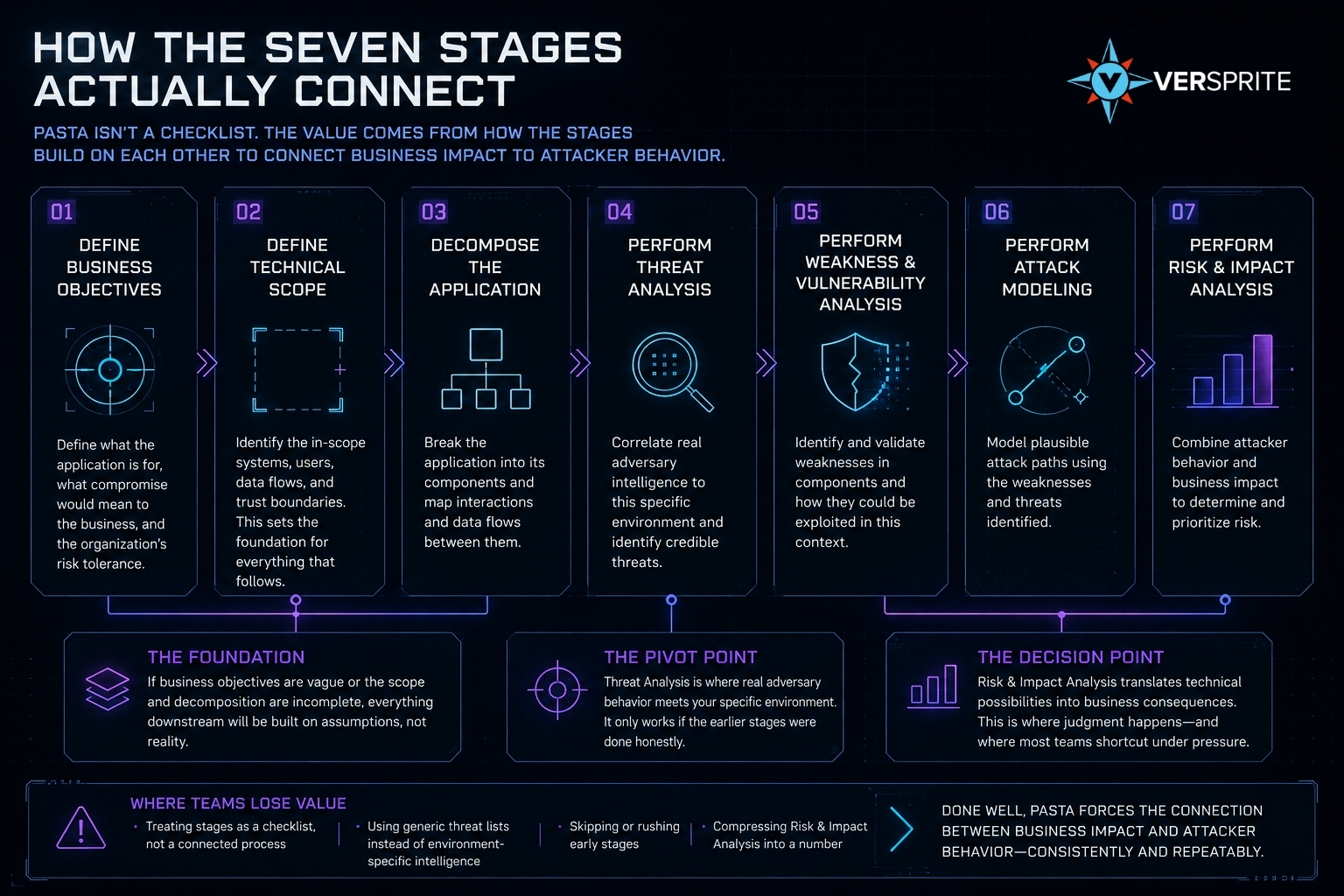
The seven stages of PASTA threat modeling run from business objectives, through technical scope definition, application decomposition, threat analysis, weakness and vulnerability analysis, attack modeling, and finally risk and impact analysis. Described that way, it reads like a checklist, and treating it as one is the most common way teams get less value out of the methodology than it’s capable of providing.
The stages that do the real work of connecting business impact to attacker behavior are threat analysis and risk and impact analysis, the fourth and seventh stages, and they only function correctly if the stages before them were done honestly. Threat analysis correlates real intelligence about adversary behavior against the specific system in scope, which is a meaningfully different exercise than pulling a generic threat list from a vendor feed. It requires knowing something about who would actually want to attack this particular system, which depends on the technical scope and decomposition work from stages two and three having actually mapped out what’s exposed and where the trust boundaries sit. Skip that groundwork and stage four just produces plausible-sounding threats with no real connection to the environment.
Risk and impact analysis, the final stage, is where attacker behavior and business impact get combined into something a decision-maker can act on. This is also the stage most likely to get compressed under deadline pressure, because it’s the one that requires synthesis rather than documentation. Someone has to actually weigh an attack path’s likelihood against what the business defined as costly back in stage one, and that weighing is a judgment call, not a formula. Frameworks that promise to remove the judgment call from risk scoring are usually promising something they can’t deliver. PASTA doesn’t remove it. It insists the judgment be applied to information that’s actually relevant, and it makes the reasoning visible enough that someone else could check it.
What This Looks Like for an Application Security Team
For a team responsible for a real application portfolio rather than a single system, the honest version of PASTA threat modeling looks less like a workshop and more like a habit built into how design reviews happen. Threats get modeled while an architecture decision is still reversible, not after the system has shipped and a finding means a backlog item competing with feature work for the same sprint capacity.
That’s harder to sustain than it sounds, for reasons that have nothing to do with the methodology itself. Engineering teams experience a new review requirement as friction, especially early on, before the practice has proven it catches something a code review or a scanner wouldn’t have. Getting a threat model taken seriously as an input to a design decision rather than treated as documentation produced after the decision was already made is an organizational problem that PASTA threat modeling doesn’t solve by itself. The methodology gives you a structure for the analysis. It doesn’t give you the standing within the organization to make that analysis matter, and conflating the two is a common way threat modeling initiatives quietly become a formality.
Where the Risk-Centric Claim Gets Harder to Sustain

A single analyst applying the seven stages carefully to one system produces a defensible risk ranking. Ten analysts applying the same methodology to a hundred systems across a large portfolio will produce ten somewhat different calibrations of what counts as high, medium, and low impact not because anyone is doing it wrong, but because the judgment calls in stages four and seven are genuinely judgment calls, and judgment varies between people even when they’re using the same framework.
This is usually where organizations either invest in tooling and shared scoring criteria to keep the analysis consistent across a large number of systems, or quietly let the inconsistency stand and accept that “risk-centric” in practice means “risk-centric according to whoever wrote this particular model.” Both are real outcomes of adopting PASTA threat modeling at scale, and only one of them delivers what the methodology promises. It’s worth naming that gap directly rather than implying the framework closes it automatically, because it doesn’t.
PASTA threat modeling doesn’t make threat modeling easy. It makes a specific point that the judgment calls a security team is already making, whether they admit it or not, should be tied to something the business would recognize as risk rather than something a scanner flagged as severe. That’s a smaller promise than a lot of methodologies in this space make, and it’s probably part of why the framework has held up as well as it has; it’s honest about what it is asking a team to do, which is harder than most alternatives, not easier.
