Understanding Advanced Threat Modeling in 2026

Date
Authors
Tony UcedaVélez
Follow Us


The term “advanced threat modeling” is used loosely enough in industry writing that it risks meaning nothing more than “threat modeling done carefully.” This paper attempts a more precise definition: advanced threat modeling is distinguished from basic, checklist-driven threat modeling by three specific practices: risk-driven analysis that ties findings to business impact, continuous attack surface evaluation rather than point-in-time diagramming, and threat-informed design decisions made before implementation rather than control validation after it. We examine current attack surface exposure and remediation data to test whether checklist-based approaches are keeping pace with the environments they’re meant to secure, and argue they generally are not. We close by stating where the “advanced” alternative is itself incomplete.
Introduction
Most published definitions of advanced threat modeling describe it by contrast: it is not a one-time diagram, not a static checklist, not a control-mapping exercise performed once before launch. Contrast is a reasonable starting point but an insufficient one, because it defines the term entirely in terms of what it isn’t. This paper tries to be more specific about what advanced threat modeling actually adds, using three components: a risk-driven scoring approach that connects technical findings to business consequence, systematic attack surface evaluation that treats the set of exposed systems as something to be measured rather than assumed, and threat-informed design, where decisions about architecture and access are shaped by real adversary behavior before a system is built rather than checked against a control list afterward.
The rest of this paper is organized as follows. Section 2 characterizes basic, checklist-driven threat modeling and its specific failure modes. Section 3 presents current data on attack surface exposure to test whether checklist-based coverage is adequate. Section 4 examines remediation-speed data as a proxy for whether organizations are acting on what they find quickly enough to matter. Section 5 describes risk-driven, threat-informed design as a structural response, using PASTA as a worked example. Section 6 states this argument’s limitations. Section 7 concludes.
What Basic Threat Modeling Usually Means in Practice
“Basic” threat modeling, as most security architects would recognize it, typically means working through a fixed category list; STRIDE’s six threat categories are the most common example against a system diagram, once, usually before a major release. Each category gets checked against each component, findings get logged, and the exercise ends. This isn’t a strawman; it’s a legitimate, widely taught starting point, and it produces real findings.
Its limitation is not inaccuracy. A checklist applied carefully will surface real threats. Its limitation is that it treats every surfaced threat as equally worth acting on, because the checklist itself carries no mechanism for weighing one finding against another in terms of actual consequence. Practitioner guides on threat modeling methodology increasingly describe mature teams layering a scoring step and a business-impact rollup on top of a categorization exercise like STRIDE, precisely because the categorization step alone doesn’t produce a prioritized action list; it produces an inventory.
The second limitation is temporal. A checklist run once against a system-as-diagrammed says nothing about the system as it exists six months later, after new integrations, new cloud services, and new exposed endpoints have accumulated. Whether that gap matters in practice is an empirical question, addressed in the next two sections.
Attack Surface Evaluation: What the Exposure Data Shows
Intruder’s 2026 Attack Surface Management Index, based on anonymized data from 3,000 organizations, found that 60 percent had at least one exposed HTTP administrative panel, 49 percent had a risky exposed port or service such as RDP, 42 percent had an internet-facing database, and 30 percent had exposed files or information, commonly API documentation that was never intended to be public.
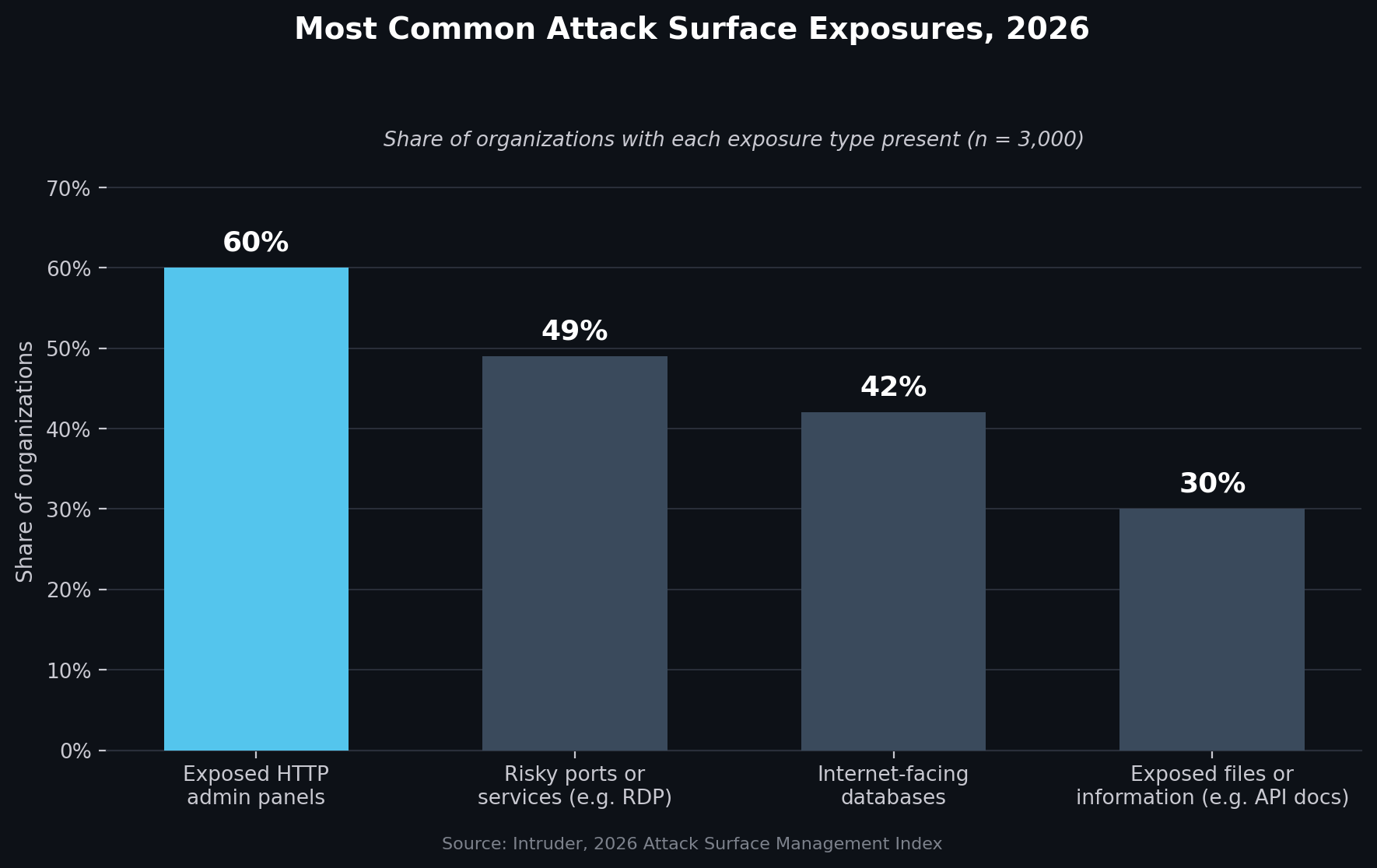
None of these four exposure categories are exotic. A checklist-driven threat model would almost certainly ask whether administrative interfaces are exposed, whether databases are reachable from the internet, and whether unnecessary ports are open. The fact that these remain the most common exposures despite being checklist-obvious findings suggests the gap is not in what organizations know to look for. It is in whether the systems being modeled at the point of design still resemble the systems actually running in production by the time anyone checks.
This is corroborated by a separate dataset: Arctic Wolf’s 2026 State of the Cybersecurity Attack Surface Report, drawing on more than 800,000 monitored IT assets, found that 33 percent of assets lacked at least one critical security control, with 18 percent specifically missing coverage under enterprise patch or configuration management. An asset missing from patch management coverage is, definitionally, an asset that fell outside whatever inventory the organization’s security process was built around, which is a coverage problem a one-time model, however carefully executed, cannot detect after the fact.
Remediation Speed as a Proxy for Process Maturity
Finding an exposure is not the same as closing it, and the gap between the two is where a checklist-based process most visibly runs out of runway. The same Intruder index found that remediation speed varies sharply by sector and by organizational scale: the banking sector remediated exposures in an average of 11 days, while insurance and pharmaceutical firms averaged more than 40 days, and midmarket organizations in the 5,000-to-10,000-employee range averaged 56 days, roughly four times slower than the smallest organizations in the dataset.
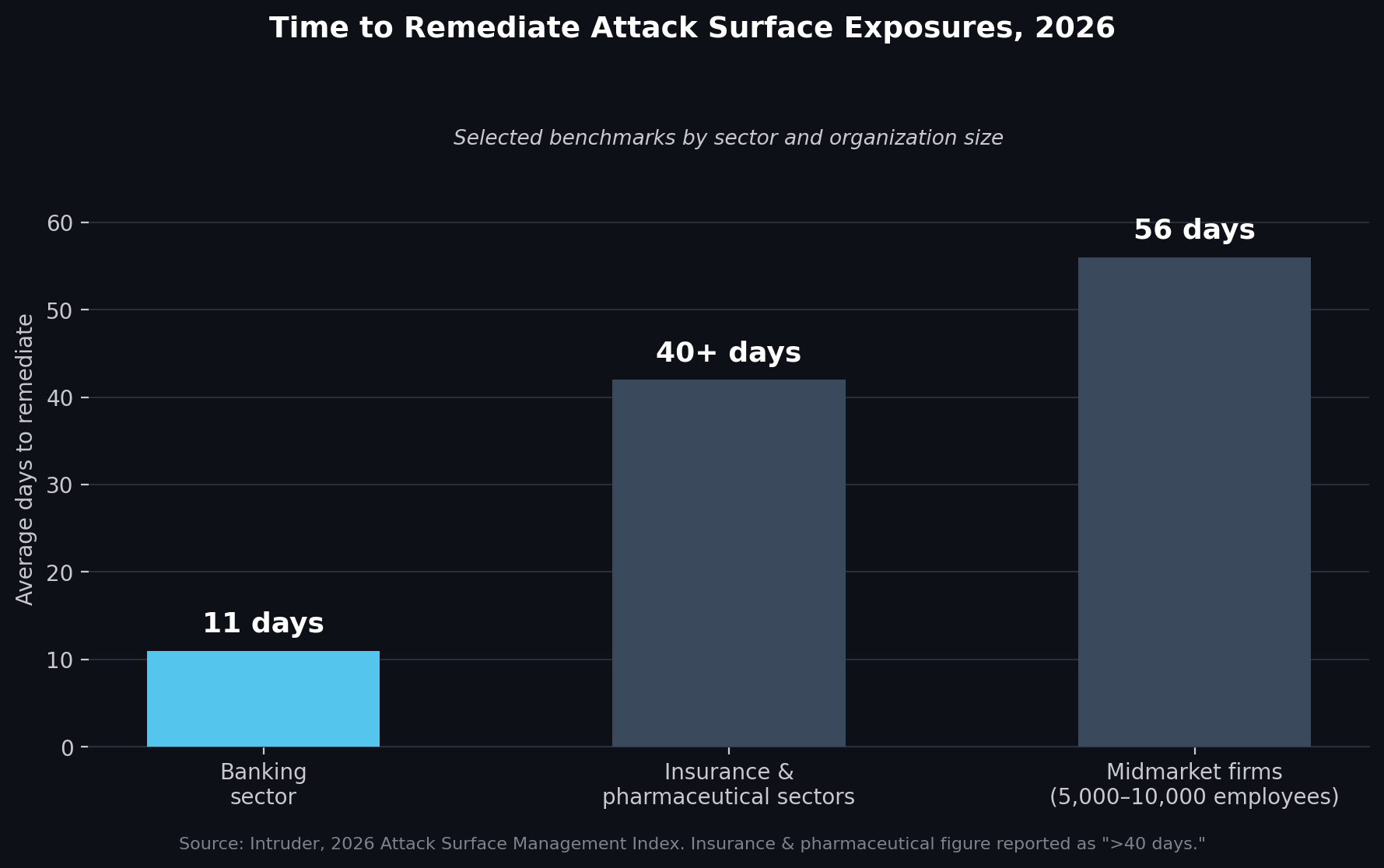
The banking figure is worth sitting with, because it cuts against a simple “regulation drives speed” narrative in one direction while data volume complicates it in another. Banks remediate fastest in this dataset, plausibly because regulatory pressure and mature security operations compress response time. But the same index reports that midmarket organizations a category that includes many regulated firms outside banking specifically face the slowest remediation, attributed to attack surfaces that have scaled with growth faster than headcount, budget, or tooling maturity have kept pace. Regulation alone does not explain the gap; organizational capacity relative to attack surface size appears to matter at least as much.
Separately, Palo Alto Networks’ Unit 42 2026 Global Incident Response Report found that among the largest enterprise environments studied, unpatched or otherwise exploitable vulnerabilities accounted for just over a quarter of initial access in 2025 a meaningful share, but smaller than the share attributable to identity and credential-based access. This complicates a purely exposure-centric view of risk: attack surface evaluation matters, but it is one input among several, not a complete threat model by itself.
Risk-Driven, Threat-Informed Design as a Structural Response
If checklist-driven threat modeling produces an inventory rather than a prioritized action list, and static models fail to track systems that change continuously, the specific gap advanced threat modeling needs to close is twofold: findings need a consistent way to be weighed against each other, and the model needs to reflect the system as it currently exists rather than as it existed at the last review.
PASTA (Process for Attack Simulation and Threat Analysis), the seven-stage risk-centric methodology developed by VerSprite founder Tony UcedaVélez and Marco M. Morana, is a useful worked example because it addresses both gaps directly rather than as an afterthought. Its early stages require defining business objectives and technical scope before any component-level analysis begins, which is what allows later-stage findings to be weighed against a business consequence rather than logged as a flat list. Its later stages threat analysis and attack modeling specifically depend on correlating real adversary behavior against the system’s actual decomposition, which is a different exercise than checking a category list against a diagram; it requires the technical scope to reflect what’s actually running, not what was originally designed.
This is also where “threat-informed design” earns its name as distinct from “control validation.” A checklist validates whether a control exists. A threat-informed design process asks, before the system is built, what an adversary matching a specific, current threat profile would actually attempt against this specific architecture and lets that answer shape the design rather than auditing the design afterward. Continuous platforms built on this model, Fork among them, extend the practice further by keeping the underlying model current as APIs, integrations, and infrastructure change, which is the direct structural answer to the temporal gap described in Section 2.
Limitations and Open Questions
This argument is incomplete in several specific ways worth naming.
First, the exposure and remediation data in the sections above measure the output of attack surface management, not threat modeling practice directly. No dataset cited here directly measures whether the organizations with faster remediation or fewer exposures were using a risk-driven threat modeling methodology, a basic checklist, or no formal process at all. The connection drawn in this paper that checklist-based, point-in-time modeling is structurally ill-suited to the exposure and remediation patterns observed is an inference from the shape of the data, not a measured causal finding.
Second, the Section above Unit 42 data complicates rather than simplifies the case for attack-surface-centric threat modeling: if identity and credential-based access account for a larger share of initial access than unpatched vulnerabilities in the largest enterprise environments, then a threat modeling practice focused primarily on exposed systems and unpatched components is modeling only part of the actual risk surface. Advanced threat modeling, as defined in this paper, needs to account for identity and access relationships with the same rigor it applies to exposed infrastructure, and it is fair to say the discipline as commonly practiced still weights the two unevenly.
Third, risk-driven scoring in PASTA or any comparable methodology depends on a business-impact judgment that is not itself standardized across analysts or organizations. This paper has made this point in prior work on PASTA specifically, and it applies with equal force here: naming a methodology as risk-driven does not, by itself, guarantee that two different teams applying it would rank the same finding the same way.
Fourth, threat-informed design depends on the quality and currency of the threat intelligence informing it, and industry survey data on threat intelligence maturity is mixed at best; more than half of surveyed security professionals in a 2025 industry survey characterized their own organization’s threat intelligence practice as less than advanced. A design process informed by immature or stale threat intelligence is threat-informed in name without necessarily being more accurate than a well-constructed checklist.
Conclusion
Advanced threat modeling, defined precisely rather than by contrast with a strawman, adds three specific things to a checklist-based baseline: a consistent way to weigh findings against business consequence, a model that tracks a system as it currently exists rather than as it was designed, and a design process shaped by current adversary behavior rather than validated against a static control list afterward. Current attack surface data supports the case that checklist-driven, point-in-time approaches are not keeping pace with how quickly exposure accumulates or how slowly, in many organizations, it gets addressed. It does not support a claim that risk-driven methodology alone solves the problem; identity-based access risk, uneven threat intelligence maturity, and inconsistent scoring judgment all remain open problems that “advanced” does not automatically resolve.
References
- Intruder. 2026 Attack Surface Management Index. intruder.io/blog/attack-surface-exposures
- Arctic Wolf. 2026 State of the Cybersecurity Attack Surface Report.
- Palo Alto Networks, Unit 42. 2026 Global Incident Response Report. paloaltonetworks.com/resources/research/unit-42-incident-response-report
- Recorded Future. 2025 State of Threat Intelligence Report.
- UcedaVélez, T., and Morana, M.M. Risk Centric Threat Modeling: Process for Attack Simulation and Threat Analysis. Wiley, 2015.