Threat Modeling Platforms for Government Secure SDLC
Date
Authors
Tony UcedaVélez
Follow Us


Government compliance regimes have historically operated on long, manual, document-heavy review cycles. FedRAMP, the authorization program for cloud services used by federal agencies, is in the middle of a structural shift away from that model, toward machine-readable submissions and continuous, automated validation. This paper uses that shift as a case study to ask a narrower question: what does a threat modeling platform need to do differently to remain useful inside a compliance environment that is itself moving from periodic and manual toward continuous and automated? We argue that a static, point-in-time threat model is structurally mismatched with where government compliance is heading, and specify what a platform needs instead. We close by noting that the reform this paper treats as a case study is itself still in pilot, not yet proven at full scale.
Introduction
Threat modeling platforms are usually evaluated against generic criteria: coverage, integration, ease of use. For government-secured SDLC specifically, a more useful evaluation criterion is fit with the compliance regime the platform’s output is ultimately meant to support. That regime is changing quickly. FedRAMP’s ongoing modernization, FedRAMP 20x, as a concrete illustration of the direction of change. Section 3 argues that static threat modeling is a poor fit for that direction. Section 4 specifies what a platform needs instead. Section 5 separates the platform question from the underlying methodology question. Section 6 states this paper’s limitations. Section 7 concludes.
The Compliance Reform Underway: FedRAMP as a Case Study
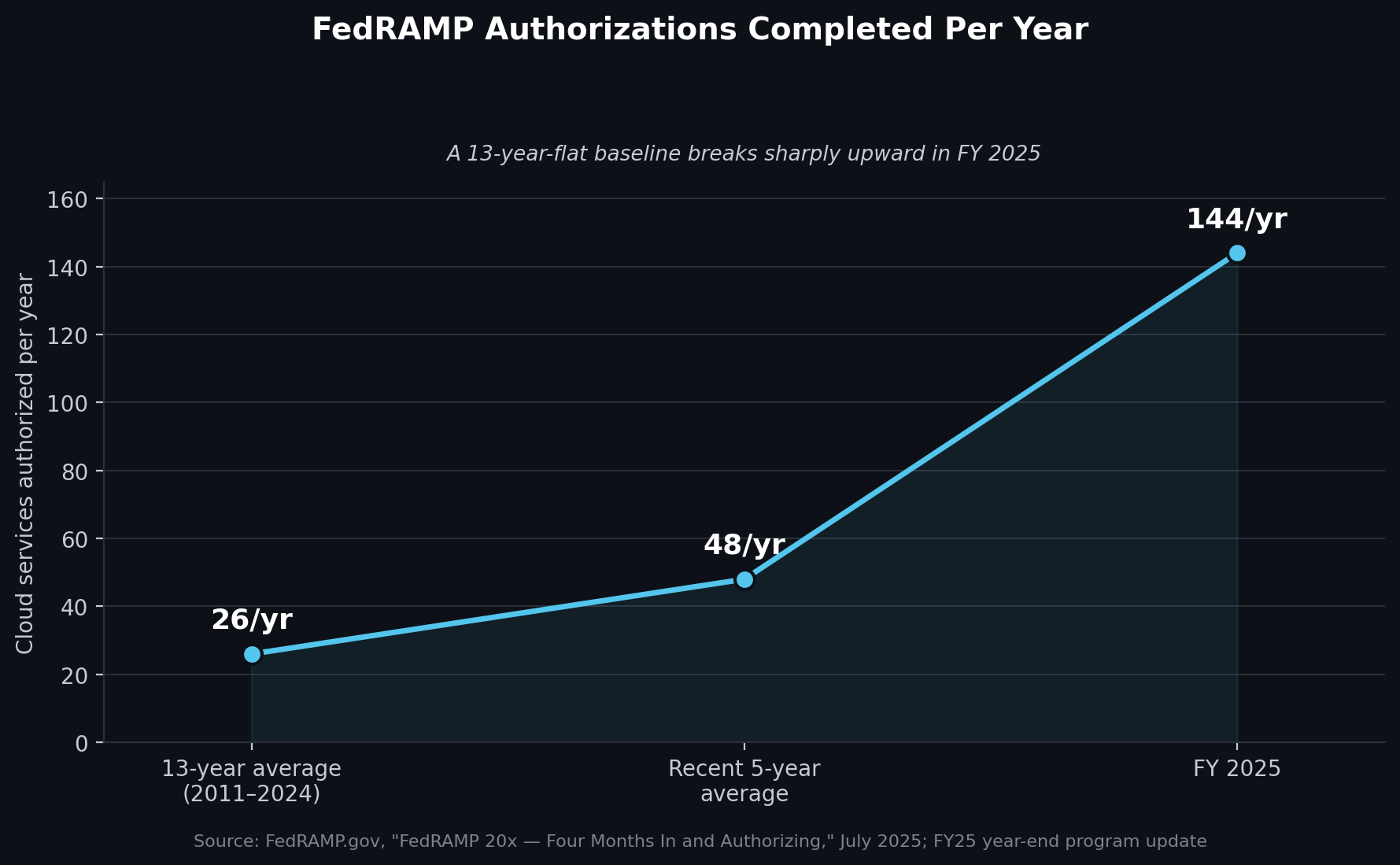
For most of its history, FedRAMP authorization has been slow. A 2024 Government Accountability Office report found authorization backlogs for FedRAMP Moderate averaging 22 months, with an in-process review queue exceeding 200 vendors at points. Across the program’s first thirteen years, roughly 350 cloud services were authorized in total, an average of about 26 per year, with the most recent five-year average still under 50 per year.
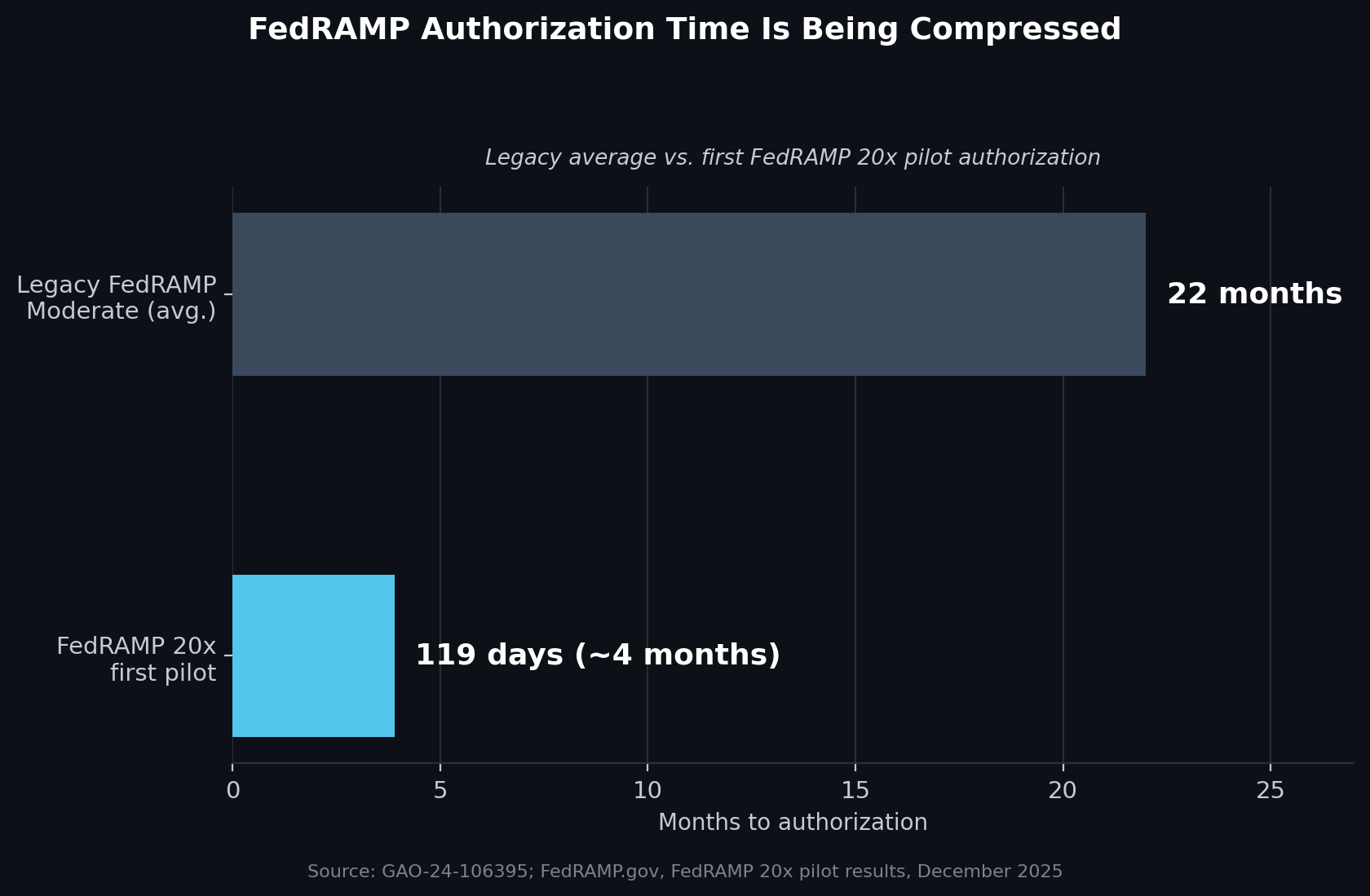
FedRAMP 20x, launched in 2025 following OMB Memorandum M-24-15, replaces manual document review with machine-readable OSCAL submissions and a small set of Key Security Indicators, and shifts continuous monitoring from periodic reporting toward streaming validation. The program’s first pilot authorization was completed in 119 days, and the broader push authorized over 100 cloud services in a six-month window in 2025 alone, more than the program had completed in the entirety of fiscal year 2024. Fiscal year 2025 closed with 144 total authorizations, a sharp break from the historical trend.
The specific mechanism behind this shift matters more than the raw numbers: FedRAMP 20x’s speed gains come from replacing static, human-reviewed documents with machine-readable, continuously validated data. That is a change in the type of artifact the compliance process consumes, not merely a change in reviewer headcount or process efficiency.
Why Static Threat Modeling Doesn’t Fit This Model Anymore
A threat model produced once, attached to a System Security Plan, and revisited only at the next scheduled reauthorization is exactly the kind of artifact FedRAMP 20x’s reforms are designed to move away from. It is a static document describing a system’s risk posture at a single point in time, submitted into a process that increasingly expects continuously validated, machine-readable evidence instead.
This mismatch would matter less if government secure SDLC environments changed slowly. They generally don’t. Agencies and their cloud service providers add integrations, update infrastructure, and modify APIs on a cadence that has little to do with the reauthorization calendar, which means a static threat model is typically stale well before the compliance process that depends on it comes back around for its next look. A platform whose output is a document generated once and shelved until the next audit is solving a version of the problem the compliance regime itself is actively trying to stop relying on.
What a Threat Modeling Platform Needs for This Environment
A threat modeling platform intended to support government secure SDLC needs several specific properties beyond generic usability.
It needs to produce output that can be consumed as structured, machine-readable data rather than only as a narrative report, so that its findings can plausibly feed into an OSCAL-adjacent submission process rather than requiring manual transcription into one. It needs to update continuously, or at minimum on a cadence that matches actual system change rather than the reauthorization calendar, since a model that’s accurate only as of the last review inherits the exact staleness problem It needs to map findings to NIST SP 800-53 controls directly, since that mapping is the connective tissue between a technical finding and the compliance artifact an agency or authorizing official actually needs. It needs coverage across applications, APIs, and cloud infrastructure as a single connected model, since government systems increasingly span all three and a platform that only models one layer is describing part of the system. And it needs to route findings into existing remediation workflows with tracked ownership, since a finding that surfaces but isn’t assigned and tracked provides compliance narrative value without providing actual risk reduction.
Separating the Platform Question From the Methodology Question
A platform satisfying every property is still only as good as the analytical logic determining which findings matter. This is a distinct question from platform capability, and it is worth keeping the two separate rather than assuming better tooling automatically produces better risk judgment.
PASTA (Process for Attack Simulation and Threat Analysis), the seven-stage risk-centric methodology developed by VerSprite founder Tony UcedaVélez and Marco M. Morana, supplies that analytical logic by tying findings to defined mission and business objectives before ranking them, rather than ranking by a generic severity scale. A platform running an inconsistent or purely severity-based methodology at high speed and large scale is not solving the problem described in this paper; it is automating the same inconsistency described in prior work on severity-based prioritization, just faster. Continuous platforms built specifically to keep a PASTA-based model current as systems change, Fork among them, are one way of combining both halves of this requirement, methodology and continuous platform capability, rather than treating them as substitutes for each other.
Limitations and Open Questions
Several limitations bound this paper’s argument.
First, FedRAMP 20x is, as of this writing, still in a pilot phase. Phase Two, targeting Moderate-baseline authorizations, involves approximately ten to thirteen participating cloud service providers, a small fraction of the FedRAMP marketplace. The dramatic timeline and volume improvements described in Section 2 are real but come from a limited, self-selected pilot cohort, not yet from the program operating at full scale across all authorization levels. Generalizing “government compliance is now continuous and automated” from a still-piloting program risks overstating how far the shift has actually progressed as of 2026.
Second, this paper draws a structural analogy between compliance reform and threat modeling platform requirements; it does not measure whether agencies or cloud service providers using continuously updated, machine-readable threat modeling platforms actually achieve better security or compliance outcomes than those using traditional, document-based approaches. No dataset cited here makes that comparison directly.
Third, the resource gap implied by this paper’s argument is worth naming rather than glossing over. Smaller agencies and smaller cloud service providers may have neither the budget for an advanced, continuously updated threat modeling platform nor the engineering capacity to produce OSCAL-native submissions, even as FedRAMP 20x and comparable reforms make that capability increasingly assumed. A reform that compresses authorization time from 22 months to under four months for well-resourced participants does not automatically compress it equally for participants without comparable resources, and the same caution applies to platform adoption specifically.
Conclusion
FedRAMP’s shift from slow, document-based authorization toward fast, machine-readable, continuously validated compliance is a specific, measurable illustration of a broader direction in government secure SDLC. A threat modeling platform built around a static, point-in-time document is structurally mismatched with that direction, regardless of how thorough any single analysis is. A platform built for this environment needs machine-readable output, continuous update capability, direct control mapping, coverage across applications, APIs, and cloud infrastructure, and integrated remediation routing, paired with a risk-centric methodology that determines what the platform should prioritize in the first place. The reform this paper uses as its central case study remains in pilot, and the resource gap between well-resourced and under-resourced participants in both the compliance reform and platform adoption remains unresolved.
References
- Government Accountability Office. GAO-24-106395: FedRAMP Authorization Backlogs.
- FedRAMP.gov. FedRAMP 20x — Four Months In and Authorizing. July 2025.
- FedRAMP.gov. FedRAMP 20x Timeline and Phase Two Pilot Results. 2025–2026.
- Office of Management and Budget. Memorandum M-24-15: Modernizing the Federal Risk and Authorization Management Program.
- UcedaVélez, T., and Morana, M.M. Risk Centric Threat Modeling: Process for Attack Simulation and Threat Analysis. Wiley, 2015.