Fork: Advanced Threat Modeling Workflow Automation for Banks
Date
Authors
Tony UcedaVélez
Follow Us


Advanced threat modeling is distinguished from a basic security checklist by two things a checklist doesn’t provide on its own: a consistent method for weighing findings against business impact, and a workflow that updates as the system it describes changes. A checklist run once against a static diagram can be thorough and still fail on both counts. For financial institutions specifically, where the underlying workflow has traditionally been a manual, calendar-driven process, the gap between “advanced” and “checklist” shows up most clearly in the day-to-day mechanics of how a threat model actually gets built, maintained, and acted on.
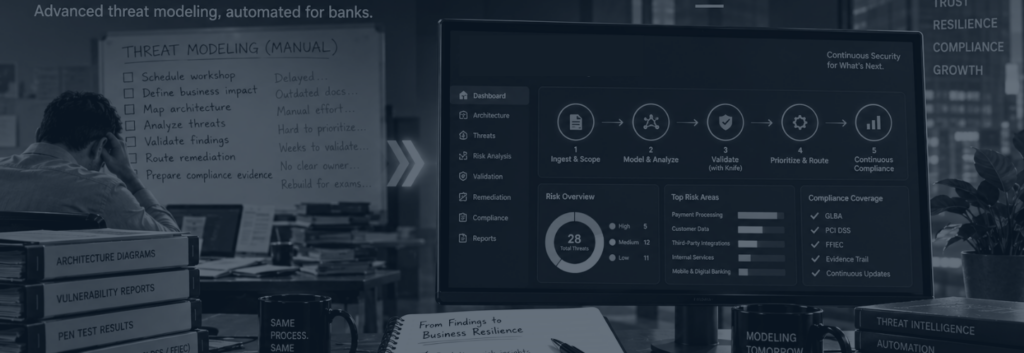
Fork automates that workflow directly. Below is a stage-by-stage look at what the manual version of this process typically looks like inside a bank, and what changes at each stage when it’s automated.
What Makes Threat Modeling “Advanced” Rather Than a Checklist
A checklist-based review, applying a fixed category list like STRIDE uniformly across every component, produces a comprehensive inventory of theoretical threats. It doesn’t produce a ranking of which of those threats an attacker would actually pursue, because a category list carries no inherent connection to business consequence. Advanced threat modeling closes that gap by starting from business objectives and technical scope before any component-level analysis begins; the structure PASTA (Process for Attack Simulation and Threat Analysis) is built around, so that every finding downstream inherits a business-relevance filter a checklist doesn’t provide on its own.
The Manual Bank Threat Modeling Workflow, Stage by Stage
A typical manual workflow for a financial institution runs through a familiar sequence, and each stage has a familiar failure point.
Intake and scoping usually means scheduling a workshop, which competes for calendar time against release deadlines and often slips by weeks. Business impact definition depends on getting a specific, substantive answer from a business stakeholder rather than a generic risk statement, which is harder to get in a one-hour meeting than the process assumes. Decomposition, mapping components, data flows, and trust boundaries, is only as accurate as the architecture documentation feeding it, which is frequently stale in a fast-moving environment. Threat and vulnerability analysis typically means cross-referencing scanner output against a generic severity scale manually, without a live connection to current threat intelligence. Attack validation, confirming a theoretical finding is actually exploitable, usually requires scoping a separate penetration test, often weeks removed from the original review. Remediation routing frequently means a finding lands in a shared queue rather than with a specific accountable owner. Compliance evidence, mapping findings to GLBA, PCI DSS, or FFIEC expectations, gets reconstructed by hand before each exam rather than existing continuously.
The Same Workflow, Automated With Fork
Fork is built around the same sequence, with each stage’s manual failure point addressed directly rather than papered over with faster tooling.
Intake and scoping happen without a scheduling bottleneck: Fork is built to produce a risk-centric threat model in under two hours, using AI to accelerate the PASTA sequence rather than skip its stages. Decomposition and technical scope stay current because Fork ingests data continuously from SAST, DAST, software composition analysis, SBOM and OVAL feeds, and manual penetration test findings, rather than relying on a single point-in-time architecture review. Threat and vulnerability analysis draws on live threat intelligence and full-stack vulnerability data, with dynamic residual risk scoring that recalculates automatically as new findings and intelligence arrive, so prioritization reflects current exposure rather than a static score. Attack validation happens without a separate engagement cycle: Fork’s integration with Knife, VerSprite’s AI-led, human-on-the-loop adversarial testing platform, lets a team request on-demand testing of a specific finding directly from the model, with results feeding back automatically into the residual risk score. Remediation routing and compliance evidence follow from the same continuous correlation; findings tied to business impact from the start produce an evidence trail as a byproduct of ongoing use, rather than a separate reconstruction project before each exam cycle.
Why This Matters Specifically for Banks
The manual workflow’s weakest points- stale scoping, disconnected validation, ad hoc remediation ownership- are also the points examiners scrutinize most directly under GLBA, PCI DSS, and FFIEC guidance. A workflow that closes those gaps continuously produces the evidence an examiner needs as a matter of course, which is a meaningfully different position than reconstructing that evidence under deadline pressure every cycle. For institutions managing a large application portfolio, the same automation is what makes advanced, risk-based threat modeling achievable across every system that needs it, not just the flagship applications that get manual attention first.
Getting Started
Fork is available as a free Community edition supporting a single application threat model with SBOM- or OVAL-based vulnerability ingestion, a reasonable way to evaluate the workflow against one system first. Fork Enterprise extends the same workflow across unlimited applications and teams, with SSO, access controls, and audit logging that a regulated institution needs to run this as a portfolio-wide program. Fork Enterprise PT adds on-demand adversarial testing through Knife and VerSprite’s BREAKERS offensive security team, for institutions that want validated risk, not just modeled risk. Institutions that want the same PASTA-based methodology delivered as expert-led engagement rather than a self-service platform can find that through VerSprite’s Threat Modeling as a Service offering instead.
