Manual vs. Advanced Threat Modeling: Why Bank Risk Decisions Slow Down
Date
Authors
Tony UcedaVélez
Follow Us


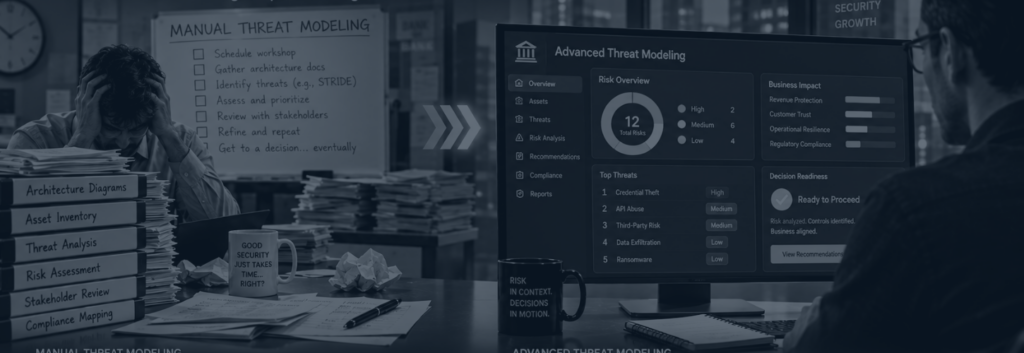
Manual threat modeling doesn’t just take time to produce. It sits on the critical path of a real business decision, a product launch, a cloud migration, a new vendor integration, and every day it takes to complete is a day that decision waits. Advanced threat modeling, in the sense of moving beyond a basic security checklist, means more than a more thorough review. It means a process built to run at the speed the decision it’s informing actually requires, which for most financial institutions today is faster than a scheduled workshop can deliver.
This piece looks at why that speed gap exists, using current data on deployment cadence and exploitation timelines, and what closing it structurally requires.
The Real Cost Isn’t the Review. It’s the Decision It Delays
A threat model that takes three weeks to complete is often treated as a three-week cost. In practice, the more relevant cost is whatever business decision was waiting on it: a new digital banking feature held from release, a cloud migration paused pending review, a fintech partnership integration stalled while security signs off. Financial institutions operate in a competitive environment where a delayed launch has a real opportunity cost, and a threat modeling process built around a workshop calendar rather than the pace of the business it serves becomes a bottleneck the business feels directly, not just a security team’s internal scheduling problem.
How Fast Everything Else Is Moving
The gap between manual review cadence and actual business cadence is measurable. DORA’s Accelerate State of DevOps research classifies software delivery performance into tiers with deployment frequency spanning roughly two orders of magnitude: elite performers deploy on demand, often multiple times a day, while lower-performing teams deploy monthly to every six months.
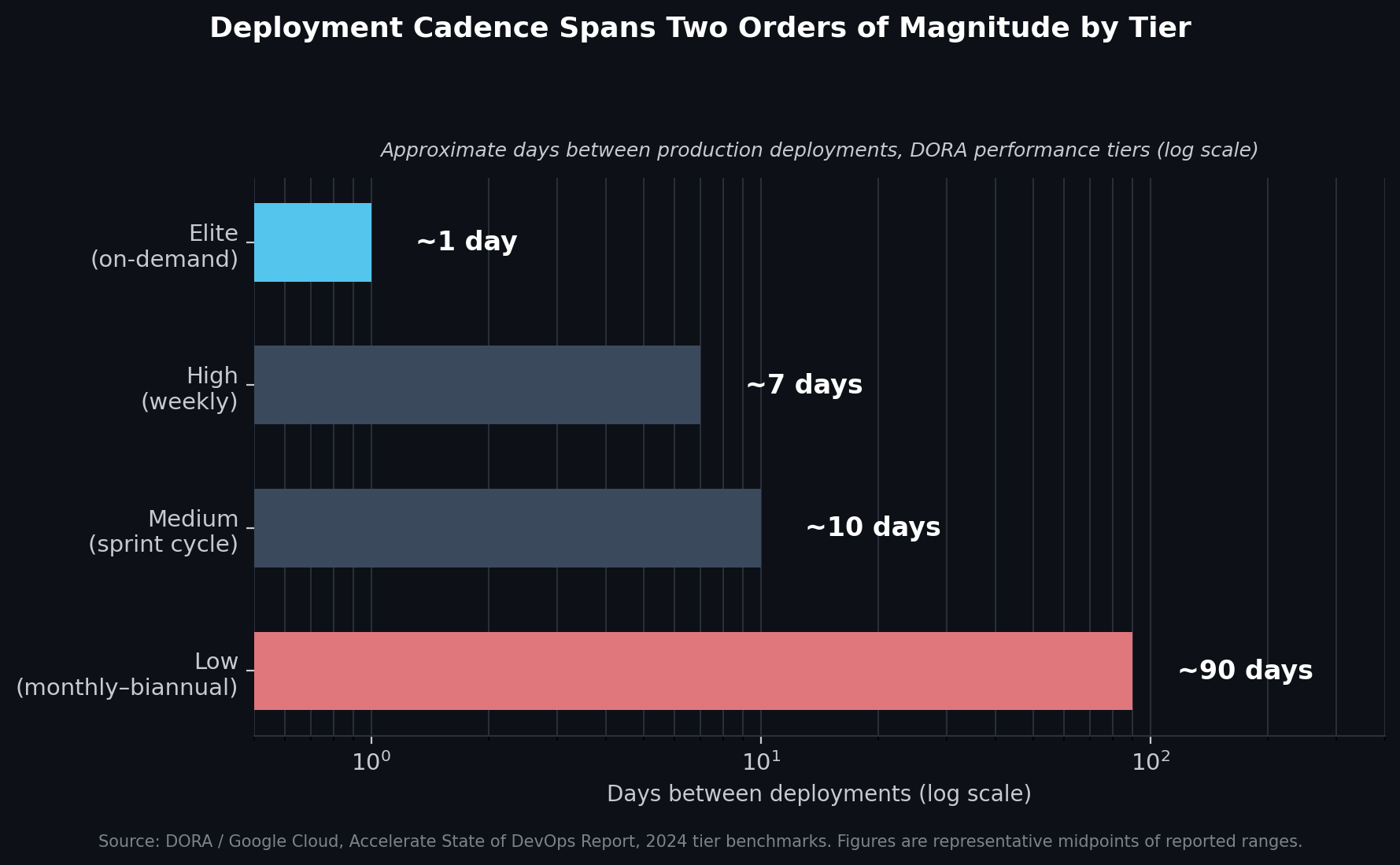
A threat modeling process anchored to a sprint boundary, roughly a one-to-two-week cadence, is a reasonable match for a mid-tier team. It is a significant mismatch for an institution deploying daily, where the system a review describes may have changed substantially by the time the review is finished. At the same time, the cost of being slow has risen on the other side of the equation: research on vulnerability exploitation timing found the median time between disclosure and active exploitation has fallen from roughly 63 days to about 5 days.
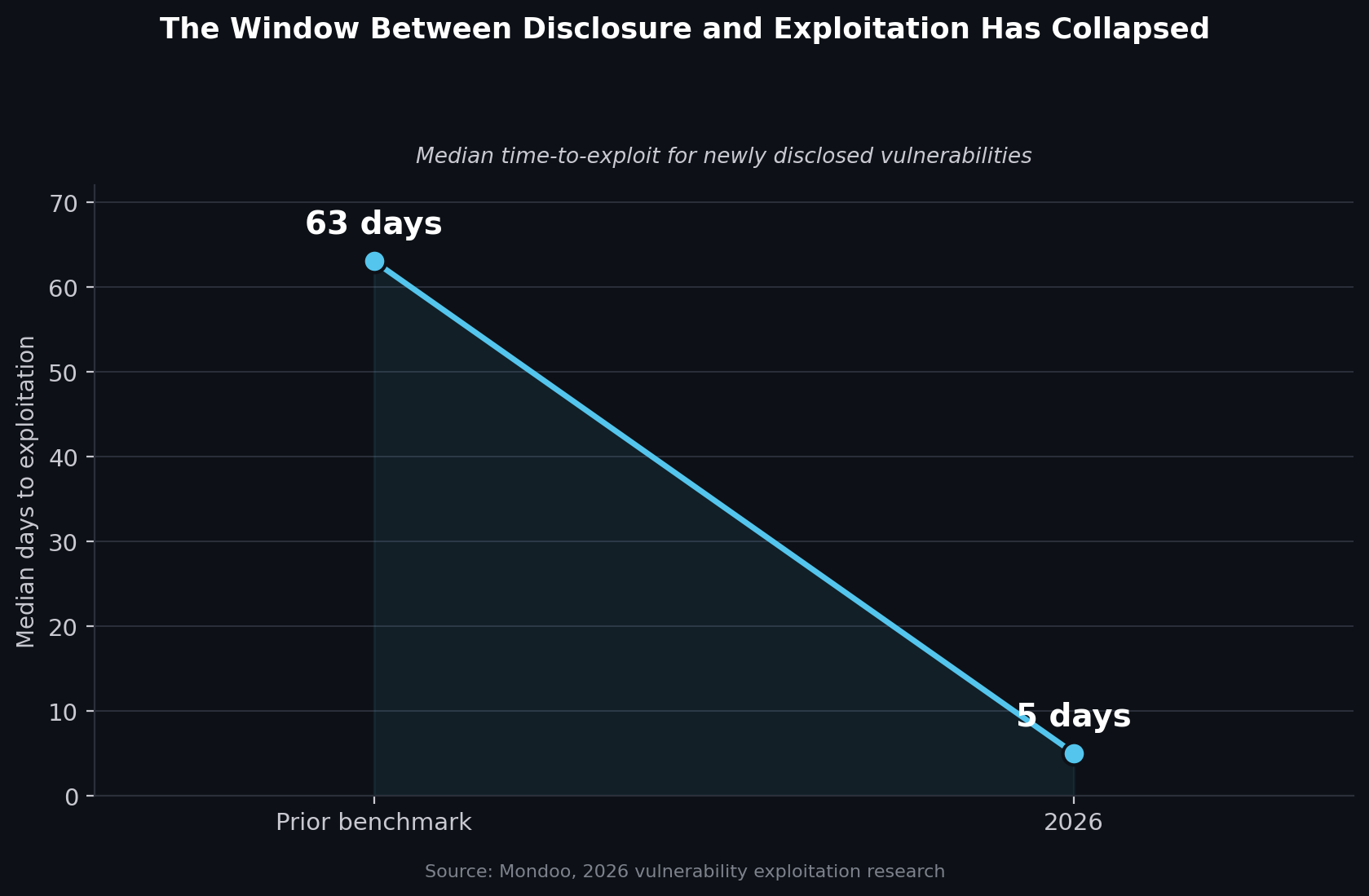
Both trends point the same direction. The window in which a slow risk decision was merely inefficient, rather than actively dangerous, has been closing from both ends: businesses need decisions faster, and the consequences of a wrong or delayed decision arrive faster too.
What “Advanced” Actually Means Here, Beyond a Faster Checklist
A checklist-based review applied more quickly is not the same thing as advanced threat modeling. Running STRIDE categories against a diagram in two days instead of two weeks still produces an inventory of theoretical threats with no inherent connection to which ones matter to the business, just a faster inventory. Advanced threat modeling, in the risk-centric sense associated with methodologies like PASTA (Process for Attack Simulation and Threat Analysis), ties findings to business objectives and technical scope before component-level analysis begins, so the speed gain isn’t just faster output; it’s output that’s already ranked by consequence rather than requiring a separate translation step before a decision-maker can act on it.
This distinction matters specifically for decision speed. A fast but unranked list of findings still requires someone to figure out which ones actually matter before a go or no-go decision can be made, which reintroduces the delay the speed improvement was supposed to remove.
Why Manual Processes Can’t Close This Gap Structurally
The bottleneck in manual threat modeling isn’t usually the analysis itself; a skilled analyst can reason carefully about a system in a reasonable amount of time. The bottleneck is coordination: scheduling a workshop with the right stakeholders, waiting for a specific, substantive answer about business impact rather than a generic risk statement, and working from architecture documentation that’s often already stale by the time the workshop happens. None of these delays scale down as an institution’s deployment frequency scales up. A team shipping daily generates new coordination overhead daily if the review process depends on a human-scheduled meeting for every material change.
What Changes When Risk Analysis Runs Continuously
Closing this gap requires two things together, not either one alone. Automation addresses the coordination bottleneck by removing the dependency on scheduling a discrete workshop for every change, allowing analysis to run continuously against a system as it evolves rather than periodically against a snapshot. A consistent, risk-based scoring methodology addresses the ranking problem, ensuring that faster output is still weighed against business consequence rather than generic severity. Automating the first without the second produces a faster stream of unranked findings, which doesn’t actually shorten the decision delay this piece opened with; it just moves the bottleneck from “waiting for the review” to “waiting for someone to figure out what the review means.”
Limitations and Open Questions
This argument has specific limits worth naming. First, deployment cadence and threat modeling cadence are related but not identical; the DORA data in Figure 1 measures how fast systems change, which is a reasonable proxy for how fast a threat model needs updating, but no dataset cited here directly measures actual threat modeling review cycles against actual deployment frequency at the same institutions. Second, threat modeling delay is one contributor to slow business decisions among several; legal review, procurement, and change management processes also introduce delay, and this piece does not have data isolating threat modeling’s specific share of total decision latency at a typical financial institution. Third, faster risk analysis reduces one source of decision delay but does not by itself guarantee better decisions; speed and judgment quality are separate variables, and this piece’s argument concerns the former specifically.
Conclusion
Manual threat modeling slows bank risk decisions for a structural reason, not a process-quality one: its coordination overhead doesn’t scale down as deployment frequency scales up, while the cost of a slow or wrong decision has been rising as exploitation timelines compress. Advanced threat modeling addresses this by combining continuous analysis, which removes the scheduling bottleneck, with a consistent risk-based methodology, which ensures faster output is still ranked by business consequence rather than shifting the delay from the review itself to interpreting what the review found.
Frequently Asked Questions
Share
- /
- /
- /
- /
- /
- /
- /
- /
- /
- /
- /
- /
- /
- /
- /
- /
- /
- /
- /
- /
- /
- /