How to Replace Manual Threat Modeling for Financial Institutions
A Banking Migration Playbook
Date
Authors
Tony UcedaVélez
Follow Us


Deciding to move on from manual threat modeling for financial institutions is the easy part. Most CISOs and risk managers reach that conclusion on their own, usually after the third time a workshop-based review missed a change that shipped between review cycles. The hard part is the migration itself — and that’s where most attempts either stall out or quietly revert to the old process six months in.
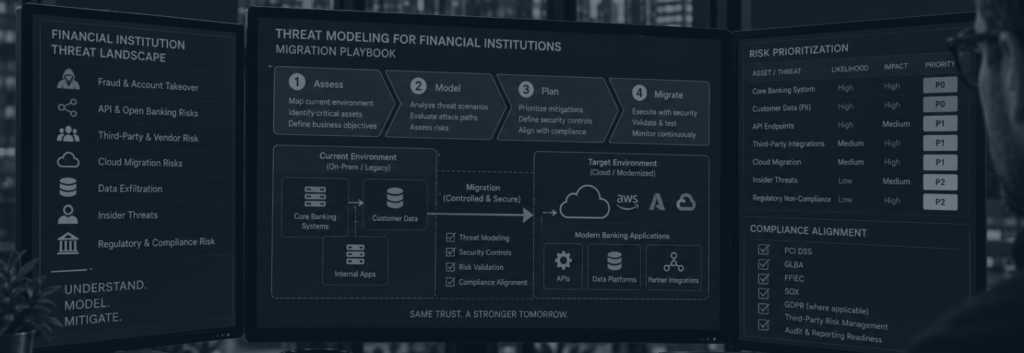
This is a practical playbook for that migration: not another list of reasons manual threat modeling for financial institutions falls short, but a phase-by-phase guide for what actually needs to happen to replace it with something that scales, stays consistent, and produces remediation guidance the business will act on. If you’re looking for the underlying case for why manual processes break down, our related piece on automated threat modeling for financial institutions covers that in depth. This one assumes you’re past that question and focused on execution.
Why This Is a Migration, Not a Tooling Swap
The most common failure mode in this transition is treating it as a procurement decision: buy a platform, point it at the application portfolio, done. That approach almost always underperforms, because manual threat modeling for financial institutions isn’t just a technique — it’s a set of habits, ownership assumptions, and compliance workflows built up over years. Replacing it means changing how security, engineering, and compliance teams work together, not just changing which tool produces the report.
Phase 1: Assess Where Manual Threat Modeling Actually Stands Today
Before automating anything, inventory what currently exists: which applications have a threat model at all, how old each one is, and which high-risk systems — fraud detection, payment processing, core banking APIs — have gone the longest without a review. This assessment routinely surfaces an uncomfortable but useful fact: the systems with the highest actual financial exposure are often the ones with the stalest threat models, because they’re also the most complex to review manually.
Phase 2: Define the Risk-Based Methodology Before Selecting a Platform
This is the step most institutions skip, and it’s the one that determines whether the rest of the migration succeeds. Selecting automation tooling before agreeing on how risk gets scored just automates inconsistency instead of fixing it. Define the methodology first — VerSprite’s practice is built on PASTA, which ties every finding to business objectives and quantified impact — so that whatever platform gets selected in Phase 5 is executing a methodology you’ve already agreed on, not inventing one for you.
Phase 3: Pilot on One High-Value System, Not the Whole Portfolio
Pick a single system where the stakes are real but the blast radius of a rough first attempt is contained — a customer-facing payments API is often a good choice, since it’s business-critical enough to get organizational attention but scoped enough to run as a genuine pilot. Use this phase to validate that risk scoring is producing consistent, defensible results and that findings are specific enough for an engineering team to act on. A pilot that only proves the tool works isn’t enough; it needs to prove the new process produces better decisions than the old one did.
Phase 4: Secure Cross-Functional Buy-In Before You Scale
This is where most of the real security process challenges show up, and they’re rarely technical. Development teams often experience a new threat modeling requirement as friction added to their release process, and compliance teams may be skeptical that an automated approach satisfies the same scrutiny a manual review did. Address both directly: embed findings into the workflows engineering teams already use — Jira, ServiceNow, existing sprint planning — rather than a separate portal they have to remember to check, and involve compliance stakeholders early enough that they’re validating the new evidence trail before it’s presented as a fait accompli.
Phase 5: Select and Integrate Automation Tooling
With methodology defined and a pilot validated, platform selection becomes a much narrower decision. Evaluate candidates against: whether they maintain a continuously updated model rather than a static snapshot, whether they map findings to recognized frameworks like MITRE ATT&CK and OWASP ASVS automatically, and whether they integrate with the ticketing and development tools your teams already use. Fork is built around exactly this integration model — unifying code, runtime, and business context so the threat model updates as the environment changes, rather than requiring a new manual review to catch up.
Phase 6: Map Automated Findings to Regulatory Requirements From Day One
Don’t treat regulatory mapping as a step that happens after the technical migration is complete. Build the connection between findings and GLBA, PCI DSS, and FFIEC requirements into the automated workflow from the start, so the evidence an examiner will eventually ask for is a natural output of the program rather than a separate reconstruction project every time an exam cycle approaches.
Phase 7: Scale Across the Portfolio and Set a Hard Sunset Date
Expand from the pilot outward, prioritizing by business criticality rather than convenience — the highest-risk systems should be migrated next, not the easiest ones. Just as important: set an explicit date after which the old manual, workshop-based process is retired for good. Without a hard sunset, teams under deadline pressure will quietly fall back to the familiar process for “just this one system,” and the migration never fully completes.
Phase 8: Measure Success With Metrics That Reflect Risk Reduction
Track coverage (percentage of the portfolio with a current threat model), time-to-remediate for high-priority findings, and the trend in residual risk score over time — not the raw number of findings generated, which rewards volume over actual risk reduction. A successful migration should show fewer high-severity findings surviving past a defined SLA, not more findings overall.
Security Process Challenges to Plan For
A few specific friction points show up often enough in this migration to plan for in advance:
- Executive sponsorship gaps. Without visible support from a CISO or risk committee, the migration reads as an IT initiative rather than a risk management priority, and it loses momentum the first time it competes with another project for resources.
- Portfolio scope creep. Attempting to convert every application simultaneously, rather than sequencing by risk, overwhelms both the security team and the platform’s initial configuration.
- Ownership ambiguity. If findings don’t route to a specific, accountable owner with a tracked deadline, automation just produces a faster stream of unaddressed reports instead of actual remediation.
- Compliance skepticism. Auditors and examiners who are used to a specific manual deliverable format may need direct engagement to understand how the new evidence trail satisfies the same requirements — this is a conversation worth having proactively, not after the first exam under the new model.
