Threat Modeling as a Service for Apps, APIs, and Cloud
Date
Authors
Tony UcedaVélez
Follow Us


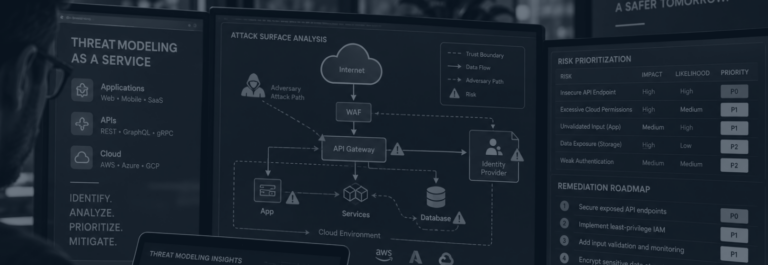
Threat modeling as a service gives enterprise security teams a risk-based, on-demand way to secure applications, APIs, and cloud-native systems at the design stage — before architecture decisions get locked into code that’s expensive to change later. For security leaders in healthcare, government, financial services, and other regulated organizations, that timing matters as much as the analysis itself: a threat identified in a design review costs a conversation. The same threat found in production costs a remediation sprint, and sometimes an incident report.
Below is a practical look at what threat modeling as a service actually needs to cover across applications, APIs, and cloud infrastructure, and what a real security design review looks like when it’s done as a risk-based discipline instead of a documentation exercise.
What Threat Modeling as a Service Covers
Enterprise environments rarely fail at just one layer. A payment application’s real exposure might run through its API authorization logic and a misconfigured cloud storage bucket at the same time — which is why threat modeling as a service has to cover all three layers together, not as separate, disconnected reviews.
Securing Applications: Threat Modeling at the Design Stage
Application-layer threat modeling identifies trust boundaries, data flows, and abuse cases before a single line of code reflects a design decision. Actionable design review guidance at this layer typically covers:
- Mapping trust boundaries between components — where does data cross from an authenticated to an unauthenticated context, and is that boundary actually enforced in the design?
- Reviewing authentication and session design for business logic abuse, not just textbook vulnerability classes
- Identifying abuse cases specific to the application’s actual function — a lending platform and an internal reporting tool have different threat profiles even on similar tech stacks
- Flagging design decisions that would be expensive to reverse after implementation, so they get revisited now instead of after a penetration test finds them
Securing APIs: Where Modern Attack Surface Concentrates
APIs are frequently where the actual attack surface concentrates in a modern enterprise, since they connect internal systems, third-party partners, and customer-facing applications with far less scrutiny than the applications sitting on either end. Threat modeling as a service applied to APIs should address:
- Authorization enforcement at the endpoint level, not just authentication at the gateway
- Rate limiting and abuse-case modeling for business logic exploitation, not only technical injection classes
- Trust review for third-party and partner API integrations, where the weakest link is often outside the organization’s direct control
- Exposure from versioning and deprecated endpoints that were never fully decommissioned
Securing Cloud-Native Systems: Shared Responsibility and Configuration Risk
Cloud environments introduce a category of risk that traditional application threat modeling doesn’t fully capture: shared responsibility gaps, identity sprawl, and configuration drift. VerSprite’s cloud security practice applies a threat modeling approach specifically to establish trust boundaries across cloud components before authentication and access controls are designed, rather than bolting them on after deployment. That includes:
- Identity and access management modeled around least privilege, not default permissions
- Trust boundaries across containers, orchestration layers, and serverless event triggers
- Multi-cloud consistency, since the same control implemented differently across AWS, Azure, and GCP creates its own risk
- Ongoing configuration drift, which is a design problem as much as an operational one — the design has to anticipate that infrastructure will change
What a Risk-Based Security Design Review Actually Looks Like
Security design reviews get a bad reputation because so many of them are checklist exercises: a form, a rubber stamp, a meeting nobody remembers a month later. A risk-based design review, delivered as threat modeling as a service, follows a different sequence:
- Start with business objectives, not architecture. Before touching a diagram, define what the system needs to protect and what “unacceptable outcome” actually means for this specific application, API, or cloud workload.
- Decompose the system and map trust boundaries. Break the architecture into components and identify exactly where trust is assumed rather than verified.
- Correlate real threat intelligence against the specific environment. Generic threat categories are a starting point, not an answer — the review has to ask which threats are actually plausible against this system.
- Validate findings against exploitability, not theoretical severity. A finding that’s plausible in principle but not reachable in practice shouldn’t consume the same remediation budget as one that is.
- Rank findings by business impact and hand off actionable guidance. The output should be specific enough to become a design change or a backlog ticket, not a PDF that requires a second meeting just to translate it into action.
This is the same underlying discipline as PASTA (Process for Attack Simulation and Threat Analysis), the risk-centric methodology VerSprite’s CEO co-created, applied specifically at the design review stage rather than after an application, API, or cloud workload is already built.
Why a Risk-Based Approach Beats a Compliance Checklist
A checklist tells you whether a control exists. It doesn’t tell you whether that control matters against a plausible attack path in your specific environment, or whether a “compliant” design still leaves a business-critical workflow exposed. For enterprise security leaders managing compliance and risk management obligations alongside real security outcomes, that distinction determines whether an audit and an actual risk reduction program are the same activity or two separate ones.
This is precisely why threat modeling as a service is structured around business impact from the start: the compliance evidence a regulated organization needs — for HIPAA, FISMA, FedRAMP, PCI DSS, or SOC 2 — becomes a natural byproduct of a design review that was already prioritizing real risk, instead of a separate translation exercise layered on top of it.
Threat Modeling Platforms: Scaling Design Reviews Across a Portfolio
A single design review is manageable with a workshop and a whiteboard. A portfolio of dozens or hundreds of applications, APIs, and cloud services is not — which is where threat modeling platforms become the difference between a program and a one-off engagement. Platform tooling correlates business context, threat intelligence, and vulnerability data automatically, and for organizations that need coverage to stay current as systems change, Fork extends the same PASTA-based methodology into a continuously updated model rather than a point-in-time snapshot.
How This Applies Across Regulated Industries
The same layered approach — applications, APIs, cloud — applies whether the organization is a healthcare system protecting patient portals and connected medical devices, a government agency securing citizen-facing systems under FedRAMP, or a financial institution protecting payment infrastructure and APIs. What changes between sectors is the compliance framework and the specific consequence of failure — not the underlying discipline of threat modeling as a service applied consistently at the design stage.
