How Advanced Threat Modeling Helps CISOs Prioritize AI, Cloud & Third-Party Risk in 2026
Compliance tells you how a control operated during the assessment period. It does not tell you whether that control still looks the same today.
Date
Authors
Germán Miotti
Follow Us


Consider the following scenario: your company received its SOC 2 Type II report on a Friday, with no exceptions noted, with a twelve-month review period.
The following Tuesday, a misconfigured S3 bucket exposed customer records.
Both things were true at the same time. The report was accurate, and simultaneously, the breach was real. That is not a flaw in the audit. It is exactly what an audit is: a record of the past. The problem is when organizations treat that record as a current description of their security posture and lose sight of what the audit is supposed to be: a snapshot, not a status.
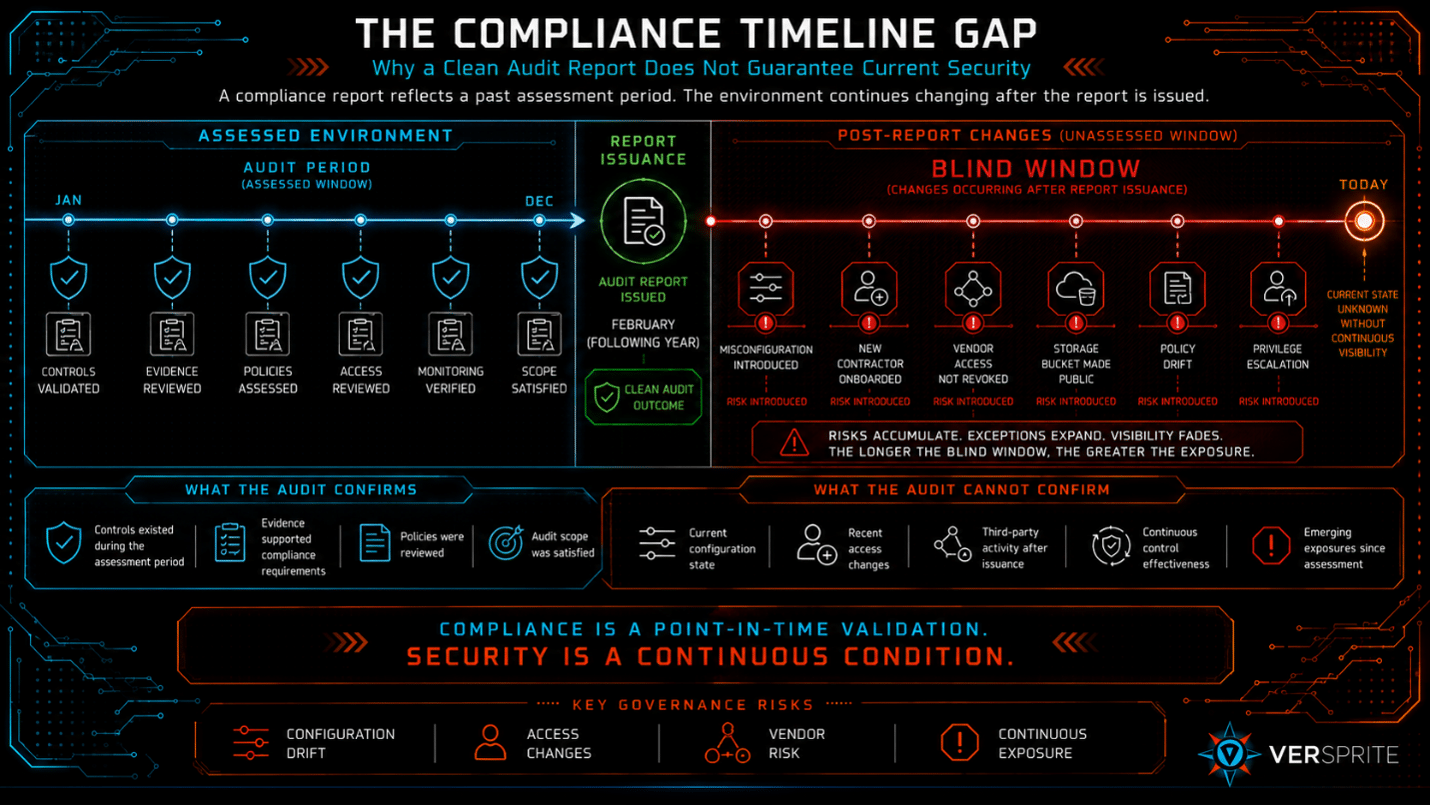
A SOC 2 report is not a real-time measure of security. It confirms that defined controls operated during a past review period. Continuous controls monitoring helps organizations verify whether those controls are still working today and identify configuration, access, and process drift between audits.
Key Takeaways
- The strongest integrated risk management programs report compliance posture and current security posture as two distinct data points.
- Continuous controls monitoring turns live control data into evidence that supports audit readiness, board reporting, and incident response.
- Control drift can emerge immediately after an audit through access changes, cloud misconfigurations, unapproved deployments, and third-party access.
- SOC 2, PCI DSS, and ISO 27001 provide point-in-time or period-based assurance, not proof of current security posture.
What These Frameworks Actually Measure
SOC 2, PCI DSS, and ISO 27001 should not be mistaken for proof of current security posture. They provide assurance that specific controls were assessed against defined criteria during a particular period in time. The distinction matters.
A SOC 2 Type II opinion covers twelve months of control operation. The auditor reviews evidence: access logs, change tickets, configuration screenshots, policy acknowledgments. They assess whether the evidence supports the stated control objectives. They do not assess what your environment looks like today. They cannot. The engagement ended weeks before the report was signed.
PCI DSS operates similarly. The standard requires periodic risk analyses and ongoing security governance activities, but compliance assessments occur at defined intervals. A merchant that achieves PCI DSS compliance in March and introduces a network segmentation gap in July can carry both facts simultaneously. The assessment accurately reflected the environment at the time it was performed. It does not describe what changed afterward.
ISO 27001 builds a management system framework. Clause 9.1 requires organizations to monitor, measure, and evaluate information security performance, but the standard specifies neither the frequency nor the tooling. The how is left to the organization. Many fill that gap with spreadsheets and annual reviews, which satisfy the auditor and tell you nothing about drift.
None of this is a criticism of the frameworks. They accomplish what they were designed to accomplish: establishing a documented, auditable baseline. What they do not do is tell you whether that baseline is holding right now.
The Evidence Collection Problem
The deeper issue is how most organizations generate audit evidence. A control that exists in a policy document needs to be operating in production. Those two things are not the same, and the gap between them is where drift happens.
Consider access governance, which sits at the center of nearly every compliance framework. SOC 2 criterion CC6.2 requires that access to systems is provisioned and deprovisioned appropriately. In practice, most organizations demonstrate this through quarterly or semi-annual access review reports, pulled from an identity provider or exported from an IAM tool. The auditor sees the report. The audit process is not designed to continuously monitor the service account created six weeks ago for a contractor who left three weeks ago and never had access removed.
That account does not appear in the quarterly report because the report was generated before the contractor departed. The control passed. The gap exists. Both are true.
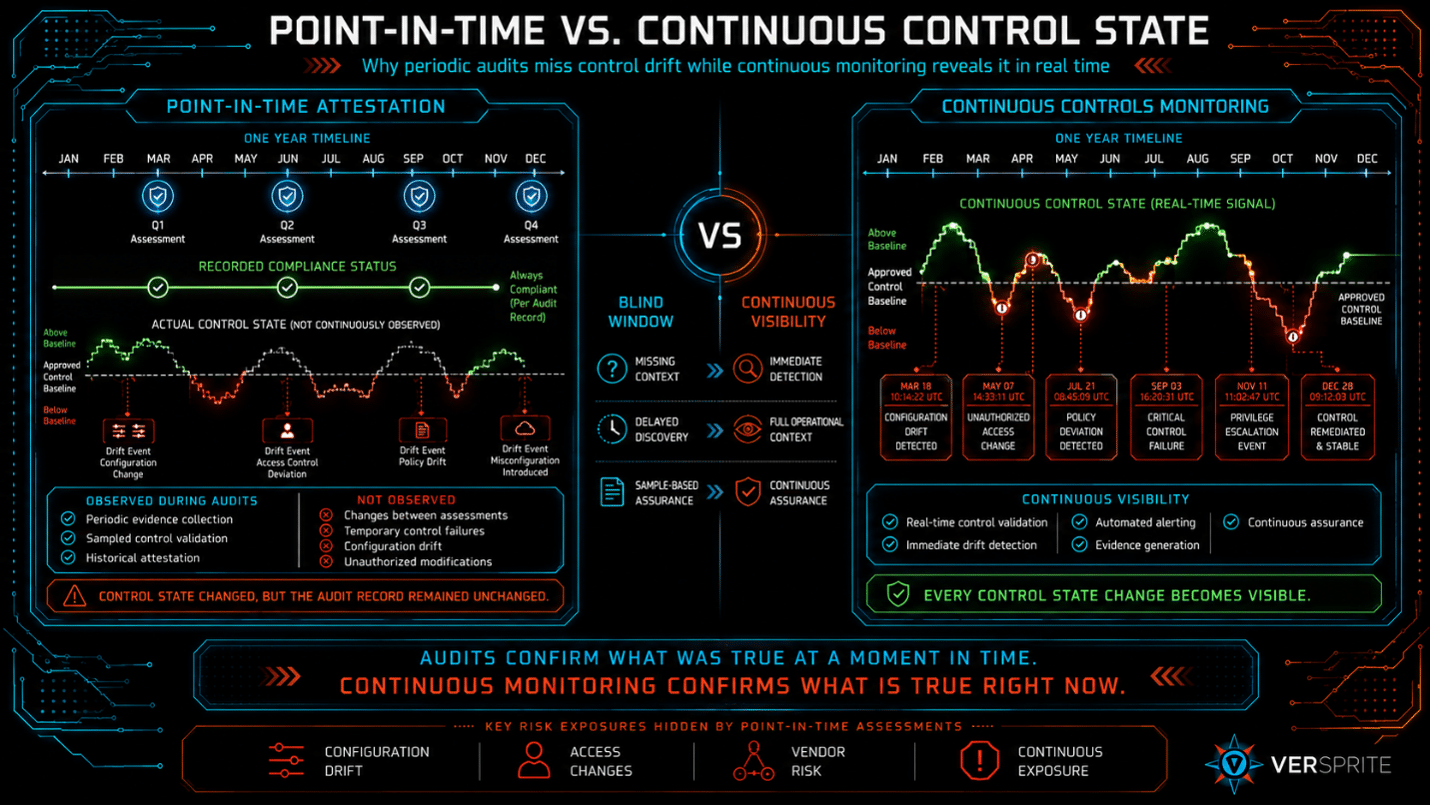
This is the evidence collection problem in its cleanest form. Point-in-time attestation captures a sample of the environment at a specific moment. It does not detect drift. The further you get from the last evidence collection date, the less the evidence reflects the actual state of the environment. A quarterly access review conducted in January describes January. It says nothing about March.
The same dynamic plays out across control families. Change management evidence is pulled from ticketing systems at audit time, but production deployments outside approved windows happen between pulls. Configuration baseline evidence is captured from a CSPM scan during the audit window, but new workloads spun up after that scan carry no such review. Vendor access records show the approved list as of the last review date, not as of today.
Some organizations understand this. Most do not act on it until after an incident.
Why Passing an Audit Creates a Risk of Its Own
There is a specific dynamic that plays out inside organizations after a clean audit report lands. The program team is relieved. Leadership asks a question they should not need to ask (“Are we secure?”) and the compliance team gives an answer they should not be giving: we passed. A status gets updated in a GRC tool somewhere. The organization moves on.
That moment of closure is the risk.
A clean audit report communicates that controls were operating during the review period. It does not mean the threat surface is stable, that no new misconfigurations have been introduced since the audit window closed, or that the access governance that looked fine in March still looks fine in August. Boards and executive teams who conflate compliance status with security posture are not being irrational. They are using the information they have been given. The problem is that the information is four to twelve months old by the time it reaches them.
This is the false sense of closure problem, and it runs through organizations at every level. The CISO who presents the SOC 2 certificate at the board meeting is not lying. They are communicating a documented fact about the recent past while the audience hears a current fact about the present. The gap between those two interpretations is exactly where incidents live.
Security programs that understand this spend as much effort on the period between audits as on the audit itself. They treat the clean report as a baseline, not a destination. Programs that do not make that distinction show up in breach disclosures with a current certification on the wall and a two-year-old network diagram in the incident response packet.
A clean audit report is a record of the past.
Your threat surface is live right now.
What Continuous Control Monitoring Actually Looks Like
Continuous controls monitoring supports ongoing SOC 2 compliance by detecting changes in control effectiveness between formal assessments. It gives security, compliance, and integrated risk management teams a current view of whether key controls remain aligned with approved baselines.
Continuous controls monitoring (CCM) is not a product category. It is an operating model. The difference between point-in-time attestation and CCM is the difference between a quarterly blood pressure reading and a continuous cardiac monitor. One tells you how a single measurement looked on one day. The other tells you what is happening between measurements, which is when most problems actually develop.
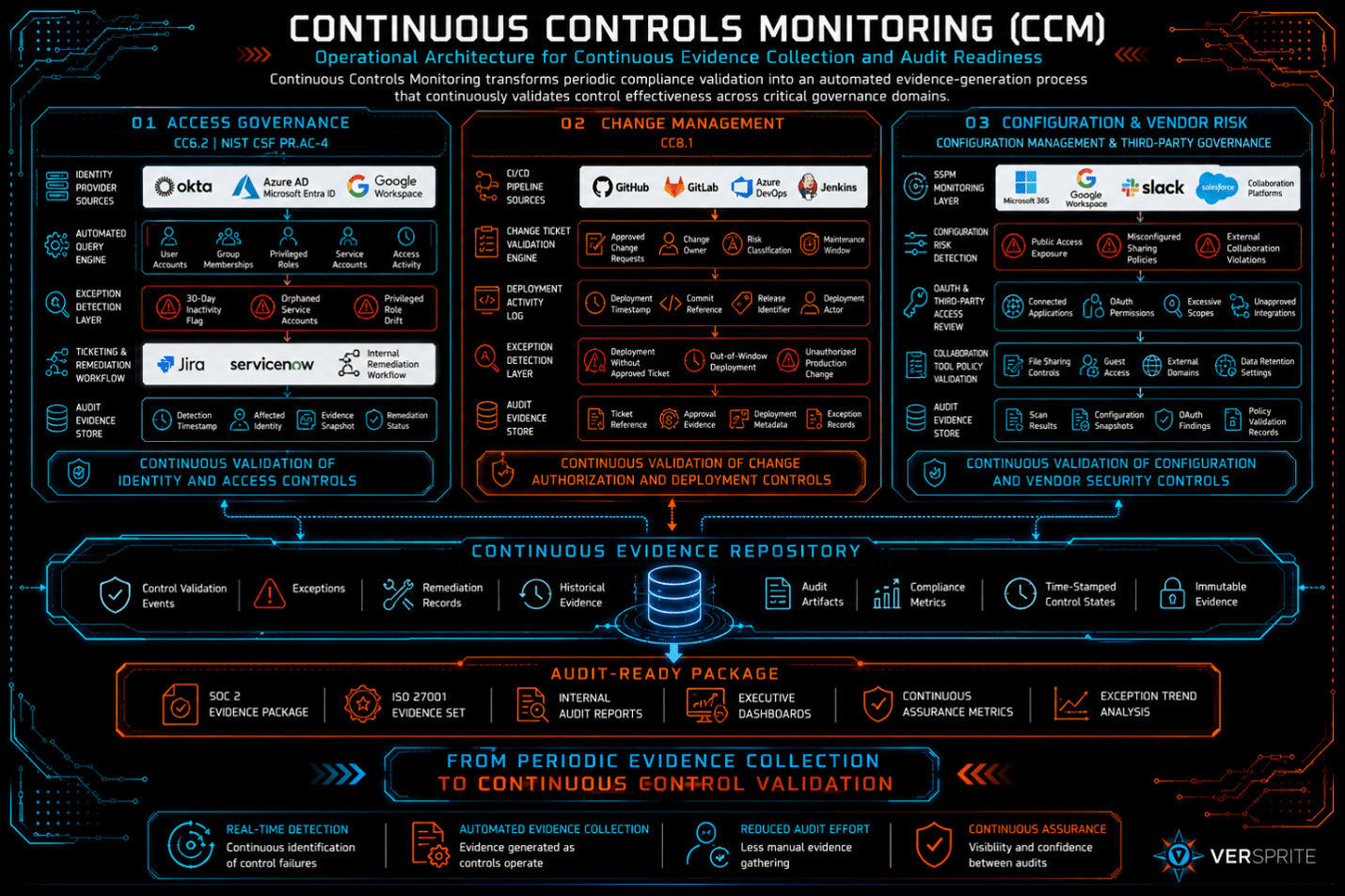
In practice, CCM for an IRM (Integrated Risk Management) program means instrumenting the controls that carry the most audit weight and monitoring them against a defined baseline in something closer to real time. The specific implementation varies by control family.
For access governance (CC6.2 under SOC 2, aligned with NIST CSF 2.0 PR.AA-05), automated queries against identity providers such as Okta, Microsoft Entra ID, or Google Workspace identify inactive accounts, service accounts without designated owners, and privileged access assignments that fall outside approved baselines. These checks run on a defined cadence rather than being pulled manually at audit time. Exceptions are logged and worked to resolution, with the remediation record attached. The monitoring record becomes the audit artifact, not a spreadsheet assembled two weeks before the auditor arrives.
For change management (CC8.1 under SOC 2): CI/CD pipeline telemetry identifies production deployments outside an approved change window. This is not reconstructed from ticket logs six months after the fact. It is captured at deployment time, with the change ticket reference embedded in the pipeline run. If a deployment happens without a ticket, that event is flagged immediately, not discovered during evidence collection.
For configuration and vendor risk: SSPM tooling against your SaaS environment is where the most common surprises live. Storage objects with public access enabled are the obvious one. Less obvious are OAuth applications that a developer authorized six months ago, granted broad scopes, and that nobody has reviewed since. The same logic applies to sharing configurations on collaboration tools. These findings surface before an auditor asks you to explain a breach, not after.
CCM does not replace the audit cycle. SOC 2 reports are contractual requirements for many organizations. ISO 27001 certification is a procurement prerequisite in others. What CCM does is close the gap the audit cycle leaves open. You know what your control state looks like between engagements, not only during them. When the auditor arrives, you have twelve months of continuous monitoring data, not twelve months of silence followed by a two-week evidence sprint.
The Board Conversation You Should Be Having
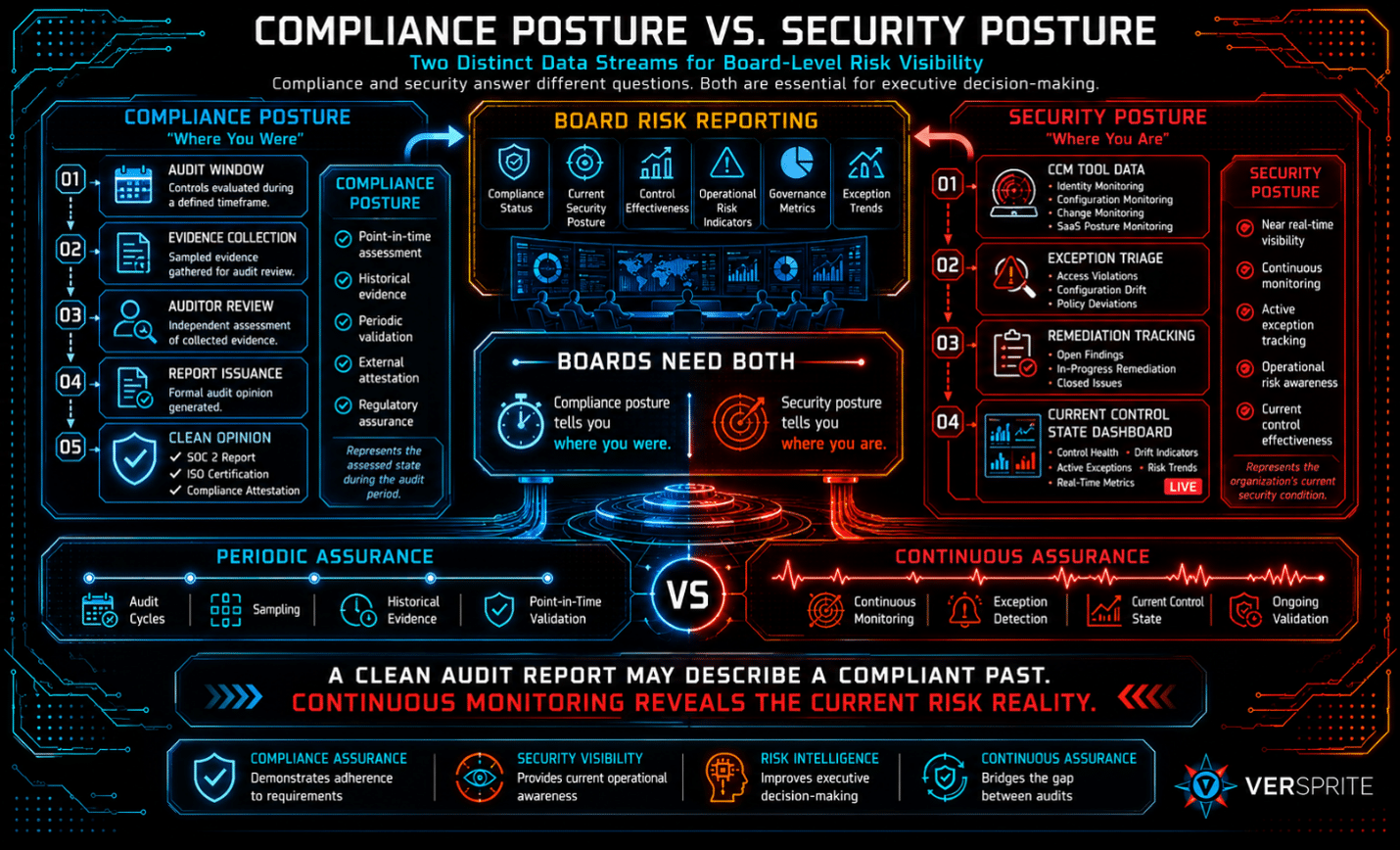
The question board members ask after a clean audit (“Are we secure?”) deserves a more precise answer than the compliance status provides. A useful answer sounds like: our last audit confirmed controls were operating through this period. Our current monitoring shows these specific gaps against that baseline, and we are working on these issues on this timeline.
That answer requires current monitoring data. If the only data you have is the audit report, you cannot have that conversation honestly. You can confirm the past. You cannot speak to the present.
The accountability gap this creates is not theoretical. When an organization suffers a breach and the post-incident review begins, the first question is what the security team knew and when. A compliance team that can produce only a clean audit report from eight months ago is in a different position than one that can show a continuous monitoring record with the relevant control’s status on the day of the incident. Both organizations might have the same breach. Only one can demonstrate that the program was functioning as designed and that the specific failure was a genuine gap, not an ignored signal.
IRM programs that are ahead of this problem have built the infrastructure to clearly distinguish compliance posture (what the last audit covered) from current security posture (what the environment looks like today). Boards that receive both data points make better decisions. They understand what the certification represents and what it does not. They ask better questions. They budget more accurately for the monitoring work that lives between audit cycles.
Boards that receive only the audit report assume the two are the same. They are not. The gap between them is exactly what attackers are looking for.
What the Gap Costs When It Surfaces
The costs of the compliance-posture gap are not hypothetical, and they do not all arrive in the form of a breach. Some of the most damaging ones show up in a conference room during a customer security review, or on a legal call two weeks after an incident, or in a regulatory inquiry where the question is not whether a control existed, but whether it was operating.
Consider the customer audit scenario first, because it is far more common than breaches and rarely discussed in GRC literature. Enterprise customers in regulated industries now routinely request security evidence during procurement and at annual renewal. A SOC 2 Type II report satisfies the initial request. When the customer’s security team follows up with questions about current access governance or asks for evidence that a specific control is operating today, the organization that has only the audit report is in trouble. They can describe what happened twelve months ago. They cannot speak to this quarter.
The regulatory scenario carries more structural risk. Under frameworks like HIPAA, PCI DSS, and several state-level data protection laws, compliance is not a point-in-time event. It is an ongoing obligation. The audit provides evidence for a defined period. A regulator investigating an incident that occurred eight months after a clean audit will ask whether the controls that passed were still operating at the time of the incident. If the only available answer is “We passed last year,” that answer will not satisfy the inquiry. The regulatory question is what you knew about your control state in the period before the incident, not what an auditor concluded about the period before that.
There is also the incident response scenario, which is the one that moves fastest. When a breach is confirmed, the first 72 hours are consumed by containment and notification obligations. The forensic question, what happened and how long has it been happening, comes right behind. Organizations with continuous monitoring can answer that question from their own data. They can show when a configuration drifted, when the anomaly was first visible, what the response timeline looked like. Organizations without it are reconstructing the timeline from incomplete logs and memory. That reconstruction is slower, less precise, and less defensible when regulators or plaintiff attorneys review it later.
Audit readiness, properly understood, is not a sprint that happens once a year before the engagement window opens. It is a continuous state. The organizations that manage it well do not treat the audit as the goal. They treat the audit as a check on a process that is already running. When the auditor asks for evidence, they pull it from a live system rather than assembling it manually. When a customer security team asks about current control status, they can answer the question directly. When an incident occurs, they have a monitoring record that describes the environment in the period before it happened.
The organizations that do not manage it this way have a different experience. Their audit cycles are expensive evidence sprints. Their customer security reviews are exercises in describing the past. Their incident timelines are reconstructions. And their board conversations are built on a compliance status that nobody in the room has actually verified since the auditor left.
Frequently Asked Questions
How long is a SOC 2 report considered current?
A SOC 2 report covers the specific review period stated in the report. Customers may accept a report for a defined period, but the report does not confirm that controls remain unchanged after the assessment window closes.
Does SOC 2 compliance mean an organization is secure?
No. SOC 2 provides assurance that selected controls were designed and operated against defined criteria during the review period. It does not guarantee that the organization is free from vulnerabilities, misconfigurations, control drift, or future incidents.
What is continuous controls monitoring?
Continuous controls monitoring is an operating model that uses automated or frequently scheduled checks to evaluate control status against an approved baseline. It helps identify exceptions in areas such as identity, cloud configuration, change management, and vendor access.
Does continuous controls monitoring replace a SOC 2 audit?
No. Continuous controls monitoring complements the audit process. It provides current evidence between audit cycles and can reduce manual evidence collection when the next assessment begins.
Which controls should organizations monitor first?
Organizations should prioritize controls with high business, regulatory, and security impact. Common starting points include privileged access, account deprovisioning, production changes, public cloud exposure, SaaS configuration, and third-party access.