PASTA vs. Other Threat Modeling Methodologies: Choosing the Right Approach
By Tony UcedaVélez, CEO of VerSprite and Co-Creator of PASTA

Date
Authors
Tony UcedaVélez
Follow Us


Threat modeling is not a competition to determine which acronym wins.
Different methodologies were created to answer different questions. Some help development teams categorize potential security failures. Some help organizations standardize threat modeling across large application portfolios. Others score technical findings, evaluate enterprise risk, or visualize the sequence of actions an attacker may take.
The challenge begins when these approaches are treated as interchangeable.
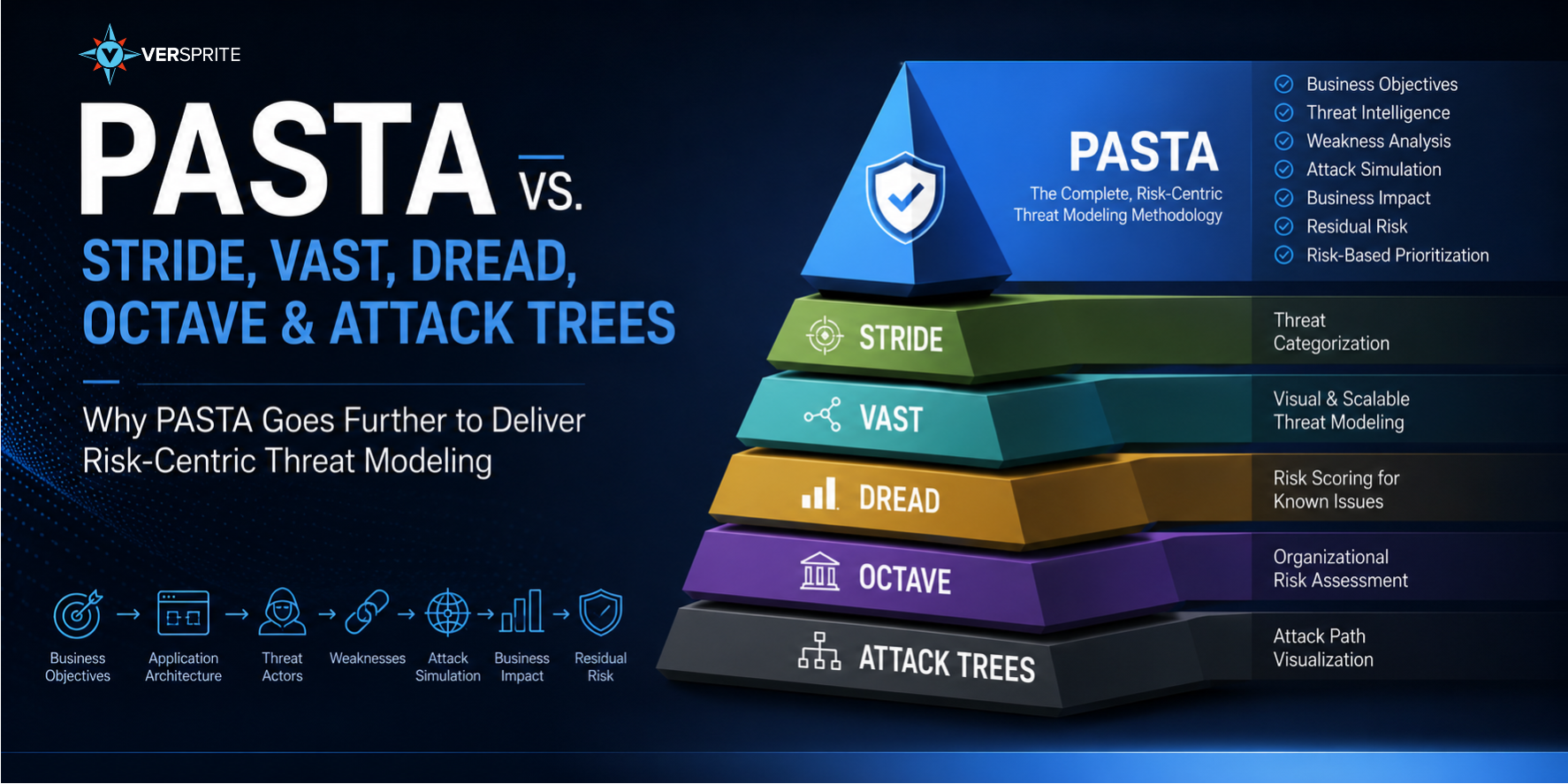
PASTA, STRIDE, VAST, DREAD, OCTAVE, and attack trees can all contribute to security analysis, but they operate at different levels, produce different deliverables, and support different decisions. Selecting the wrong approach can leave a team with a technically accurate list of threats that does not explain which risks matter to the business, which attacks are realistically viable, or where limited remediation resources should be applied.
This guide compares the methodologies and explains where each one fits.
What Is the Difference Between a Threat Model and a Threat Modeling Methodology?
A threat model is the resulting representation of how a system could be attacked, what may be affected, and what should be done about the identified risks.
A threat modeling methodology is the structured process used to produce that model.
OWASP describes threat modeling as a way to identify, communicate, and understand threats and mitigations in the context of protecting something of value. It also recognizes that there is no single correct methodology for every organization or system.
That distinction matters because some of the approaches commonly grouped under “threat modeling methodologies” are more accurately understood as:
- Threat categorization systems
- Risk-ranking models
- Enterprise risk assessment frameworks
- Visualization techniques
- End-to-end application risk methodologies
PASTA is an end-to-end, risk-centric methodology. STRIDE is primarily a threat-classification model. DREAD is a risk-scoring model. Attack trees are a technique for representing attack paths. OCTAVE is oriented toward organizational information security risk. VAST was designed to make threat modeling scalable and repeatable across modern development environments.
Each can be useful, but usefulness depends on the question being asked.
What Is PASTA Threat Modeling?
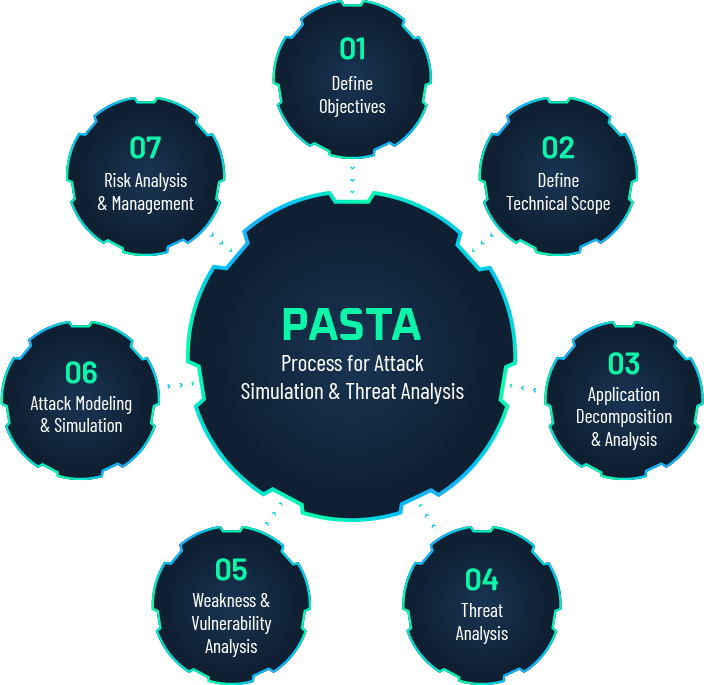
PASTA stands for the Process for Attack Simulation and Threat Analysis.
PASTA is a seven-stage, risk-centric threat modeling methodology that connects application design, technical threats, exploitable weaknesses, attack simulation, and business impact.
I co-created PASTA with Marco M. Morana to address a fundamental limitation in many traditional threat modeling exercises: identifying a theoretical threat does not automatically establish that the threat represents material risk.
A threat becomes relevant when several conditions align:
- The system supports something the organization values
- A credible threat actor has the intent or opportunity to target it
- The application or its environment contains a usable weakness
- A viable attack path connects that weakness to an objective
- Exploitation can produce a meaningful technical or business impact
PASTA evaluates this full chain rather than stopping after threats have been enumerated.
The seven stages are:
Stage 1: Define Objectives
Establish the business objectives, security requirements, risk appetite, compliance obligations, and potential impact associated with the application.
Stage 2: Define the Technical Scope
Identify the technologies, infrastructure, software dependencies, deployment models, APIs, services, and external integrations supporting the application.
Stage 3: Application Decomposition
Map components, data flows, trust boundaries, identities, entry points, privileges, assets, and security controls.
Stage 4: Threat Analysis
Use threat intelligence, industry context, attacker profiles, historical activity, and environmental information to identify credible threat scenarios.
Stage 5: Vulnerability and Weakness Analysis
Determine which design weaknesses, implementation flaws, misconfigurations, and known vulnerabilities could support the identified threats.
Stage 6: Attack Modeling
Construct and evaluate attack paths to determine how an adversary could move from an initial opportunity to a defined objective. Attack trees, attack patterns, adversary techniques, and simulation can all support this stage.
Stage 7: Risk and Impact Analysis
Assess the likelihood and impact of viable attack scenarios, identify residual risk, and prioritize countermeasures according to business consequences.
PASTA uses these stages to connect threat analysis with business objectives, attack simulation, and risk-based remediation.
PASTA vs. STRIDE
STRIDE is one of the most widely recognized threat modeling models. It was developed within Microsoft’s security engineering practices and organizes potential threats into six categories:
- Spoofing: Pretending to be another user, process, or system
- Tampering: Unauthorized modification of data or code
- Repudiation: Denying an action without sufficient evidence to prove otherwise
- Information Disclosure: Exposing information to unauthorized parties
- Denial of Service: Preventing legitimate access to a system or resource
- Elevation of Privilege: Gaining permissions beyond those granted
Microsoft describes STRIDE as a method for systematically identifying categories of security threats during design analysis.
Where STRIDE Works Well
STRIDE gives architects and developers a consistent vocabulary for examining system components and data flows.
It is especially useful when a team needs to ask structured questions such as:
- Can this identity be spoofed?
- Can this data flow be altered?
- Could sensitive information be exposed?
- Could a user or process gain greater privileges?
This makes STRIDE accessible for development teams, architecture reviews, security workshops, and repeatable design analysis.
Where STRIDE Has Limitations
STRIDE identifies categories of things that could go wrong, but it does not independently provide a complete process for determining:
- Which threat actors are relevant
- Whether an attack is realistically viable
- Which weaknesses enable the threat
- What the business impact would be
- Which findings should receive priority
- Whether a proposed countermeasure meaningfully reduces risk
A STRIDE analysis may identify information disclosure as a possibility, for example, but that classification alone does not explain what information is exposed, who would target it, how the attacker would reach it, or what the exposure would cost the organization.
How PASTA and STRIDE Can Work Together
PASTA and STRIDE do not have to be mutually exclusive.
STRIDE can be used as one threat-enumeration technique during PASTA’s application decomposition and threat-analysis stages. PASTA then adds attacker context, weakness correlation, attack modeling, validation, business impact, and risk prioritization.
PASTA vs. VAST
VAST stands for Visual, Agile, and Simple Threat Modeling.
ThreatModeler developed VAST to make threat modeling more scalable, repeatable, and suitable for high-velocity development environments. For a look at how ThreatModeler’s VAST-based platform compares with other options, see ThreatModeler alternatives and Fork vs. ThreatModeler. Its stated objective is to transform threat modeling from a selective or rigid exercise into a sustainable practice that can support many applications and teams.
Where VAST Works Well
VAST focuses heavily on operational scalability.
It is intended to support organizations that need to:
- Model large application portfolios
- Involve developers and infrastructure teams
- Produce repeatable models across multiple environments
- Integrate threat modeling with agile development
- Automate portions of threat identification
- Standardize how diagrams and models are created
VAST is generally associated with two perspectives: application threat models for development teams and operational threat models for infrastructure or platform teams.
How PASTA Differs From VAST
VAST and PASTA address different primary concerns.
VAST asks how threat modeling can become a scalable, visual, and repeatable organizational practice.
PASTA asks how security teams can connect business objectives, credible threats, exploitable weaknesses, attack paths, and business impact to make defensible risk decisions.
A scalable model is not automatically a risk-centric model. Automation can identify common threat patterns quickly, but the result still requires application context, adversary relevance, and business-impact analysis.
PASTA places greater emphasis on:
- Business objectives and asset value
- Industry-specific threat intelligence
- Threat actor motivation and capability
- Vulnerability and weakness correlation
- Attack simulation and validation
- Residual-risk analysis
- Countermeasure prioritization
Can VAST and PASTA Be Combined?
Elements associated with VAST, such as visual modeling, automation, developer participation, and portfolio-level repeatability, can strengthen how an organization operationalizes PASTA.
The methodologies should not be treated as exact substitutes.
VAST is principally concerned with making threat modeling scalable. PASTA is principally concerned with making threat modeling risk-centric and evidence-driven.
PASTA vs. DREAD
DREAD is a risk-rating model traditionally used to score security issues according to five factors:
- Damage Potential
- Reproducibility
- Exploitability
- Affected Users
- Discoverability
Each factor is assigned a value, and the values are combined to create a comparative score.
Microsoft’s earlier threat modeling guidance described DREAD as a way to assess risk at a more granular level, while also acknowledging the subjectivity involved in scoring its factors.
Where DREAD Works Well
DREAD is easy to understand and can help teams create an initial ranking when several technical issues compete for attention.
It may support workshop discussions by forcing participants to consider:
- How damaging an issue could be
- How consistently it can be reproduced
- How difficult exploitation would be
- How broadly users may be affected
- How easily an attacker might find the issue
Why DREAD Is Not a Complete Threat Modeling Methodology
DREAD does not define how to:
- Establish business objectives
- Decompose an application
- Identify threat actors
- Gather threat intelligence
- Discover architecture-level weaknesses
- Build attack paths
- Validate threat viability
- Select appropriate countermeasures
It scores an issue after the issue has been identified. It does not create the complete threat model.
DREAD scores can also imply a level of mathematical precision that the underlying judgments may not support. Two teams can assign different values to the same issue because terms such as “damage” and “discoverability” depend heavily on context.
How PASTA Handles Risk Differently
PASTA does not begin with a generic technical score.
It begins by defining what the application does for the business and what consequences could follow if its security objectives fail. Technical weaknesses are then correlated with credible threats and attack paths before risk is evaluated.
The difference is significant:
DREAD ranks characteristics of an identified issue. PASTA evaluates the risk created by a viable attack scenario within a specific business context.
DREAD may be used as a supplemental scoring technique, but it should not replace threat analysis, attack modeling, or business-impact analysis.
PASTA vs. OCTAVE
OCTAVE stands for Operationally Critical Threat, Asset, and Vulnerability Evaluation.
The Software Engineering Institute developed OCTAVE as an approach for identifying and managing information security risk. It focuses on important organizational information assets, the threats facing those assets, and the vulnerabilities that may expose them.
Where OCTAVE Works Well
OCTAVE is asset-driven and organizationally focused.
It is useful for evaluating:
- Mission-critical information assets
- Enterprise security practices
- Organizational vulnerabilities
- Operational risk
- Security strategy and governance
- Risk-management capabilities
OCTAVE FORTE, a more recent process model, is intended to help executives and decision-makers prioritize complex risks across an enterprise.
How PASTA Differs From OCTAVE
OCTAVE generally operates at an organizational or information-risk level. PASTA is more directly oriented toward applications, supporting technologies, and adversarial attack scenarios.
OCTAVE may determine that a category of customer information is a critical asset and that weak access governance creates organizational risk.
PASTA goes further into the application context by examining:
- Which application components process the information
- How data moves through the system
- Where trust boundaries exist
- Which threat actors would target the information
- Which technical weaknesses support an attack
- How the attack would be executed
- Whether existing controls interrupt the attack path
- What residual risk remains
When to Use OCTAVE and PASTA Together
An organization can use OCTAVE to establish enterprise-level risk priorities and PASTA to perform deeper application-level analysis of the systems supporting those priorities.
For example, OCTAVE may identify payment data as an operationally critical asset. PASTA can then model the payment application, its APIs, third-party services, authentication paths, cloud components, weaknesses, and realistic attack scenarios.
The relationship can be summarized as:
OCTAVE identifies and manages organizational information risk. PASTA models how application-specific attacks can produce that risk.
PASTA vs. Attack Trees
An attack tree is a visual technique for representing how an attacker could achieve a defined objective.
The attacker’s objective is placed at the root of the tree. Branches represent alternative or dependent paths toward that objective, while leaf nodes represent individual actions, conditions, or prerequisites.
Bruce Schneier’s foundational description characterizes attack trees as a formal and methodical way to represent attacks against a system through a hierarchical tree structure.
Where Attack Trees Work Well
Attack trees are valuable for:
- Breaking complex attacks into understandable steps
- Comparing alternative attack paths
- Identifying attack prerequisites
- Visualizing dependencies between attacker actions
- Mapping controls to specific parts of an attack
- Supporting tabletop exercises and adversarial testing
A tree may begin with an objective such as “execute an unauthorized financial transaction” and branch into paths involving account takeover, session theft, API abuse, business-logic manipulation, or insider access.
Why Attack Trees Are Not a Complete Methodology
An attack tree does not independently tell a team:
- Which business objectives should be protected
- Which assets are most important
- Which threat actors should be modeled
- Which technologies are in scope
- Which vulnerabilities exist
- How likelihood and impact should be evaluated
- Which remediation option best aligns with business priorities
The quality of the tree depends on the quality of the context supplied to it.
How PASTA Uses Attack Trees
Attack trees are a natural fit within Stage 6 of PASTA: Attack Modeling.
By the time a PASTA analysis reaches this stage, the team has already established the business objectives, technical scope, application architecture, relevant threats, and supporting weaknesses.
This allows the attack tree to represent something more meaningful than a collection of hypothetical attacker actions. Its paths can be tied to credible actors, known attack patterns, actual application conditions, and defined business impacts.
Attack trees visualize how an attack may occur. PASTA establishes why the scenario matters, whether it is viable, and how the resulting risk should be treated.
Threat Modeling Methodology Comparison
| Approach | Primary Purpose | Typical Scope | Main Output | Business Context | Attack Validation |
|---|---|---|---|---|---|
| PASTA | Risk-centric threat and attack analysis | Applications and supporting environments | Prioritized attack scenarios, risks, and countermeasures | Central to the methodology | Built into attack modeling |
| STRIDE | Categorize potential threats | Components and data flows | Categorized threat list | Limited unless added separately | Not inherently required |
| VAST | Scale threat modeling across teams and systems | Application portfolios and infrastructure | Visual, repeatable threat models | Can be incorporated | Depends on implementation |
| DREAD | Score and rank identified issues | Individual threats or vulnerabilities | Comparative risk score | Simplified within scoring | Not included |
| OCTAVE | Evaluate organizational information security risk | Enterprise assets and operations | Organizational risk profile and mitigation strategy | Central at enterprise level | Limited application-level simulation |
| Attack Trees | Visualize attacker paths to an objective | Individual attack goals or scenarios | Hierarchical attack-path diagram | Must be supplied separately | Can support validation but does not require it |
Which Threat Modeling Methodology Should You Choose?
The right choice depends on the decision your organization needs to make.
Use PASTA When:
- Security decisions must be connected to business impact
- The organization needs to distinguish credible attacks from theoretical threats
- Threat intelligence must inform the analysis
- Application architecture, weaknesses, and attack paths must be correlated
- Security findings need to be validated through adversarial analysis
- Remediation must be prioritized according to actual risk
- The resulting threat model must support executives, security teams, architects, and developers
Use STRIDE When:
- Development teams need a simple threat-enumeration framework
- The primary objective is identifying common security failure categories
- The team is conducting a focused architecture or data-flow review
- A consistent vocabulary is more important than detailed risk analysis
Use VAST When:
- Threat modeling must scale across a large application portfolio
- Development and infrastructure teams require repeatable visual models
- Automation and workflow integration are primary requirements
- The organization needs broad participation in threat modeling
Use DREAD When:
- A lightweight scoring mechanism is needed
- The team already has a defined list of threats or vulnerabilities
- Comparative technical ranking is sufficient
- Subjective scoring limitations are understood
Use OCTAVE When:
- The analysis is focused on enterprise information assets
- Leadership needs an organizational risk-management process
- Mission, operational resilience, and governance are primary concerns
- The scope extends beyond an individual application
Use Attack Trees When:
- A specific attacker objective needs to be decomposed
- Alternative attack paths must be visualized
- The organization is planning adversarial testing
- Controls need to be mapped to individual attack steps
Is PASTA Better Than STRIDE, VAST, or OCTAVE?
“Better” is not the most useful way to frame the decision.
The more important question is whether the methodology produces enough context to support the decision the organization must make.
STRIDE can efficiently identify threat categories. VAST can help operationalize threat modeling at scale. OCTAVE can guide enterprise risk analysis. DREAD can provide a lightweight ranking. Attack trees can explain how an attacker reaches an objective.
PASTA can incorporate outputs or techniques from several of these approaches while providing a broader process for moving from business objectives to validated attack scenarios and risk-based remediation.
This is where PASTA is differentiated.
It is not limited to asking what could go wrong. It asks:
- What does the business need this application to do?
- Which assets and outcomes matter most?
- Who is likely to attack the system, and why?
- Which weaknesses support those threats?
- How could the attack progress?
- What evidence supports the scenario?
- What would the impact be?
- Which countermeasures reduce the most meaningful risk?
For organizations that need threat modeling to inform investment, engineering priorities, security testing, and risk acceptance, those questions cannot be separated.
Can Multiple Threat Modeling Approaches Be Used Together?
Yes.
Mature threat modeling programs rarely depend on a single taxonomy, data source, or modeling technique.
A PASTA engagement might use:
- STRIDE to support threat enumeration
- MITRE ATT&CK to provide adversary tactics and techniques based on observed activity
- CAPEC to identify reusable attack patterns
- CWE and CVE data to connect threats with weaknesses and vulnerabilities
- Attack trees to model attack paths
- DREAD or another scoring model as a supplementary ranking mechanism
- OCTAVE outputs to provide enterprise asset and risk context
MITRE describes ATT&CK as a knowledge base of adversary tactics and techniques derived from real-world observations that can support the development of threat models and security methodologies.
These resources become more useful when they are placed within a structured process rather than treated as isolated checklists.
PASTA provides that process.
Operationalizing PASTA With Fork Threat Modeling
PASTA defines how organizations conduct risk-centric threat modeling. Fork helps teams operationalize that methodology continuously and at scale.
Fork is a continuous application threat modeling platform, built around PASTA’s seven-stage process. It gives product, engineering, and security teams a shared environment for developing threat models, tracking application risk, and keeping the analysis aligned with how software changes over time.
This addresses a common threat modeling problem.
Even a well-developed threat model can lose value when it remains a static document created during a workshop or design review. Applications evolve, dependencies change, new vulnerabilities emerge, controls are modified, and threat actors adopt new techniques.
The threat model must evolve with them.
How Fork Extends PASTA Into a Continuous Practice
Fork guides teams through PASTA’s seven stages while preserving the business, technical, and adversarial context that differentiates the methodology.
The platform helps teams:
- Define business objectives and application context
- Document the technical attack surface
- Decompose application components and data flows
- Evaluate relevant threats and adversary behavior
- Correlate weaknesses and vulnerabilities with application risk
- Develop attack scenarios
- Assess business impact and residual risk
Fork can create an initial threat model in under two hours through guided automation, according to its current product positioning. It is designed to help organizations maintain a shared view of vulnerabilities, business impact, risk decisions, and supporting audit history as products evolve.
From Point-in-Time Models to Living Risk Analysis
Traditional threat modeling is often conducted at a specific moment in the software development lifecycle.
The resulting model may accurately reflect the application on the day it was created, but its assumptions can become outdated as teams introduce:
- New application features
- Architecture changes
- APIs and integrations
- Cloud services
- Third-party dependencies
- Identity and access changes
- New vulnerabilities
- Modified security controls
- Updated attacker techniques
Fork allows the PASTA threat model to become a living representation of application risk rather than a one-time deliverable.
The VerSprite implementation can incorporate information from security testing and application security tools, including SAST, DAST, software composition analysis, and manual penetration testing. This allows new technical findings to be evaluated within the broader threat model instead of remaining isolated in separate dashboards.
A Shared Risk View for Security, Engineering, and Product Teams
Threat modeling often fails to scale because different teams describe risk differently.
Security teams may focus on vulnerabilities and controls.
Engineering teams may focus on implementation effort and release timelines.
Product teams may focus on customer impact, revenue, and delivery priorities.
Fork applies PASTA to give these teams a common risk model.
Rather than presenting an unprioritized list of technical findings, the platform helps connect:
Application change → Threat scenario → Enabling weakness → Attack path → Business impact → Remediation decision
This creates a clearer basis for deciding which risks need immediate attention, which controls should be implemented, and which risks may be accepted or deferred.
How Fork Differs From Generic Automated Threat Modeling
Automated threat modeling platforms can generate threats quickly, but the volume of generated findings does not necessarily reflect the quality of the resulting risk analysis. How those platforms differ in approach is covered in Threat Modeling Tools Compared, including Fork vs. IriusRisk and a roundup of IriusRisk alternatives.
Fork is differentiated by its foundation in PASTA.
It is designed to preserve:
- Business objectives
- Product context
- Threat actor relevance
- Application-specific attack paths
- Weakness and vulnerability correlation
- Business-impact analysis
- Residual-risk evaluation
This prevents automation from reducing threat modeling to generic security recommendations or checklist-based threat generation.
The objective is not simply to generate more threats.
The objective is to identify the attack scenarios that matter most and maintain that understanding as the application changes.
Fork Community and Fork Enterprise
Fork supports different levels of organizational threat modeling maturity.
Fork Community gives practitioners and teams access to PASTA-based threat modeling capabilities for building and managing application threat models.
Fork Enterprise extends those capabilities for organizations that need greater scale, collaboration, governance, integrations, and ongoing risk management across an application portfolio.
Enterprise capabilities can support organizations that need to:
- Standardize PASTA across multiple teams
- Maintain portfolio-wide application threat models
- Establish role-based access and governance
- Integrate threat modeling with security and development workflows
- Track remediation and residual risk
- Produce human-readable or API-integrated outputs
- Maintain evidence for audits and risk decisions
Fork’s current service model also includes expert-led support, portfolio-wide threat modeling, remediation guidance, and structured delivery options.
Why Fork Strengthens PASTA’s Advantage
STRIDE, VAST, DREAD, OCTAVE, and attack trees can each contribute to a threat modeling program.
Fork demonstrates how PASTA can serve as the methodology that connects those individual activities and keeps the resulting risk analysis current.
STRIDE categories may support threat identification.
Attack trees may support attack modeling.
Vulnerability data may inform weakness analysis.
Enterprise risk findings may provide business context.
Fork brings these inputs into a continuous PASTA process that connects technical change with business risk.
PASTA provides the risk-centric methodology. Fork provides the platform for applying it continuously across modern applications and development environments.
Learn more about Fork continuous application threat modeling and how it helps product, engineering, and security teams maintain PASTA-based threat models as applications evolve.
Moving From Threat Identification to Risk-Based Decisions
A threat model should not exist solely to prove that a threat modeling exercise occurred.
It should help the organization decide:
- Which attack paths require immediate attention
- Which controls interrupt credible threats
- Which findings can be accepted or deferred
- Where security testing should be focused
- Which business services face the greatest exposure
- How risk changes as the architecture changes
- Whether remediation has reduced residual risk
Threat lists alone cannot answer these questions.
The model needs business context, technical accuracy, adversarial thinking, and a defensible method for connecting attacks with consequences.
That is the purpose of PASTA.
Rather than replacing every other threat modeling technique, PASTA provides a risk-centric structure in which those techniques can be applied where they add value.
The result is a threat model that does more than document possibilities. It gives security and business leaders an evidence-based understanding of what is realistically exploitable, what the organization stands to lose, and what should be done next.
Frequently Asked Questions
What is the difference between PASTA and STRIDE?
STRIDE is a threat-classification model that organizes threats into six categories. PASTA is a seven-stage, risk-centric methodology that connects business objectives, application design, threat intelligence, weaknesses, attack paths, business impact, and residual risk. STRIDE can be used within PASTA, but it does not replace the complete PASTA process.
Is PASTA more comprehensive than STRIDE?
Yes. STRIDE helps identify common categories of threats, while PASTA evaluates complete attack and risk scenarios. PASTA determines which threat actors are relevant, which weaknesses support exploitation, how an attack could progress, what the business impact would be, and which countermeasures should be prioritized.
Is PASTA better than VAST for risk-based threat modeling?
PASTA provides greater emphasis on adversary relevance, attack simulation, business impact, and residual risk. VAST is primarily designed to make visual threat modeling scalable across many teams and applications. Organizations focused on defensible risk decisions may use scalable modeling practices to operationalize PASTA.
Can STRIDE be used within PASTA?
Yes. STRIDE can support threat enumeration during PASTA’s application decomposition and threat-analysis stages. PASTA then adds threat intelligence, vulnerability correlation, attack modeling, impact analysis, and residual-risk evaluation.
Is DREAD a complete threat modeling methodology?
No. DREAD is a risk-scoring model used to rank known security issues. It does not define how to establish business objectives, decompose an application, identify threat actors, model attack paths, or determine residual risk.
What is the difference between PASTA and OCTAVE?
OCTAVE focuses primarily on organizational information security risk. PASTA focuses more deeply on applications, technical architecture, threat actors, vulnerabilities, attack paths, and business impact. OCTAVE can identify enterprise risk priorities, while PASTA shows how specific application attacks could create that risk.
Are attack trees part of PASTA?
Attack trees can be used during Stage 6 of PASTA to represent the paths an attacker may take to achieve an objective. PASTA provides the business, technical, threat, vulnerability, and impact context needed to determine which attack paths are relevant.
Which threat modeling methodology includes business impact?
PASTA explicitly begins with business objectives and concludes with risk and impact analysis. It connects technical attack scenarios with operational, financial, regulatory, and reputational consequences.
Which threat modeling methodology is best for enterprise applications?
PASTA is well suited for complex, regulated, business-critical, and enterprise applications where threat modeling must support risk-based remediation, offensive testing, security investment, and executive decision-making.
Does PASTA support continuous threat modeling?
Yes. PASTA can be operationalized through reusable threat libraries, automation, application inventories, platform integrations, security-tool data, and continuous reassessment as the application and threat environment change.
Move Beyond Threat Enumeration
A threat list tells an organization what could theoretically go wrong.
A risk-centric threat model explains:
- Which adversaries are relevant
- Which attacks are credible
- Which weaknesses make those attacks possible
- How the attack could progress
- What the business could lose
- Which controls matter most
- What should be remediated first
- What residual risk remains
That is the difference between documenting threats and managing risk.
PASTA was created to close that gap.
About the Author
Tony UcedaVélez is the CEO and founder of VerSprite and co-creator of the Process for Attack Simulation and Threat Analysis, commonly known as PASTA.
His work focuses on application security, threat modeling, adversarial analysis, and connecting technical security risks with measurable business impact.
Tony has helped organizations apply risk-centric threat modeling to complex applications, cloud environments, software development programs, and enterprise security initiatives.
