PCI Penetration Testing as a Service (PTaaS) for US Retailers

Date
Authors
Tony UcedaVélez
Follow Us


PCI penetration testing as a service fits recurring PCI checks for US retailers when it delivers what PCI DSS 4.0.1 requires: manual, exploit-based testing by a qualified, organizationally independent tester at least every 12 months and after significant changes, with fixes retested.
Penetration testing as a service (PTaaS) is a subscription delivery model for penetration testing: recurring and on-demand tests, findings delivered through a portal as they are validated, and retesting to verify fixes. For retail cybersecurity teams, it turns PCI’s minimum, annual testing, into a routine, so the “after significant change” and “verify the fix” obligations don’t depend on someone booking a project. PCI compliance is validated by your QSA or acquirer, not by a penetration test report.
Key Takeaways
- PCI DSS 4.0.1 requires manual, methodology-driven penetration testing at least every 12 months and after significant changes, with fixes retested. It does not require continuous testing.
- PCI penetration testing as a service fits when it makes after-change testing and retesting routine, keeps evidence in one place, and ranks findings by business risk.
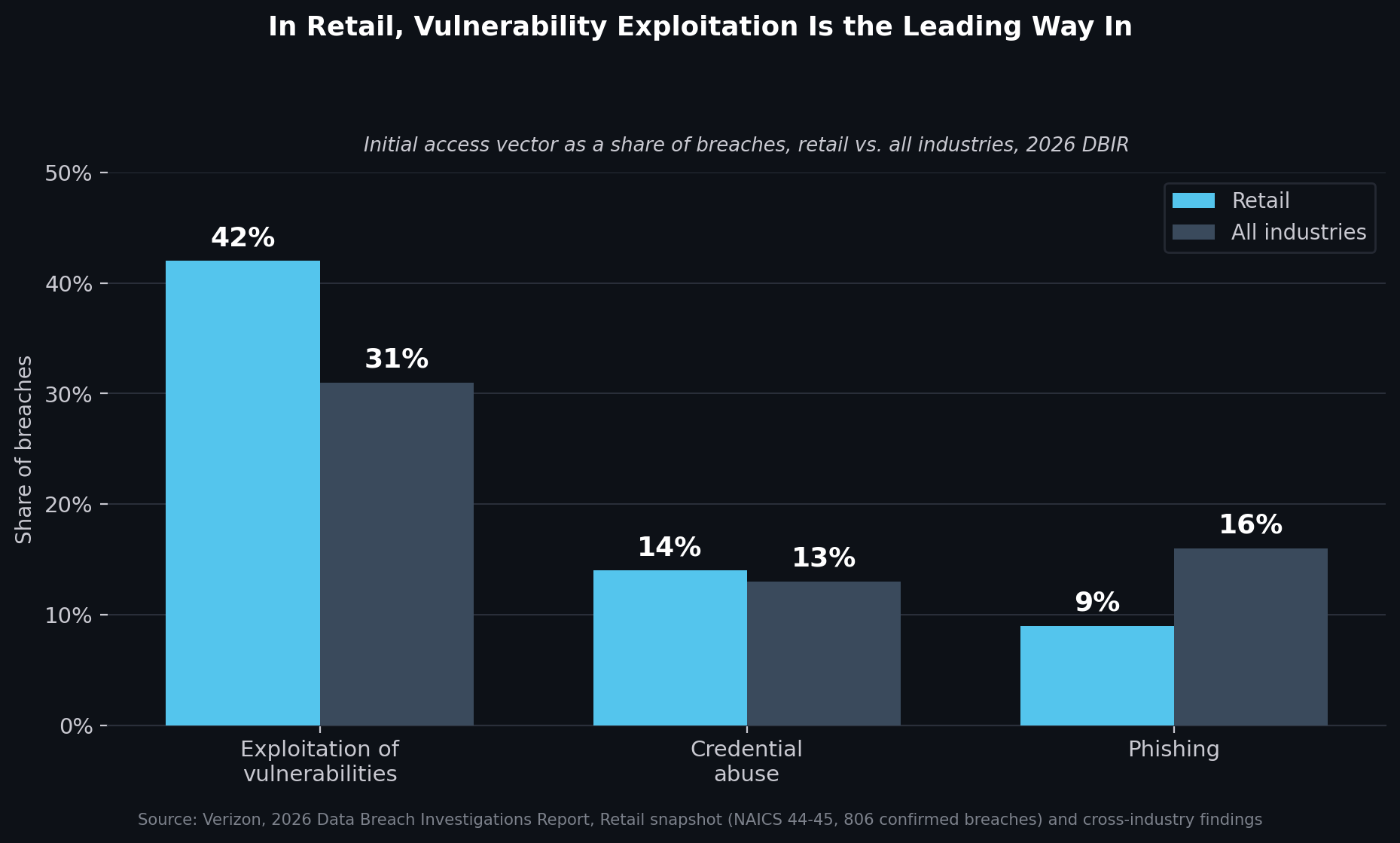
- PCI scope is a floor, not a threat model. In Verizon’s 2026 retail data, vulnerability exploitation was the leading way in (42% of breaches), and internal data, credentials, and secrets were compromised far more often than card data alone suggests.
- Choose a provider on testing method, tester qualification, retest and evidence practices, and retail-specific scope.
What Does PCI DSS 4.0.1 Require of Penetration Testing?
PCI DSS 4.0.1 Requirement 11.4 requires a documented methodology, internal and external penetration tests at least every 12 months and after significant changes, correction and retesting of exploitable findings, and segmentation testing where segmentation reduces scope. Testers must be qualified and organizationally independent. Three acronyms recur below: a QSA is a Qualified Security Assessor, an ASV is an Approved Scanning Vendor, and the CDE is the cardholder data environment. See the PCI Security Standards Council for the standard itself.
| Requirement (v4.0.1) | What it asks for | What a recurring PTaaS cycle can produce |
|---|---|---|
| 11.4.1 | A documented penetration testing methodology covering the CDE perimeter and critical systems, inside and outside testing, application- and network-layer testing, and retention of results | A written scope and methodology per cycle, with results kept in one portal for the retention period |
| 11.4.2 and 11.4.3 | Internal and external penetration tests at least every 12 months and after significant infrastructure or application changes, by a qualified, organizationally independent tester | A scheduled cycle plus on-demand tests triggered by changes you define as significant |
| 11.4.4 | Exploitable vulnerabilities corrected per your risk assessment, then testing repeated to verify | Built-in retests, with a recorded status for each finding |
| 11.4.5 | If segmentation reduces your scope, segmentation controls tested at least every 12 months and after changes (every six months for service providers under 11.4.6) | Segmentation validation in the test plan, with evidence that out-of-scope networks can’t reach the CDE |
| 11.3.1 and 11.3.2 | Quarterly vulnerability scans (internal authenticated; external by an ASV) | Separate controls. A penetration test doesn’t replace them. |
| 6.4.3 and 11.6.1 | Authorized script inventory and tamper detection for payment pages | Separate controls. Testing can probe whether tampering is feasible and detected, but doesn’t replace the monitoring. |
Three points cause most of the confusion. The tester doesn’t have to be a QSA or ASV, but must be qualified and organizationally independent. An exported vulnerability scan isn’t a penetration test. And the standard says nothing about continuous testing, despite how some vendor content describes it. PTaaS is a delivery model that makes the required cadence dependable, not a PCI requirement.
What Is the Difference Between a PCI Penetration Test, a Vulnerability Scan, and PTaaS?
A PCI penetration test proves what an attacker can exploit, a vulnerability scan lists known weaknesses, and PTaaS is a way of delivering penetration testing on a recurring basis.
| PCI penetration test (11.4) | Vulnerability scan (11.3) | PTaaS | |
|---|---|---|---|
| What it is | Manual, exploit-based testing under a documented methodology | Automated identification of known vulnerabilities | A delivery model for penetration testing: recurring and on-demand cycles, portal delivery, retesting |
| PCI cadence | At least every 12 months and after significant change | Quarterly (internal authenticated; external by an ASV) | Not a PCI requirement; satisfies 11.4 when the testing meets its requirements |
| Who performs it | Qualified, organizationally independent tester | Tooling; external scans by an ASV | The provider’s testers, ideally validating every finding |
| Output | Proof of exploitable weaknesses, attack paths, remediation guidance | A list of known vulnerabilities | The same as a penetration test, delivered continuously with retest status and trends |
Why Is Annual Penetration Testing the Minimum, Not the Plan?
Annual testing is the PCI floor, but retail attackers mostly get in by exploiting vulnerabilities, and fixes lag. Verizon’s 2026 Data Breach Investigations Report, covering incidents from October 2024 through November 2025, examined 997 retail incidents, 806 of them confirmed breaches. Three patterns, system intrusion, basic web application attacks, and social engineering, accounted for 95 percent of retail breaches. Exploitation of vulnerabilities was the initial access vector in 42 percent of them, well above the 31 percent seen across all industries, and third parties were involved in 68 percent.
Across industries, only 26 percent of vulnerabilities in CISA’s Known Exploited Vulnerabilities (KEV) catalog were fully remediated in 2025, down from 38 percent the year before, and the median time to fully resolve them rose to 43 days. A single annual test can’t keep pace with a window like that, which is why testing after significant change and verifying fixes matter more than the annual date on the calendar.
Scope matters as much as cadence. Verizon notes that retail breaches once centered on payment card data, and that attackers now go after any data they can monetize. In 2026, internal data was compromised in 84 percent of retail breaches, up from 65 percent the year before, with credentials in 26 percent and secrets in 20 percent.
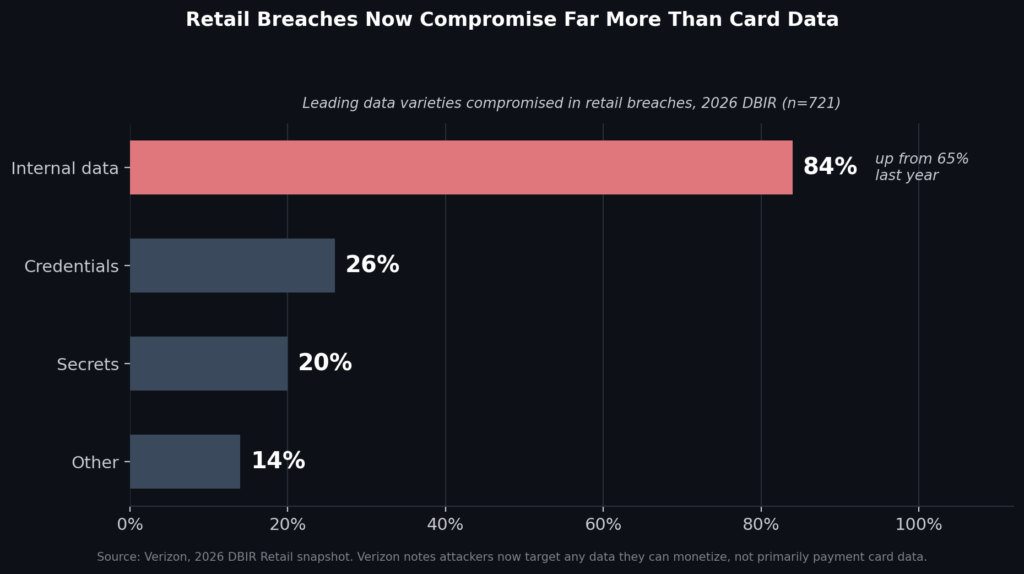
PCI defines which systems are in scope for compliance. A threat actor doesn’t read that boundary. A PCI-only test can pass while the path attackers actually use, such as an admin interface, an API, or a third-party integration, sits just outside it.
Recurring testing also tracks with faster fixes. Cobalt’s 2026 State of Pentesting report, drawn from its own platform data over five years, found the half-life of high-risk findings was 10 days for the top 10 percent of organizations and 249 days for the bottom 10 percent. Organizations running testing as an ongoing program were 4.5 times more likely to resolve critical findings within three days than those testing ad hoc or only for compliance. That is a vendor dataset and shows association, not cause, but it points the same direction as PCI 11.4.4’s requirement to verify fixes.
What Does Manual Validation Mean for PCI Evidence?
Manual validation means a person confirms each finding is exploitable, removes false positives, chains weaknesses into a real attack path, and tests the business logic scanners can’t see. That is what turns tool output into evidence a QSA can rely on, because PCI requires the test to follow a documented methodology and be performed by a qualified tester.
Independent research shows why both halves matter. A peer-reviewed 2026 study by researchers at Stanford, Carnegie Mellon, and Gray Swan AI compared AI agents with ten professional penetration testers on a live university network of about 8,000 hosts. The best AI agent placed second overall and outperformed nine of the ten humans at a fraction of the hourly cost. But AI agents produced more false positives and struggled with tasks that required a graphical interface, and most of the other AI frameworks tested underperformed nearly all of the humans. Separately, Cobalt’s 2026 survey of 455 security professionals found the share relying entirely on AI automation for testing fell from 29 percent to 9 percent in a year, while 47 percent preferred a hybrid model with human expertise supporting AI.
The practical point for a retailer: PCI doesn’t prohibit automation, but it does require the test to follow a methodology and be owned by a qualified, independent tester. Ask any provider who validated each finding.
How Does PCI Penetration Testing as a Service Work?
PCI penetration testing as a service typically runs as recurring security assessments, each a repeatable cycle:
- Scope against business risk. Define the CDE, payment flows, and the assets and workflows that would cause the most damage if compromised.
- Test on a cadence and after change. Run scheduled cycles, plus on-demand tests after changes you’ve defined as significant.
- Validate. Testers confirm exploitability, remove false positives, and document proof.
- Deliver as findings are confirmed. Results appear in a portal, mapped to standards such as CWE and OWASP and ranked by business impact.
- Retest and keep evidence. Fixes are retested per 11.4.4, statuses are recorded, and results are retained for the required period.
- Track trends. Each cycle adds to a view of exposure by application, severity, and time to remediate.
Retailers with in-store systems should also review point-of-sale risk. See VerSprite’s point-of-sale insecurities research for a technical look at how payment applications fail.
What Should a Retail PTaaS Program Test Beyond the CDE?
A retail PTaaS program should test checkout and payment flows, the APIs and business logic around orders, refunds, promotions, and loyalty, customer accounts, store and POS networks, and third-party integrations, because attackers target value, not PCI scope. The following are illustrative attack paths, not documented incidents:
| Retail asset | Illustrative attack path | Why it matters |
|---|---|---|
| Checkout and payment flow | Tampering with payment page scripts, hosted fields, or redirects | Direct card data exposure; ties to 6.4.3 and 11.6.1 |
| Order, refund, loyalty, and gift-card APIs | Broken object-level authorization, excessive data exposure, workflow abuse | Fraud and customer data exposure outside the CDE |
| Promotions, pricing, and loyalty logic | Stacked discounts, gift-card abuse, price tampering | Direct revenue loss that scanners don’t detect |
| Accounts and saved payment methods | Credential stuffing and account takeover | Credentials were compromised in 26% of retail breaches |
| Store, office, and POS networks | Lateral movement toward card systems | Segmentation validation under 11.4.5 |
| Third-party integrations | Compromised vendor or over-permissioned access | Third parties were involved in 68% of retail breaches |
Which Penetration Testing as a Service Fits Recurring PCI Checks for US Retailers?
The best fit is a PTaaS that delivers manual, exploit-based testing by qualified, independent testers, runs on a schedule and after significant changes, retests fixes, and keeps evidence you can hand to a QSA. No single provider fits every retailer, so ask each one:
- Is the testing manual and exploit-based, or a scan with a new label? Ask who validated each finding.
- Who are the testers, and how are qualification and organizational independence documented?
- How are after-change tests triggered, and how fast can one start once you define a change as significant?
- How are fixes retested, and where does the evidence live for the retention period?
- Is segmentation validation included for in-store and POS environments?
- Does scope cover retail abuse cases such as promotions, loyalty, gift cards, APIs, and third-party scripts, not only the CDE?
- How are findings ranked? Business impact is more useful than severity score alone.
Penetration testing services in this category include enterprise PTaaS providers such as NetSPI and Cobalt, specialist PCI penetration testing firms, and VerSprite. These aren’t ranked, and descriptions of other providers reflect their public materials. See our questions to ask penetration testing providers for a longer checklist.
Limitations
PCI DSS doesn’t require PTaaS, and your QSA or acquirer decides what evidence satisfies each requirement, so confirm how they define “significant change” and what they’ll accept. The Verizon figures come from a cross-industry dataset; the retail subset is 806 confirmed breaches, and the data-compromised chart reflects the leading varieties Verizon lists. The Cobalt figures are vendor platform and survey data and show association, not cause. The AI-versus-human study ran on one network with ten human participants, and the field is moving quickly. Requirement numbers follow PCI DSS v4.0.1 and should be checked against the current standard.
Final Takeaway
PCI sets the minimum: annual, manual, methodology-driven testing, repeated after significant change, with fixes verified. PCI penetration testing as a service makes that dependable and keeps the evidence together. The larger value for retail cybersecurity is scope and prioritization: testing the paths attackers use and ranking what’s found by what it would cost the business.
Sources
- Verizon, 2026 DBIR Retail snapshot
- PCI Security Standards Council, PCI DSS v4.0.1, Requirements 6.4.3, 11.3, 11.4, and 11.6.1
- CISA, Known Exploited Vulnerabilities catalog
- VerSprite, Penetration Testing as a Service and hybrid penetration testing case study
Frequently Asked Questions
Share
- /
- /
- /
- /
- /
- /
- /
- /
- /
- /
- /
- /
- /
- /
- /
- /
- /
- /
- /
- /
- /
- /