The Patch Window Was a Human Artifact
Autonomous Exploit Generation and What It Changes

Date
Authors
Tony UcedaVélez
Follow Us


Abstract. On November 16, 2026, Google Threat Intelligence Group (GTIG) and Mandiant reported the first observed case of an AI framework that discovers and exploits vulnerabilities without a human in the loop. The framework, which GTIG calls exploit_agent, compares web application code before and after a patch, locates the fixed flaw, writes an exploit and runs it. This paper argues that the “patch window” most programs plan around was never a control. It was a side effect of how long it took humans to reverse-engineer a fix. We review what was observed, what did not change, and how threat modeling (specifically PASTA Stages 4 through 7) absorbs a patch-to-exploit interval that is trending toward zero. We close with the limits of the evidence, which are real.
1. Introduction: a patch is now an exploit announcement
Autonomous exploit generation is the use of AI agents to find a vulnerability, write a working exploit, and launch it with no human making decisions along the way. As of November 2026 it is no longer a forecast. GTIG observed it in a live operation.
For twenty years, vulnerability management has leaned on an unstated assumption. When a vendor ships a fix, attackers need time to figure out what was fixed and how to abuse it. That interval, the patch window, shaped SLAs, change-freeze calendars and the monthly patch cycle. Most of us never wrote it down as a dependency, because it never failed all at once.
It is failing now, and the cause is specific. Patch diffing, the work of comparing old and new code to find what changed, is exactly the kind of tedious, pattern-heavy task language models are good at. Once diffing is automated, the publication of a patch becomes a signal that machines can act on within hours.
This is a change in timing, not a change in kind. The attacks still land on the same weaknesses. What changes is how much time a defender gets between knowing and being targeted. That distinction matters, because it tells us where to put effort.
2. What GTIG observed
GTIG’s quarterly AI Threat Tracker, published November 16, 2026, with Mandiant, documents three developments that belong together [1][2].
2.1 exploit_agent. Researchers found an exposed staging server running a multi-agent framework wired to several frontier and locally hosted models. Its workflow is a straight line:
- Watch popular web applications for new patches.
- Compare the code before and after the patch.
- Identify the fixed flaw.
- Draft an exploit and run it against targets.
Configuration comments were written in Russian and labeled the model API keys as an auto-exploitation pilot. Victim telemetry pointed at French media, entertainment and education sites [2]. Google did not attribute the server to a known group [6].
2.2 A threshold crossed in one quarter. In the previous tracker, released in September, GTIG said it had not yet seen fully autonomous attack pipelines [3]. That same edition described a financially motivated actor who used a multi-agent framework to stand up a credential theft operation in under six hours [4]. Two months later, the human was out of the exploitation step entirely.
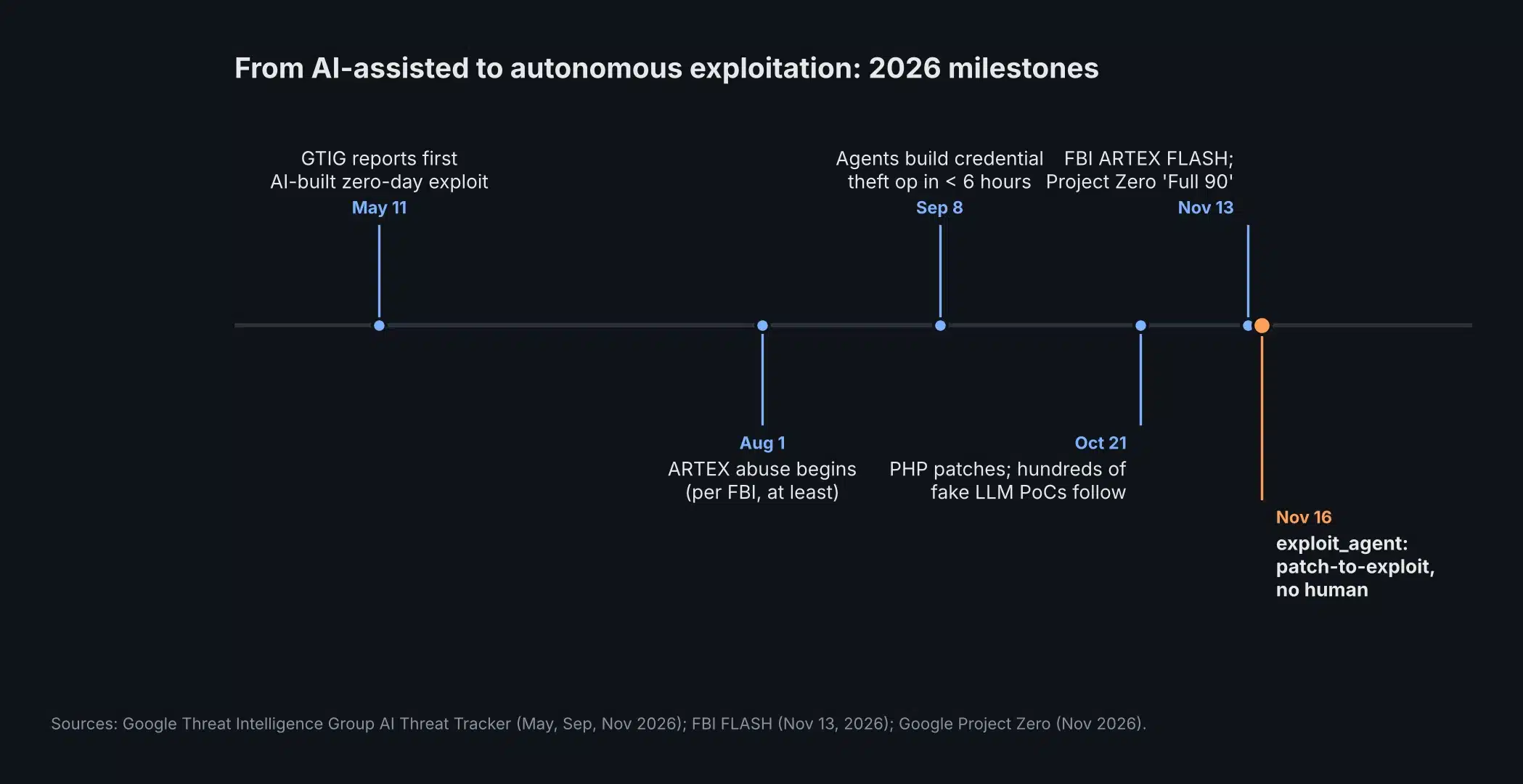
2.3 Offensive frameworks in general use. GTIG also saw several actors running open-source agentic pentesting frameworks during intrusions, ARTEX most prominently. The FBI issued a FLASH alert on November 13, noting ARTEX use since at least August 2026 against financial services, government, healthcare, energy, and other sectors [2][5].
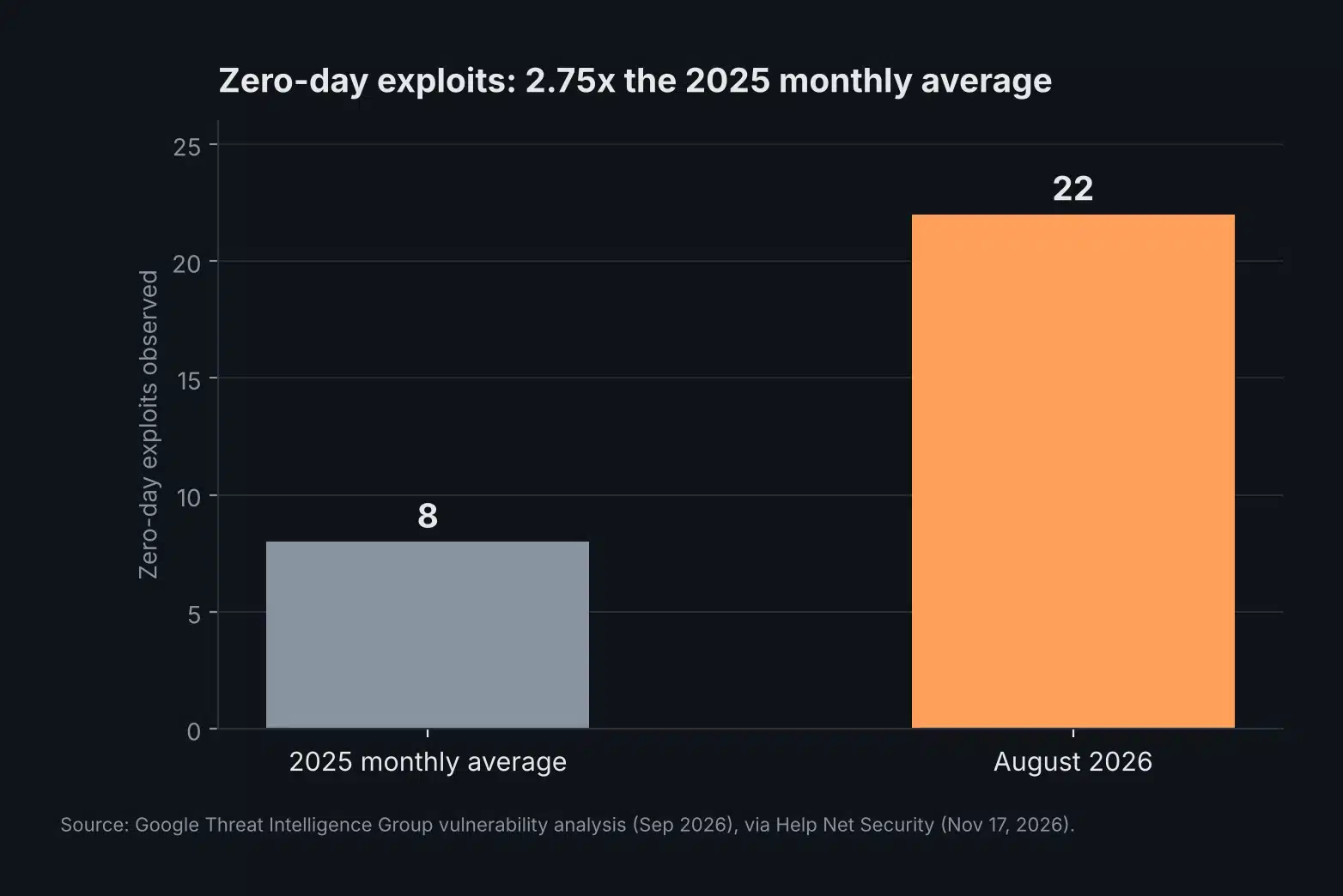
2.4 The volume backdrop. GTIG’s September vulnerability analysis found that disclosures and exploits nearly doubled between January and August 2026. Zero-day exploits reached 22 in August against a 2025 average of 8 per month [2]. Separately, CISA added UnrealIRCd CVE-2026-114713 to its Known Exploited Vulnerabilities catalog after exploitation began roughly one day after disclosure [7].
3. The patch window was a human-latency assumption
The patch window never came from a policy or a standard. It came from labor. A skilled reverse engineer needed days to weeks to diff a binary or a codebase, isolate the change and turn it into something reliable. Defenders borrowed that time without naming it.
We can test this by asking what the window was made of:
- Discovery of the fix. Reading release notes and pulling the new version. This was already automatable.
- Diffing. Comparing versions and isolating security-relevant changes. This was the expensive human step.
- Weaponization. Turning a root cause into a working exploit. This was skilled and slow.
- Targeting. Finding exposed instances. Internet-wide scanning made this cheap years ago.
exploit_agent automates the two expensive steps. When those collapse, the window collapses with them. Nothing about the vulnerability itself changed.
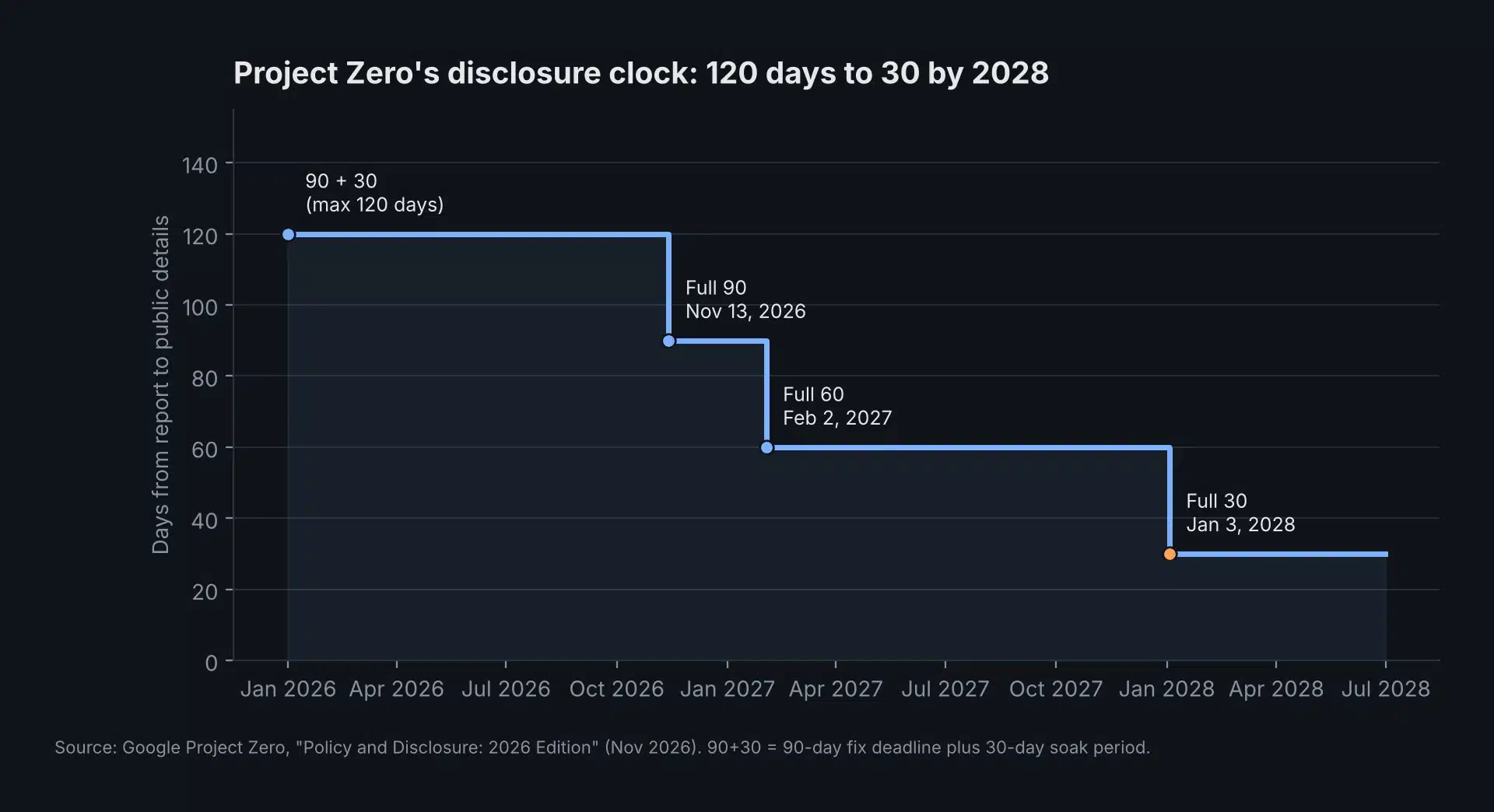
The disclosure side is moving the same way. Google Project Zero replaced its “90 + 30” policy on November 13, 2026. Details now publish 90 days after a report whether or not a fix exists, falling to 60 days on February 2, 2027, and 30 days on January 3, 2028. The 30-day post-patch soak period is gone [8][9]. Both trends point at the same conclusion: time-to-patch can no longer be the primary control.
4. What hasn’t changed
The useful parts of the GTIG report are as much about limits as capabilities.
The mechanics are the same. Google’s own summary is that intrusions still rely on compromised credentials and unpatched systems. What is new is the speed and scale at which known weaknesses get hit [2]. Hygiene that worked against a human operator still works against an agent.
Current frameworks are loud. GTIG assesses that these tools currently trade stealth for velocity, leaving traffic and code traces that make them easier to catch [2][3]. An agent that hammers a freshly patched endpoint with machine-generated attempts produces a pattern that a tuned detection stack can see. GTIG expects stealth to improve, so this is a window of its own, not a permanent property.
Much of the output is junk. After patches for two PHP flaws (CVE-2026-109618 and CVE-2026-109619) shipped on October 21, hundreds of non-working, LLM-generated proofs of concept appeared online, and the community had to vet each one [2]. Machine-speed exploitation arrives alongside machine-speed noise. Triage capacity becomes a real constraint.
Defenders have the same tools. Researchers at Huntress and elsewhere have used language models to produce working exploits within a day of disclosure for validation purposes [3]. Patch diffing is symmetric. The side that operationalizes it first gets the time back.
5. Implications for threat modeling
If time-to-patch stops being the primary control, the decision moves upstream. Before the next patch drops, a team needs to know which assets matter, which are reachable, and what an attacker could do with each one. That is the job threat modeling was built for.
In PASTA terms, autonomous exploit generation mostly changes one input: the attacker’s time and cost to weaponize a known flaw. Here is how that ripples through the later stages.
| PASTA stage | What changes when patch-to-exploit time approaches zero |
|---|---|
| 4. Threat analysis | Treat agentic frameworks (exploit_agent, ARTEX and similar) as a distinct threat actor capability, sourced from current intelligence such as the GTIG tracker. |
| 5. Vulnerability and weakness analysis | Flag internet-facing components built on widely deployed web software as “patch equals disclosure” assets. Popular web apps were exactly what exploit_agent watched. |
| 6. Attack modeling | In attack trees, set the effort for exploiting a newly patched flaw on exposed assets to near zero. Paths that once looked expensive may now be the cheapest. |
| 7. Risk and impact analysis | Rank exposure by business impact and reachability, not CVSS order. A medium-severity flaw on a reachable revenue system can outrank a critical one on an isolated host. |
Three practical moves follow from that analysis:
- Pre-stage compensating controls. For assets flagged in Stage 5, decide in advance how to reduce exposure on patch day: WAF virtual patches, feature flags that disable a component, or temporary access restrictions. Doing this during the incident is too late.
- Detect the noise. Agentic exploitation is currently loud. Alert on bursts of malformed or exploratory requests against recently patched endpoints, especially in the 24 to 72 hours after a vendor release.
- Diff your own patches. Point the same class of tooling at vendor fixes that affect your stack, so your team understands the flaw as fast as an agent does. VerSprite’s broader view on AI-driven attacks covers adjacent techniques.
6. Limitations
We want to be precise about what this evidence supports.
- One observed framework. The fully autonomous case rests on a single exposed staging server. We do not know how many similar operations exist or how successful this one was.
- No published timing data. GTIG has not released patch-to-exploit times for exploit_agent. “Approaching zero” is a direction, not a measurement.
- Visibility bias. GTIG reports what Google’s telemetry and Mandiant’s engagements see. Quieter operations would be underrepresented by design.
- Volume figures have more than one cause. The near-doubling of disclosures in 2026 likely reflects AI-assisted discovery on the defensive side too. Not all of that growth is attacker capability.
- Forecasts are forecasts. GTIG’s expectation that these tools will become stealthier is an assessment, not an observation.
7. Conclusion
The patch window was always borrowed time, paid for by the attacker’s labor. Autonomous exploit generation removes that labor, and Project Zero’s new disclosure clock removes much of the grace period on the other side. Neither development introduces a new kind of weakness.
What they change is where the decision has to be made. Teams that know their reachable, high-impact assets before a patch ships will treat patch day as a routine event. Teams that discover their exposure on patch day are now competing with software that does not sleep. The work that closes that gap is threat modeling, done before it is needed.
Frequently Asked Questions
What is autonomous exploit generation?
What is exploit_agent?
What is AI patch diffing?
Does autonomous exploit generation mean organizations should patch faster?
Can defenders detect AI agent-driven exploitation?
How does threat modeling help against autonomous exploit generation?
What changed in Google Project Zero’s disclosure policy?
References
- Google Threat Intelligence Group. GTIG AI Threat Tracker: Agentic Threat Activity Crosses a Significant Threshold. Google Cloud Blog, November 16, 2026.
- Markovic, S. Google finds AI agent writing and launching exploits with no human in the loop. Help Net Security, November 17, 2026.
- Riley, D. Google says an AI framework turned security patches into exploits with no human in the loop. SiliconANGLE, November 16, 2026.
- Help Net Security. Threat actors are giving AI agents a bigger role in cyberattacks. September 8, 2026.
- Federal Bureau of Investigation. FLASH alert on ARTEX. IC3, November 13, 2026.
- Baumgärtner, A. KI-Agent macht aus Patches Exploits. Blogspan, November 16, 2026. See also Lyons, J., The Register, November 16, 2026.
- Cyber Recaps. Daily Cybersecurity News, November 16, 2026.
- Google Project Zero. Policy and Disclosure: 2026 Edition. November 2026.
- Help Net Security. Google Project Zero will disclose bugs after 90 days, fixed or not. November 16, 2026.
Share
- /
- /
- /
- /
- /
- /
- /
- /
- /
- /
- /
- /
- /
- /
- /
- /
- /
- /
- /
- /
- /
- /