MDR for SaaS Teams Preparing for SOC 2
Date
Authors
Tony UcedaVélez
Follow Us


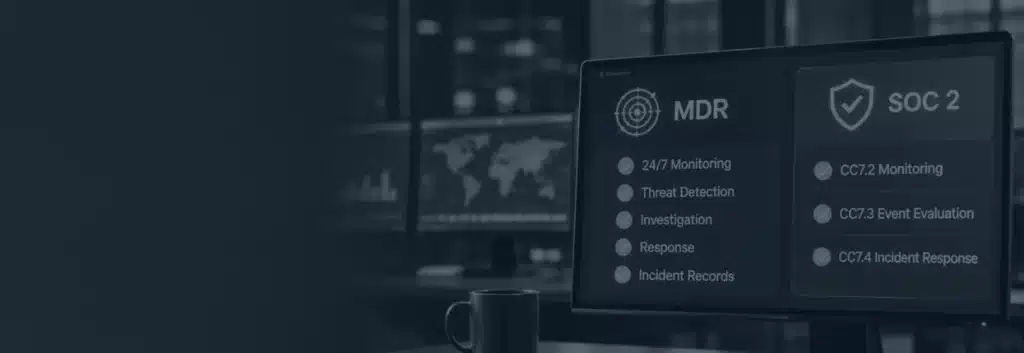
MDR for SaaS teams preparing for SOC 2 means using a managed detection and response service as the control behind SOC 2’s monitoring and incident-response criteria: it watches your identity, cloud, source-control, and production telemetry around the clock, investigates alerts, responds to confirmed incidents, and leaves dated records an auditor can test. SOC 2 doesn’t require MDR or any specific vendor. It requires that your controls meet the criteria throughout the audit period.
One naming trap is worth clearing up first. A security operations center (SOC) is a function that watches for threats, while SOC 2 is an audit report from a CPA firm. MDR is typically bought to run the first, and the second asks whether it ran. VerSprite publishes this guide and is one of the providers listed.
Key Takeaways
- SOC 2’s CC7 criteria cover detecting vulnerabilities, monitoring for anomalies, evaluating security events, responding to incidents, and recovering. MDR mainly supplies CC7.2, CC7.3, and CC7.4.
- Evidence matters as much as detection. For a Type II report, an auditor tests whether the controls operated across a period, so dated alert, case, and coverage records are the deliverable.
- Providers differ on telemetry coverage, response authority, evidence support, and whether they state their own SOC 2 report. Ask for each in writing.
- Detection benchmarks are public but not standardized. Define your own detection and response targets and measure them.
What Does SOC 2 Require for Detection and Response?
SOC 2 reports are based on the AICPA’s Trust Services Criteria. A Type I report assesses the design of controls at a point in time, and a Type II report assesses design and operating effectiveness over a period agreed with your auditor. The detection and response criteria sit under CC7, System Operations. The table paraphrases the criteria and shows where MDR typically fits.
| Criterion | What it asks (paraphrased) | What MDR can supply | What it usually doesn’t cover |
|---|---|---|---|
| CC7.1 | Detect configuration changes that introduce vulnerabilities, and susceptibility to newly discovered vulnerabilities | Sometimes, through integrations with vulnerability or cloud posture tools | Vulnerability scanning and configuration monitoring are usually separate tools or services |
| CC7.2 | Monitor system components for anomalies indicating malicious acts, natural disasters, and errors, and analyze them to determine whether they are security events | 24/7 monitoring, detection content, and triage | Application-level and tenant-data anomalies, unless those logs are onboarded |
| CC7.3 | Evaluate security events to determine whether they could or have caused a failure to meet objectives, and act | Triage, severity classification, case records, and escalation | Your decisions on materiality and customer impact |
| CC7.4 | Respond to identified incidents by executing a defined incident response program to understand, contain, remediate, and communicate | Investigation, containment actions where authorized, and external responders | Your written plan, roles, customer notification, and legal decisions |
| CC7.5 | Recover from incidents | Guidance | Recovery is typically your responsibility |
The criteria’s points of focus anticipate outsourcing: the incident response roles are expected to include external resources when necessary. That’s the hook for using a provider, but the plan and the accountability remain yours.
What Evidence Should an MDR Program Leave for a SOC 2 Auditor?
For a Type II period, the useful question is “what record will exist for every month of the window?” This table lists the evidence that compliance monitoring through MDR should produce.
| Evidence | Maps to | Why an auditor tests it |
|---|---|---|
| Coverage inventory: data sources onboarded (identity provider, cloud audit logs, source control, endpoints and workloads, SaaS admin logs) with dates | CC7.2 | Shows what was and wasn’t monitored |
| Integration health records, including alerts when a log source went silent | CC7.2 | Shows monitoring ran continuously, not just at onboarding |
| Alert and case records with timestamps from detection to triage, escalation, and resolution | CC7.2, CC7.3 | Shows events were evaluated |
| Severity definitions, escalation runbook, and named contacts | CC7.3 | Shows decisions follow a defined process |
| Written incident response plan, including the MDR provider’s role, and tabletop or exercise records | CC7.4 | Shows the program is defined and tested |
| Post-incident reviews and customer communications for any real incident | CC7.4 | Shows response was executed |
| Periodic reports and review meetings | CC7.3 | Shows detected events were communicated and reviewed |
| The provider contract and the provider’s own assurance report | Vendor management (CC9.2) | The provider becomes a vendor your auditor may assess |
Keep this evidence for the whole observation period, and confirm with your auditor which items they’ll request.
What Do Detection Benchmarks Say?
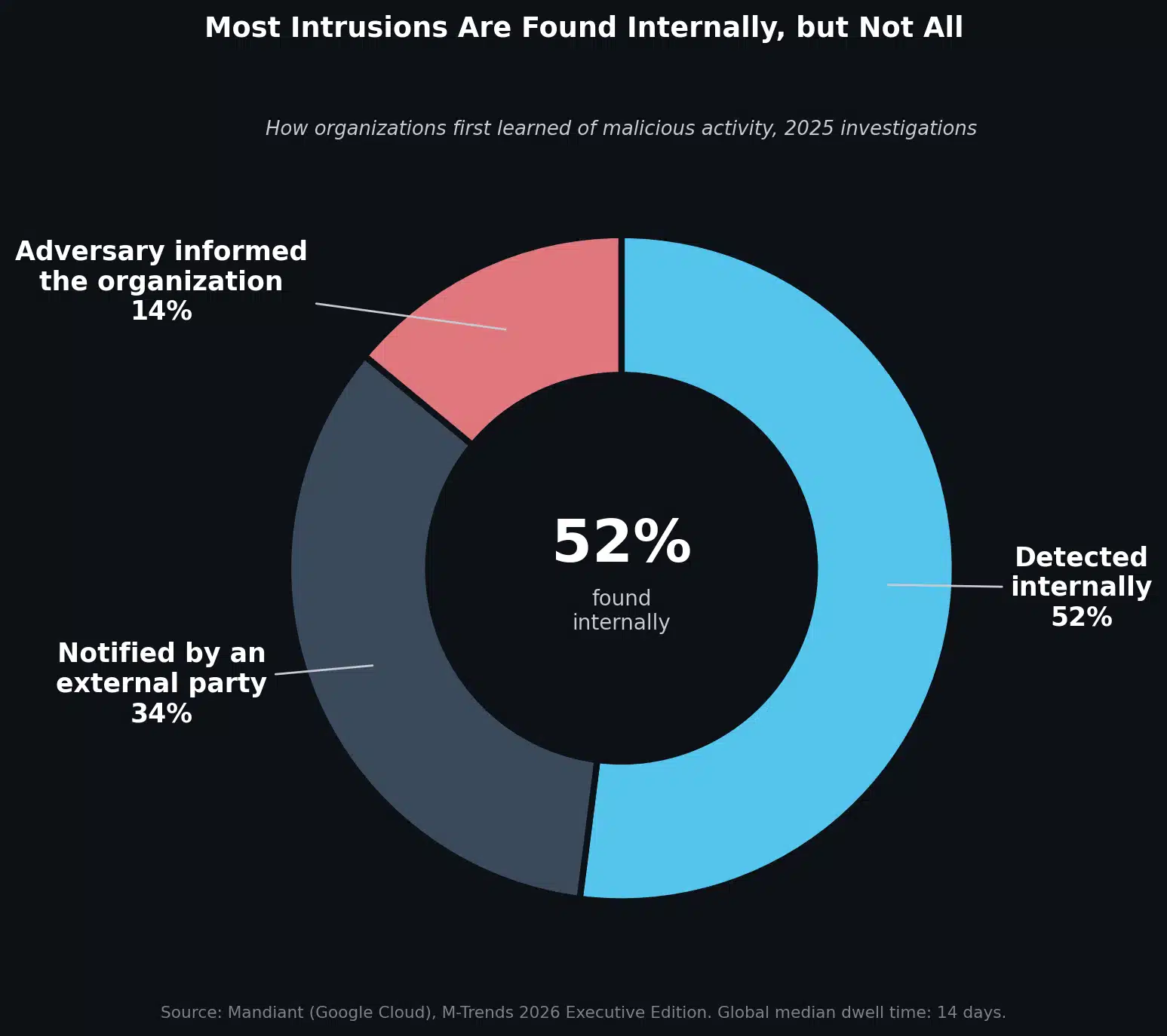
SOC 2 sets no detection-time targets, but public data shows what’s realistic. Mandiant’s M-Trends 2026, based on its 2025 incident investigations, put the global median dwell time at 14 days, up from 11. Organizations first detected malicious activity internally 52 percent of the time, up from 43 percent in 2024, while 34 percent were notified by an external party and 14 percent were told by the adversary.
The cloud picture matters for SaaS teams. In Mandiant’s cloud-related investigations, the most common initial vector was voice phishing at 23 percent, followed by third-party compromise at 17 percent and stolen credentials at 16 percent. Exploits accounted for only 6 percent, and evidence of data theft appeared in 59 percent of cloud compromises.
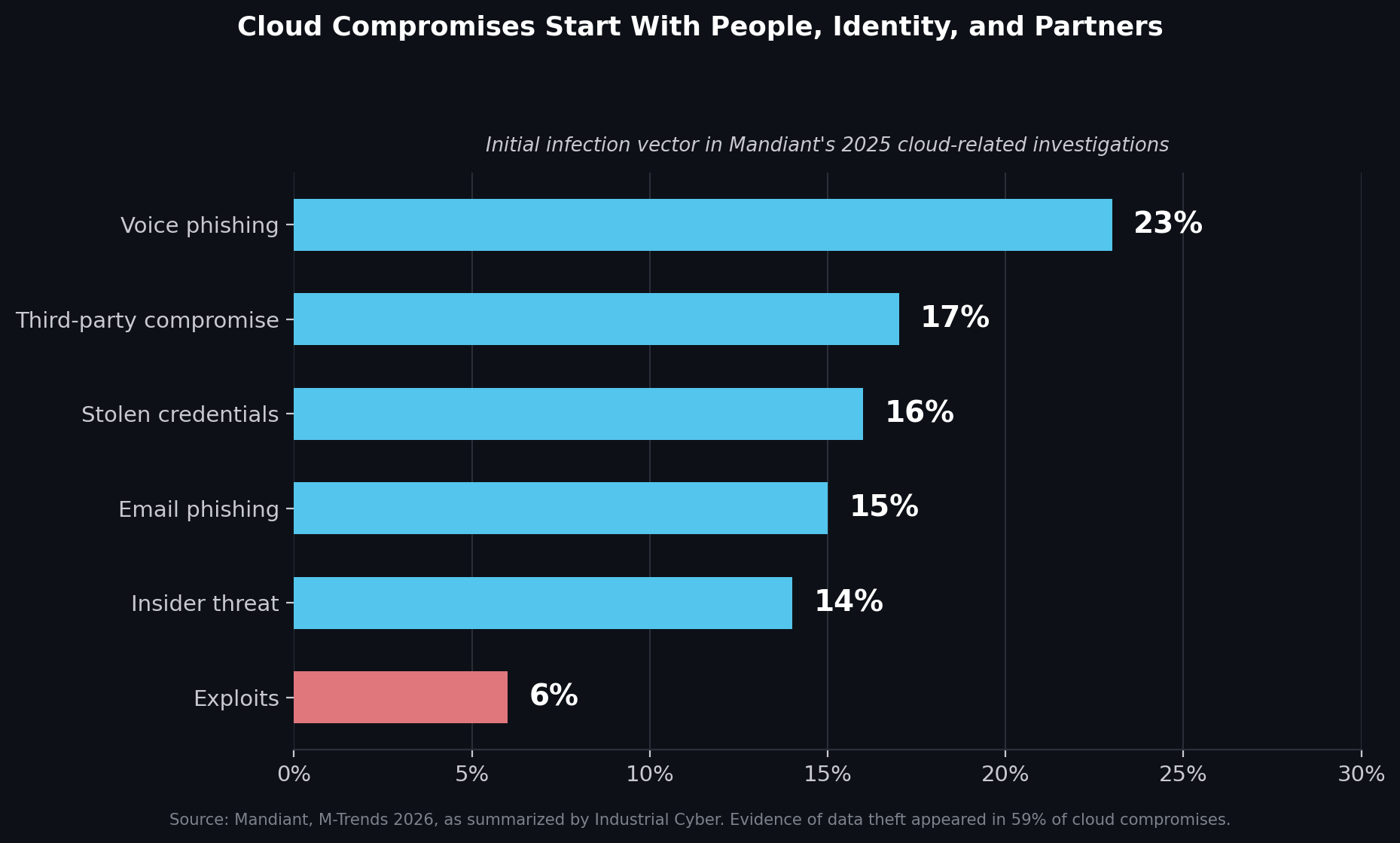
The implication is practical: SaaS detection can’t stop at the endpoint. Identity, third-party access, and cloud control-plane logs need to be in scope, and your provider should be able to show they are.
Which MDR Services Work Best for SaaS Companies Needing SOC 2 Readiness?
No single MDR service works best for every SaaS company. The right fit depends on which of your systems the provider monitors, what it’s authorized to do in response, and what evidence it can hand your auditor. The table summarizes what each provider states on its own pages.
| Provider | Telemetry and coverage stated | Response model stated | Compliance support stated | Pricing | Provider’s own SOC 2 report |
|---|---|---|---|---|---|
| VerSprite | 24/7 monitoring using SIEM technologies across endpoints, network, and cloud; integrates with existing SIEM, EDR, and cloud platforms; for SaaS, monitoring across cloud-native, hybrid, and multi-tenant environments with detection targeting authentication, APIs, and production infrastructure | Threat hunting, incident response playbooks tailored by industry and infrastructure, and Purple Team validation of controls | Reporting and audit evidence aligned to NIST, ISO 27001, HIPAA, and PCI DSS; SOC 2 not named | Not published | Not stated on the page reviewed |
| CrowdStrike | Falcon Complete Next-Gen MDR: 24/7 across endpoints, identities, and cloud workloads; third-party data through Falcon Next-Gen SIEM; Falcon OverWatch threat hunting | Managed triage, investigation, and “surgical” end-to-end remediation | Not stated on the pages reviewed | Not published | Not stated on the pages reviewed |
| Expel | API integrations stated for cloud (AWS CloudTrail and GuardDuty, Google Cloud, Azure), identity (Okta, Microsoft Entra ID, Duo, 1Password), SaaS (GitHub, GitLab, Google Workspace, Microsoft 365, Salesforce Shield, Workday), endpoint, network, and SIEM tools | 24×7 security operations; states it monitors integration health and flags coverage gaps | Not stated on the integrations page | Not stated on that page | Not stated on that page |
| Sophos | 24/7 MDR; states 500+ integrations and a bring-your-own-stack model | States AI resolves 52% of cases end to end in an average of 89 seconds, with analysts supervising; critical incident response with no hourly caps; breach protection warranty | NIS2 and NIST named; SOC 2 not named | Quoted on request | Not stated on the page reviewed |
VerSprite
- Service: VerSprite’s Advanced MSS and MDR service combines managed security services (co-managed SIEM, security tool management, log management, and compliance support) with 24/7 MDR. Managed security services are the ongoing operation of security tools and processes, while MDR is the detection, investigation, and response layer.
- Prioritization: VerSprite builds an organizational threat model for each client, using PASTA, which shapes how events and incidents are prioritized for the MDR service.
- Validation: A Purple Team approach combines offensive and defensive specialists to test detection and logging.
- Not stated on its page: SOC 2 support, published pricing, response-time targets, named EDR or SIEM platforms, and a list of SaaS integrations.
CrowdStrike
- Service: Falcon Complete Next-Gen MDR, built around the Falcon platform, with managed endpoint, cloud workload, and identity threat protection and 24/7 threat hunting through Falcon Adversary OverWatch.
- Scope note: Coverage beyond Falcon-native telemetry is extended through Falcon Next-Gen SIEM.
- Not stated on the pages reviewed: compliance framework support, pricing, and the provider’s own SOC 2 report.
Expel
- Service: An API-first, vendor-agnostic MDR. Expel states it connects to your existing tools through APIs rather than replacing them, and its integrations page lists identity, cloud, source-control, and SaaS sources by name.
- Operations: It states it monitors integration health and alerts when a data source goes silent, which maps directly to showing continuous coverage.
- Not stated on the page reviewed: compliance framework support, pricing, and its own SOC 2 report.
Sophos
- Service: Sophos MDR, described as an “Agentic SOC” in which AI handles triage and response for part of the caseload while analysts supervise.
- Response terms: Critical incident response is stated to carry no hourly caps or extra fees, and the service is backed by a breach protection warranty.
- Not stated on the page reviewed: SOC 2 support and its own SOC 2 report. Sophos’s page gives both 350+ and 500+ as its integration count, so confirm which applies.
How Should SaaS Teams Evaluate MDR for SOC 2?
Evaluate on what the provider monitors, what it’s allowed to do, and what it can prove. Ask each provider:
- Which telemetry will you ingest for us? Look for the identity provider, cloud control-plane logs, source control, production workloads, SaaS admin logs, and application authentication and API logs.
- What response actions can you take, and which need our approval? Disabling an account, isolating a host, and revoking a token are different authority levels.
- What evidence can you export? Ask for case records with timestamps, coverage inventories, integration health history, and periodic reports.
- How long do you retain case data and logs? Compare retention against your audit period.
- Do you have your own SOC 2 Type II report? Auditors commonly ask about vendors in scope, so ask for it early.
- How do you define and measure detection and response times? There’s no standard definition, so get yours in writing.
- How do you detect a log source going silent? Gaps in coverage are a finding waiting to happen.
- How are detections prioritized for our business? Detection tuned to your tenant data, CI/CD, and identity setup is more useful than generic coverage.
- What does incident response include? Ask about included hours, caps, and the handoff to a retainer.
When Is MDR Not Required?
MDR is one way to meet CC7, not the only way. A SaaS team with a SIEM, defined alert triage, round-the-clock on-call coverage, and a tested incident response plan can also meet the criteria, and the auditor decides whether the controls are suitable and operated. Teams often choose MDR because building 24/7 coverage in-house is difficult, which is a staffing and cost decision, not a SOC 2 requirement.
Limitations
SOC 2 criteria are paraphrased from the AICPA’s Trust Services Criteria (2017, with revised points of focus 2022), and your auditor’s interpretation controls. The mapping of MDR outputs to criteria is analysis, not guidance from the AICPA. Provider descriptions come from each provider’s public pages as of November 2026, and several figures, such as Sophos’s case-resolution rates, are vendor claims. The M-Trends figures describe Mandiant’s incident response caseload, which isn’t a random sample of organizations, and the cloud-vector figures were reviewed through a secondary summary. VerSprite publishes this guide, so verify its entry against its own page like any other.
Final Takeaway
SOC 2 asks whether monitoring and response actually ran, so the best MDR choice for a SaaS team is the one that covers your identity, cloud, and production telemetry and produces records an auditor can test across the whole period. Compare providers on coverage, response authority, evidence, and their own assurance, and confirm the details with your auditor before the observation window opens.
Sources
- AICPA & CIMA, 2017 Trust Services Criteria with Revised Points of Focus (2022)
- Mandiant (Google Cloud), M-Trends 2026 Executive Edition
- VerSprite, Advanced MSS and MDR Service
- Sophos, Managed Detection and Response
- Expel, Integrations
- CrowdStrike, Falcon Complete Next-Gen MDR data sheet and service pages
Share
- /
- /
- /
- /
- /
- /
- /
- /
- /
- /
- /
- /
- /
- /
- /
- /
- /
- /
- /
- /
- /
- /