AI Red Teaming for Financial Services
Testing Generative AI Before Attackers Do
Date
Authors
Tony UcedaVélez
Follow Us


AI red teaming for financial services is the adversarial testing of the generative AI that banks, lenders, insurers, and payment firms deploy: testers attack assistants, agents, retrieval systems, and models the way a fraudster or intruder would, to find exploitable paths to customer data, unauthorized transactions, and control failures before an attacker does. The practice is sometimes called AI red teaming and LLM penetration testing, and the two terms overlap heavily. For financial institutions it matters now for a specific reason: the rules that govern model risk haven’t caught up to generative AI, so the evidence that these systems resist attack has to come from testing you design, not testing a regulator prescribes.
The Regulatory Picture: Guidance Is Moving, Gaps Remain
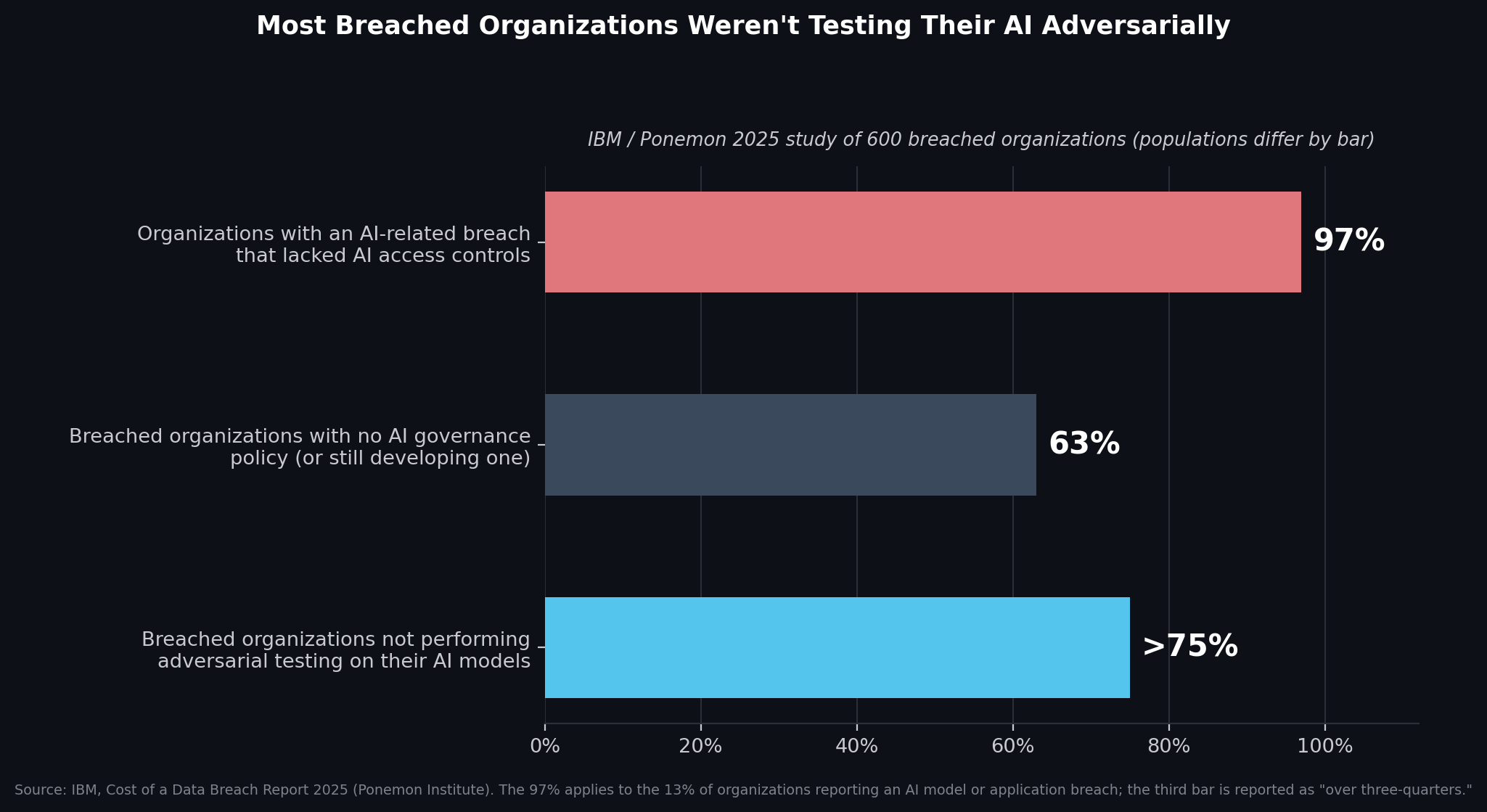
Three developments define the current environment, and the first one surprises most security teams.
US federal model risk guidance excludes generative AI. On April 17, 2026, the OCC, Federal Reserve, and FDIC jointly replaced SR 11-7, the 2011 framework most US bank model risk programs were built on, with SR 26-2 and OCC Bulletin 2026-13. The new guidance is principles-based, and by the agencies’ own scoping it places generative and agentic AI outside its coverage, pointing banks to broader risk management and governance practices while the agencies plan a separate request for information on AI. Practically, a bank deploying an LLM assistant has no dedicated supervisory model risk framework to anchor its testing to. That puts the burden on the institution to decide, and defend, what adversarial testing is adequate.
NYDFS already expects AI in your risk assessment. The Department’s October 16, 2024 industry letter imposes no new requirements, but it explains how Part 500 applies to AI: risk assessments under Section 500.9 should address the entity’s own use of AI, AI used by vendors, and the vulnerabilities of AI applications, and third-party diligence under Section 500.11 should cover AI providers. Law-firm analyses describe it as a roadmap of likely enforcement focus.
The EU timeline slipped, but the scope didn’t. DORA has applied across the EU since January 2025. Under the EU AI Act, AI systems used to evaluate the creditworthiness of individuals or establish their credit score, and those used for life and health insurance risk assessment and pricing, are classified high-risk. Regulation (EU) 2026/1744, the Digital Omnibus on AI, entered into force on July 27, 2026 and moved those obligations from August 2, 2026 to December 2, 2027. Systems used to detect financial fraud are carved out of the credit-scoring category, though they remain in scope of ordinary security and operational resilience expectations.
What the Breach Data Says About AI Oversight
IBM’s 2025 Cost of a Data Breach Report, based on 600 breached organizations, found 13 percent reported a breach of an AI model or application, and 97 percent of those lacked proper AI access controls. Across the breached organizations studied, 63 percent had no AI governance policy or were still developing one, and over three-quarters reported not performing adversarial testing on their AI models. Unauthorized “shadow AI” was involved in 20 percent of breaches and added an average of $670,000 to breach costs.
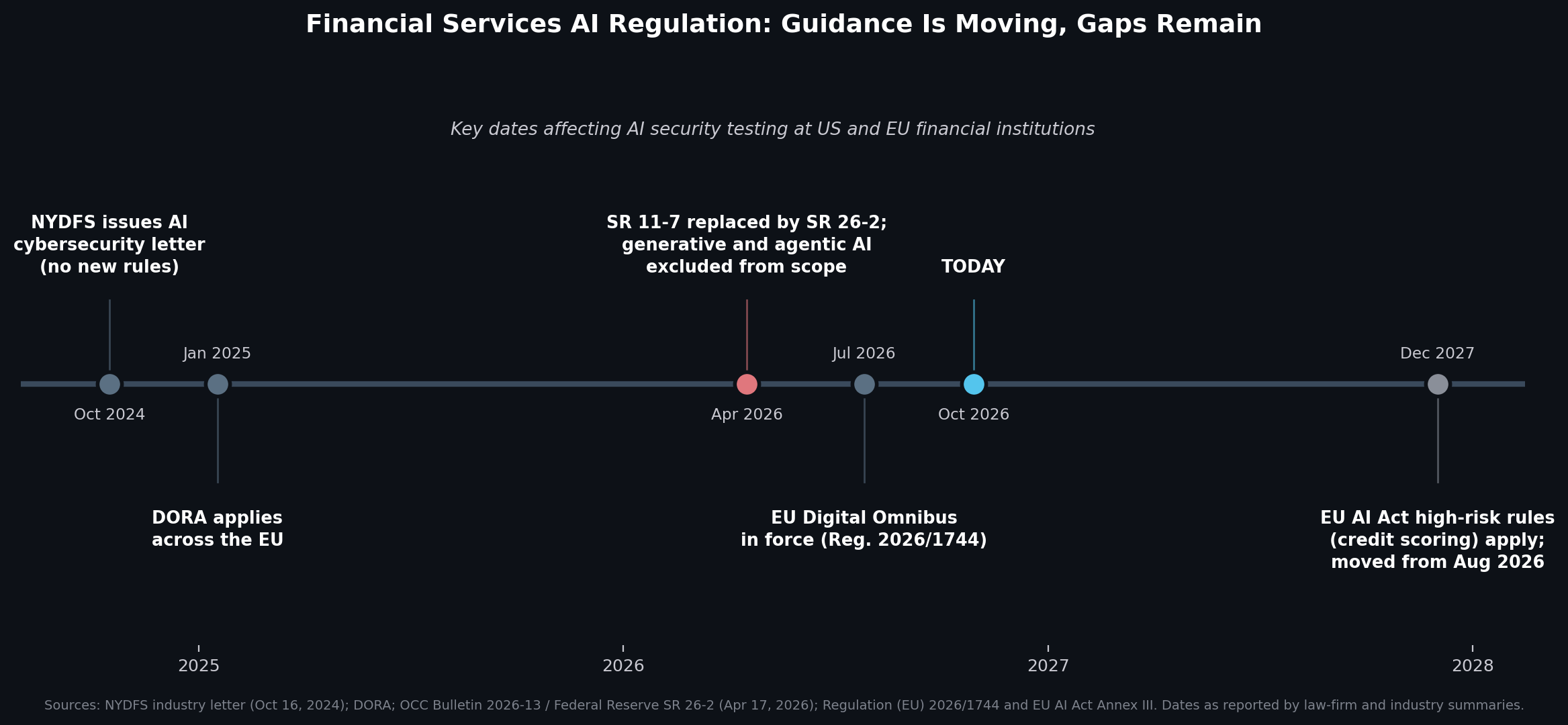
This data is cross-sector, not financial-services-specific, and it measures gaps in oversight, not a finding that adversarial testing prevents breaches. It still shows the control most relevant here, adversarial testing of AI, is the one most breached organizations weren’t performing.
Model Validation Is Not Adversarial Testing
Model validation and performance testing ask whether a model is accurate, stable, and fair. AI red teaming asks a different question: can an adversary make this system leak data, take unauthorized actions, or return manipulated output? A credit model can validate cleanly and still be vulnerable to inversion attacks that expose applicant data. An LLM assistant can pass accuracy testing and still follow instructions hidden in an uploaded document. Institutions need both, and the guidance gap above means the second isn’t handed to them by a supervisory letter.
Where Generative AI Is Attackable in a Financial Institution
The table below is illustrative: these are plausible attack paths mapped to the OWASP Top 10 for LLM Applications (2025), not documented incidents.
| AI system | Example attack path | OWASP LLM category | Why it matters |
|---|---|---|---|
| Customer-facing assistant (banking or insurance virtual agent) | Injected instructions or manipulation reveal another customer’s details or bypass identity checks | Prompt injection; sensitive information disclosure | NPI exposure and fraud enablement |
| Agentic assistant with service or payment tools | An agent is manipulated into actions beyond the user’s authorization, or tool parameters are attacker-chosen | Excessive agency | Unauthorized transactions and loss exposure |
| Internal copilot with retrieval over policies, client files, and deal documents | Retrieval returns documents the user shouldn’t see, such as across information barriers, or a poisoned document carries hidden instructions | Vector and embedding weaknesses; indirect prompt injection | Confidential and material non-public information leakage |
| Credit-decisioning and fraud models | Evasion inputs defeat fraud detection; inversion or membership inference exposes applicant data; training data is poisoned | Adversarial machine learning | Fraud losses, privacy exposure, fair lending risk |
| KYC, AML, and document summarization | Content in submitted documents manipulates summaries or risk outputs | Prompt injection; improper output handling | Integrity of compliance decisions |
How VerSprite Approaches AI Red Teaming for Financial Institutions
VerSprite’s AI red teaming and LLM penetration testing services apply PASTA, the risk-centric methodology co-created by VerSprite’s CEO, so each test ties to a business objective and a credible threat rather than a generic list of prompts. For a financial institution, the first stage defines what the AI system must protect: the decisions it influences, the customer and non-public information it touches, and the regulatory obligations that apply. Later stages map the full attack surface (models, system prompts, retrieval pipelines and vector stores, agent tools and MCP servers, and the APIs that expose them), document trust boundaries, model threats using MITRE ATLAS, and then build and run attack scenarios to confirm what is exploitable. Findings are ranked by exploitability and business impact, so remediation starts where it reduces the most loss and regulatory exposure.
Findings map to the frameworks risk and compliance teams already use: the OWASP Top 10 for LLM Applications (2025), MITRE ATLAS, the NIST AI Risk Management Framework and its Generative AI Profile, and ISO/IEC 42001 and EU AI Act requirements where they apply. For financial services, VerSprite describes adversarially testing fraud-detection, credit-scoring, and trading models and assessing LLM-powered financial assistants and agents for prompt injection, data leakage, and unauthorized transactions. The work is human-led, by offensive security practitioners rather than automated scanning alone. For continuous coverage as models and prompts change, Knife, VerSprite’s automated AI penetration testing platform, is included in its Penetration Testing as a Service offering. Typical deliverables include findings, AI-specific attack scenarios, business-impact prioritization, remediation recommendations, and executive and technical reporting, on timelines from a few weeks to a phased engagement. For sector context, see VerSprite’s financial services security solutions.
What Cybersecurity Firms Provide AI Red Teaming and LLM Penetration Testing?
Several firms publicly list AI-specific testing. Bishop Fox lists AI and LLM security assessments, and Schellman, Bridewell, and Praetorian each list an AI red teaming or AI/ML penetration testing service. we45 lists AI model security testing, RAG and agentic system assessments, MCP security assessments, and AI security architecture review. Smaller specialists, including CyberSigma, GRC Solutions, and TruvoCyber, also list AI red teaming or AI penetration testing services. VerSprite, which publishes this guide, delivers AI red teaming and LLM penetration testing. These firms aren’t ranked, and descriptions reflect their public service pages as of October 2026.
How to Evaluate a Provider for Financial Services
- Regulatory mapping. Can findings be reported in a form your examiners and risk teams use, such as evidence for a Part 500 risk assessment, NIST AI RMF, or EU AI Act documentation, given there is no US federal model risk framework to lean on for generative AI?
- Production and data safety. How will testers handle customer NPI and avoid disrupting live transaction systems, and what are the rules of engagement for agents that can move money or change account settings?
- Agentic depth. Does testing cover tool-level authorization, MCP trust boundaries, and confused-deputy attacks, not just the chat interface?
- Third-party AI. If your AI runs on a hosted foundation model, what testing is authorized under the provider’s terms, and how does the assessment connect to vendor due diligence?
- Risk-based prioritization. Are findings ranked by loss, fraud exposure, and regulatory impact instead of generic severity?
- Human-led depth and retesting. What do human testers do beyond automated prompt libraries, and how are fixes retested?
Limitations
No standard defines the scope of AI red teaming, so providers’ engagements vary widely. The IBM data is cross-sector and survey-based, and it measures oversight gaps, not outcomes of testing. Regulatory descriptions come from law-firm and industry summaries, and the US agencies’ planned request for information on AI means the federal picture may change. The attack-path table is illustrative, not incident-based. And testing is point-in-time, while models, prompts, and integrations change continuously.
Conclusion
For financial institutions, generative AI is moving into customer-facing and transaction-adjacent roles while supervisory guidance on how to test it is incomplete in the US and delayed in the EU. That leaves institutions to decide what adequate adversarial testing looks like, and to be able to show it. AI red teaming and LLM penetration testing produce that evidence: proven attack paths, ranked by business risk, mapped to the frameworks examiners and risk committees already recognize.
Frequently Asked Questions
Share
- /
- /
- /
- /
- /
- /
- /
- /
- /
- /
- /
- /
- /
- /
- /
- /
- /
- /
- /
- /
- /
- /