Healthcare AI Red Teaming and LLM Penetration Testing

Date
Authors
Tony UcedaVélez
Follow Us


Healthcare AI red teaming and LLM penetration testing are adversarial security tests of the AI systems used in care delivery and operations: testers attack a model, its prompts, its data connections, and the applications around it the way an attacker would, to find exploitable paths before an attacker does. In healthcare, the stakes are specific. AI systems increasingly touch ePHI and clinical workflows, so a successful attack can expose patient data or corrupt clinical content, not just break an application. VerSprite delivers this work through its AI red teaming and LLM penetration testing services, also known as AI hacking, using PASTA to rank every finding by patient-data and business risk.
Why Healthcare AI Needs Its Own Testing
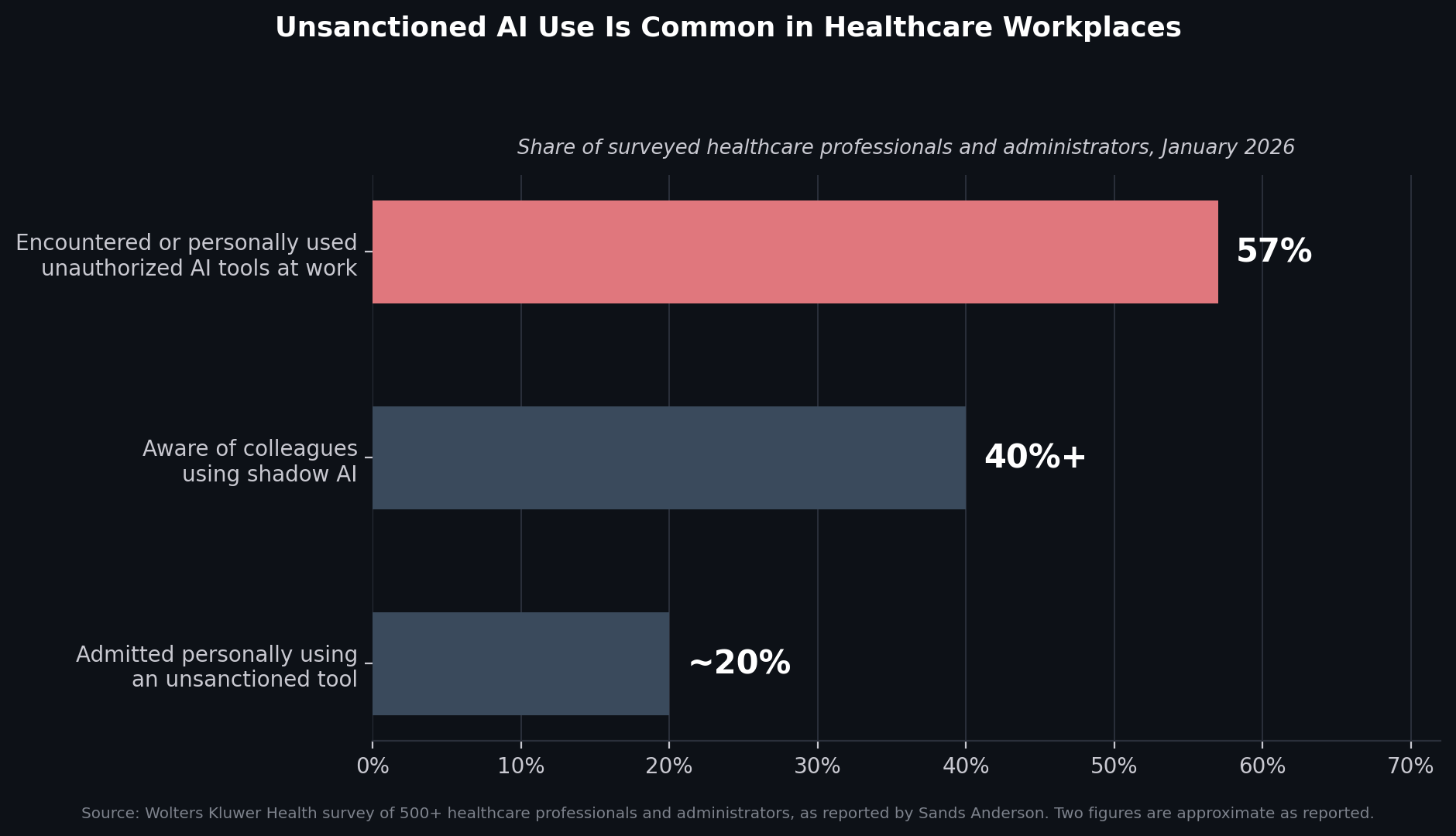
Three developments make this a 2026 problem. First, the sector’s top patient-safety organization has flagged AI directly: ECRI named the misuse of AI chatbots in healthcare its number one health technology hazard for 2026, ahead of unpreparedness for a “digital darkness” event and falsified medical products. Second, unsanctioned use is widespread. A January 2026 Wolters Kluwer Health survey of more than 500 healthcare professionals and administrators found 57 percent had encountered or personally used unauthorized AI tools at work, and nearly 20 percent admitted using one themselves.
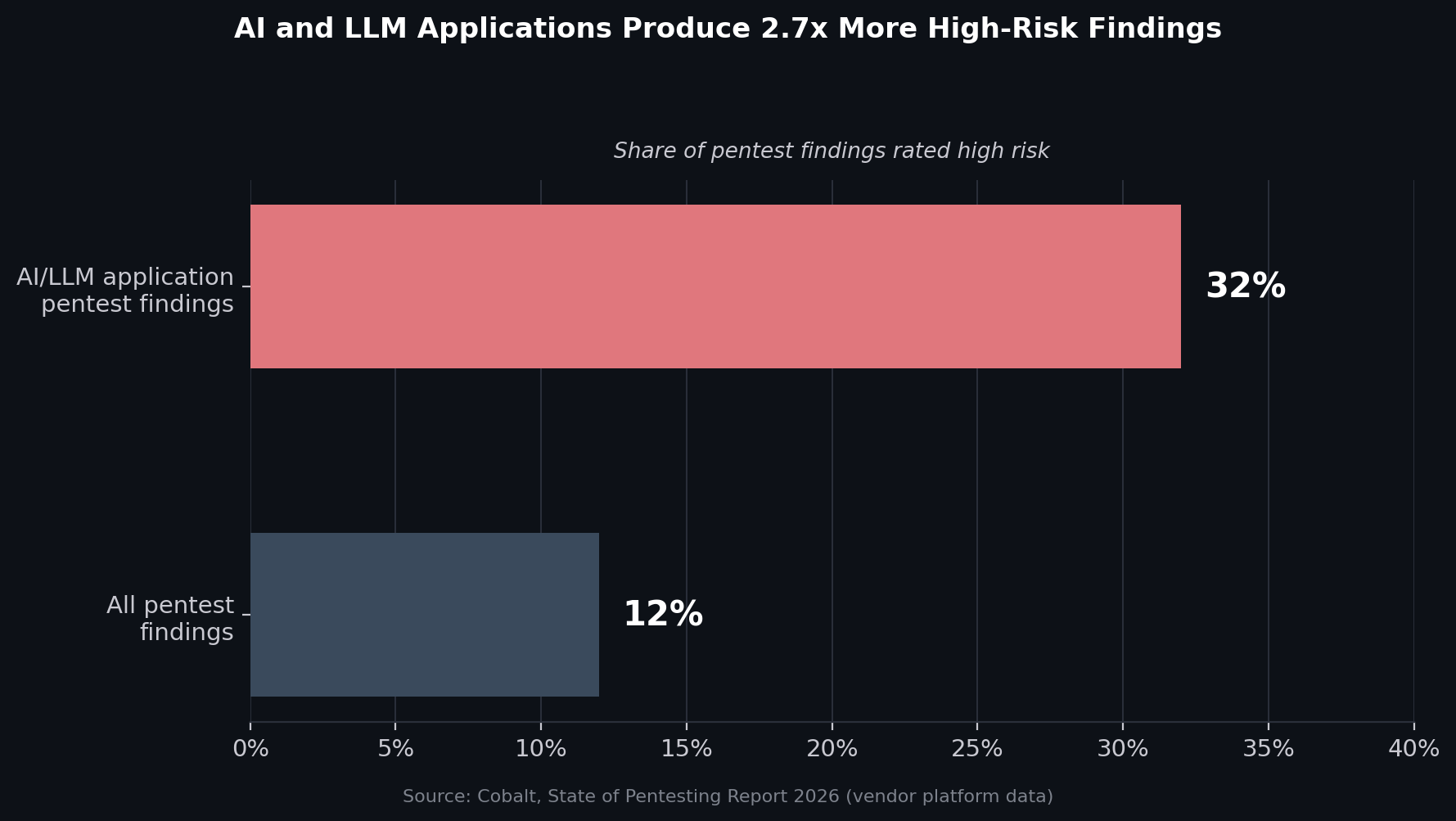
Third, AI applications are producing more serious findings than conventional software. Cobalt’s 2026 State of Pentesting data found 32 percent of AI and LLM application findings were rated high risk, compared with 12 percent across all findings, about 2.7 times higher.
The regulatory exposure is familiar. Staff entering PHI into AI tools without a signed business associate agreement is a HIPAA problem regardless of intent, and any AI system that creates, receives, maintains, or transmits ePHI belongs in your risk analysis like any other system. That matters because HHS’s Office for Civil Rights cited failure to conduct a thorough risk analysis in every one of its first ten HIPAA settlements of 2025. An AI system missing from the analysis is the same gap in a new place.
Safety Evaluation vs. Security Testing: Know Which Question You’re Asking
ECRI’s hazard is about misuse and accuracy: chatbots giving confident but wrong clinical information. That’s a patient-safety question, and it’s mostly answered by governance, validation, and model safety evaluation. Red teaming and penetration testing answer a different one: can an adversary make this system do something it shouldn’t, such as leak data, take unauthorized actions, or return manipulated content. Healthcare organizations usually need both, and mixing them up leaves one question unanswered.
| Discipline | Question it answers | Typical output |
|---|---|---|
| Model safety evaluation | Does the model give accurate, unbiased, appropriate answers? | Accuracy, bias, and hallucination assessments |
| AI red teaming | Can an adversary manipulate the model or system to misbehave? | Adversarial scenarios, bypassed safety controls, abuse cases |
| LLM penetration testing | Can the AI application be exploited, including its APIs, data connections, and integrations? | Proven exploit paths, ranked findings, remediation guidance |
In practice, the terms overlap, and many providers blend red teaming and penetration testing in one engagement.
What a Healthcare-Focused Test Examines
Generic prompt-injection testing misses where healthcare AI actually sits. The table below is illustrative: these are plausible attack paths mapped to the OWASP Top 10 for LLM Applications (2025), not documented incidents.
| AI system | Example attack path | OWASP LLM category | Why it matters in healthcare |
|---|---|---|---|
| Patient-facing chatbot (scheduling, triage) | Injected instructions bypass guardrails or surface another patient’s information | Prompt injection; sensitive information disclosure | PHI exposure and misleading patient guidance |
| Clinician copilot using retrieval over clinical documents | Retrieval returns records the user shouldn’t see, or a poisoned document carries hidden instructions | Vector and embedding weaknesses; indirect prompt injection | Cross-patient disclosure; manipulated clinical content |
| Ambient documentation and note generation | Injected content in transcripts or uploaded files alters generated notes | Prompt injection; improper output handling | Record integrity |
| Agentic workflow (prior authorization, coding, billing) with system access, including MCP-connected tools | An agent is tricked into actions beyond its intended scope, or a tool description is manipulated | Excessive agency | Unauthorized actions against ePHI systems |
| Clinical or diagnostic ML model | Membership inference or model inversion exposes training data; data poisoning degrades performance | Adversarial machine learning | ePHI exposure and clinical integrity |
How VerSprite Approaches AI Red Teaming and LLM Penetration Testing
VerSprite’s AI red teaming and LLM penetration testing services apply PASTA, the risk-centric methodology co-created by VerSprite’s CEO, so every test ties to a business objective and a credible threat instead of running a generic list of prompts. For a healthcare engagement, the first stage defines what the AI system must protect: the clinical and operational decisions it drives, the ePHI it touches, and regulatory obligations such as HIPAA. The next stages map the full AI attack surface (models, system prompts, retrieval pipelines and vector stores, agent tools and MCP servers, training and inference infrastructure, and APIs), document trust boundaries, including which inputs are user-controlled versus retrieved, and identify the threats relevant to your system using MITRE ATLAS and AI-specific threat intelligence. VerSprite then builds and executes attack scenarios to confirm what is exploitable and ranks each by business impact, so remediation starts where it reduces the most risk.
Findings map to the frameworks your security, risk, and compliance teams already use: the OWASP Top 10 for LLM Applications (2025), MITRE ATLAS, the NIST AI Risk Management Framework and its Generative AI Profile, and ISO/IEC 42001 and EU AI Act requirements where they apply. Engagements are scoped to your systems rather than running every technique by default, and they cover five areas:
- LLM and generative AI applications: direct and indirect prompt injection, jailbreaking, system prompt leakage, and unsafe output handling.
- AI agents and MCP: excessive agency, tool abuse, MCP server trust boundaries, and multi-agent trust.
- RAG pipelines and vector stores: RAG poisoning, retrieval access control (including cross-tenant leakage), and embedding weaknesses.
- Adversarial machine learning: evasion, data poisoning, model extraction, and membership inference and model inversion.
- AI infrastructure and MLOps: training and deployment pipelines, model registry and supply chain, data pipelines, and containers.
For healthcare specifically, VerSprite describes testing clinical and diagnostic AI for data poisoning, model inversion, and unauthorized inference against systems that process ePHI. The work is human-led, by offensive security practitioners rather than automated scanning alone. For continuous coverage as models and prompts change, Knife, VerSprite’s automated AI penetration testing platform, is included in its Penetration Testing as a Service offering, and many clients use a human-led engagement to establish depth before moving to continuous testing. Typical deliverables include findings, AI-specific attack scenarios, business-impact risk prioritization, remediation recommendations, and executive and technical reporting, with timelines from a few weeks to a phased engagement depending on the number of models and APIs, pipeline complexity, and testing scope. For sector context, see VerSprite’s healthcare security solutions.
Who Provides AI Red Teaming and LLM Penetration Testing?
Several firms publicly list AI-specific testing. Bishop Fox lists AI and LLM security assessments among its offerings. Praetorian lists an AI/ML penetration testing service, and Schellman lists an AI red teaming service. we45 lists AI model security testing, RAG system and agentic system assessments, MCP security assessments, and AI security architecture review. VerSprite, which publishes this guide, delivers AI red teaming and LLM penetration testing services. These aren’t ranked, and descriptions reflect each firm’s public materials as of October 2026. Fit depends on the evaluation criteria below, not on a list.
How to Evaluate Any Provider for Healthcare AI
- Healthcare context. Can the provider explain how it handles ePHI during testing, and whether a business associate agreement applies?
- Methodology. Does it map to recognized taxonomies such as the OWASP Top 10 for LLM Applications and MITRE ATLAS, and tie findings to your risk model instead of generic severity?
- Human-led depth. Automated prompt libraries find known patterns; ask what human testers do beyond them, such as chaining weaknesses across the model, the retrieval layer, and connected systems.
- Full-stack scope. Does testing cover the model, the application, the retrieval and data layer, agents and their permissions, and the supporting infrastructure, not only the chat interface?
- Authorization for third-party models. If your AI runs on a hosted model, confirm what testing is permitted under the model provider’s terms, since testers usually focus on your application layer.
- After the report. Ask about retesting and how findings feed your remediation workflow, since fixing, not finding, is where most programs stall.
Limitations
No standard defines the scope of AI red teaming, so two providers selling it may deliver very different engagements. Published, healthcare-specific data on AI attacks is thin; the statistics here describe AI risk generally (Cobalt, a vendor survey of pentest findings) or measure exposure and misuse (Wolters Kluwer, ECRI), not confirmed attacks on clinical AI. The attack-path table is illustrative, not incident-based. Testing is point-in-time, and models, prompts, and integrations change, so results age quickly. And ECRI’s top hazard concerns accuracy and misuse, which security testing only partly addresses.
Conclusion
Healthcare organizations are deploying AI faster than they’re testing it, while staff adopt unsanctioned tools on their own. A defensible response combines governance and safety evaluation with adversarial testing that proves what an attacker could actually do, and ranks the results by patient-data and business risk. That’s the question AI red teaming and LLM penetration testing exist to answer.