Fork for Financial Threat Modeling Bottlenecks
Date
Authors
Tony UcedaVélez
Follow Us


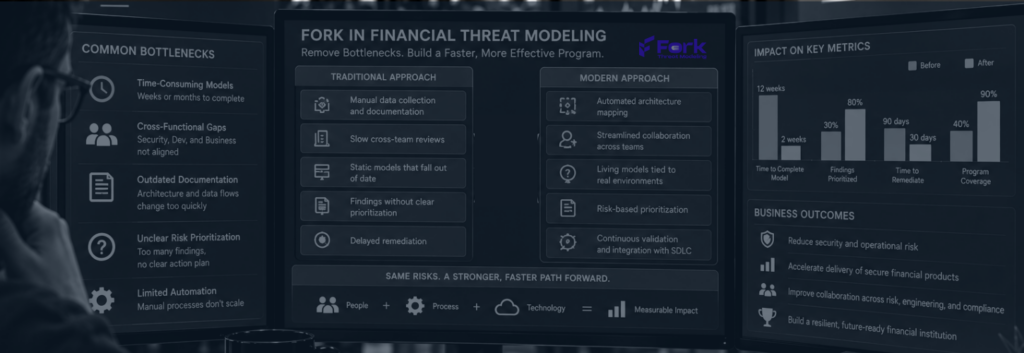
Financial institutions rarely disagree that risk-based threat modeling is worth doing. What slows them down is the process itself. A manual, workshop-based approach to financial threat modeling can take weeks to produce a single application’s threat model, and by the time it’s finished, the API integrations, cloud configuration, or third-party connections it describes have already changed. The workflow meant to reduce risk becomes a bottleneck that sits between security and the pace the business actually needs to move at.
Fork, VerSprite’s continuous application threat modeling platform, was built specifically to remove that bottleneck without cutting the rigor a regulated institution needs. Built on PASTA, the risk-centric methodology VerSprite’s founder co-created and accelerated by AI, Fork produces risk-centric threat models in under two hours and keeps them continuously aligned with how an application actually evolves. Below is where financial threat modeling typically stalls, and specifically how Fork addresses each point.
The Bottlenecks Slowing Down Financial Threat Modeling
1. Threat Models Take Too Long to Produce
A manual threat modeling workshop for a single application can consume days of scheduling, facilitation, and write-up before a financial institution has anything usable. For a portfolio of dozens or hundreds of applications, that timeline makes full coverage effectively impossible with a small team.
How Fork addresses it: Fork produces a risk-centric threat model in under two hours, using AI to accelerate the PASTA sequence business objectives, technical scope, decomposition, and threat analysis without skipping the stages that connect a finding to real business impact.
2. Models Go Stale the Moment They’re Finished
A threat model is a snapshot. Financial institutions ship changes to APIs, cloud infrastructure, and third-party integrations continuously, which means a model produced last quarter may no longer reflect what’s actually running in production.
How Fork addresses it: Fork ingests data continuously from SAST, DAST, software composition analysis, SBOM, and OVAL feeds, and manual penetration test findings, keeping the model aligned with the application as it changes rather than accurate only as of the last workshop.
3. Findings Aren’t Prioritized by Real Attacker Behavior
A list of technical findings ranked by generic severity doesn’t tell a financial institution which one an attacker would actually use, or what it would cost the business if they did.
How Fork addresses it: Fork contextualizes findings with live threat intelligence and full-stack vulnerability data, then applies dynamic residual risk scoring that updates automatically as new findings, tests, and threat intelligence come in so prioritization reflects current exposure, not a static score assigned once and left unchanged.
4. Validating Exploitability Requires a Separate, Slow Engagement
Knowing a theoretical attack path exists is different from knowing it’s actually exploitable. Confirming that difference has traditionally meant scoping and scheduling a separate penetration test, often weeks removed from the original threat model.
How Fork addresses it: Fork now integrates directly with Knife, VerSprite’s AI-led, human-on-the-loop adversarial testing platform. From inside a Fork threat model, a team can request targeted, on-demand testing of a specific weakness or attack pattern; Knife runs the assessment, and the results flow back into the model automatically, updating the application’s residual risk score without a separate engagement cycle.
5. Compliance Evidence Has to Be Rebuilt Every Exam Cycle
Financial institutions operating under GLBA, PCI DSS, and FFIEC guidance need evidence that security findings map to the frameworks examiners actually ask about. Reconstructing that mapping by hand for every exam is a recurring, avoidable cost.
How Fork addresses it: Because Fork’s findings are continuously correlated to threat intelligence and vulnerability data rather than assembled after the fact, the evidence trail an examiner needs already exists as a byproduct of the ongoing threat modeling process instead of a project undertaken each cycle separately.
6. Scaling Across a Large Application Portfolio Outpaces a Small Team
Even a fast, well-run manual process caps out at however many applications a small team can review in a given quarter, which leaves gaps in exactly the systems a financial institution can least afford to leave unmodeled.
How Fork addresses it: Fork Enterprise supports unlimited applications and teams, with the integrations, SSO, granular access controls, and audit logging a regulated institution needs to run threat modeling as a portfolio-wide program rather than a per-application project.
How Fork Is Built for This
Fork isn’t a generic automation layer applied to threat modeling after the fact; it’s a direct implementation of PASTA, the seven-stage risk-centric methodology co-created by VerSprite founder Tony UcedaVélez. That lineage matters for how the platform is structured: findings are prioritized by business impact rather than technical severity alone, attack scenarios are modeled to reflect realistic adversary behavior rather than a generic threat category, and the model is designed to be revisited continuously rather than treated as a one-time deliverable. The recent addition of Knife extends that same discipline into validation: an attack path Fork identifies as high-risk can be tested on demand rather than left as an untested hypothesis until the next scheduled penetration test.
