The Complete Guide to Modernizing Financial Threat Modeling
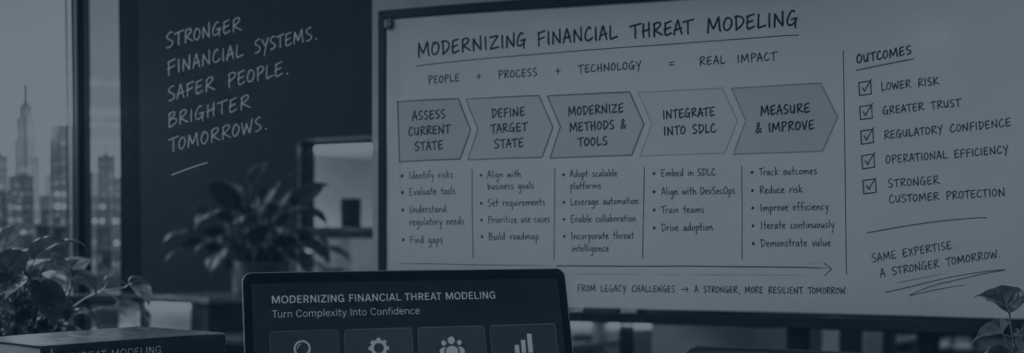
Most guidance on modernizing financial threat modeling assumes an institution is starting from zero: manual, slow, and ready to be replaced wholesale with an automated program. In practice, almost no institution is actually starting from zero. Most have some process already, a workshop cadence, a partially adopted tool, a methodology that exists on paper but isn’t consistently followed. The real diagnostic question isn’t “manual or automated.” It’s “which of five recognizable maturity levels is this institution actually operating at, and what does the next level genuinely require?”
This guide is organized around that maturity model rather than a single migration path, because the right next step depends entirely on where an institution starts. Jumping straight to Level 4 tooling while still operating a Level 2 process is one of the most common and most expensive mistakes financial institutions make when they try to modernize threat modeling, and it’s a mistake this guide is specifically built to help avoid.

The Five Levels of Financial Threat Modeling Maturity
Level 1: Ad Hoc
At this level, threat modeling happens inconsistently, if at all, driven by individual initiative rather than institutional process. There’s no standard methodology, no documentation practice, and no consistent record of what was reviewed or when. Findings, if they exist, live in an engineer’s notes or a single unreturned email thread rather than anywhere the organization can reference later.
Diagnostic signs: No repeatable process exists. Threat modeling happens only when a specific person champions it for a specific project. There’s no visibility into threat modeling activity at the compliance or board level, because there’s nothing consistent to report.
Level 2: Documented but Manual
A formal methodology exists, often STRIDE-based or an early, workshop-only version of a risk-centric approach, but it runs entirely through periodic, manual sessions. Threat models exist as static documents, typically reviewed once before a major release and rarely revisited afterward.
Diagnostic signs: Threat models are real documents with real findings, but they’re reviewed annually or per-release rather than continuously. Findings are often stale by the time anyone acts on them, since the system has usually changed since the review happened. This is where most financial institutions with a mature-sounding process actually sit.
Level 3: Partially Automated
The institution has adopted some tooling, but it operates in isolation from the workflows security and engineering teams actually use day to day. A platform might generate findings, but those findings still require manual export, manual triage, and manual translation into a ticket before anyone acts on them.
Diagnostic signs: A platform exists, but it isn’t connected to ticketing or CI/CD pipelines. Coverage is usually limited to a subset of the application portfolio, often just the highest-profile systems. Compliance evidence still gets assembled by hand before each exam, because the tooling’s output doesn’t map cleanly to what examiners ask for.
Level 4: Integrated and Continuous
Threat modeling is embedded directly into the software development lifecycle rather than treated as a separate exercise. Models update continuously as APIs, integrations, and infrastructure change. Findings route automatically to an accountable owner with a tracked deadline, and evidence for regulatory frameworks exists as a byproduct of the ongoing process rather than a separate project.
Diagnostic signs: Coverage extends across the full application portfolio, not just flagship systems. Findings are consistently tied to business impact rather than generic severity. When an examiner asks for evidence, it already exists rather than requiring a scramble to reconstruct it.
Level 5: Adaptive and Predictive
The institution correlates threat modeling output with live threat intelligence and adversarial validation, using trending residual risk data to anticipate exposure before it’s exploited rather than only reacting to what’s already been found. Threat modeling output actively informs business and product decisions, including decisions about where to invest security resources next, rather than only validating decisions already made.
Diagnostic signs: Security posture data feeds directly into enterprise risk management and board-level reporting. New product or architecture decisions get modeled before launch as a matter of course, not as an exception process. Very few financial institutions currently operate consistently at this level across their full portfolio.
How to Assess Your Institution’s Current Level
The honest answer is usually “different levels for different systems.” A flagship customer-facing application might receive Level 4 treatment while dozens of smaller internal or acquired systems sit at Level 1 or 2, invisible until an audit or incident forces attention. A useful assessment exercise is less about assigning the institution a single number and more about mapping which level each major system category currently sits at, since that map is what actually determines where modernization effort should go first.
A few direct questions help locate an institution’s real maturity level, as opposed to its aspirational one: When was the last time a threat model was updated because a system changed, rather than because a scheduled review came due? Can a specific person and deadline be named for every unresolved finding above a defined risk threshold? If an examiner asked for evidence tomorrow, would it already exist, or would someone need a week to assemble it? The more honest the answers, the more useful the resulting roadmap.
What Actually Changes Between Levels
The jump from Level 2 to Level 3 is primarily about tooling adoption. The jump from Level 3 to Level 4 is not, and this is where most modernization efforts stall. Moving from partially automated to integrated and continuous requires changes to ownership and process, not just software: findings need a defined, accountable owner rather than a shared queue; engineering teams need to treat threat modeling output as an input to their existing workflow rather than a separate compliance artifact; and leadership needs to sponsor the shift as a risk management priority rather than an IT project competing for attention with everything else on a roadmap.
The jump from Level 4 to Level 5 is different again, requiring threat intelligence integration and a level of cross-functional trust, security, risk, and the business genuinely acting on the same data, that most institutions haven’t built yet regardless of how mature their technical tooling is.
Common Traps When Jumping Levels
The most expensive mistake is procuring Level 4-capable tooling while the underlying methodology is still Level 2. A platform can generate findings continuously, but if there’s no consistent risk-scoring methodology behind it, and no defined ownership model for what happens to a finding once it’s generated, the result is a faster version of the same inconsistency the institution already had, not genuine progress. This is a specific instance of a broader security process challenge: technology adoption tends to outpace the organizational and governance changes it depends on, and the gap between the two is where modernization efforts most often lose momentum or credibility with the teams meant to use the new process.
A second common trap is treating every system as equally deserving of Level 4 investment immediately. Full-portfolio Level 4 maturity is a genuine end state worth working toward, but sequencing matters: the highest-risk, highest-exposure systems should reach Level 4 first, with the rest of the portfolio following on a realistic timeline rather than everything moving at once and nothing actually finishing.
Where This Leaves Financial Institution Security Leaders
Modernizing financial threat modeling isn’t a single project with a defined end date. It’s a maturity curve, and most of the actual work happens in the organizational changes between levels, not in the initial tooling decision. A PASTA-based methodology provides the consistent risk-scoring foundation that makes progress through these levels durable rather than cosmetic, and continuous platforms built on that methodology, Fork among them, are what make Level 4 and Level 5 maturity operationally realistic for an institution with a large application portfolio rather than an aspiration that stalls at the pilot stage.
Frequently Asked Questions
- /
- /
- /
- /
- /
- /
- /
- /
- /
- /
- /
- /
- /
- /
- /
- /
- /
- /
- /
- /
- /
- /