Best Penetration Testing Firms Compared for 2026

Date
Authors
Tony UcedaVélez
Follow Us


There is no single best penetration testing firm for a regulated enterprise. There is a best fit for your regulator, your scope, and how your team fixes what the test finds. In 2026, the penetration testing firms most often shortlisted by healthcare organizations, financial institutions, and government agencies fall into six models: specialist offensive-security consultancies, enterprise PTaaS providers, crowdsourced platforms, compliance-integrated assessors, platform vendors with services, and methodology-led firms. This guide compares them on four criteria regulated buyers should weigh, discloses that VerSprite, which publishes it, is one of the firms, and says plainly where the evidence is thin.
Disclosure: VerSprite offers penetration testing, including Penetration Testing as a Service, so it appears below as one option among several. Firms aren’t ranked, because the models aren’t interchangeable and a single score would hide the tradeoffs that matter. Descriptions come from each firm’s public materials as reviewed in October 2026, not from engagements or demonstrations.
How to Read “Best Penetration Testing Companies” Lists
Many widely cited lists of ethical hacking firms and security assessment providers are published by firms that appear in their own rankings, and several assign scores or “best for” labels without a disclosed method. Directory pages add another layer: placement can follow listing tier, not test quality. That doesn’t make every list wrong. It means a list is a starting point for a shortlist, and the criteria below are what turn it into a decision.
Four Criteria That Matter to Regulated Buyers
1. Qualification and independence your regulator recognizes
Regulated buyers don’t get to pick a tester on reputation alone. The rules constrain who can test.
| Regime | What it asks of the tester | What to request |
|---|---|---|
| PCI DSS 4.0, Requirement 11.4 | Testing by a qualified internal resource or external third party with organizational independence, annually and after significant change | Tester qualifications, an independence statement, methodology documentation |
| DORA threat-led testing (TLPT), Articles 26-27 and RTS (EU) 2025/1190 | For designated entities, TLPT at least every three years. External testers need a manager with five or more years of experience, at least two testers with two or more years each, five references, professional indemnity insurance, and accreditation-body certification or adherence to a formal code of conduct. Every third TLPT must use fully external testers | CVs, certifications, references, insurance evidence |
| FedRAMP and NIST SP 800-53 (CA-8) | Penetration testing is a required control, and FedRAMP assessments include testing performed through an accredited third-party assessment organization (3PAO) | 3PAO status and prior assessment experience |
| HIPAA Security Rule | Doesn’t currently name penetration testing; the proposed 2025 update would require it annually, but it isn’t final | A documented methodology that would satisfy either outcome |
External validation helps here. CREST accreditation, for example, requires an independent assessment of a firm’s methodology, quality assurance, and data handling, which is the kind of evidence a PCI or DORA reviewer can check. VerSprite’s own CREST accreditation covers penetration testing.
2. Safe testing in clinical and production environments
For healthcare organizations, the question isn’t only “can they find it” but “can they test without disrupting patient care.” Ask about:
- Rules of engagement for production clinical systems and connected medical devices, including testing windows and an immediate stop procedure.
- ePHI handling. Testers may encounter protected health information, so confirm whether a business associate agreement applies and is signed before testing begins.
- Integration and API coverage, including patient portals and interoperability interfaces such as HL7 and FHIR, where much of the exposure sits.
- Clinical context in reporting, so findings are ranked by patient-safety and data impact, not only technical severity.
3. Depth, method, and scope
Vulnerability testing (scanning) finds known weaknesses; penetration testing proves what an attacker can actually do with them. PCI DSS 4.0 explicitly rules out presenting an exported scan as a penetration test, so confirm what’s being sold. Ask for the manual-to-automated split, which at least one large provider publishes (Rapid7 states 85 percent manual and 15 percent automated), and for how the firm tests authorization and business-logic flaws that scanners miss.
AI scope is now a real differentiator. Cobalt’s 2026 State of Pentesting Report found 32 percent of AI and LLM application findings were rated high risk, compared with 12 percent across all findings, about 2.7 times higher.
If AI-enabled features are in your scope, ask whether the firm has tested them, with what methodology, and whether the testers are the same people who’ll test your core applications. Scoping method matters too: risk-based scoping, such as PASTA-driven attack paths, concentrates effort on what the business would lose most, where asset-count scoping spreads it evenly.
4. What happens after the report
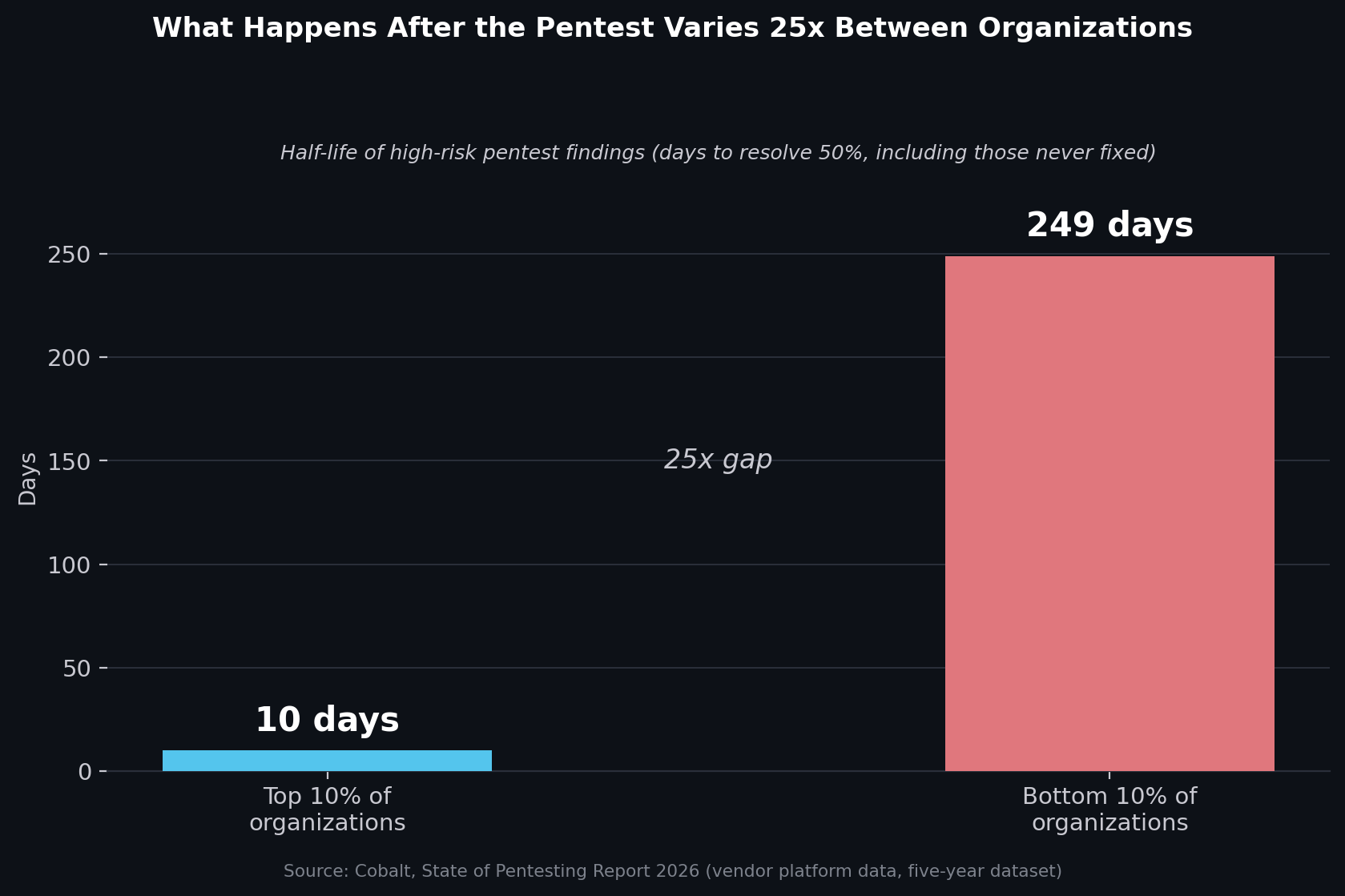
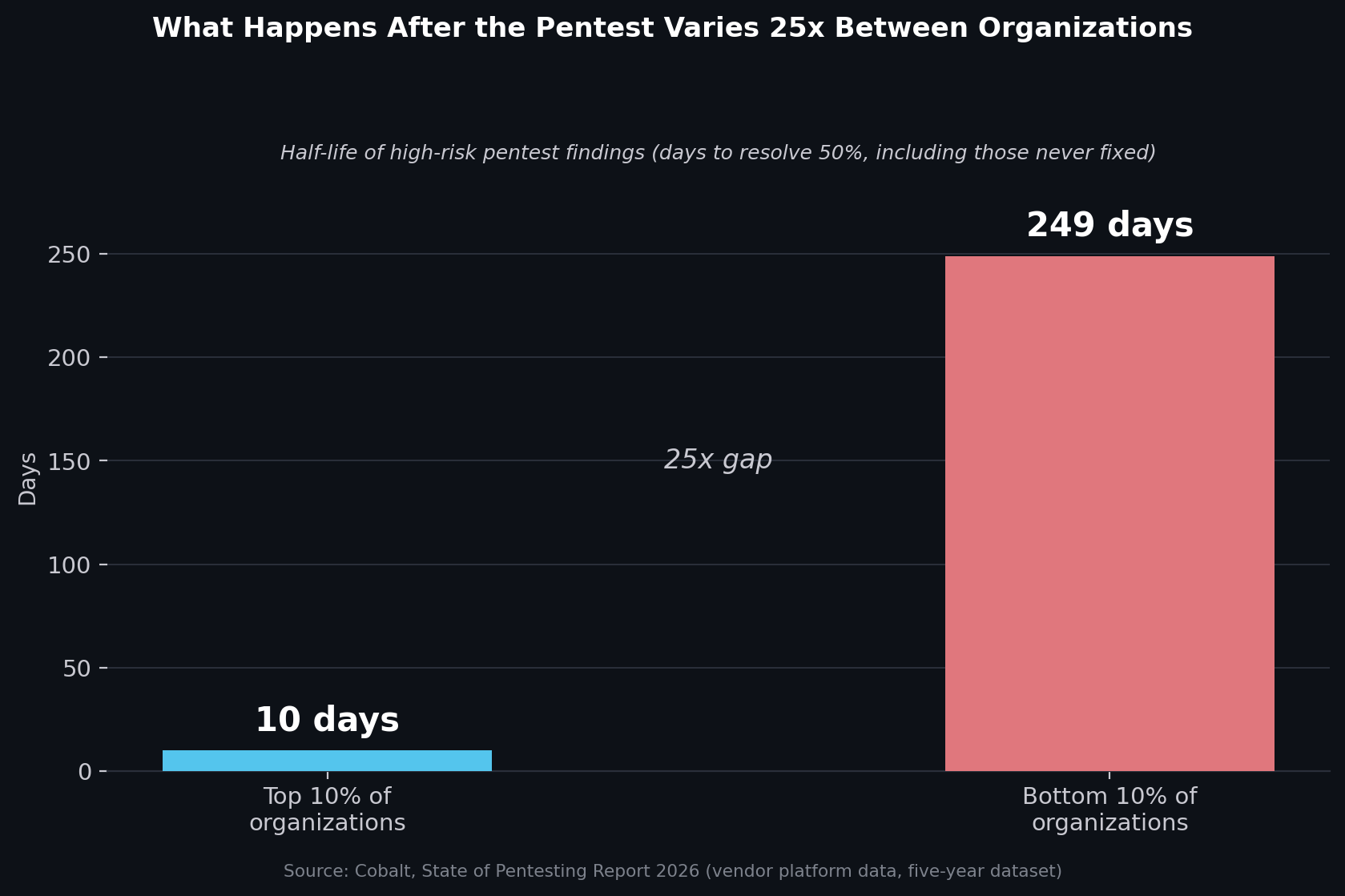
The same dataset shows where the value is actually decided. Cobalt’s five-year analysis found the half-life of high-risk findings, the time to resolve half of them including those never fixed, was 10 days for the top 10 percent of organizations and 249 days for the bottom 10 percent, a 25x gap.
Organizations running a programmatic, continuous approach were 4.5 times more likely to resolve critical findings within three days than those treating testing as an ad hoc or compliance-driven task. The practical reading for a buyer: a firm’s report matters less than whether findings get fixed, so weigh retesting terms, remediation support, ticketing integration, and on-demand or continuous options as heavily as technical depth.
Treat these numbers with care. They come from one PTaaS vendor’s own platform, and pooled resolution rates (about 52 percent of all findings) differ sharply from the typical organization’s rate (86 percent of high-risk findings) because the pooled figure is weighted toward organizations with the most findings.
Penetration Testing Firms Compared by Model
| Model | Examples (publicly described) | Typical strengths | Tradeoffs to test | Fit for regulated buyers | ||
|---|---|---|---|---|---|---|
| Specialist offensive-security consultancy | Bishop Fox, NCC Group | Depth, adversary emulation, custom research; Bishop Fox lists application, cloud, hardware, code, and AI/LLM assessments | Engagement-based scheduling and pricing; confirm retesting terms and report format | Complex, high-stakes scopes and threat-led testing | ||
| Enterprise PTaaS | NetSPI, Cobalt | Continuous or on-demand testing with platform-delivered findings and retesting | Depth varies by scope and tester; confirm the manual-testing share | Teams testing on a release cadence | ||
| Crowdsourced platform | Synack, HackerOne | Large researcher pools and continuous coverage; Synack publishes FedRAMP authorization | Per-researcher depth varies; confirm vetting, scope control, and data handling | Federal-adjacent programs and broad continuous coverage | ||
| Compliance-integrated assessor | Coalfire | Pairs offensive testing with assessment work; its offensive-security page cites 3PAO expertise across PCI, HIPAA, and FedRAMP | Confirm how testing scope and findings feed the assessment, and who owns each | Buyers who want testing aligned to an assessment program | ||
| Platform vendor or incident-response-heritage firm | Rapid7, Mandiant, IBM X-Force Red | Testing within a broader security relationship, including managed security services | Testing may be one service among many; ask about dedicated testers | Organizations consolidating vendors | ||
| Methodology-led firm | VerSprite (publisher of this guide) | PASTA-based risk scoping; PTaaS delivered through Tavola; CREST-accredited for penetration testing since 2019; AI-led, human-on-the-loop testing through Knife; sector work in healthcare, financial services, and government | Confirm delivery footprint and capacity for your volume | Programs that want testing tied to a threat model and business risk |
A Practical Selection Process
- Map your regimes to tester requirements using the table above, and write down what evidence each requires.
- Define scope beyond the obvious, including APIs, cloud, clinical integrations, and any AI-enabled features.
- Request a sample report and the retesting terms before you talk pricing, and read how findings are ranked and explained.
- Check references in your own sector, and ask what happened after delivery, not only what was found.
- Run a scoped pilot on one real system and measure how long findings take to resolve, not only how many were found.
- Decide on cadence. If your deployment pace outruns an annual test, compare PTaaS and continuous options on the same criteria.
For VerSprite’s offerings, see Penetration Testing as a Service, penetration testing, and AI hacking services, alongside sector pages for healthcare, financial services, and government.
Limitations
This comparison reflects public materials as of October 2026, not engagements, and the firms named are illustrative, not exhaustive. No independent benchmark compares penetration test quality across firms, so the criteria come from regulatory text and the structure of the problem, not measured outcomes. The remediation data is a single vendor’s platform dataset. The DORA tester requirements are drawn from the regulation as summarized by secondary sources and should be checked against Commission Delegated Regulation (EU) 2025/1190. And the publisher is one of the firms, which is why nothing here is ranked and every claim about another firm is limited to what it says publicly.
Conclusion
Choosing among penetration testing firms is a fit question. Regulatory qualification decides who is allowed to test, healthcare safety decides whether testing is acceptable in clinical environments, depth and method decide what gets found, and the post-report process decides whether any of it reduces risk. Weigh all four, and treat any list that skips them, including this one, as a starting point.
| Model | Examples (publicly described) | Typical strengths | Tradeoffs to test | Fit for regulated buyers |
|---|---|---|---|---|
| Specialist offensive-security consultancy | Bishop Fox, NCC Group | Depth, adversary emulation, custom research; Bishop Fox lists application, cloud, hardware, code, and AI/LLM assessments | Engagement-based scheduling and pricing; confirm retesting terms and report format | Complex, high-stakes scopes and threat-led testing |
| Enterprise PTaaS | NetSPI, Cobalt | Continuous or on-demand testing with platform-delivered findings and retesting | Depth varies by scope and tester; confirm the manual-testing share | Teams testing on a release cadence |
| Crowdsourced platform | Synack, HackerOne | Large researcher pools and continuous coverage; Synack publishes FedRAMP authorization | Per-researcher depth varies; confirm vetting, scope control, and data handling | Federal-adjacent programs and broad continuous coverage |
| Compliance-integrated assessor | Coalfire | Pairs offensive testing with assessment work; its offensive-security page cites 3PAO expertise across PCI, HIPAA, and FedRAMP | Confirm how testing scope and findings feed the assessment, and who owns each | Buyers who want testing aligned to an assessment program |
| Platform vendor or incident-response-heritage firm | Rapid7, Mandiant, IBM X-Force Red | Testing within a broader security relationship, including managed security services | Testing may be one service among many; ask about dedicated testers | Organizations consolidating vendors |
| Methodology-led firm | VerSprite (publisher of this guide) | PASTA-based risk scoping; PTaaS delivered through Tavola; CREST-accredited for penetration testing since 2019; AI-led, human-on-the-loop testing through Knife; sector work in healthcare, financial services, and government | Confirm delivery footprint and capacity for your volume | Programs that want testing tied to a threat model and business risk |