What Is Attack Surface Analysis for Threat Modeling?
Date
Authors
Tony UcedaVélez
Follow Us


Attack surface analysis is the process of identifying every point where an attacker can interact with a system, including APIs, cloud services, identities, and third-party integrations, and then evaluating each entry point by the trust boundary it crosses and the business consequence if it’s abused. In advanced threat modeling, it’s the step that turns “everything that exists” into “what an attacker can actually reach, and what it would cost us.” For APIs and cloud applications, where the surface changes with every deployment, doing it early in design is the difference between finding an exposure in a design review and finding it in an incident report.
Attack Surface Enumeration vs. Attack Surface Analysis
The two get conflated constantly. Enumeration is inventory: how many endpoints, how many internet-facing services, how many storage buckets. Scanners and attack surface management tools do this well, and it’s a necessary first step.
Attack surface analysis is what happens next. It asks which of those entry points sit on a trust boundary, what sits behind each one, and what a realistic attacker could do with it. A list of 600 endpoints is an inventory. A ranked view of the six that expose customer data without strong authorization is an analysis. Threat modeling supplies the second part, and it’s the part a checklist can’t, because a checklist asks whether controls exist, not whether they hold at the boundaries that matter.
What Attack Surface Analysis Examines in APIs and Cloud Applications
A design-stage analysis works through four categories:
- Entry points: API endpoints, authentication flows, webhooks, admin interfaces, cloud storage and IAM roles, third-party integrations, and, increasingly, the tool definitions that AI agents use to call internal systems.
- Trust boundaries: where data crosses from authenticated to unauthenticated contexts, between tenants, between services, and between your environment and a vendor’s.
- What sits behind each entry point: the data sensitivity and business function an attacker would reach, which is what turns a technical finding into a risk.
- Existing exposure: which paths require no authentication at all, and which rely on authorization logic that only works if every caller behaves.
What the Current Data Shows
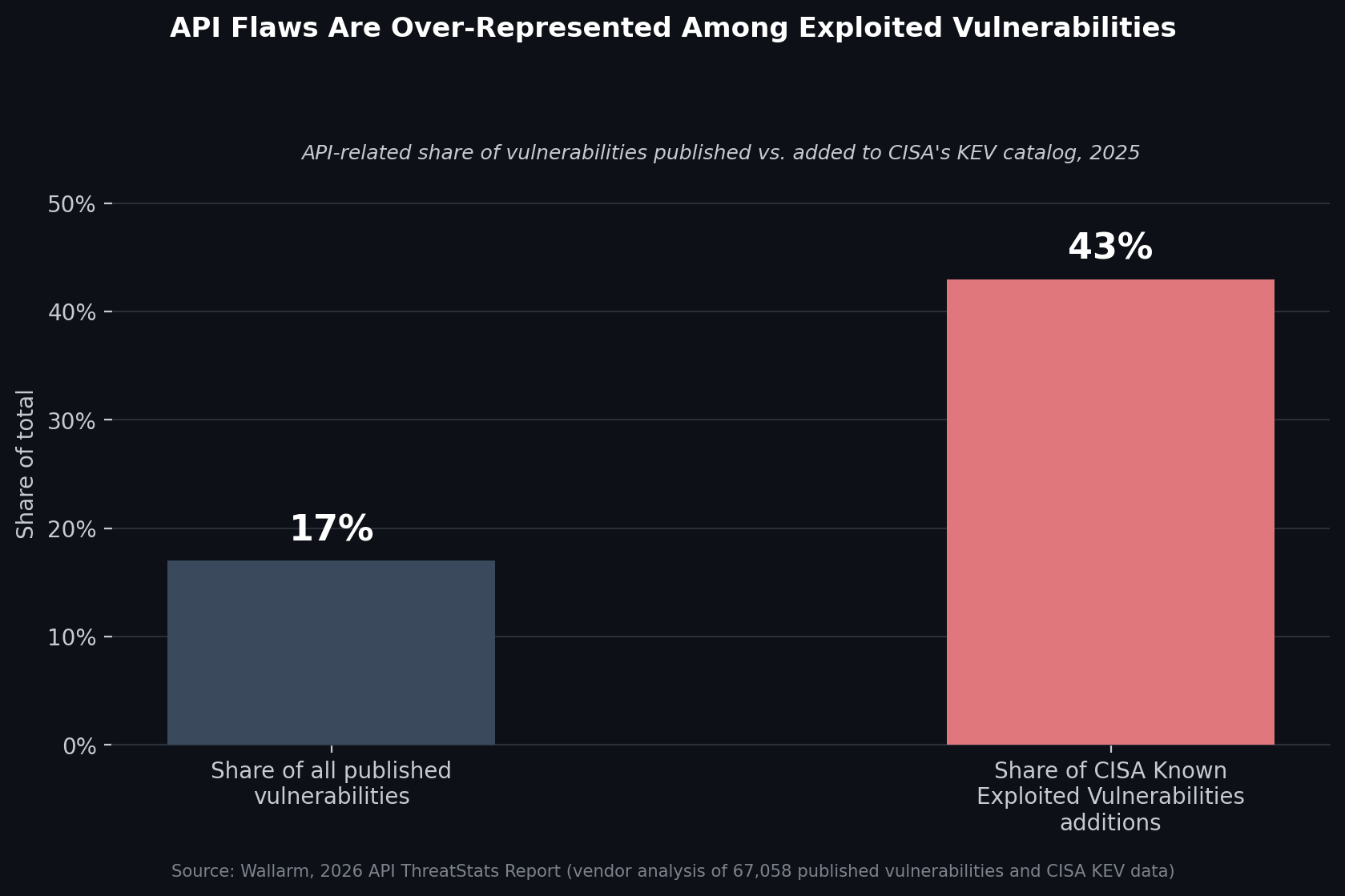
APIs are over-represented where it counts. Wallarm’s 2026 API ThreatStats Report, analyzing 67,058 vulnerabilities published in 2025, found API-related flaws made up 17 percent of all published vulnerabilities but 43 percent of the entries CISA added to its Known Exploited Vulnerabilities catalog that year. The same report found 59 percent of API vulnerabilities require no authentication at all.
Awareness isn’t the gap. Salt Security’s 2025 CISO report found 73 percent of CISOs rank API security a high or critical priority, yet only 19 percent have full visibility into their API inventory, 27 percent at large enterprises and 12 percent at smaller organizations.
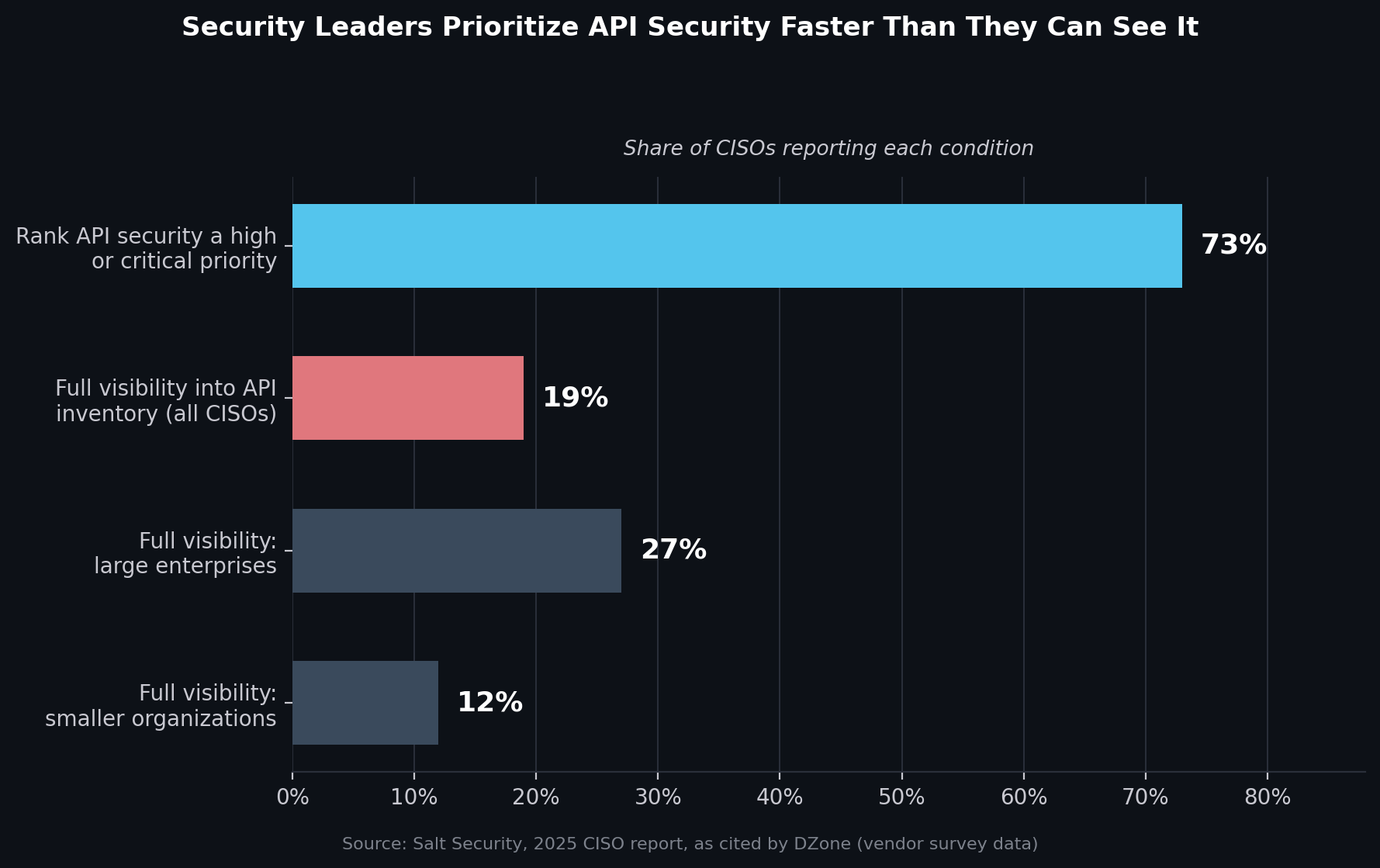
Both datasets come from API security vendors, so read the magnitudes as directional. The pattern is still consistent: attackers favor APIs, and most organizations can’t yet see their own.
The Shadow API Question Is Less Settled Than It Sounds
Shadow APIs, endpoints nobody documented or retired, get cited as the headline risk, and the estimates are all over the map: “over 20 percent” of API inventory in one source, 30 to 40 percent of the footprint in another, 40 to 60 percent more endpoints than documented in a third. None comes from a standardized, independent benchmark, and several trace back to vendors who sell discovery tooling.
A countervailing finding deserves equal weight. 42Crunch’s State of API Security 2026 report, built on two years of curated real-world vulnerability and exploit cases, found breaches through unmanaged or undocumented APIs are uncommon; most API exploitation involves known endpoints with failures in input validation, authentication, or operation-level authorization. If that holds, discovery is necessary but not sufficient. The more consequential question for many teams isn’t “what APIs don’t we know about” but “how does authorization actually work on the ones we do.”
How Attack Surface Analysis Strengthens Advanced Threat Modeling
Advanced threat modeling differs from a checklist review in one way that matters here: findings are weighed against business consequence instead of matched against a generic pattern. Attack surface analysis supplies the raw material. In PASTA, the methodology VerSprite’s CEO co-created, business objectives and technical scope come first, then decomposition maps components, data flows, and trust boundaries. Entry points identified there feed threat and vulnerability analysis, so what gets ranked is exposure that connects to something the business would actually lose.
That’s also why this belongs early. A security design review that catches an unauthenticated path to sensitive data costs a design conversation. The same path found in production costs a remediation sprint, or worse. For fast-moving API and cloud environments, application threat modeling and continuous threat modeling exist for the same reason: an analysis done once describes a surface that has already changed.
Four Questions for a Security Design Review
- What can an unauthenticated caller reach? Start with the paths that require no credentials, since those carry the lowest attacker cost.
- Where do the trust boundaries sit? Identify tenant boundaries, service-to-service calls, and third-party dependencies, and check which are enforced by design rather than assumed.
- What does each entry point expose? Tie every endpoint to the data and business function behind it, so severity reflects consequence.
- What will change this surface next? New integrations, deployments, and agent tooling all add entry points. Decide how the analysis will stay current rather than assuming a point-in-time review will hold.
Limitations
This analysis works best at design time, and design time has limits. It can’t see runtime drift, such as an endpoint added after review or a configuration changed in production, so it needs paired validation and monitoring. The statistics here come mainly from vendors with a commercial interest in API visibility, and the shadow API estimates aren’t independently benchmarked. And no study cited here links attack surface analysis practice to fewer incidents; the case rests on the structure of the problem and the exploitation data in Figure 1, not a measured before-and-after.
Conclusion
Attack surface analysis is what separates a long list of endpoints from a ranked understanding of exposure. For APIs and cloud applications, where the surface shifts continuously, and most organizations can’t yet see all of it, it’s the step that makes threat modeling advanced rather than merely thorough: every entry point weighed by the boundary it crosses and what it would cost if abused.
Bringing PASTA into API Testing
PASTA Threat Modeling for API Security Testing
PASTA (Process for Attack Simulation and Threat Analysis) applies a seven-stage, business-risk-driven methodology to API security testing — moving beyond simple vulnerability scanning to prioritize threats based on actual business impact. APIs are the backbone of most modern web applications, and that interconnectivity introduces security risks that generic testing checklists often miss.