AI Supply Chain Attacks: Why Trusted AI Artifacts Are Becoming a Primary Attack Vector
Date
Authors
Tony UcedaVélez
Follow Us


The software supply chain problem has entered a new operational phase. The attacker no longer needs to compromise only source code, package registries, build pipelines, or signing keys. In the AI supply chain, the attacker can also compromise trust in models, prompts, agent skills, documentation, package descriptions, tool permissions, and runtime autonomy.
This changes the threat model.
A PASTA-informed analysis places the highest concentration of risk across Stage III: Decomposition, Stage IV: Threat Analysis, Stage V: Weakness Analysis, and Stage VI: Attack Modeling. These are the stages where defenders must stop treating AI artifacts as static files and start modeling them as executable influence channels.
Recent campaigns against Hugging Face, ClawHub, OpenClaw, npm, PyPI, GitHub Actions, and agentic coding workflows show that trusted AI artifacts are becoming a primary attack vector.
Executive Summary
AI supply chain security now extends beyond traditional software dependencies. It includes models, prompts, agent skills, repositories, package metadata, coding-agent recommendations, and runtime permissions.
The immediate risk is not only model poisoning. The dominant near-term risk is trusted artifact abuse combined with agent execution authority.
Controls that stop at SBOM compliance, package provenance, and vulnerability scanning will miss attacks that operate through semantic manipulation, indirect prompt injection, deceptive documentation, and agent runtime abuse.
Acronis TRU recently documented active abuse of Hugging Face and ClawHub/OpenClaw for malware delivery, including 575+ malicious OpenClaw skills across 13 developer accounts targeting Windows and macOS with trojans, cryptominers, and AMOS stealer payloads. The same research noted the use of hidden commands, malicious dependencies, and indirect prompt injection as part of the attack pattern.
What Happened: Hugging Face and ClawHub Became Malware Delivery Infrastructure
Attackers poisoned AI distribution channels by publishing malicious agent skills and using trusted AI platforms as staging infrastructure.
In the Acronis TRU research, attackers abused ClawHub/OpenClaw by publishing hundreds of skills that appeared useful but contained malicious instructions or installation paths. These skills instructed users or AI agents to execute encoded commands, retrieve external payloads, or install hidden dependencies. Hugging Face repositories were also used as staging infrastructure in multistep infection chains.
This matters because agent skills are not passive content. They often define what an AI agent can do, what tools it can call, what files it can access, what network destinations it can reach, and what commands it can execute.
That creates a new supply chain equation:
Trusted artifact + agent authority = executable risk
The artifact may look benign. The execution path may not.
Why AI Supply Chain Risk Is Different
Traditional software supply chain security focused on package integrity, source provenance, build repeatability, signing, dependency visibility, and known vulnerability detection.
Those controls remain necessary. They are not sufficient.
AI supply chain risk is broader because trust is delegated to language and context. An agent can be influenced by a README, a prompt, a skill manifest, a package description, a repository instruction file, a model card, or an external document loaded at runtime.
That means the attack surface now includes:
- Model repositories
Attackers can use model hubs and AI marketplaces to host malicious artifacts, poisoned examples, or payload staging components. - Agent skills and tool definitions
Skills can instruct agents to fetch payloads, run shell commands, access credentials, or interact with external systems. - Package descriptions and documentation
Attackers can optimize text so that coding agents select malicious packages over legitimate alternatives. - Prompt and instruction channels
Hidden instructions and indirect prompt injection can influence agent behavior without looking like traditional malware. - Runtime execution permissions
Agentic systems often have file, shell, network, repository, and secret access. That turns trust into execution authority.
The result is a supply chain that no longer stops at code. It extends into semantics, identity, tool permissions, and runtime behavior.
PASTA Decomposition: Where the Risk Concentrates
Using PASTA, this attack class becomes clearer when decomposed across stages III through VI.
Stage III: Decomposition
Decompose the AI delivery chain into trust boundaries:
- Model repositories
- Skill marketplaces
- Package registries
- CI/CD workflows
- Prompt and instruction channels
- Agent tools
- Runtime execution environments
- Secret stores
- Developer workstations
- Cloud credentials
The critical question is not only “Where does code come from?” It is also “Where does agent behavior come from?”
Stage IV: Threat Analysis
Threat actors abuse trust in several ways:
- Listing trust in marketplaces
- Maintainer identity and fake developer personas
- Agent selection logic
- Package recommendation workflows
- Developer urgency and workflow automation
- Default trust in GitHub repositories and install instructions
PromptMink is a clear example of this shift. Cloud Security Alliance summarized the campaign as a North Korea-linked operation in which Famous Chollima deliberately engineered malicious npm packages to be selected and installed by AI coding agents rather than humans. The reported technique exploited AI package-recommendation behavior by crafting plausible package documentation for agent confidence and selection heuristics.
Stage V: Weakness Analysis
The weaknesses are not limited to vulnerable code. They include:
- Weak semantic review of documentation and prompts
- Overtrusted package metadata
- Lack of behavioral install controls
- Excessive agent runtime privilege
- Missing egress restrictions
- Human approval gaps
- Weak publisher identity validation
- CI/CD credential reuse
- Build cache poisoning
- Inadequate runtime telemetry
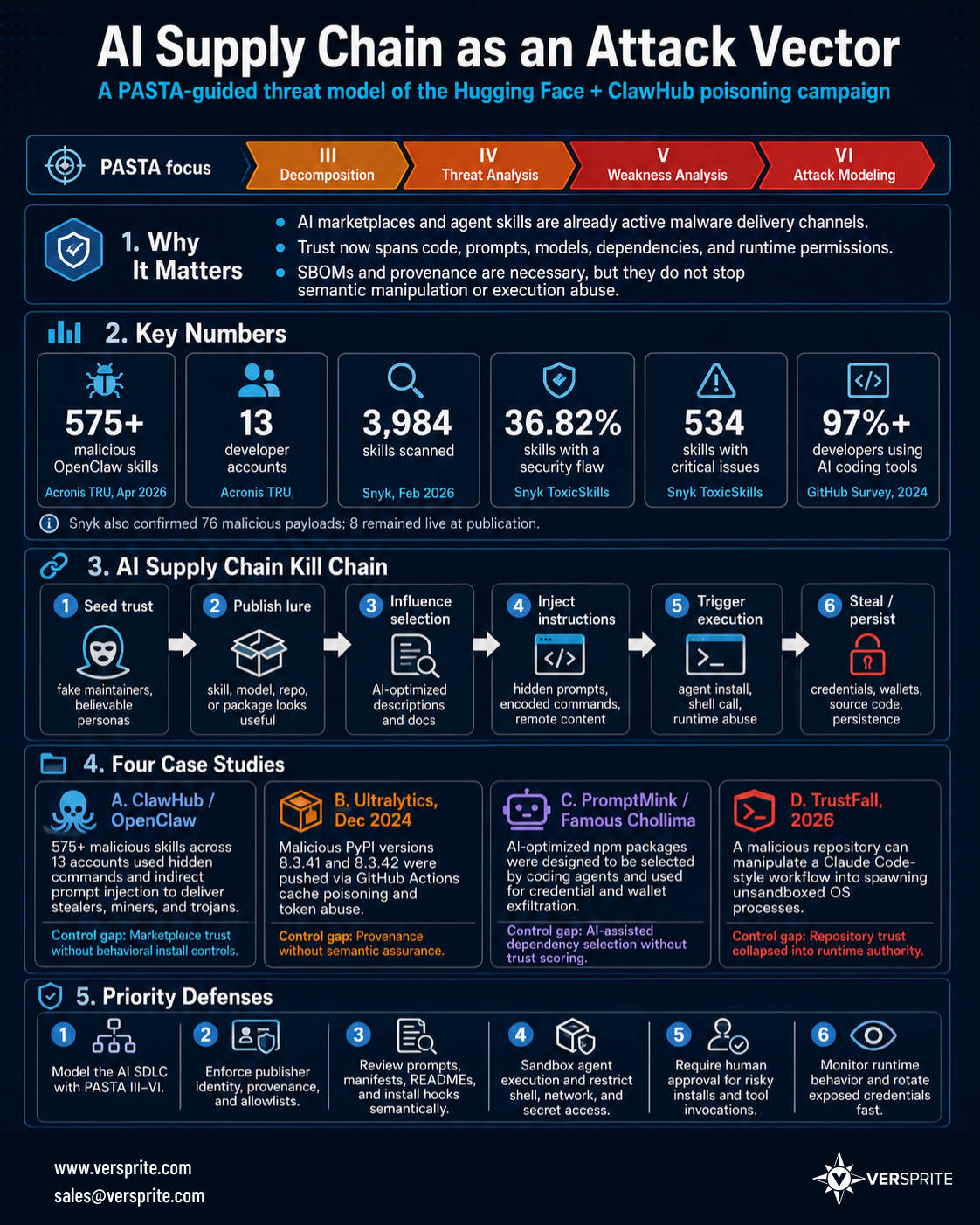
Snyk’s ToxicSkills research found that, in a corpus of 3,984 agent skills, 36.82% had at least one security flaw, 534 had at least one critical-level issue, and researchers confirmed 76 malicious payloads designed for credential theft, backdoor installation, and data exfiltration.
Stage VI: Attack Modeling
The generalized attack path is now repeatable:
- Seed trust through a believable maintainer, persona, package, repository, model, or skill.
- Publish a useful-looking artifact.
- Influence human or agent selection through documentation, descriptions, examples, and prompts.
- Inject hidden instructions, encoded commands, or remote content.
- Trigger execution through install hooks, agent tool calls, shell commands, or repository trust.
- Steal credentials, wallets, API tokens, source code, or cloud keys.
- Persist through backdoors, miners, remote access tools, or lateral movement.
The kill chain is not theoretical. It is already present in the current AI supply chain abuse.
Anecdotal Research: Four Cases That Define the Attack Vector
1. Hugging Face and ClawHub/OpenClaw Poisoning
Acronis TRU documented 575+ malicious OpenClaw skills across 13 developer accounts, with payloads targeting both Windows and macOS. The malicious skills masqueraded as legitimate tools while instructing users or agents to execute encoded commands, install hidden dependencies, or retrieve external payloads.
Control gap: Marketplace trust without robust behavioral install controls.
PASTA relevance: Stage III decomposition must treat skills and model repositories as active execution channels, not static artifacts.
2. Ultralytics Compromise, December 2024
The Ultralytics PyPI package compromise showed that traditional software supply chain controls can fail when build automation is abused. Socket reported that malicious Ultralytics releases were pushed through GitHub Actions cache poisoning and token abuse, including versions 8.3.41 and 8.3.42.
The practical lesson is direct: provenance and SBOM visibility help identify lineage, but they do not automatically determine whether the semantic behavior of the resulting artifact is safe.
Control gap: Provenance without semantic assurance.
PASTA relevance: Stage V weakness analysis must include cache poisoning, credential reuse, and malicious behavior introduced through trusted automation.
3. PromptMink and Famous Chollima
PromptMink demonstrates that adversaries are designing packages for AI-assisted development workflows.
Cloud Security Alliance reported that Famous Chollima engineered malicious npm packages to be selected by AI coding agents, including a February 28, 2026 commit to the open-source crypto trading project openpaw-graveyard that introduced the malicious transitive dependency @validate-sdk/v2. The dependency was reported to exfiltrate wallet credentials and establish SSH backdoors.
This is not normal typosquatting with a new label. It is semantic targeting of agent behavior.
Control gap: AI-assisted dependency selection without trust scoring or human review.
PASTA relevance: Stage IV threat analysis must model adversaries who optimize documentation and package metadata for agent selection.
4. TrustFall and Agent Runtime Abuse
TrustFall, reported by Adversa.AI, showed how a malicious repository could manipulate an agentic Claude Code workflow into spawning unsandboxed operating system processes. Public reporting described the issue as a trust-dialog and settings-scope failure that could lead to full compromise of a user account through repository-driven execution.
The lesson is that static scanning is weak when the critical behavior occurs at runtime through an agent’s tool authority.
Control gap: Repository trust collapsed into runtime execution authority.
PASTA relevance: Stage VI attack modeling must trace how a trusted repo becomes shell execution, credential access, and account compromise.
Why SBOM Compliance Is Not Enough
SBOMs answer an important question: What components are present?
They do not fully answer:
- What instructions influence the agent?
- Which README text shaped package selection?
- Which hidden prompt altered runtime behavior?
- Which install command retrieved a payload?
- Which tool permissions allowed execution?
- Which semantic cues made a malicious dependency look legitimate?
- Which remote content changed after review?
This is why AI supply chain security requires a broader control model. SBOMs, SLSA, provenance, signatures, and dependency scanning remain foundational. But AI introduces a semantic layer that must be reviewed, constrained, and monitored.
In practical terms, security teams must inspect not only the package but also the persuasion layer around the package.
The AI Supply Chain Attack Path
A simplified AI supply chain attack path looks like this:
- Trusted artifact appears
A model, skill, prompt, package, or repository appears legitimate. - Semantic manipulation occurs
The artifact includes deceptive descriptions, hidden instructions, indirect prompt injection, or agent-optimized documentation. - Agent selects or installs it
The agent or developer treats the artifact as useful and grants expected permissions. - Execution abuse begins
The artifact triggers shell commands, install hooks, network calls, remote downloads, or tool execution. - Impact follows
The attacker steals credentials, wallets, source code, API tokens, or cloud keys, then establishes persistence or lateral movement.
The key insight is that AI supply chain attacks convert trust into execution.
Recommended Controls for AI Supply Chain Security
1. Model the AI SDLC with PASTA stages III–VI
Threat model the AI software development lifecycle by decomposing models, prompts, skills, repositories, registries, tools, and runtime permissions.
2. Enforce publisher identity and artifact provenance
Require verified publishers, signed artifacts, trusted registries, allowlists, and strong provenance for models, skills, packages, and repositories.
3. Add semantic review to supply chain review
Review prompts, READMEs, manifests, model cards, skill files, examples, install hooks, and remote fetch instructions. Treat natural-language instructions as part of the attack surface.
4. Sandbox agent execution
Restrict shell access, network egress, file writes, credential access, cloud API access, and repository-level trust by default.
5. Require human approval for high-risk actions
Human approval should be required for dependency installs, repository trust changes, tool invocation, shell execution, secret access, and external downloads.
6. Monitor runtime behavior
Instrument agent activity. Detect suspicious process spawning, outbound network calls, credential access, unusual package installs, and unexpected file modifications.
7. Rotate credentials fast
When agentic workflows are exposed to malicious artifacts, assume secrets may be compromised. Rotate developer tokens, CI/CD credentials, cloud keys, npm/PyPI tokens, SSH keys, and wallet-related credentials.
8. Reimage compromised developer environments
If a developer workstation executed a malicious skill, package, or agent workflow with shell access, credential rotation alone may not be enough.
Frequently Asked Questions
What is AI supply chain security?
AI supply chain security is the practice of securing the models, prompts, datasets, skills, packages, repositories, tools, and agent workflows that influence how AI systems are built, selected, deployed, and executed.
Why are AI supply chain attacks different from traditional software supply chain attacks?
Traditional attacks focus heavily on code, packages, build systems, and dependencies. AI supply chain attacks also target semantic layers such as prompts, documentation, model cards, skill manifests, and agent instructions that can influence behavior without looking like conventional malware.
Why are SBOMs not enough for AI supply chain security?
SBOMs document component lineage. They do not reliably detect malicious instructions, deceptive package descriptions, prompt injection, remote instruction loading, or runtime tool abuse.
What is indirect prompt injection in the AI supply chain?
Indirect prompt injection occurs when an AI system consumes untrusted content that contains hidden or malicious instructions. In agentic workflows, those instructions can influence tool use, data access, command execution, or external communication.
What is the highest-priority AI supply chain risk right now?
The highest-priority risk is trusted artifact abuse combined with agent execution authority. When a trusted model, skill, package, or repository can influence an agent with shell, network, file, or secret access, the compromise path becomes operationally significant.
How should organizations defend against malicious AI skills?
Organizations should enforce publisher identity, use allowlists, review skill semantics, restrict runtime permissions, sandbox agent execution, monitor behavior, and require human approval for high-risk actions.
Bottom Line
The AI supply chain is not a future problem. It is an active attack surface where identity, code, prompts, dependencies, and runtime permissions converge.
PASTA gives defenders the right lens: decompose the system, identify trust boundaries, model adversaries, analyze weaknesses, and map attack paths from trusted artifact to execution impact.
Security programs that stop at SBOM compliance will miss the execution path.
The immediate risk is clear:
Trusted artifact abuse plus agent authority.
