AI-Powered Attacks, Autonomous Defense, and the Fragility of Modern Digital Supply Chains
Date
Authors
Tony UcedaVélez
Follow Us


Artificial intelligence is not creating an entirely new cybersecurity problem. It is accelerating the old ones.
Attackers still want access, persistence, privilege, money, influence, and operational disruption. What has changed is the speed at which they can test ideas, personalize deception, chain tools together, and exploit weak trust relationships across software, cloud, identity, and third-party ecosystems.
For defenders, the answer cannot be more dashboards, more isolated tools, or more compliance language. The harder truth is that most of what follows in this piece inventory, risk-tiering, governed autonomy, threat modeling describes a maturity level that very few organizations have actually reached. That gap is worth naming directly, because most write-ups on this topic describe the destination without admitting how far most security programs currently are from it.
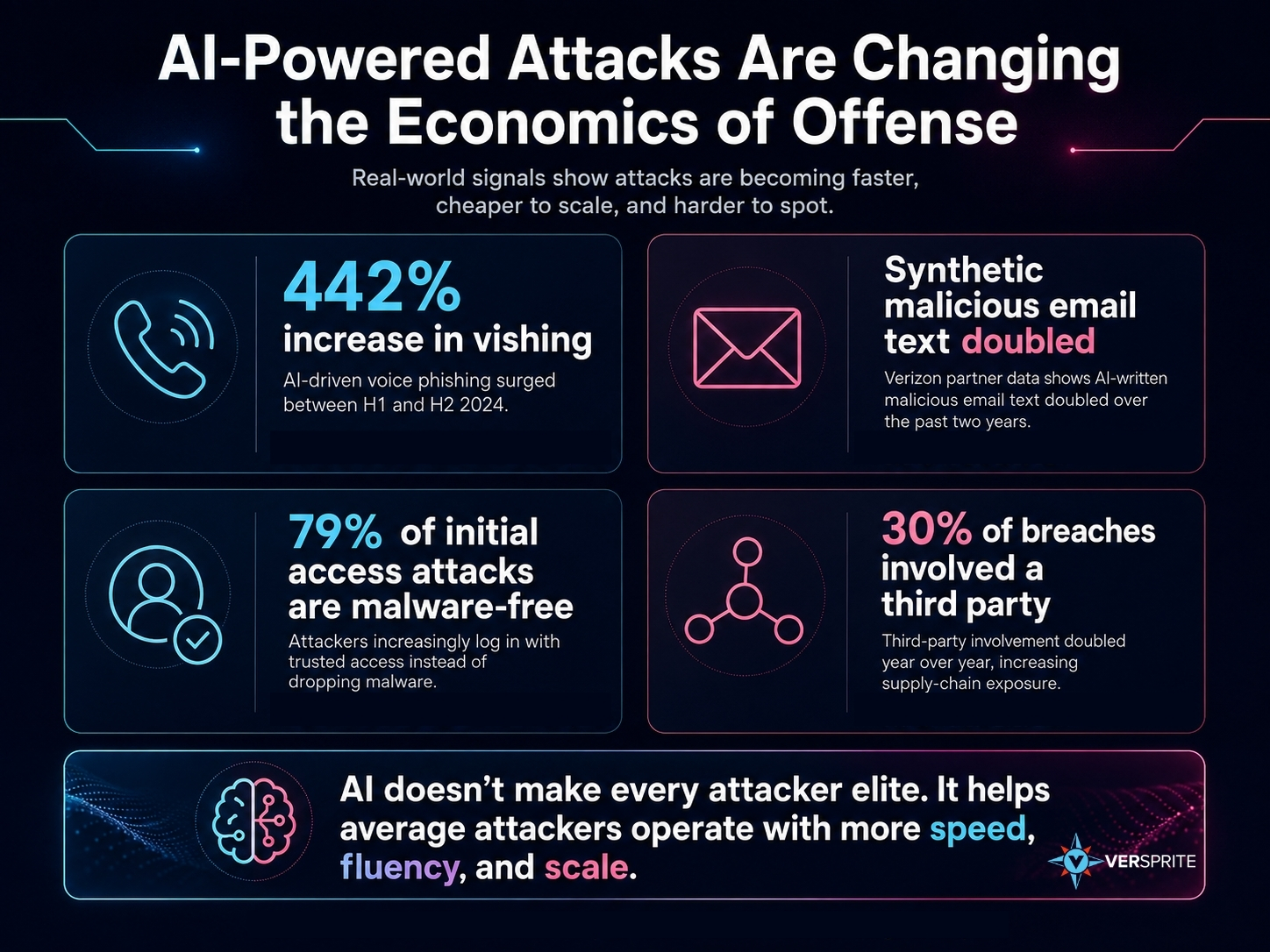
AI-Powered Attacks Are Changing the Economics of Offense
AI gives adversaries leverage. It reduces the cost of experimentation and increases the volume of believable output.
A phishing campaign that once required manual research can now be personalized across roles, industries, languages, and current events. Reconnaissance can be assisted by models that summarize public information, identify likely technology stacks, and generate plausible attack paths. Malware authors can use AI to refactor code, analyze errors, or adapt lures for different targets.
The more important shift is not that AI makes every attacker elite. It is that AI helps average attackers operate with better speed, better language, and better iteration. Most of what this actually looks like in practice isn’t technically novel it’s an attacker with more patience and fewer grammatical tells. That’s a harder problem than it sounds, because the controls built to catch sophistication don’t catch fluency, and a lot of security awareness training still implicitly relies on phishing “looking wrong” as a detection signal.
This matters because most organizations are already struggling with alert fatigue, identity sprawl, exposed APIs, vulnerable dependencies, and inconsistent asset visibility. AI-powered attacks apply pressure exactly where enterprise security programs are already thin.
Agentic AI Expands Both Capability and Risk
The rise of autonomous AI agents introduces a more complex security challenge than traditional AI tools.
A chatbot answers. An agent acts.
Agents can call APIs, retrieve data, create tickets, write code, modify workflows, trigger automations, query repositories, and interact with enterprise systems. When properly governed, this creates major productivity and security opportunities. When poorly governed, it creates a new class of machine-speed operational risk.
The core security question becomes: what can the agent reach, what can it change, and who approved that authority?
Agentic systems should be reviewed through the same lens applied to privileged users, service accounts, third-party vendors, and CI/CD automation. If an AI agent can touch production systems, write to repositories, access sensitive data, or execute workflow changes, then it is not merely a productivity tool. It is part of the enterprise trust architecture.
That means organizations need controls around:
- Agent identity and ownership
- Tool permissions and scope boundaries
- Human approval gates for high-impact actions
- Immutable logging of prompts, tool calls, and outputs
- Segmentation between development, staging, and production
- Monitoring for abnormal agent behavior
- Incident response procedures for agent-caused failures
It’s harder to execute than it reads. Ask most security teams who currently owns every agent running in a development environment, and the honest answer is usually “we’re not fully sure” not because nobody’s thought about it, but because a developer can spin up a new agent with a new tool integration faster than any governance process can register it. The control list above assumes an inventory that, in practice, is usually a few weeks stale the moment it’s written down. AI governance cannot stop at an acceptable-use policy, but it also can’t pretend the technical layer is keeping pace with adoption, because right now it mostly isn’t.
Autonomous AI Defense Is Becoming Necessary, but It Must Be Risk-Led
Security teams cannot defend machine-speed environments with manual processes alone.
Autonomous and semi-autonomous defense systems are emerging because the scale of modern attack activity demands faster triage, correlation, containment, and response. AI can help defenders enrich alerts, identify patterns, prioritize vulnerabilities, detect anomalous behavior, generate investigation paths, and recommend containment steps.
Used well, autonomous defense can reduce dwell time and help teams focus on high-value decisions. Used poorly, it can amplify mistakes, suppress important context, or trigger disruptive actions without adequate oversight.
The practical path forward is not blind automation. It is governed autonomy. Classify defensive actions by risk level, automate the low-risk ones, and require confirmation or explicit authorization further up the scale.
That framework is easier to state than to apply. The boundary between “medium-risk” and “high-risk” is where most of these programs actually stall, because reasonable people disagree about where a given action sits. Is automatically isolating a single suspicious endpoint low-risk enrichment or a disruptive containment action that needs sign-off? The answer depends on what’s running on that endpoint, and most playbooks don’t specify the threshold precisely enough to automate the decision, which means the “governed” part of governed autonomy often ends up being a human in the loop for almost everything, undermining the speed the automation was supposed to provide in the first place.
Regulation Is Turning AI Security From Best Practice Into Board-Level Exposure
AI risk is no longer only a technical concern. It is becoming a regulatory, contractual, and governance concern.
The NIST AI Risk Management Framework organizes AI risk around Govern, Map, Measure, and Manage functions, which gives organizations a practical structure for assigning ownership, understanding system context, measuring risk, and applying controls.
The European Union’s AI Act is moving through staged implementation, with general provisions and prohibitions already applying, general-purpose AI rules beginning in 2025, and broader enforcement milestones for high-risk and transparency obligations continuing through 2026 and 2027. At the same time, NIS2 establishes a cybersecurity framework across critical sectors in the EU, while the Cyber Resilience Act introduces cybersecurity requirements for products with digital elements placed on the EU market.
Organizations will increasingly need to prove that digital systems are governed, monitored, resilient, and secure by design. What’s less clear, and rarely acknowledged in write-ups of these frameworks, is that the sequence they imply govern, then map, then measure, then manage assumes a stable system to govern. AI deployments in most organizations don’t hold still long enough for that sequence to complete before something changes underneath it. Teams frequently discover a new model dependency or plugin mid-“Measure” that sends them back to “Map,” and the frameworks don’t have a clean answer for how often that loop is supposed to run.
Regulators are not asking organizations to predict every AI failure. They are asking whether organizations exercised reasonable control over foreseeable risk. But “foreseeable” is doing a lot of work in that sentence, and it’s worth sitting with how much of what shows up in AI incident postmortems was, in fact, foreseeable in hindsight but invisible at the time an inventory was last updated.
Digital Supply Chains Are Becoming More Fragile Because Trust Is More Distributed
Modern applications are not single systems. They are ecosystems.
They depend on open-source packages, SaaS platforms, cloud services, APIs, CI/CD workflows, containers, infrastructure-as-code, identity providers, managed models, data pipelines, third-party scripts, and vendor-hosted components.
AI adds another layer of dependency. Organizations now rely on model providers, embedding services, vector databases, prompt orchestration frameworks, AI coding assistants, agent platforms, plugins, and data connectors. Each one can become part of the attack surface.
The traditional vendor risk model was not built for this level of speed or granularity. Procurement may review a major SaaS provider, but a developer can connect an AI tool to a repository, grant OAuth access, and create a material exposure before the vendor list is updated.
Most vendor risk programs still run on an annual or quarterly review cycle, while OAuth grants and plugin installs happen at the pace of a single sprint. No governance calendar closes that gap on its own; at best, it accepts the gap exists and tries to keep the exposure window short through other means: dependency monitoring, secrets detection, and runtime visibility, rather than review cadence.
A mature digital supply chain security program should include:
- Software bill of materials visibility
- AI bill of materials visibility for models, datasets, plugins, and agents
- Dependency and package integrity monitoring
- Secrets detection across repositories and pipelines
- CI/CD workflow hardening
- Vendor and subcontractor risk reviews
- OAuth application governance
- Runtime monitoring for third-party integrations
- Threat modeling of critical business workflows
Supply chain security is no longer just about knowing what code you use. It is about knowing what systems you trust and it’s worth being honest that “knowing” here is aspirational for most organizations, not a current state. Most AI-bill-of-materials efforts we’d expect a maturing security program to have are still partial, because the tooling to generate one automatically and keep it current largely doesn’t exist yet at the fidelity SBOMs achieved for traditional software dependencies.
Threat Modeling Must Evolve for AI-Driven Systems
AI risk becomes manageable when it is modeled in context.
Traditional vulnerability management asks, “What is exposed?” Threat modeling asks, “How could this system be abused, by whom, and with what business impact?”
That distinction matters. AI systems introduce risks that do not always look like conventional software flaws. Prompt injection, excessive agency, data leakage, model manipulation, insecure plugin design, training data exposure, and unsafe tool execution may not appear in a standard vulnerability scan.
For AI-enabled applications, threat modeling should examine:
- The business function the AI system supports
- The sensitivity of the data it can access
- The decisions it influences
- The tools or APIs it can call
- The trust boundaries between users, models, agents, plugins, and backend systems
- The ways malicious input could alter outputs or actions
- The blast radius if the AI system behaves incorrectly
- The residual risk after controls are applied
That last question, blast radius, is the one most current AI threat models answer badly, and it’s worth explaining why. Most threat modeling practice still treats each agent or model integration as its own bounded system with its own blast radius. In practice, agents increasingly call other agents, and a modest failure in one component can compound across several imperfect controls in ways that a single-system model doesn’t capture. The methodology hasn’t fully caught up to the architecture it’s supposed to describe, and that’s a limitation worth stating rather than papering over with a clean checklist.
Security Leaders Need a New Operating Model for AI-Era Cyber Risk
The organizations that manage this transition well will not be the ones that ban AI or blindly automate everything. They will be the ones that build disciplined operating models while recognizing that “disciplined operating model” describes a maturity level, not a starting point.
A practical AI-era security operating model has five components. None of them are quick to build, and it’s worth being specific about where each one is genuinely hard rather than presenting them as a checklist to complete.
1. Real inventory
Security teams need visibility into sanctioned and unsanctioned AI usage AI tools connected through OAuth, agents running in development environments, AI features inside third-party platforms, model APIs, plugins, MCP servers, and automation workflows. In practice, “real inventory” for most organizations is discovered retrospectively during a vendor questionnaire, an audit, or an incident rather than maintained proactively. That’s not a failure of effort; shadow AI adoption currently outpaces any inventory process built for a slower technology cycle.
2. Risk-tiering
Not every AI tool carries the same risk. A writing assistant with no sensitive data access is different from an agent that can modify code, trigger deployments, or query customer records. Controls should match the level of authority and business impact, but as noted above, the boundary between tiers is genuinely contestable in specific cases, and most organizations haven’t yet built the internal precedent needed to make that judgment call consistently across teams.
3. Secure architecture
AI systems need strong identity controls, least privilege, segmentation, logging, data minimization, and human approval for high-impact actions. Security cannot be bolted on after agents are already embedded in workflows, though in most organizations, that’s exactly the sequence that’s already happened, which means “secure architecture” for AI right now is frequently a retrofit project rather than a design principle applied from day one.
4. Continuous testing
AI systems should be tested for prompt injection, unsafe tool use, data leakage, model manipulation, access control failures, and abuse cases, as part of the development lifecycle rather than a one-time review. The harder part is that these abuse cases often only manifest through chains of a traditional API weakness combined with an over-permissioned agent; for instance, testing each component in isolation misses exactly the scenarios that matter most.
5. Board-level reporting
Executives need clear reporting on AI risk, supply chain exposure, regulatory readiness, and control maturity. The board does not need every technical detail. It does need to understand where risk concentrates and whether the organization can operate through failure, which requires the first four components to actually exist first, not just be described in a slide.
Where This Leaves Security Leaders
Compliance can set a floor. It cannot define resilience, and the gap between the two is exactly where most of the friction described above actually lives.
None of the five capabilities in the previous section are things an organization can simply decide to have. Real inventory requires tooling that mostly doesn’t exist yet at the needed fidelity. Risk-tiering requires internal judgment calls that most organizations haven’t built consensus around. Secure architecture is usually a retrofit, not a starting point. Continuous testing has to account for chained failures that single-component reviews don’t catch. And board-level reporting is only as good as the four capabilities underneath it.
AI-powered attacks will continue to mature. Autonomous defense will become more common. Regulation will become more specific. Digital supply chains will remain fragile. None of that is in serious dispute.
What’s less settled is how quickly the operational maturity described here can actually be built, given that the technology it’s meant to govern is changing faster than most governance processes are designed to accommodate. That’s not a reason to wait. It’s a reason to be honest about which of the five capabilities above your organization actually has today, versus which ones exist mainly as a slide.