Threat Modeling as a Service for Healthcare in 2026
Date
Authors
Tony UcedaVélez
Follow Us


Healthcare security teams have spent the last decade bolting controls onto systems that were never architected with attackers in mind. Patient portals got built for convenience, APIs got built for interoperability mandates, and cloud migrations got built for cost and speed. Security showed up afterward, usually in the form of a scan.
That sequencing is the actual problem. Not the volume of vulnerabilities. Not the compliance paperwork. The sequencing.
Threat Modeling as a Service (TMaaS) flips that order. Instead of finding out what’s broken after it ships, healthcare and public sector organizations get a structured, recurring practice for understanding how their systems can be attacked before they’re built, and how that risk maps to the business and regulatory obligations they actually answer to.
What Threat Modeling as a Service Actually Means
Threat Modeling as a Service is the delivery of structured, repeatable threat modeling — performed by an external team with dedicated methodology, tooling, and cadence — rather than as a one-off workshop or an internal side project squeezed between sprints.
The distinction matters. A single threat modeling engagement tells you what’s wrong with one application today. A service tells you what’s wrong with your portfolio, continuously, as your architecture, your APIs, and your regulatory obligations all shift under you. For healthcare and government organizations running dozens of interconnected systems — EHR platforms, patient portals, claims APIs, telehealth infrastructure, identity systems — that continuity is the entire value proposition.
At VerSprite, this work is built on PASTA (Process for Attack Simulation and Threat Analysis), a risk-centric methodology that ties technical threat modeling directly to business impact rather than treating security as a parallel, disconnected exercise.
Why Healthcare and Government Systems Are a Different Problem
Healthcare and public sector environments carry a specific combination of pressures that make ad hoc threat modeling insufficient:
Attack surface sprawl.
Interoperability requirements have pushed healthcare organizations to expose more APIs, not fewer. Patient portals, provider-facing integrations, and third-party health data exchanges all widen the perimeter that has to be modeled.
Regulatory exposure that moves.
HIPAA’s Security Rule has governed electronic protected health information for over two decades, and it’s currently in the middle of the most significant proposed overhaul since its introduction — new expectations around encryption, access controls, incident reporting timelines, and business associate oversight are on the table at HHS, even though the final rule’s timing has slipped and remains unconfirmed as of mid-2026. Whatever shape that rule eventually takes, the direction is unambiguous: documented, defensible risk analysis is what regulators expect to see, not just a completed checklist.
Legacy and connected-device debt.
Government and healthcare infrastructure rarely gets to modernize on a clean timeline. Threat models have to account for systems that will be running for years past their intended lifecycle, sitting next to brand-new cloud-native services.
Consequences that aren’t hypothetical.
A breach in a retail environment is a bad quarter. A breach in a hospital system or a government service can mean disrupted patient care or compromised public trust. That changes what “acceptable risk” means and who has to sign off on it.
Generic vulnerability scanning doesn’t account for any of this. It tells you a port is open. It doesn’t tell you what happens to a patient record, a claims process, or a public benefits system when that port is exploited — which is precisely the question a risk-based threat model is built to answer.
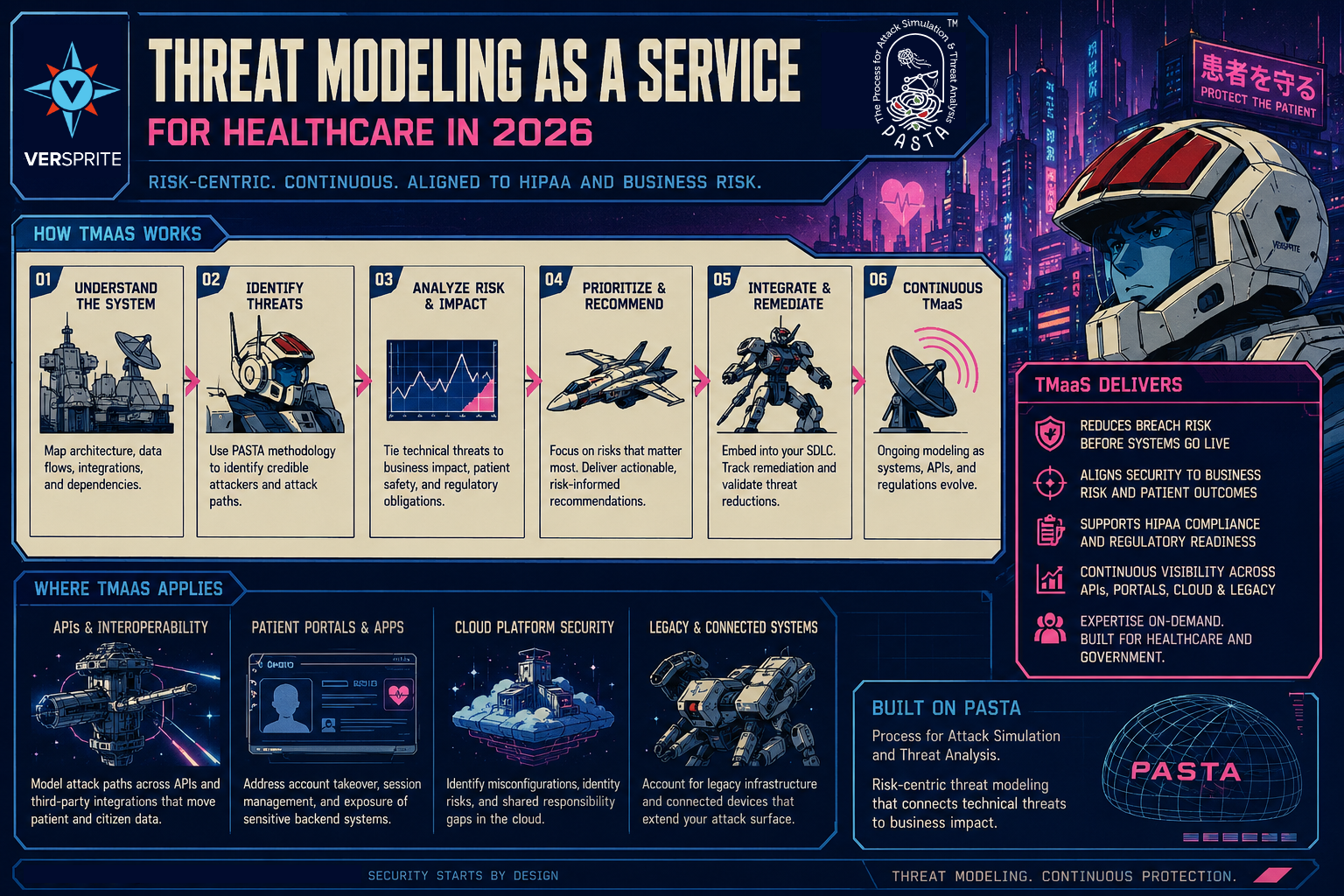
Where TMaaS Applies: APIs, Portals, Cloud, and Connected Systems
APIs and interoperability endpoints.
Every API that moves patient or citizen data is a modeled attack path, not just an integration point. TMaaS maps how authentication, authorization, and data flow decisions on the API layer translate into exploitable conditions — and where a compromised third-party integration could become a foothold into core systems.
Patient portals and citizen-facing applications.
These are the systems with the broadest, least-trusted user base by design. Threat modeling here has to account for account takeover, session handling, and the reality that the portal is often the front door to far more sensitive backend systems.
Cloud platform security.
Migration to cloud infrastructure changes the threat model, not just the hosting bill. Misconfigured identity and access management, overly permissive service roles, and shared responsibility gaps between the organization and the cloud provider are exactly the kind of structural risks that threat modeling surfaces before they become findings in an incident report.
Connected and embedded systems.
Medical devices, remote monitoring tools, and IoT deployments in clinical and government environments introduce attack paths that traditional application security testing wasn’t built to catch. Threat modeling extends the same rigor to hardware-adjacent systems that application teams apply to software.
Aligning Security Work to Compliance and Business Risk
The reason threat modeling belongs in a compliance conversation isn’t that it satisfies an audit line item. It’s that a well-documented threat model is the artifact regulators, auditors, and boards actually want to see: evidence that risk was identified, evaluated, and addressed deliberately — not that a checklist got completed.
That’s the structural difference between checklist-based compliance work and risk-based threat modeling. A checklist tells you a control exists. A threat model tells you why that control matters, what it’s defending against, and what happens if it fails. For a healthcare CISO reporting to a board, or a government security leader briefing an oversight committee, that second framing is the one that actually holds up under questioning.
This is also where TMaaS earns its place as an ongoing service rather than a point-in-time deliverable. Regulatory expectations shift. Architectures shift faster. A threat model produced once during a compliance push goes stale the moment the next API ships or the next cloud service gets provisioned. A recurring practice keeps the model — and the risk register behind it — current enough to actually inform decisions instead of documenting decisions after the fact.
What to Look for in a Threat Modeling as a Service Partner
Not all threat modeling delivery is equivalent. Healthcare and government organizations evaluating a TMaaS partner should look for:
- A named, risk-centric methodology (like PASTA) rather than an ad hoc workshop format, so results are consistent across teams and repeatable across engagements.
- Experience translating technical findings into language a compliance officer, board member, or agency oversight body can act on.
- A model that scales across a portfolio of applications and APIs, not just a single system reviewed in isolation.
- A cadence that matches how fast the organization actually ships — quarterly or continuous, not annual.
- The Shift Healthcare Security Leaders Are Already Making
The Shift Healthcare Security Leaders Are Already Making
The organizations getting the most value from threat modeling right now aren’t treating it as a compliance deliverable. They’re treating it as a design input — something that happens before an API contract is finalized or a cloud architecture is locked in, not after.
That’s the actual promise of Threat Modeling as a Service: it moves the question “is this secure?” to the point in the process where the answer can still change the outcome.
Frequently Asked Questions
What is Threat Modeling as a Service?
Threat Modeling as a Service is an ongoing, externally delivered practice of identifying, analyzing, and prioritizing security threats across an organization’s applications, APIs, and infrastructure, using a structured methodology rather than one-off assessments.
How does threat modeling support HIPAA compliance?
Threat modeling produces documented evidence that risk to electronic protected health information has been systematically identified and addressed, which aligns with the risk analysis expectations at the core of the HIPAA Security Rule — including the strengthened cybersecurity requirements HHS has proposed as part of its pending Security Rule update.
Why do healthcare organizations need threat modeling for APIs and patient portals?
APIs and patient portals are the most exposed, most frequently targeted components in healthcare IT because they connect the widest range of users and systems to sensitive patient data, making them high-value targets that require dedicated threat analysis.
What methodology does VerSprite use for threat modeling?
VerSprite uses PASTA (Process for Attack Simulation and Threat Analysis), a risk-centric threat modeling methodology developed to tie technical vulnerabilities directly to business impact and risk.
How is Threat Modeling as a Service different from a penetration test?
Penetration testing identifies exploitable vulnerabilities in a system as it currently exists. Threat modeling is proactive and architectural — it evaluates how a system could be attacked based on its design, often before it’s fully built, and informs what a penetration test should target.
