From Control Validation to Risk Understanding: The Case for Threat Modeling
Date
Authors
Tony UcedaVélez
Follow Us


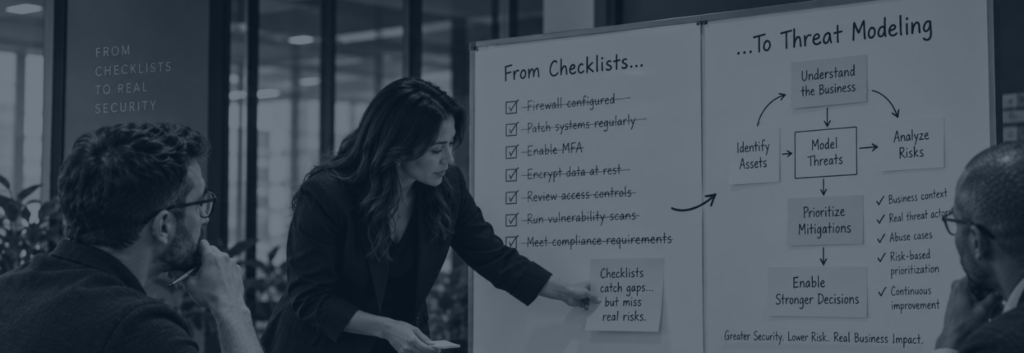
Security checklists have helped organizations create consistency, but they were never designed to fully explain risk.
They can confirm whether a control exists. They can verify whether a requirement was reviewed. They can support audit readiness.
But they often fail to answer the questions that matter most to enterprise security leaders:
- What can go wrong?
- How likely is it to happen?
- What business process would be affected?
- What would the impact be if the threat becomes real?
- Where should the organization focus first?
This is where advanced threat modeling changes the conversation.
Instead of treating security as a static list of tasks, advanced threat modeling helps organizations evaluate applications, systems, workflows, and technologies through the lens of adversarial behavior, business impact, technical exposure, and risk prioritization.
For regulated organizations, this shift matters. Security teams are under pressure to move faster, support cloud adoption, secure AI-enabled systems, govern third-party risk, and prove that security decisions are tied to measurable business outcomes.
A checklist can show activity.
Threat modeling shows risk.
What Is Advanced Threat Modeling?
Advanced threat modeling is a structured, risk-based approach for identifying, analyzing, and prioritizing threats against applications, systems, and business processes.
Unlike basic checklist-driven reviews, advanced threat modeling evaluates how a system works, how it supports the business, where it is exposed, how adversaries may abuse it, and which security decisions reduce the most meaningful risk.
At VerSprite, threat modeling is often approached through a risk-centric methodology rooted in PASTA, the Process for Attack Simulation and Threat Analysis. This approach connects technical architecture, business objectives, threat intelligence, attack paths, vulnerabilities, and residual risk into one decision-making process.
The goal is not simply to create diagrams or satisfy a requirement.
The goal is to help security leaders make better decisions about risk.
Why Security Checklists Fall Short
Security checklists are not inherently bad. They serve a purpose. They can help teams standardize reviews, validate common requirements, and ensure that known control categories are not ignored.
The problem begins when checklists become the primary method for assessing security risk.
A checklist may ask whether authentication is enabled.
Threat modeling asks whether the authentication flow can be bypassed, abused, chained with business logic flaws, or exploited through weak trust boundaries.
A checklist may ask whether encryption is used.
Threat modeling asks whether sensitive data is exposed before encryption, mishandled in downstream services, or accessible through unintended workflows.
A checklist may ask whether logging exists.
Threat modeling asks whether the logs capture the right events to detect meaningful abuse, fraud, privilege escalation, or lateral movement.
Checklists often confirm the presence of controls. Advanced threat modeling evaluates whether those controls reduce risk in the context of how the system actually operates.
The Difference Between Checklist-Based Security and Threat Modeling
Checklist-based security is usually control-focused. It asks whether something was done.
Threat modeling is risk-focused. It asks whether the organization understands what could go wrong and what should be done about it.
Checklist-based security tends to be static. It reflects a fixed set of requirements that may not change often.
Threat modeling is contextual. It adapts to business logic, system architecture, user behavior, threat actor behavior, and changing technology environments.
Checklist-based security often produces pass-or-fail outputs.
Threat modeling produces prioritized findings, attack paths, risk scenarios, and remediation decisions tied to business impact.
Checklist-based security may support compliance.
Threat modeling supports security leadership, engineering prioritization, executive reporting, and compliance with stronger risk evidence.
For CISOs, this distinction is critical. Mature security programs cannot rely only on whether controls exist. They need to understand whether those controls are effective against the risks that matter most.
Why Enterprise Security Leaders Are Moving Toward Advanced Threat Modeling
Enterprise environments have become too complex for checklist-first security.
Modern applications are distributed across cloud platforms, APIs, third-party services, identity providers, data pipelines, mobile apps, SaaS integrations, and AI-enabled workflows. Every new dependency creates new assumptions. Every new assumption creates potential risk.
Regulated organizations face additional pressure. Financial institutions, healthcare organizations, government agencies, critical infrastructure operators, and technology companies must demonstrate that security decisions are intentional, risk-based, and aligned with business impact.
Advanced threat modeling helps security leaders meet this challenge by creating a repeatable process for understanding risk before attackers exploit it.
It gives teams a clearer view of:
- Business-critical assets
- Trust boundaries
- Attack surfaces
- Threat scenarios
- Abuse cases
- Control gaps
- Potential blast radius
- Compliance implications
- Remediation priorities
- Residual risk
This is a stronger foundation than a generic security checklist because it reflects how the system actually works and how it can fail.
How Threat Modeling Improves Risk Assessment
Advanced threat modeling improves risk assessment by connecting technical findings to business impact.
This is one of the most important differences between a tactical security review and a strategic risk analysis.
A traditional review may identify a vulnerability and assign severity based on technical scoring. That can be useful, but it may not explain why the issue matters to the business.
Advanced threat modeling looks deeper.
It considers the business function the system supports, the data it processes, the users who interact with it, the threat actors most likely to target it, and the consequences of compromise.
This creates a more complete risk picture.
For example, a medium-severity technical weakness in a customer onboarding workflow may create high business risk if it enables account fraud, regulatory exposure, or unauthorized access to financial records.
A checklist may miss that context.
Threat modeling brings it forward.
Replacing Static Checklists With Risk-Based Analysis
Replacing checklists does not mean eliminating structure. It means replacing static validation with a more intelligent and risk-driven process.
Enterprise security teams can make this shift by moving from generic questions to contextual analysis.
Instead of asking:
- Did we review access control?
Ask:
- Where are privilege boundaries enforced, and how could an attacker bypass or abuse them?
Instead of asking:
- Did we validate input?
Ask:
- Which inputs influence business logic, authorization, data integrity, payments, identity, or workflow decisions?
Instead of asking:
- Did we complete the security review?
Ask:
- What are the most credible threat scenarios, and which risks remain after remediation?
This is the difference between completing a task and understanding exposure.
The Role of Business Impact in Advanced Threat Modeling
Business impact is what makes threat modeling valuable to executive leadership.
Security findings often lose influence when they are presented only as technical issues. CISOs need to communicate risk in terms that business leaders, product owners, compliance teams, and engineering leaders can understand.
Advanced threat modeling supports that translation.
It helps explain how a threat could affect:
- Revenue
- Customer trust
- Regulatory obligations
- Operational continuity
- Data confidentiality
- Fraud exposure
- Product integrity
- Brand reputation
- Third-party relationships
- Executive decision-making
This level of context helps security teams move away from long lists of disconnected issues and toward business-aligned remediation planning.
Why Compliance Alone Is Not Enough
Regulated organizations often rely on checklists because compliance frameworks require documented control validation. That makes sense. Compliance matters.
But compliance is not the same as security effectiveness.
A system can satisfy a requirement and still contain exploitable business logic flaws, authorization gaps, weak trust assumptions, insecure integrations, or misuse cases that were never covered by a checklist.
Advanced threat modeling helps close this gap by giving organizations stronger evidence that they are evaluating risk in context.
It does not replace compliance work. It strengthens it.
Threat models can support audit conversations by showing that the organization understands how systems operate, where risks exist, what controls were considered, which remediations were prioritized, and what residual risk remains.
For regulated industries, that level of evidence is increasingly important.
A Practical Framework for Replacing Security Checklists With Threat Modeling
Organizations do not need to abandon all existing security processes overnight. A better approach is to evolve checklist based reviews into a risk based threat modeling program.
Here is a practical path.
1. Start With Business Context
Before evaluating technical risk, define what the application or system does for the business.
Security teams should understand:
- What business process does this system support?
- What data does it collect, process, transmit, or store?
- Who depends on it?
- What would happen if it were unavailable, manipulated, or compromised?
- Which regulations, customers, or contractual obligations are involved?
This step prevents threat modeling from becoming a purely technical exercise. It anchors the analysis in business impact.
2. Understand the Technology Environment
Next, document the architecture and technology stack.
This includes:
- Cloud services
- APIs
- Identity providers
- Databases
- Third-party integrations
- User roles
- Data flows
- Trust boundaries
- External dependencies
- Administrative functions
- Security tools and controls
This gives security and engineering teams a shared view of how the system works.
3. Decompose the Application or System
Application decomposition breaks the system into meaningful components so teams can analyze risk with precision.
This may include user workflows, authentication flows, authorization checks, data movement, service interactions, administrative capabilities, and external integrations.
The objective is to identify where risk can enter, move, escalate, or create impact.
4. Identify Credible Threat Scenarios
Threat modeling should focus on credible threats, not theoretical noise.
Teams should evaluate how adversaries could abuse the system based on the organization’s environment, industry, business model, and threat landscape.
Examples may include:
- Account takeover
- Privilege escalation
- API abuse
- Business logic manipulation
- Data exfiltration
- Payment fraud
- Session abuse
- Supply chain compromise
- Third-party integration misuse
- AI workflow manipulation
- Insider misuse
- Cloud misconfiguration abuse
The goal is not to list every possible threat. The goal is to identify the threats that matter most.
5. Map Weaknesses and Control Gaps
Once threat scenarios are defined, teams can identify weaknesses that may enable those threats.
This is where vulnerability analysis becomes more meaningful because weaknesses are connected to actual attack paths and business consequences.
A weakness is more valuable when it is understood in context.
For example, an access control issue is not just a technical defect. It may represent a path to unauthorized data access, fraud, regulatory exposure, or customer harm.
6. Prioritize Remediation Based on Risk
Not every issue deserves the same level of urgency.
Advanced threat modeling helps teams prioritize remediation based on exploitability, likelihood, business impact, compensating controls, and residual risk.
This allows security leaders to avoid two common problems:
- Treating every issue as urgent
- Treating compliance completion as risk reduction
Risk-based prioritization helps teams focus on the changes that reduce the most meaningful exposure.
7. Track Residual Risk
After remediation decisions are made, organizations still need to understand what risk remains.
Residual risk analysis helps CISOs and security leaders determine whether a risk has been reduced, accepted, transferred, or deferred.
This is especially important in regulated environments where risk decisions must be documented and defensible.
Threat modeling gives leaders a stronger basis for those decisions.
How Advanced Threat Modeling Supports Security Teams
Advanced threat modeling is not only useful for CISOs. It strengthens collaboration across security, engineering, product, compliance, and executive teams.
- For application security teams, it creates a clearer way to evaluate risk earlier in the software development lifecycle.
- For engineering teams, it provides actionable guidance that is tied to system behavior rather than generic security requirements.
- For product teams, it helps balance security decisions against customer experience and business priorities.
- For compliance teams, it produces evidence of risk based analysis and control consideration.
- For executives, it creates a clearer view of where risk exists and why investment decisions matter.
This is why advanced threat modeling becomes more powerful when it is treated as a cross functional risk discipline rather than a one time security activity.
Where Checklists Still Belong
Security checklists do not need to disappear entirely.
They can still support baseline control validation, secure coding standards, architecture review prompts, regulatory requirements, and repeatable documentation.
The key is to place checklists in the right role.
They should support threat modeling, not replace it.
A checklist can help confirm that common controls were reviewed. Threat modeling should determine whether those controls are appropriate, sufficient, and effective for the specific risk scenario.
In mature programs, checklists become inputs.
Threat modeling becomes the analysis.
Common Mistakes When Moving From Checklists to Threat Modeling
Many organizations attempt to adopt threat modeling but struggle because they treat it like another checklist.
Common mistakes include:
- Using generic templates without business context
- Creating diagrams without analyzing threats
- Focusing only on technical vulnerabilities
- Ignoring business logic abuse
- Failing to include product and engineering stakeholders
- Producing findings without prioritization
- Treating threat modeling as a one-time exercise
- Failing to track residual risk
- Measuring completion instead of risk reduction
To avoid these issues, threat modeling must be tied to decision-making. The output should influence security priorities, engineering work, risk acceptance, and executive visibility.
What Good Threat Modeling Deliverables Should Include
A mature threat modeling engagement should produce more than a diagram.
Enterprise security leaders should expect deliverables that help them act.
Strong threat modeling deliverables may include:
- System context and business objectives
- Architecture and data flow analysis
- Trust boundary identification
- Asset and user role mapping
- Threat scenario documentation
- Attack path analysis
- Weakness and control gap mapping
- Risk scoring and prioritization
- Business impact analysis
- Remediation recommendations
- Residual risk summary
- Executive ready reporting
- Engineering-focused action items
These deliverables help security leaders move from awareness to execution.
Advanced Threat Modeling and the Modern SDLC
Modern software delivery moves quickly. Security must keep pace without slowing the business down.
Advanced threat modeling can be integrated into the software development lifecycle so that risk analysis happens earlier and more continuously.
This can support:
- New application design
- Major feature releases
- API development
- Cloud migrations
- AI-enabled workflows
- Identity and access changes
- Third-party integrations
- Regulatory review
- Pre-production security validation
- Post-incident architecture review
When threat modeling becomes part of the SDLC, security teams can identify risk before it becomes expensive to fix.
This is a major improvement over checklist-driven reviews that occur late in the process.
How to Know Your Organization Is Ready to Move Beyond Checklists
Your organization may be ready for advanced threat modeling if security teams are asking questions like:
- Why do our reviews produce too many low-value findings?
- Why are business logic flaws still being missed?
- Why does engineering see security as a compliance gate?
- Why do executives struggle to understand technical risk?
- Why do we keep discovering risk late in development?
- Why are we unable to clearly explain residual risk?
- Why do our checklists not reflect how our systems actually work?
These are signs that checklist-based security is no longer enough.
Final Thoughts
Security checklists create consistency, but they do not create risk understanding on their own.
Enterprise CISOs and security leaders need more than control validation. They need a way to understand how applications, systems, workflows, and business processes can be attacked and what those attacks would mean to the organization.
Advanced threat modeling provides that path.
It replaces static security review habits with risk-based analysis tied to business impact. It helps teams prioritize what matters, communicate risk more clearly, and make stronger decisions across security, engineering, compliance, and executive leadership.
The future of enterprise application security is not checklist completion.
It is a risk understanding.
And advanced threat modeling is how organizations get there.
FAQ
What is advanced threat modeling?
Advanced threat modeling is a risk-based process for identifying and prioritizing threats against applications, systems, and business workflows. It evaluates architecture, data flows, trust boundaries, threat scenarios, weaknesses, controls, and business impact.
How is threat modeling different from a security checklist?
A security checklist confirms whether specific controls or tasks were reviewed. Threat modeling analyzes how a system can be attacked, what business impact could result, and which risks should be prioritized for remediation.
Does threat modeling replace compliance checklists?
Threat modeling does not eliminate compliance checklists. It strengthens them by adding contextual risk analysis, business impact mapping, and residual risk documentation.
Why is advanced threat modeling important for regulated organizations?
Regulated organizations need to show that security decisions are risk-based, documented, and tied to business impact. Advanced threat modeling helps provide that evidence while improving security prioritization.
When should threat modeling be performed?
Threat modeling should be performed during major design decisions, new application development, API changes, cloud migrations, third-party integrations, AI-enabled workflows, and other moments where architecture or business risk changes.
What are the main outputs of a threat model?
Common outputs include architecture analysis, data flow diagrams, trust boundary mapping, threat scenarios, attack paths, weakness identification, risk prioritization, remediation guidance, and residual risk analysis.
Why do checklists miss business logic threats?
Checklists often focus on whether standard controls exist. Business logic threats require deeper analysis of workflows, user roles, process abuse, authorization decisions, and how attackers may manipulate intended functionality.
