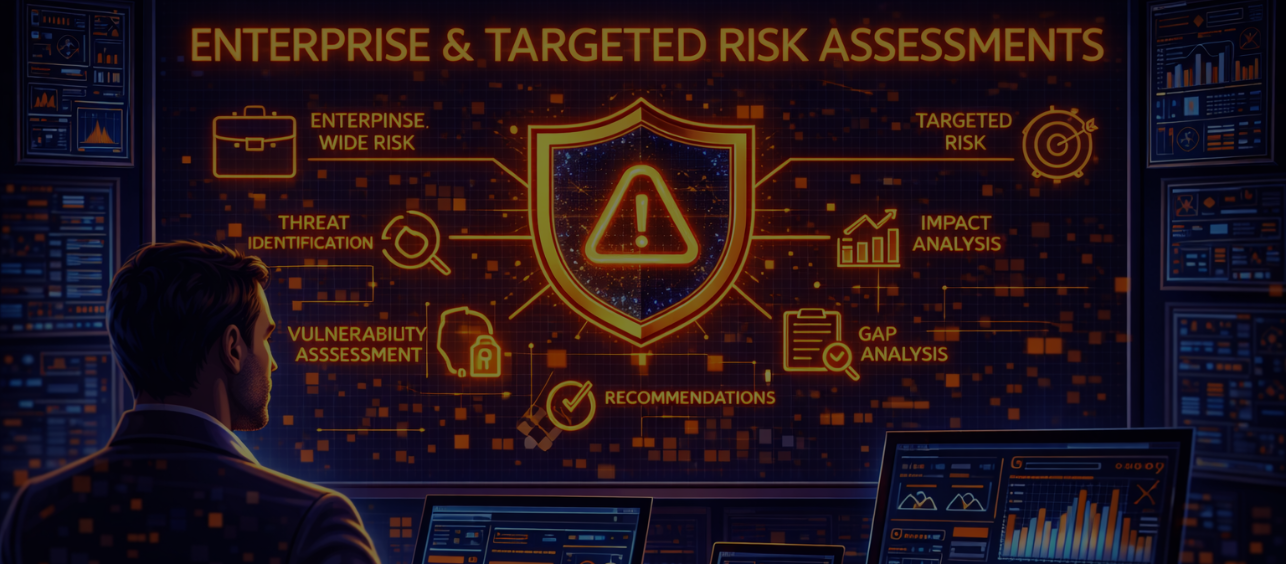
Enterprise & Targeted
Risk Assessment Services
Targeted risk assessments to identify, prioritize, and remediate high-impact cybersecurity risks across critical systems, assets, and business processes
Build a Tailored Engagement or Service Model Today- /
- /
- /
- /
- /
- /
- /
- /
- /
- /
- /
- /
- /
- /
- /
- /
- /
- /
- /
- /
- /
- /
Comprehensive Risk Intelligence for Modern Enterprises
At VerSprite, we believe that effective risk management begins with precise identification and qualification of the variables in the risk equation. Since our inception, understanding and quantifying risk has been the cornerstone of all our practice areas, from vendor assessments to enterprise-wide risk evaluations.
Our Risk Assessment Methodology
VerSprite employs the Factor Analysis of Information Risk (FAIR) methodology—a proven risk quantification framework that delivers actionable insights through:
- Probabilistic Threat Analysis: Identifying potential threat actors and calculating likelihood of attacks
- Business Impact Analysis: Quantifying potential financial and operational consequences
- Vulnerability Assessment: Evaluating existing weaknesses across your digital and physical infrastructure
- Controls Evaluation: Analyzing effectiveness of security measures already in place
This comprehensive approach enables us to transform abstract risks into quantifiable metrics that drive strategic decision-making.
- /
- /
- /
- /
- /
- /
- /
- /
- /
- /
- /
- /
- /
- /
- /
- /
- /
- /
- /
- /
- /
- /
Key Risk Assessment Services
Enterprise Risk Assessment
Our enterprise risk assessment services provide a holistic view of your organization’s risk landscape, helping you:
- Identify critical assets requiring protection
- Discover hidden vulnerabilities across your infrastructure
- Prioritize remediation efforts based on quantified risk metrics
- Develop risk-based roadmaps aligned with business objectives
- Meet regulatory compliance requirements
Targeted Risk Assessments
When specific concerns require focused attention, our targeted risk assessments deliver:
- In-depth analysis of particular systems, processes, or departments
- Specialized risk evaluation for emerging technologies
- Vendor and third-party risk quantification
- Application and product security risk assessments
- Cloud migration and adoption risk analysis
Vendor Risk Management
Our vendor risk assessment services help you:
- Evaluate security posture of potential and existing vendors
- Quantify third-party risk exposure to your organization
- Develop appropriate contractual safeguards
- Create monitoring frameworks for ongoing vendor risk management
- Implement effective remediation strategies
- /
- /
- /
- /
- /
- /
- /
- /
- /
- /
- /
- /
- /
- /
- /
- /
- /
- /
- /
- /
- /
- /
The VerSprite Difference
Over the past decade, VerSprite has distinguished itself as a global risk consulting leader through our ability to translate compliance issues and security vulnerabilities into quantified business risks. Our approach goes beyond identifying problems—we foster meaningful remediation through:
- Programmatic Changes: Implementing governance structures and security programs
- Process Improvements: Refining workflows to incorporate security by design
- Architectural Enhancements: Recommending structural changes to systems and networks
- Technical Controls: Implementing specific solutions to address identified vulnerabilities
Flexible Engagement Models
VerSprite provides both time-boxed and managed risk assessment services tailored to your organization’s needs:
- Time-Boxed Assessments: Focused engagements with defined scope and timeline
- Managed Risk Services: Ongoing risk assessment and management support
- Hybrid Approaches: Customized combinations to meet specific organizational requirements
Cost-Effective Risk Remediation
Our recommendations prioritize practical, efficient solutions that align with your business constraints. As experts in both commercial and open-source remediation options, we focus on strategies that:
- Maximize risk reduction with minimal resource investment
- Address residual risks not covered by existing controls
- Integrate seamlessly with your current technology environment
- Provide measurable return on security investment (ROSI)
Start Your Risk Assessment Journey
Partner with VerSprite to transform uncertainty into quantifiable, manageable risk. Our proven approach helps organizations make informed decisions that protect assets, ensure compliance, and enable secure business growth.
Contact us
Frequently Asked Questions

We’re Not a Vendor
We’re Your Security Partner
- Risk-centric security
- True extension of your team
- Executive-level experience
