9 Threat Modeling Deliverables CISOs Should Demand
Date
Authors
Tony UcedaVélez
Follow Us


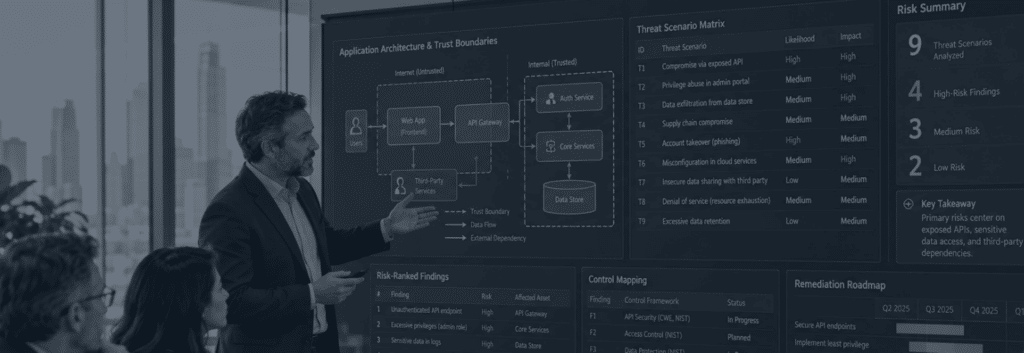
Threat modeling is often treated as a diagramming exercise or a compliance checkpoint. For CISOs at regulated enterprises, that is not enough. The real value comes from deliverables that help security leaders understand business risk, prioritize remediation, and strengthen security architecture before weaknesses become operational exposure.
Advanced threat modeling services should produce more than a list of potential threats. They should create decision-ready outputs that improve the risk assessment program, support engineering teams, and help executives see where security investment reduces business impact.
Below are nine threat modeling deliverables CISOs should expect.
What Are the 9 Essential Threat Modeling Deliverables?
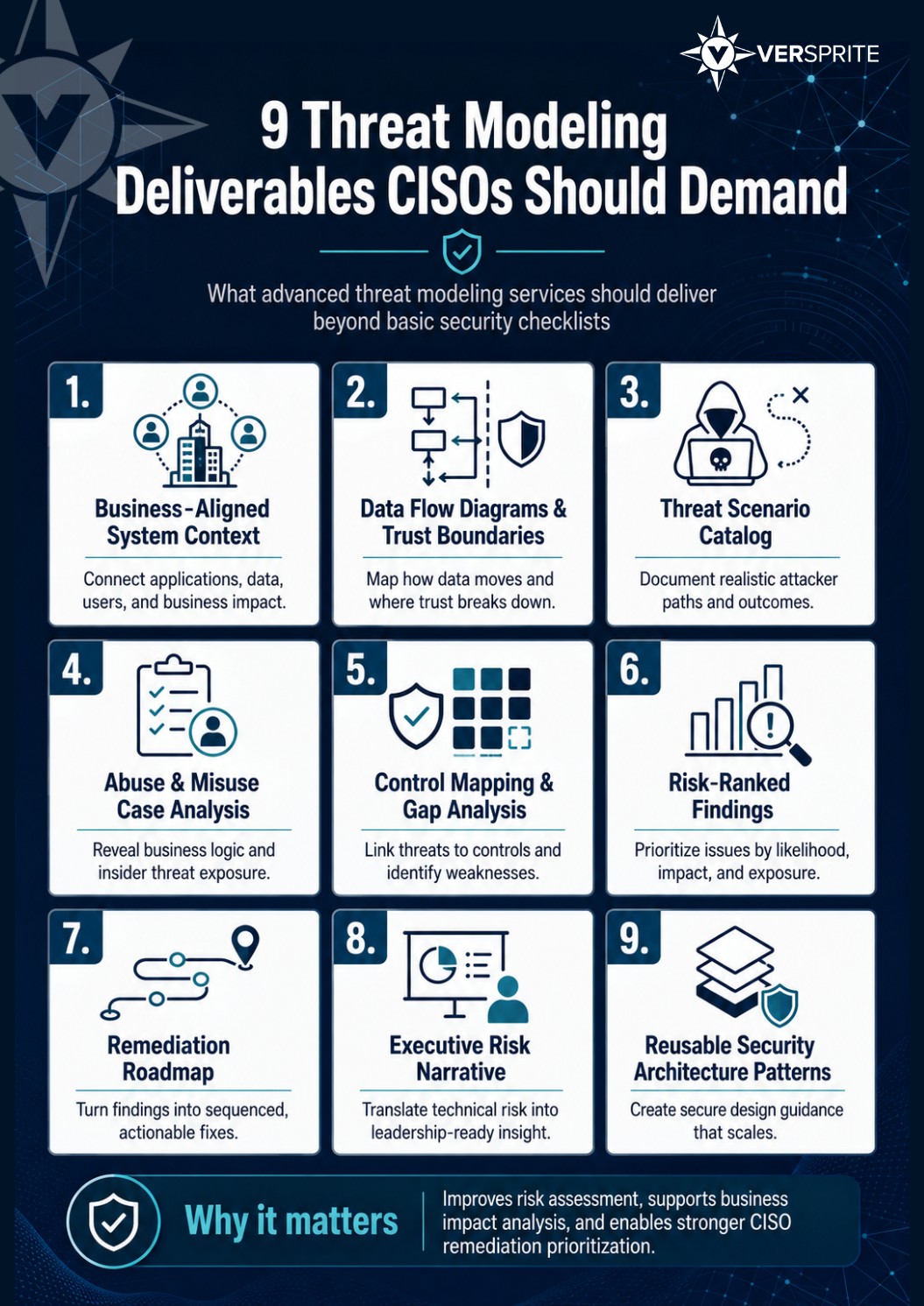
The nine essential threat modeling deliverables CISOs should expect are business-aligned system context, data flow diagrams with trust boundaries, a threat scenario catalog, abuse and misuse case analysis, control mapping and gap analysis, risk-ranked findings, a remediation roadmap, an executive risk narrative, and reusable security architecture patterns.
Together, these deliverables help enterprise security leaders identify architecture weaknesses, evaluate business impact, prioritize remediation, and communicate residual risk. Effective threat modeling connects adversarial analysis with measurable security decisions rather than producing documentation alone.
1. Business-Aligned System Context
Every effective threat model starts with a clear understanding of what the system does, who uses it, what data it handles, and why it matters to the business.
This deliverable should define the application or platform in plain business terms, including critical workflows, sensitive data, regulatory drivers, key users, third-party dependencies, and operational impact.
For CISOs, this is where threat modeling moves beyond security checklists. A well-built system context connects technical risk to business exposure, making it easier to explain why certain issues matter.
2. Data Flow Diagrams With Trust Boundaries
A data flow diagram should show how information moves through the environment, where it is processed, where it is stored, and where it crosses trust boundaries.
This is especially important for regulated enterprises where sensitive data often moves across cloud services, APIs, identity platforms, partner systems, and internal applications.
A strong deliverable should make it easy to see:
- Where sensitive data enters and exits the system
- Where authentication and authorization decisions occur
- Where external dependencies influence risk
- Where trust assumptions may be weak or undocumented
Security architecture threat modeling depends on this level of clarity. Without it, teams may miss the areas where attackers are most likely to exploit design flaws.
3. Threat Scenario Catalog
A threat model should produce practical threat scenarios, not abstract vulnerability lists.
Each scenario should describe a plausible path an attacker could take, the assets affected, the control gaps involved, and the potential business consequences.
For example, instead of simply noting “broken access control,” a useful scenario might describe how a user could manipulate an API request to access another customer’s records, leading to privacy impact, regulatory exposure, and loss of customer trust.
This is one of the most important outputs of advanced threat modeling services because it gives security and engineering teams a shared language for risk.
4. Abuse Case and Misuse Case Analysis
Threat modeling should account for how systems can be intentionally misused, not just how they are intended to function.
Abuse case analysis helps identify ways attackers, malicious insiders, compromised users, or automated tools could manipulate business logic. This is particularly valuable for applications that manage payments, user permissions, sensitive records, claims, transactions, or regulated workflows.
These deliverables help uncover risks that automated scanning and basic control reviews often miss. They also strengthen risk assessment program improvement by expanding visibility into design-level and logic-level threats.
5. Control Mapping and Gap Analysis
CISOs need to know which existing controls reduce risk and where meaningful gaps remain.
A control mapping deliverable should connect identified threats to current preventive, detective, and responsive controls. It should also identify where controls are missing, incomplete, misconfigured, or dependent on assumptions that have not been validated.
This output helps security leaders avoid duplicate effort. It also supports better investment decisions by showing whether the organization needs new controls, stronger architecture patterns, better monitoring, or more disciplined engineering practices.
6. Risk-Ranked Findings
A threat model should never leave teams with a flat list of issues.
Risk-ranked findings should consider likelihood, exploitability, control strength, affected assets, regulatory relevance, and business impact analysis. The goal is not to create fear. The goal is to help the organization act in the right order.
For CISOs, this is where CISO remediation prioritization becomes practical. A finding that affects customer data, identity infrastructure, or a revenue-critical workflow should not be treated the same as a low-impact hardening recommendation.
A mature deliverable should clearly separate:
- High-priority design risks
- Engineering remediation items
- Architecture improvement opportunities
- Accepted risks requiring executive visibility
- Longer-term security maturity recommendations
7. Remediation Roadmap
Threat modeling deliverables should translate risk into action.
A remediation roadmap should identify what needs to change, who is likely responsible, how urgent the work is, and which remediation options are available. It should also distinguish between tactical fixes and strategic improvements.
For example, a tactical remediation may involve tightening an authorization check. A strategic remediation may involve redesigning an identity pattern across multiple services.
This distinction matters because CISOs are often balancing immediate risk reduction with long-term security architecture improvement.
8. Executive Risk Narrative
Security leaders need deliverables that can communicate upward.
An executive risk narrative should summarize the most important threats, business impacts, remediation priorities, and decision points in a format suitable for leadership review. It should avoid unnecessary technical detail while preserving the seriousness of the risk.
This deliverable helps CISOs explain:
- What could happen
- Why it matters to the business
- What the organization is doing about it
- Where executive support or funding may be needed
The best threat modeling work does not stay trapped in engineering conversations. It helps executives make informed decisions about risk.
9. Reusable Security Architecture Patterns
Threat modeling should improve the current system and strengthen future systems.
Reusable security architecture patterns may include secure design recommendations, reference controls, identity and access patterns, logging requirements, segmentation guidance, API protection standards, or data protection principles.
This is where advanced threat modeling services create lasting value. The organization does not simply fix one application. It learns how to design safer systems across teams, products, and business units.
For regulated enterprises, this supports repeatability, audit readiness, and consistent security expectations across the software development lifecycle.
Threat Modeling Should Produce Decision-Ready Outcomes
CISOs should expect more from threat modeling than diagrams, worksheets, or generic findings.
The right deliverables improve visibility, sharpen remediation priorities, and connect technical risk to business impact. They help security teams guide engineering decisions with context, not just control requirements.
At VerSprite, threat modeling is grounded in adversarial thinking, security architecture expertise, and business-aware risk analysis. The objective is not to overwhelm teams with theoretical threats. It is to help organizations understand where they are exposed, why it matters, and how to reduce risk in a way that supports the business.
For enterprises operating in regulated, high-trust environments, threat modeling should be a strategic security capability. Done well, it becomes a practical engine for risk assessment program improvement, CISO remediation prioritization, and resilient application security architecture.
Conclusion
Advanced threat modeling services give CISOs the deliverables they need to lead with confidence. When threat modeling is executed with business context, technical depth, and remediation discipline, it becomes more than a security activity. It becomes a way to improve decision-making across architecture, engineering, compliance, and executive leadership.
Security leaders should demand outputs that are clear, actionable, and tied to business impact. Anything less risks becoming another checklist.
FAQ
What are advanced threat modeling services?
Advanced threat modeling services help organizations identify design-level, architecture-level, and business logic risks before they become exploitable weaknesses. Unlike basic security reviews, they evaluate how attackers could abuse systems, data flows, identities, integrations, and trust boundaries.
Why should CISOs demand specific threat modeling deliverables?
CISOs should demand specific deliverables because threat modeling must produce decision-ready outcomes. Clear deliverables help security leaders improve risk assessment, prioritize remediation, guide engineering teams, and communicate business impact to executive stakeholders.
How does threat modeling improve remediation prioritization?
Threat modeling improves remediation prioritization by ranking risks based on exploitability, affected assets, control gaps, regulatory exposure, and business impact. This helps CISOs focus resources on the issues most likely to affect critical systems, sensitive data, or enterprise operations.
How is threat modeling different from a security checklist?
Security checklists confirm whether expected controls are present. Threat modeling goes further by analyzing how attackers could misuse system design, business logic, access flows, integrations, and architecture assumptions. This makes it more useful for identifying risks that automated tools and checklist reviews may miss.
When should enterprises perform security architecture threat modeling?
Enterprises should perform security architecture threat modeling during major design phases, cloud migrations, new application development, high-risk feature releases, third-party integrations, and significant changes to identity, data, or transaction workflows. It is most valuable when performed early enough to influence design decisions.
What role does business impact analysis play in threat modeling?
Business impact analysis helps connect technical threats to enterprise consequences such as regulatory exposure, financial loss, operational disruption, fraud, customer trust erosion, or data compromise. This context helps CISOs make more informed remediation and investment decisions.
Share
- /
- /
- /
- /
- /
- /
- /
- /
- /
- /
- /
- /
- /
- /
- /
- /
- /
- /
- /
- /
- /
- /