
Penetration Testing as a Service (PTaaS)
Continuous penetration testing, from threat model to validated finding
Build a Tailored PTaaS Engagement- /
- /
- /
- /
- /
- /
- /
- /
- /
- /
- /
- /
- /
- /
- /
- /
- /
- /
- /
- /
- /
- /
Penetration Testing as a Service (PTaaS) is a subscription delivery model for penetration testing. Instead of one annual engagement that ends in a static report, PTaaS provides recurring and on-demand testing, findings delivered as they are confirmed, remediation tracking, and retesting to verify fixes. VerSprite PTaaS is led by CREST-accredited offensive security testers, prioritized with PASTA threat modeling, includes Knife adversarial AI testing, and is delivered through Tavola, VerSprite’s PTaaS client portal. In a same-scope comparison, this hybrid model surfaced 20 unique findings versus 9 from manual testing alone, in an estimated half the hours.
What Is Penetration Testing as a Service?
Penetration testing as a service changes how pen testing is delivered, not what a pen test is. The testing is still scoped, authorized, adversarial work: skilled testers attempt to exploit applications, APIs, networks, and cloud environments the way a real attacker would. What changes is the operating model around it:
- Cadence: testing runs on a recurring schedule and on demand, aligned to releases and major changes, rather than once a year.
- Platform delivery: findings reach your team through a client portal as they are validated, not weeks later in a PDF.
- Remediation loop: fixes are retested and the result is recorded, so every finding has a clear status.
- Trend reporting: results accumulate across testing cycles, showing whether exposure is actually going down.
PTaaS is not a vulnerability scanner sold as a subscription. Scanners identify known weaknesses; penetration testers prove which weaknesses can be exploited, chained together, and turned into business impact.
- /
- /
- /
- /
- /
- /
- /
- /
- /
- /
- /
- /
- /
- /
- /
- /
- /
- /
- /
- /
- /
- /
The VerSprite PTaaS Stack: Fork, Knife, BREAKERS, and Tavola
Most PTaaS providers offer testers plus a portal. VerSprite connects every stage of the testing lifecycle, from the threat model that decides what to test to the business context that decides what to fix first.
| Layer | What it does in PTaaS |
|---|---|
| Fork: the blueprint | VerSprite’s continuous application threat modeling platform, built on PASTA. Fork identifies the attack paths and components worth testing, and lets teams request targeted testing directly from a threat model. |
| Knife: adversarial AI at scale | An AI-led, human-on-the-loop adversarial testing platform for web applications and APIs. Knife ingests live HTTP traffic, classifies application behavior, and dispatches purpose-built AI agents, extending coverage across more endpoints and payload classes than manual testing alone. Knife is included in every VerSprite PTaaS program. |
| BREAKERS: human depth | VerSprite’s CREST-accredited offensive security team validates every Knife finding, removes false positives, and performs the testing AI cannot: chained exploitation, business-logic abuse, cloud and network attack paths, and judgment about real impact. |
| Tavola: business context | VerSprite’s PTaaS client portal. Tavola maps each finding to the product it affects and the business objective behind that product, so remediation is prioritized by impact rather than CVSS score alone. Tavola is included for VerSprite PTaaS clients at no additional cost. |
Threat modeling without testing is a plan with no proof. Testing without a threat model is effort with no direction. VerSprite PTaaS connects the two.
- /
- /
- /
- /
- /
- /
- /
- /
- /
- /
- /
- /
- /
- /
- /
- /
- /
- /
- /
- /
- /
- /
Case Study: Hybrid PTaaS vs. Manual Testing on the Same Application
To measure what Knife adds, VerSprite ran two assessments against the same application, with the same scope and the same credentials: a medium-sized client back-office portal handling sensitive data, with user and record management, complex forms, file uploads, and Administrator and Low Privilege User roles. Scoping objectives, including critical business and abuse cases, likely threat actors, threat motives, and targeted assets, were identical for both.
- Approach A: a human consultant performed a manual penetration test covering business logic, authentication and authorization, exploitation, and post-exploitation.
- Approach B: Knife ran an autonomous agent assessment, followed by consultant triage, validation, and peer review.
| Severity | Manual consultant test | Knife + human triage | Hybrid (combined, deduplicated) |
|---|---|---|---|
| Critical | 1 | 0 | 1 |
| High | 1 | 1 | 1 |
| Medium | 4 | 4 | 8 |
| Low | 3 | 6 | 8 |
| Info | 0 | 2 | 2 |
| Unique findings | 9 | 13 | 20 |
| Effort | 64 hours testing + 16 hours reporting | 16 hours setup + 1.5 hours analysis | ~40 hours |
The two approaches overlapped on only 2 findings. Combined, they produced 20 unique findings: 2.2 times as many as the manual test alone, in an estimated half the hours of an 80-hour standard pen test.
Where Knife won: consistent coverage of lower-severity findings that take disproportionate consultant time to document, including CORS misconfiguration, improper input validation across 11 locations, session IDs in URLs, vulnerable components, missing security headers, and user enumeration. Knife applies identical depth to every route, and its cost does not grow with each additional application in a portfolio.
Where the consultant won: the consultant found stored XSS and HTML injection that Knife missed, discovered exposed developer files and a publicly accessible developer integration console with hardcoded credentials, identified replayable tokens caused by missing HMAC validation, and tested application-specific business-logic abuse cases. Both approaches found the SQL injection, but only the consultant carried it through post-exploitation and data extraction, proving critical business impact where Knife had rated it High.
Neither result set was a subset of the other. AI-driven and manual testing fail in different places, which is why VerSprite PTaaS uses both: Knife runs first and takes the breadth, and consultant hours go where human judgment pays.
- /
- /
- /
- /
- /
- /
- /
- /
- /
- /
- /
- /
- /
- /
- /
- /
- /
- /
- /
- /
- /
- /
How VerSprite PTaaS Works
Each PTaaS program follows the same cycle, repeated for every testing window:
- Scope against business risk. VerSprite works with your security and engineering leads to identify the assets, data, and workflows that would cause the most damage if compromised.
- Model likely attacks. PASTA threat analysis, operationalized in Fork, determines which threat actors, techniques, and attack paths to emulate.
- Run Knife first. Every VerSprite PTaaS program includes Knife. Knife’s AI agents run first against web applications and APIs, clearing broad, repeatable coverage for injection, cross-site scripting, IDOR, CORS weaknesses, user enumeration, MFA bypass scenarios, information disclosure, and other application-layer risks.
- Test in depth. BREAKERS testers triage and validate Knife’s findings, then spend their hours where judgment pays: business-logic abuse cases, client-side issues such as stored XSS, content discovery, post-exploitation, chained attacks, and cloud and internal network attack paths.
- Deliver findings in Tavola. Validated findings appear in the Tavola portal as testing progresses, with proof of exploitation, CWE, CVE, CAPEC, and OWASP mapping, business-impact ranking, and developer-ready remediation guidance.
- Retest. Once your team ships a fix, VerSprite retests and confirms whether the issue is closed.
- Report the trend. Each cycle adds to a running view of exposure by product, severity, and time-to-remediate.
- /
- /
- /
- /
- /
- /
- /
- /
- /
- /
- /
- /
- /
- /
- /
- /
- /
- /
- /
- /
- /
- /
PASTA-Driven PTaaS: Testing What Matters to the Business
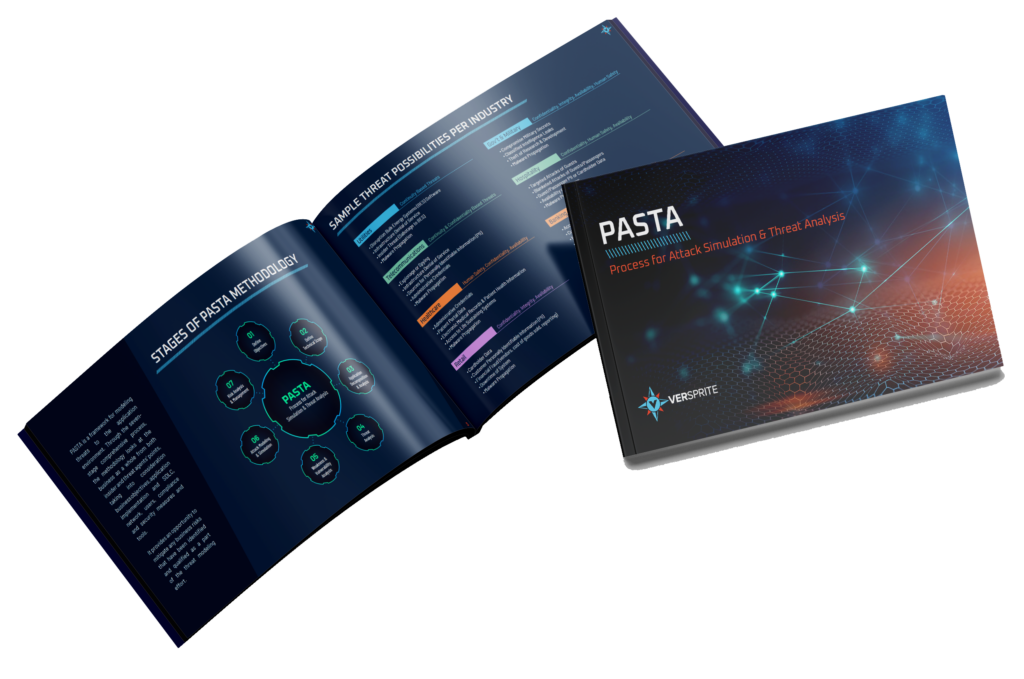
Most PTaaS providers prioritize findings by technical severity alone. VerSprite prioritizes using PASTA (Process for Attack Simulation and Threat Analysis), the seven-stage, risk-centric threat modeling methodology co-created by VerSprite founder and CEO Tony UcedaVélez. In PTaaS, the seven stages shape what gets tested and how results are ranked:
| PASTA stage | How it shapes your PTaaS program |
|---|---|
| 1. Define Objectives | Ties testing scope to the business processes, data, and revenue the organization cannot afford to lose |
| 2. Define Technical Scope | Establishes the applications, APIs, infrastructure, and cloud assets in each testing window |
| 3. Application Decomposition | Maps data flows and trust boundaries so testers target the points where controls are most likely to fail |
| 4. Threat Analysis | Selects the threat actors and techniques relevant to your industry and environment |
| 5. Vulnerability & Weakness Analysis | Identifies the weaknesses most likely to be reachable by those threats |
| 6. Attack Modeling | Builds attack trees that guide Knife’s agents and BREAKERS testers toward chained, multi-step exploitation |
| 7. Risk & Impact Analysis | Ranks confirmed findings by business impact and likelihood, surfaced in Tavola |
The result is a findings list ordered by what an attacker could actually do to the business, which is the order your team should fix things in. Learn more about PASTA threat modeling.
- /
- /
- /
- /
- /
- /
- /
- /
- /
- /
- /
- /
- /
- /
- /
- /
- /
- /
- /
- /
- /
- /
What VerSprite PTaaS Covers
| Environment | What testers look for | Knife coverage |
|---|---|---|
| Web applications | Authentication and session flaws, access control failures, injection, business-logic abuse | Yes |
| APIs | Broken object-level authorization (IDOR), excessive data exposure, CORS and auth bypass | Yes |
| Cloud environments | Misconfigured IAM, exposed storage, privilege escalation across AWS, Azure, and GCP | Human-led |
| External networks | Exposed services, weak perimeter controls, internet-facing entry points | Human-led |
| Internal networks and systems | Lateral movement, Active Directory attack paths, privilege escalation | Human-led |
| Multi-tenant SaaS | Tenant isolation failures and cross-account data access | Human-led, Knife-assisted |
Specialized testing is also available through VerSprite’s web application security, mobile security testing, AI hacking, and red teaming services.
- /
- /
- /
- /
- /
- /
- /
- /
- /
- /
- /
- /
- /
- /
- /
- /
- /
- /
- /
- /
- /
- /
PTaaS vs. Traditional Pen Testing, Scanning, Bug Bounty, and AI-Only Testing
| VerSprite PTaaS | Traditional penetration test | Vulnerability scanning | Bug bounty | AI-only pen testing tools | |
|---|---|---|---|---|---|
| Frequency | Recurring and on-demand | Point-in-time, often annual | Continuous | Continuous, unscheduled | Continuous |
| Who tests | AI agents plus CREST-accredited human testers | Human testers | Software | Independent researchers | Software agents |
| Exploitation and chaining | Yes | Yes | No | Sometimes | Limited |
| Findings validated by experts | Every finding | Yes | No | Triage varies | Usually not |
| Business-logic testing | Yes | Yes | No | Sometimes | Weak |
| Retesting | Built in | Usually extra cost | Rescan only | Not guaranteed | Rescan only |
| Prioritization | Business impact (PASTA) | Technical severity | CVSS | Bounty severity | Technical severity |
| Findings delivery | Tavola portal, as confirmed | Final report | Dashboard | As submitted | Dashboard |
The short version: a traditional penetration test answers “how secure were we on the day of testing?” PTaaS answers “how secure are we now, and is it improving?” AI-only tools add speed but not judgment; VerSprite PTaaS uses Knife for speed and BREAKERS for judgment. Scanning complements all of these, which is why PTaaS pairs well with threat and vulnerability management.
- /
- /
- /
- /
- /
- /
- /
- /
- /
- /
- /
- /
- /
- /
- /
- /
- /
- /
- /
- /
- /
- /
Who PTaaS Is For
PTaaS fits organizations that:
- Ship code weekly or faster and need testing to keep pace
- Have growing web application and API portfolios that outrun manual testing capacity
- Run cloud-native or hybrid environments that change constantly
- Must show customers, auditors, or regulators ongoing evidence of testing
- Already threat model, or want to, and need testing tied to those models
Teams using Fork can request targeted, Knife-powered testing directly from a threat model through Fork Enterprise PT.
Compliance support. PTaaS produces recurring evidence for frameworks that expect regular penetration testing, including PCI DSS (Requirement 11.4 calls for testing at least annually and after significant changes), SOC 2, ISO 27001, and HIPAA security programs.
Industries: Financial services and fintech, healthcare and life sciences, SaaS and technology, retail and e-commerce, and critical infrastructure.
- /
- /
- /
- /
- /
- /
- /
- /
- /
- /
- /
- /
- /
- /
- /
- /
- /
- /
- /
- /
- /
- /
What You Receive
- Access to the Tavola PTaaS client portal, included at no additional cost
- Knife adversarial AI testing for web applications and APIs, included in every program
- Validated, deduplicated findings with proof of exploitation
- Mapping to CWE, CVE, CAPEC, and OWASP categories
- Business-impact ranking tied to the products and objectives each finding affects
- Developer-ready remediation guidance
- Retest results confirming whether fixes closed the issue
- Executive summaries and trend reporting across testing cycles
Frequently Asked Questions
What is Penetration Testing as a Service (PTaaS)?
Penetration Testing as a Service is a subscription model for penetration testing. It replaces a single annual engagement with recurring and on-demand testing, findings delivered through a portal as they are confirmed, remediation tracking, and retesting. VerSprite PTaaS is led by CREST-accredited testers, prioritized with PASTA threat modeling, and delivered through the Tavola client portal.
How is PTaaS different from a traditional penetration test?
A traditional penetration test is a point-in-time engagement that ends with a final report. PTaaS is an ongoing program: testing repeats on a schedule and after major changes, findings arrive as they are validated, fixes are retested, and results are tracked over time so you can see whether risk is going down.
Does VerSprite PTaaS use AI?
Yes, alongside human testers. VerSprite PTaaS includes Knife, VerSprite’s adversarial AI platform, to test web applications and APIs at scale with purpose-built AI agents. Every Knife finding is validated by VerSprite’s CREST-accredited BREAKERS consultants, who also perform the chained exploitation and business-logic testing that AI tools miss.
What is Knife and how does it relate to PTaaS?
Knife is VerSprite’s AI-led, human-on-the-loop adversarial testing platform for web applications and APIs. It ingests live HTTP traffic, dispatches specialized agents to test for issues such as injection, IDOR, CORS weaknesses, and MFA bypass, and produces evidenced findings that VerSprite consultants validate. Knife is included in VerSprite PTaaS, where it extends coverage while human testers provide depth.
Does combining AI and manual penetration testing find more vulnerabilities?
In VerSprite’s same-scope comparison on a back-office web portal, a manual consultant test found 9 issues and a Knife assessment with human triage found 13. The two overlapped on only 2, so the hybrid result was 20 unique findings, 2.2 times as many as manual testing alone, in an estimated 40 hours versus 80.
Why not rely on AI penetration testing alone?
Because AI and human testers miss different things. In VerSprite’s same-scope comparison, a consultant found stored XSS, HTML injection, and exposed developer files and consoles that Knife missed, and only the consultant carried the SQL injection through post-exploitation to prove critical business impact. VerSprite PTaaS pairs Knife’s breadth with human depth.
What is Tavola?
Tavola is VerSprite’s client portal for PTaaS engagements, included at no additional cost. It shows validated findings as testing progresses and maps each one to the product it affects and the business objective behind that product, so teams prioritize remediation by business impact instead of relying on static reports or CVSS scores alone.
How does PASTA threat modeling improve PTaaS?
PASTA ties testing to business risk. VerSprite uses its seven stages, operationalized in the Fork threat modeling platform, to choose which assets and attack paths to test, which threat actors to emulate, and how to rank confirmed findings. Findings are ordered by business impact and likelihood rather than technical severity alone.
What does VerSprite PTaaS cover?
VerSprite PTaaS covers web applications, APIs, cloud environments in AWS, Azure, and GCP, external and internal networks, and multi-tenant SaaS platforms. Web applications and APIs also receive AI-scale coverage from Knife, which is included in every PTaaS program. Scope is set for each testing window based on business risk and can shift as your environment changes.
How often does PTaaS testing happen?
Testing cadence is set during scoping. Most programs combine scheduled testing cycles with on-demand tests triggered by major releases, architecture changes, or incidents. Teams using Fork can also request targeted testing directly from a threat model.
Does PTaaS help with compliance?
Yes. PTaaS produces recurring testing evidence for frameworks that expect regular penetration testing, including PCI DSS, SOC 2, ISO 27001, and HIPAA security programs. PCI DSS Requirement 11.4, for example, requires penetration testing at least annually and after significant changes, which a PTaaS cadence covers by design.
How is PTaaS different from a bug bounty program?
A bug bounty pays independent researchers for the issues they choose to report, with no guaranteed scope, method, or retesting. PTaaS uses a dedicated team testing a defined scope with a consistent methodology, built-in retesting, and reporting you can hand to auditors. Many organizations use bug bounties as a supplement, not a substitute.
- /
- /
- /
- /
- /
- /
- /
- /
- /
- /
- /
- /
- /
- /
- /
- /
- /
- /
- /
- /
- /
- /
Resources




Start Testing Like an Adversary
Security changes with every release. VerSprite PTaaS shows you how an attacker sees your environment now, ranks what matters to the business, and proves whether it is getting harder to break into over time.
