Why Attack Simulations Miss Business Logic Threats
Date
Authors
Tony UcedaVélez
Follow Us


Attack simulation has become a familiar part of modern cybersecurity programs. For application security leaders and security architects, it offers a practical way to test assumptions, validate controls, and see how an adversary might move through an environment.
But there is a problem.
Many attack simulations are strongest where systems are predictable and weakest where applications are contextual. They often uncover exposed services, misconfigurations, weak credentials, exploitable vulnerabilities, and control gaps. Those findings matter. Yet the most damaging application risks are not always found in a payload, a scanner result, or a standard exploit path.
They live in the logic of the business.
Business logic threats emerge when an application works exactly as designed, but the design allows an attacker to abuse a workflow, bypass intent, manipulate trust, or create unintended outcomes. These flaws are difficult to detect through automation alone because they require an understanding of how the application is supposed to behave, who uses it, what business decision it supports, and what an attacker gains by bending that process.
That is where risk-driven testing and threat modeling create a higher standard.
Ranking the Reasons Attack Simulation Misses Business Logic Threats
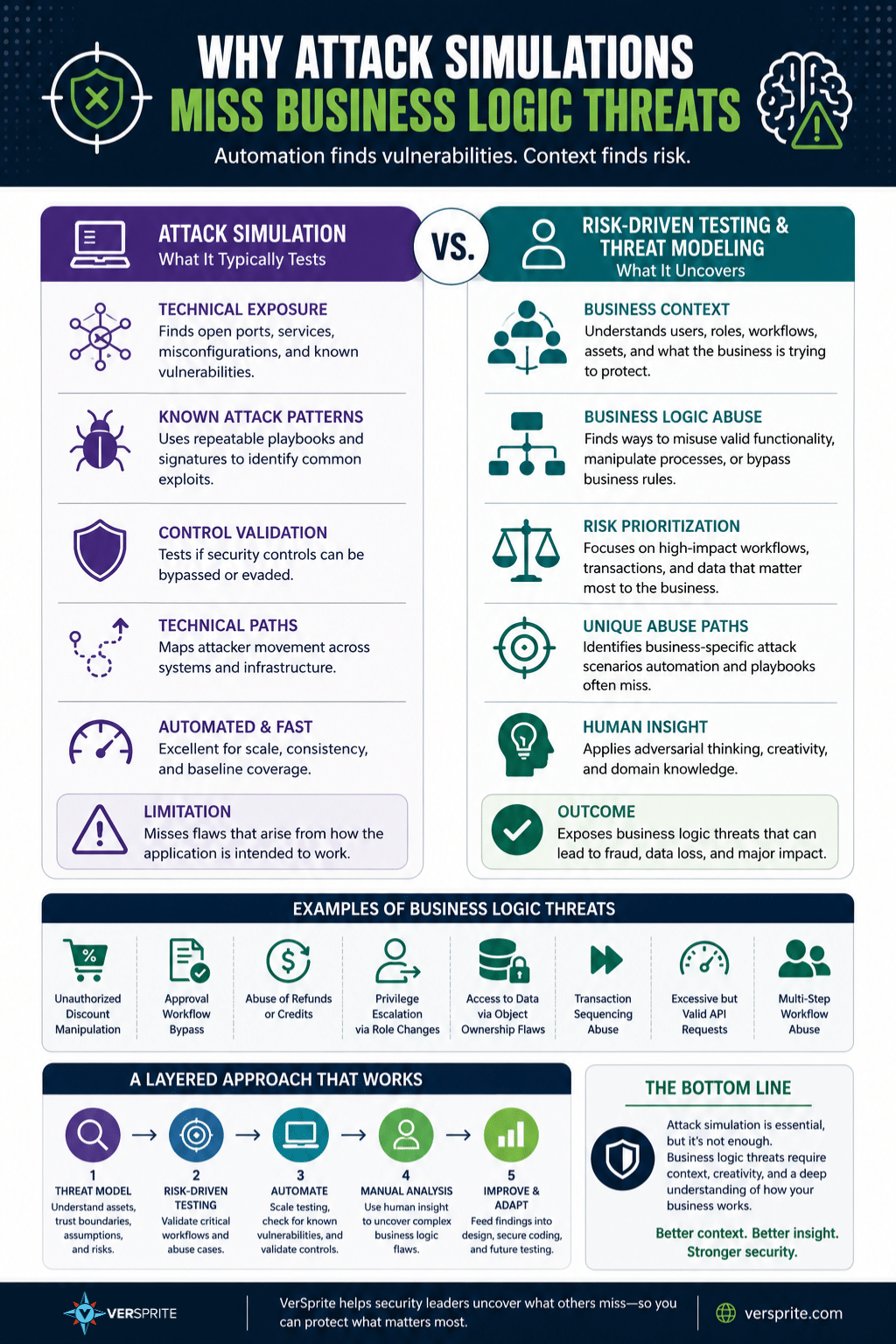
1. Attack Simulation Often Tests Technical Exposure, Not Business Intent
Most attack simulation efforts begin with technical reachability. Can an attacker access this endpoint? Can they exploit this vulnerability? Can they move from one system to another? Can they bypass a control?
Those questions are useful, but they are incomplete.
A business logic threat asks a different set of questions:
- Can a user perform an action they should not be able to perform?
- Can a legitimate workflow be abused for fraud, privilege escalation, or data exposure?
- Can an attacker manipulate sequence, timing, quantity, state, or role assumptions?
- Can the application make a bad business decision while still passing every technical validation check?
Automated attack simulation is usually built around known patterns. Business logic abuse is often built around intent. That makes it harder to find unless the tester understands the purpose of the application and the value of the transaction.
For security architects, this distinction is critical. A control can be technically present and still fail to protect the business outcome.
2. Automated Approaches Struggle With Context
Automation is excellent at repetition. It can test large surfaces quickly, identify known weaknesses, and provide consistent coverage across common vulnerability classes.
But business logic threats require context that tools rarely possess.
An automated tool may see that a payment request returns a successful response. A risk driven tester asks whether the user should have been able to submit that payment, alter the amount, change the recipient, reuse a transaction, skip an approval step, or perform the action from that account type.
An automated tool may see that an API accepts a valid token. A threat model asks whether that token grants the right level of authority for the specific business action being performed.
An automated tool may see that a workflow completes. A business logic review asks whether the workflow should have completed under those conditions.
This is where VerSprite’s application security perspective is different. Strong testing is not only about finding exploitable code. It is about understanding how technical behavior maps to business risk. The goal is not to prove that a tool can trigger a response. The goal is to determine whether the system can be misused in a way that matters.
3. Business Logic Threats Hide in “Valid” Behavior
Many serious application risks do not look like errors.
- They do not require a crash.
- They do not require malformed input.
- They do not always trigger alerts.
- They may not violate authentication.
- They may not appear as traditional vulnerabilities.
Instead, they appear as valid actions performed in the wrong order, by the wrong user, at the wrong frequency, or under the wrong business condition.
Examples include:
- Unauthorized discount manipulation
- Approval workflow bypass
- Abuse of refund or credit processes
- Account takeover through weak recovery logic
- Privilege escalation through role transition flaws
- Inventory, pricing, or transaction manipulation
- API abuse through excessive but valid requests
- Multi-step workflow abuse across sessions or users
These are not always “bugs” in the conventional sense. They are failures of design assumptions.
Attack simulation may miss these flaws because it frequently focuses on what can be exploited technically. Risk driven testing focuses on what can be abused operationally.
4. Standard Playbooks Can Miss Unusual Abuse Paths
Attack simulation programs often rely on repeatable playbooks. That repeatability is valuable because it improves consistency and measurement. However, business logic threats are often specific to the organization, application, industry, user population, and revenue model.
A banking workflow, healthcare portal, SaaS administration console, insurance claim system, marketplace application, and identity platform all have different abuse cases. A generic attack path cannot fully account for those differences.
Security leaders should be cautious when simulation results create a false sense of completeness. A successful simulation may confirm that certain controls work against expected attack techniques. It does not necessarily confirm that the application is resilient against business specific abuse.
That is why threat modeling matters. It helps teams identify the unique ways an attacker could misuse the system based on business processes, data sensitivity, trust boundaries, user roles, and decision points.
5. Attack Simulation Can Overlook Design Level Risk
Many organizations still treat application security primarily as a defect discovery function. They test late, report findings, patch vulnerabilities, and move on.
Business logic threats demand earlier engagement.
By the time an application reaches production, the most important security decisions may already be embedded into the architecture. Authentication flows, authorization models, approval chains, data ownership rules, API trust assumptions, and transaction boundaries may be difficult to change without disrupting the business.
Attack simulation can identify some weaknesses after the fact. Threat modeling helps expose the design decisions that create those weaknesses before they become expensive to fix.
This is especially important for security architects. The most effective application security programs do not only ask, “Is this vulnerable?” They ask, “What could go wrong with this design, and what risk would that create for the business?”
6. Risk-Driven Testing Prioritizes What Matters Most
Not every flaw has the same business impact. Not every exploit path deserves the same urgency. Not every technical weakness maps to material risk.
Risk-driven testing brings discipline to application security by focusing effort where the business has the most to lose.
That means testers evaluate:
- Critical workflows
- High-value transactions
- Sensitive data paths
- Privilege changes
- Identity and access assumptions
- Trust boundaries between systems
- Approval and exception handling
- Abuse cases tied to fraud, privacy, operational disruption, or regulatory exposure
This approach makes testing more strategic. Instead of treating the application as a collection of endpoints, risk-driven testing treats it as a system of business decisions.
That shift is where deeper security value emerges.
7. Threat Modeling Connects Architecture, Adversary Behavior, and Business Impact
Threat modeling is one of the most effective ways to expose business logic threats because it forces teams to examine how an application is supposed to work and how that intended behavior could be abused.
A strong threat model identifies:
- Who can interact with the system
- What assets and workflows need protection
- Where trust boundaries exist
- What assumptions the design depends on
- How attackers could manipulate process, state, or authorization
- Which controls reduce the most meaningful risk
- What abuse cases require manual validation
For application security leaders, threat modeling also creates alignment. Developers, architects, security engineers, and business stakeholders can discuss risk in a shared language before testing begins.
That alignment matters because business logic threats rarely belong to one team. They often sit between product decisions, architecture choices, engineering implementation, and business process design.
8. Human-Led Analysis Finds What Automation Cannot Infer
Automation is necessary, but it is not sufficient.
A mature application security program uses automation to scale coverage and human-led analysis to interpret risk. The two should work together, not compete.
Automated attack simulation can help identify known technical weaknesses. Manual risk driven testing can investigate how those weaknesses interact with business workflows. Threat modeling can guide both by identifying where misuse would create the greatest impact.
The result is more than a longer findings list. It is a clearer understanding of how the application can fail the business.
That is the standard security leaders should expect.
9. Business Logic Testing Requires Adversarial Thinking
Business logic threats require testers to think less like tool operators and more like adversaries.
An adversary does not care whether a vulnerability has a CVE. They care whether the system can be manipulated for gain. They look for shortcuts, assumptions, race conditions, trust gaps, and weak process controls. They explore how legitimate functionality can produce illegitimate outcomes.
This is why risk-driven testing must include abuse case development.
Instead of asking only whether a field accepts malicious input, testers ask:
- What happens if this step is skipped?
- What happens if this request is repeated?
- What happens if this user changes object ownership?
- What happens if approval occurs after the transaction instead of before it?
- What happens if two roles interact in an unexpected sequence?
- What happens if a valid API call is made at a scale the business never intended?
These questions expose a class of risk that automated attack simulation often cannot reach on its own.
10. The Best Programs Treat Attack Simulation as One Layer, Not the Whole Strategy
Attack simulation has value. It helps validate controls, test response capabilities, and reveal attacker paths. But it should not be treated as a complete application security strategy.
For business logic threats, the stronger model is layered:
- Use threat modeling to understand design risk.
- Use risk-driven testing to validate critical workflows.
- Use automation to scale repeatable checks.
- Use manual analysis to explore abuse cases.
- Use architecture review to strengthen trust boundaries.
- Use findings to improve secure design patterns across future releases.
This creates a more resilient application security program because it connects simulation, architecture, testing, and business impact.
How Security Leaders Should Evolve Their Approach
Application security leaders should not abandon attack simulation. They should expand it.
A stronger approach includes the following practices:
- Build threat models around critical business workflows, not only technical components.
- Prioritize testing based on business impact and abuse potential.
- Include security architects early in design decisions.
- Validate authorization, workflow sequencing, state transitions, and trust boundaries manually.
- Use automation for scale, but do not rely on it for business context.
- Translate findings into architectural improvements and secure design patterns.
- Measure success by risk reduction, not just vulnerability counts.
This is where application security becomes more than a compliance activity. It becomes a business-aligned risk discipline.
Frequently Asked Questions
What is attack simulation in cybersecurity?
Attack simulation is a security testing method that emulates adversary behavior to evaluate how systems, controls, and teams respond to attack paths. In application security, it can help identify exploitable weaknesses, control gaps, and exposure points.
Why does attack simulation miss business logic threats?
Attack simulation often misses business logic threats because many of these flaws occur through valid application behavior. Automated tools and standard playbooks may not understand business rules, workflow intent, user roles, approval logic, or the operational impact of process abuse.
What are business logic threats?
Business logic threats are security risks that arise when an application’s intended functionality can be misused. Examples include bypassing approval workflows, manipulating transactions, abusing refunds, escalating privileges through role changes, or accessing data through flawed object ownership rules.
How does threat modeling help find business logic flaws?
Threat modeling helps teams analyze how an application is designed, where trust boundaries exist, what assumptions the system depends on, and how an attacker could abuse workflows. This makes it easier to identify business logic flaws before or during testing.
What is risk-driven testing?
Risk-driven testing is an application security testing approach that focuses on the workflows, assets, users, and transactions that matter most to the business. It prioritizes testing based on potential impact rather than only technical vulnerability categories.
Is automation still useful for application security?
Yes. Automation is useful for scale, consistency, and detecting known vulnerability patterns. However, automation should be paired with human-led analysis, threat modeling, and risk-driven testing to uncover business logic threats that require context.
Conclusion
Attack simulation is a valuable part of a modern security program, but it is not enough to expose every meaningful application risk. Business logic threats often hide inside valid workflows, trusted user actions, and design assumptions that automated approaches cannot fully understand.
For application security leaders and security architects, the path forward is not more automation alone. It is better context, sharper threat modeling, and risk-driven testing that reflects how the business actually operates.
The strongest application security programs do not simply ask whether an attacker can exploit a system. They ask whether an attacker can abuse the way the business works.
That is where bigger risk becomes visible. And that is where better security decisions begin.