Continuous Audit Evidence Automation for SOC 2, PCI DSS, and FedRAMP
Audit evidence doesn't accumulate at audit time. It's either captured continuously or reconstructed under pressure.
Date
Authors
Germán Miotti
Follow Us


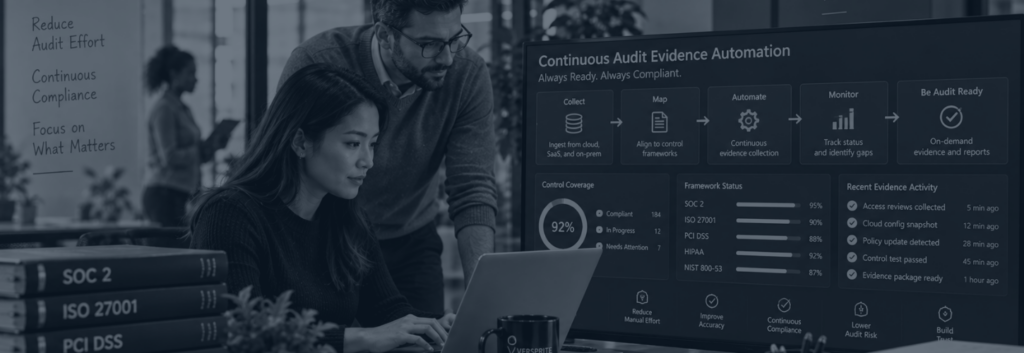
For security and compliance teams responsible for SOC 2, PCI DSS, FedRAMP, and other regulated frameworks, audit readiness depends on more than having the right tools. It depends on whether the environment can continuously produce, retain, map, and retrieve the evidence auditors need.
That is where continuous audit evidence automation becomes valuable. Instead of waiting until fieldwork begins, organizations can design logging, access reviews, configuration management, and deployment pipelines to generate audit-ready evidence as part of normal operations.
The result is a compliance program that spends less time reconstructing history and more time proving that controls are working.
Key Takeaways
- Audit evidence is already being generated by cloud platforms, IAM systems, CI/CD pipelines, logging tools, and security controls.
- Manual evidence collection creates unnecessary audit pressure because teams must reconstruct control activity after the fact.
- Continuous audit evidence automation helps SOC 2, PCI DSS, and FedRAMP teams retrieve evidence instead of rebuilding it.
- Control mapping is the missing layer that connects technical events to framework requirements.
- Compliance as code helps reduce drift by enforcing policy requirements before non-compliant resources enter production.
- VerSprite helps organizations identify where manual evidence collection can be replaced with automated, auditor-usable evidence.
The Core Problem: Evidence Is an Afterthought
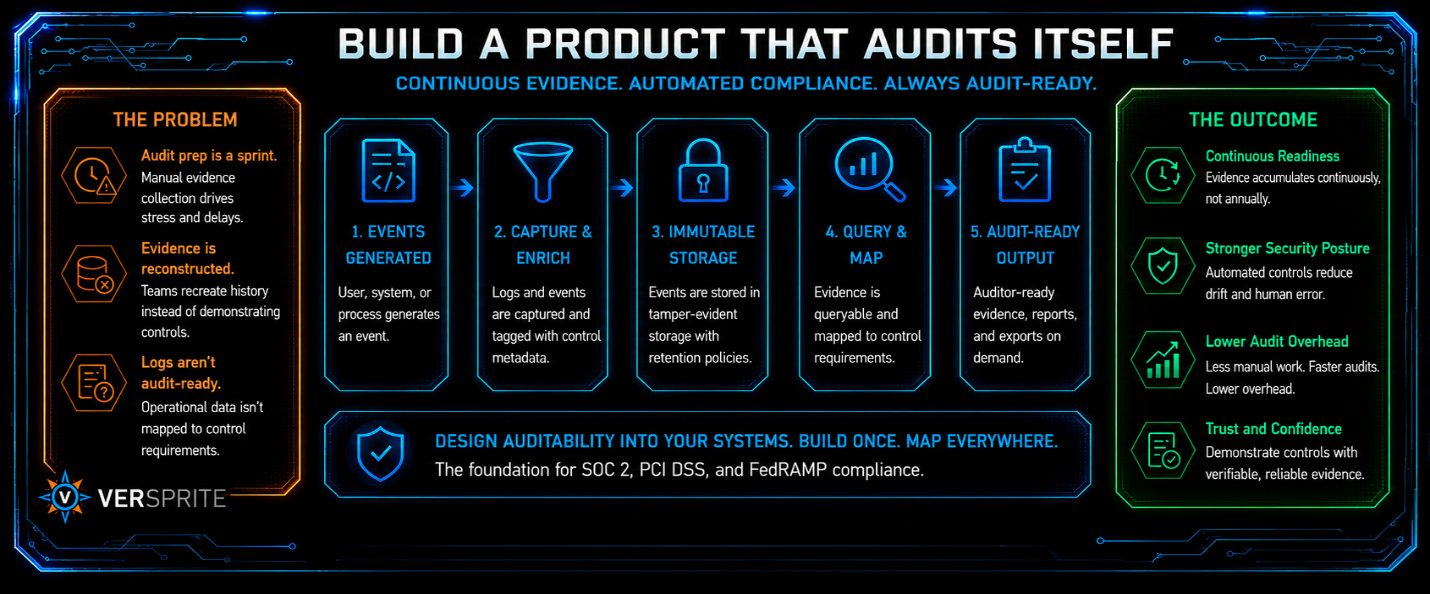
SOC 2 Type II, PCI DSS, and FedRAMP all require continuous evidence. The controls need to be operating consistently, not reconstructed at audit time. When teams collect evidence manually, they are recreating history rather than demonstrating it.
The root cause is usually architectural: logging, access controls, and configuration management were built for operations, not for compliance consumption. They capture what happened, but not in a format that maps cleanly to control requirements. Preparing evidence means translating operational data into audit language, manually, every time.
The fix is to design that translation into the system from the start. When your logging pipeline tags events with the control IDs they satisfy, when your deployment process generates signed artifacts that constitute change management records, when your access review workflow writes to a queryable log, you stop reconstructing and start retrieving.
Continuous evidence collection is also how you detect drift before it becomes a finding. When evidence collection is manual, gaps go undetected until someone looks.
A logging configuration that drifted three months ago, a privileged access grant that was never reviewed, a deployment that bypassed the pipeline during an incident: none of these surfaces until the next audit cycle forces a full inventory. By then, the gap is historical, harder to explain, and in some frameworks, a reportable finding. A system that collects evidence continuously catches drift as it happens.
What Is Continuous Audit Evidence Automation?
Continuous audit evidence automation is the process of designing security, cloud, identity, logging, and deployment systems to automatically produce evidence that maps to compliance controls.
Instead of collecting screenshots, spreadsheets, and exports at audit time, teams configure systems to retain structured evidence as events occur. This can include access review records, policy enforcement logs, deployment approvals, vulnerability scan outputs, configuration baselines, and immutable audit logs.
For regulated organizations, the value is not just speed. The value is confidence. When evidence is generated continuously, teams can detect control drift earlier, reduce manual audit preparation, and show auditors a more complete record of control operation.
The Control Mapping Problem
The gap most automation efforts miss is mapping. Your logging system captures events. Your CI/CD pipeline captures deployments. Your IAM system captures access changes. But which events map to which controls, in which framework, with what evidence format?
This mapping layer is where most automation efforts stall. Teams build solid technical infrastructure and then spend weeks manually translating it into audit documentation because nobody defined the relationship between the technical controls and the framework requirements upfront.
The answer is to build a control matrix early, a document or structured data file that maps each framework control to the technical system that satisfies it, the evidence format it produces, and the retention requirement. This becomes the backbone of your audit readiness program. When the auditor asks for evidence of CC6.1, your team looks at the matrix, knows it’s the IAM access review export, and retrieves it. No archaeology required.
The matrix also forces a useful conversation upfront. When you map PCI DSS Requirement 10.5.1 to your logging infrastructure and realize there is no immutable storage configuration, that gap is an engineering ticket, not an audit finding. Teams that build the matrix before they build the automation consistently close fewer last-minute gaps than teams that discover missing evidence during fieldwork. The earlier the mapping happens, the cheaper the fix.
GRC platforms like Vanta, Drata, and Hyperproof automate parts of this mapping, but they work best when the underlying technical infrastructure is already generating clean, structured evidence. Plugging one into a poorly configured environment just gives you faster access to incomplete data.
Structural Changes That Pay Off Across Frameworks
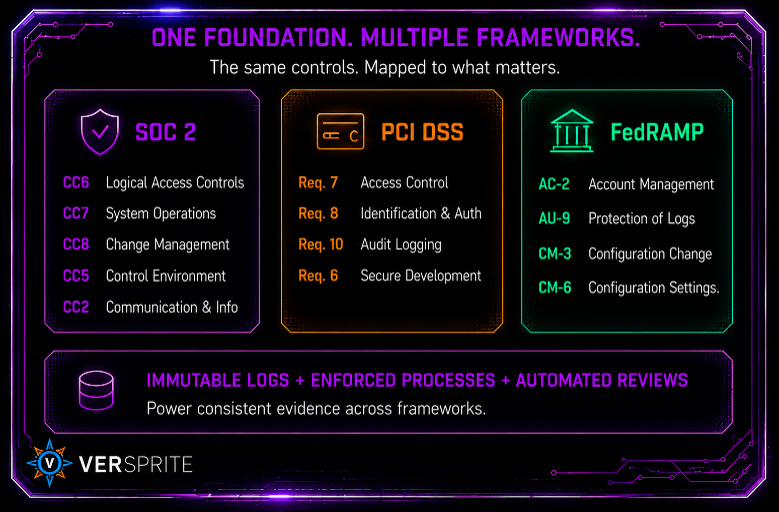
The most effective investments satisfy multiple frameworks at once. SOC 2 CC6 logical access controls, PCI DSS Requirement 10 audit logging, and FedRAMP AC 2 account management all care about the same underlying data: who has access to what, and whether someone reviewed it. Build the system once and map it to each framework’s language.
The Azure and PCI DSS combination shows how this works in practice. Payment card environments require strict network segmentation, encryption in transit and at rest, exhaustive audit logging, and continuous evidence that every control is held across the full audit period. That last requirement is where manual programs break. The team described above had all those controls documented. What they lacked was a system that collected the evidence without human intervention.
Azure’s native tooling addresses each control family directly. Entra ID manages identity and access centrally. Azure Privileged Identity Management governs privileged access grants and captures the approval chain immutably. Microsoft Sentinel retains log data across the environment and satisfies PCI DSS Requirement 10.5’s log integrity controls. Azure Firewall enforces and documents network segmentation. Each of these systems holds evidence PCI DSS auditors will ask for. In a manual program, collecting it means touching every system individually before each audit cycle.
The automated version works differently. Privileged grants flow through Azure PIM with the approval chain written to an immutable log automatically. Network segmentation, encryption baselines, and logging requirements are defined as code using Azure Policy: a non-compliant resource doesn’t get created because the pipeline blocks provisioning before it completes. Sentinel ingests the full audit trail continuously. When the auditor asks for 90 days of access logs, the query takes minutes, not weeks.
To map this to one control concretely: PCI DSS Requirement 10.5.1 requires audit log protection from destruction and unauthorized modification. The engineering translation is object lock-enabled storage with a defined retention period, structured log metadata identifying the control each event satisfies, and Sentinel configured to alert on any modification attempt. That single implementation also satisfies FedRAMP AU 9 protection of audit information and contributes to SOC 2 CC7.2 monitoring for anomalies. One build, three frameworks.
CI/CD pipelines and access reviews follow the same pattern. If your deployment pipeline requires a pull request, a code review approval, automated test passage, and a deployment record, you have change management evidence for SOC 2 CC8, PCI DSS Requirements 6.4 and 6.5, and FedRAMP CM 3. The gap for most teams is not that the pipeline doesn’t produce this evidence: it’s that nobody configured it to retain and export that evidence in a form auditors can consume.
Automated access reviews native in Azure Entra ID Access Reviews, AWS IAM Access Analyzer, or third-party platforms follow the same pattern: the review becomes a logged event with timestamps, reviewer identities, and actions taken, rather than a spreadsheet reconstructed under pressure.
On GCP, Organization Policy Service and Cloud Audit Logs apply the same logic to SOC 2. On AWS, CloudFormation combined with Config Rules and Security Hub maps FedRAMP High or Moderate baselines to NIST 800 53 control families and enforces them at deployment. The tooling differs by platform; the architecture is the same.
One implementation detail worth getting right early: log metadata structure. Operational logs are built for incident response. Audit logs need the same event data, plus the resource involved, the applicable policy, and the control satisfied. The difference is a few additional fields at ingestion time. Retrofitting that structure onto an existing logging pipeline after an audit request is significantly more work than building it in from the start. Define the schema once, enforce it at the pipeline level, and every log event produced from that point forward is audit-ready without additional processing.
Compliance as Code: Policies That Enforce Themselves
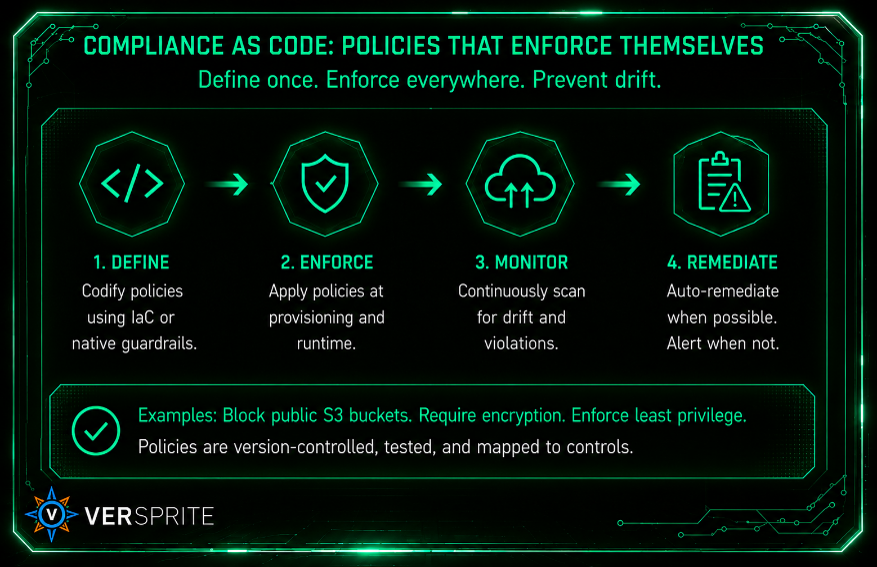
A written policy that says “all S3 buckets must have public access blocked” describes a requirement. Without a technical control enforcing it, the environment drifts: new resources get provisioned without the right configuration, and the gap between policy and actual environment state grows quietly until an auditor finds it.
Compliance as code closes that gap. Tools like AWS Config Rules, Azure Policy, and GCP Organization Policies let you define configuration requirements as code, enforce them automatically at resource creation, and generate findings when drift occurs. For PCI DSS Requirement 2 secure configurations, this is the difference between a policy document and a technical control.
The audit benefit is concrete: instead of describing your configuration management process in a narrative, you export the policy assignments, the compliant and non-compliant resource counts, and the remediation history. That’s the control operating, not someone’s description of how the control is supposed to operate.
For FedRAMP specifically, the continuous monitoring requirement makes this especially relevant. FedRAMP isn’t a one time authorization; it requires monthly vulnerability scanning, ongoing configuration assessment, and regular reporting to the sponsoring agency. Organizations that try to run continuous monitoring manually hit a wall fast. Automated policy enforcement with continuous scanning is what makes continuous monitoring sustainable at scale.
Apply the same logic to vulnerability management. PCI DSS Requirement 11 requires internal and external vulnerability scanning on defined cadences, with remediation tracked and documented. Most teams run scans manually and export results to a spreadsheet before each assessment. Integrating scanning into the pipeline, with findings written to a centralized tracking system and remediation status updated automatically, converts a periodic manual task into a continuous documented process. The scan still runs; the difference is that the evidence it produces is already in the right format when the auditor asks for it.
Where to Start
The full audit-ready architecture takes time to build. Start by identifying where your current evidence gaps are, then work backward to the technical root cause.
For most organizations, the highest value investments are:
- Centralized, immutable log aggregation with defined retention periods. This fixes the most common audit finding across SOC 2, PCI DSS, and FedRAMP.
- Pipeline enforcement for all production changes, with no manual bypass path.
- Automated access reviews on a defined schedule, with results written to a log.
- A control matrix that maps each requirement to its technical implementation and evidence source.
Getting these four things right does more for audit readiness than any GRC platform subscription or annual evidence collection sprint. They shift the operational model away from reactive, manual, narrative-based compliance toward something that runs continuously and produces verifiable output.
The sequencing matters too. Log aggregation first, because it fixes the most common audit finding and creates the data foundation everything else depends on. Pipeline enforcement second, because it closes the change management gap that manual deployments leave open. Access reviews third, because the tooling is straightforward once identity is centralized. Control matrix last, because by that point you have enough implemented infrastructure to map accurately. Building the matrix before the infrastructure produces a document that describes intentions rather than reality.
Frequently Asked Questions
What is audit evidence automation?
Audit evidence automation is the process of configuring security, cloud, identity, logging, and deployment systems to continuously generate compliance evidence. Instead of collecting screenshots and exports during an audit, teams retrieve structured evidence that has already been captured.
Why does manual audit evidence collection create risk?
Manual evidence collection creates risk because teams often reconstruct control activity after the fact. That makes it harder to prove that controls operated consistently across the full audit period and increases the chance of missing gaps, drift, or incomplete records.
How does continuous evidence collection support SOC 2?
Continuous evidence collection supports SOC 2 by helping teams prove that controls operated consistently over time. Examples include access reviews, change management records, incident monitoring logs, and system configuration evidence.
How does compliance as code help with PCI DSS and FedRAMP?
Compliance as code helps teams enforce configuration requirements automatically. Instead of relying only on written policies, teams can use cloud native policy tools to block non compliant resources, detect drift, and generate evidence for audit review.
What is a control matrix?
A control matrix maps framework requirements to the technical systems, controls, evidence formats, and retention requirements that support them. It helps teams understand which system produces which evidence for each compliance requirement.
Where should organizations start with audit evidence automation?
Organizations should start with the areas that create the most audit friction: centralized log aggregation, immutable retention, production change enforcement, automated access reviews, and control mapping. These areas usually provide the fastest improvement in audit readiness.