Compliance Automation for AI Security: Why Manual Evidence Collection Weakens Cloud Security
Date
Authors
Germán Miotti
Follow Us


Compliance automation strengthens AI security by turning audit evidence, cloud configuration, access controls, and runtime monitoring into continuous security processes. When organizations rely on manual evidence collection, spreadsheets, and periodic reviews, they create drift, audit gaps, and attack surface. By using Infrastructure as Code, CSPM, and automated evidence pipelines, security teams can enforce controls continuously and make compliance evidence available before auditors ask for it.
Key Takeaways
- AI security tools are only as strong as the compliance and control foundation underneath them.
- Manual evidence collection creates operational drag, audit gaps, and cloud security exposure.
- Infrastructure as Code helps enforce compliance at deployment time.
- CSPM helps detect runtime drift, misconfigurations, and policy violations after deployment.
- Automated evidence collection turns compliance from a pre-audit project into a continuous security control.
- If more than 40% of audit evidence is collected manually, the compliance foundation needs attention.
Last quarter, we sat with a Fortune 500 security team that was three weeks into reconstructing twelve months of PCI evidence. Firewall rule exports, MFA enforcement snapshots, privileged access approval logs; all theoretically already produced by their environment, none of it collected in a form an auditor could consume. Three engineers were doing nothing else for the duration of the cycle. The same organization had, the quarter before, signed a seven-figure contract for an autonomous threat detection platform.
This pattern is everywhere right now. Security leaders are buying AI on top of a compliance process that still runs on calendar reminders and shared drives. The roof is going up before the foundation is set, and the foundation is the part that determines whether anything above it holds.
Compliance automation is not a past decade talking point. The interesting argument is what sits underneath it: organizations are investing in autonomous security capabilities on top of manual and reactive compliance foundations. Until that gap closes, the investment does not compound. It just adds complexity. A useful measure: if more than 40% of the evidence collected in your last audit cycle was pulled manually, the foundation is the problem, and we will return to that number.
Compliance Is a Security Control. Stop Treating It Like Paperwork.
The traditional view of compliance as an annual audit and a binder of screenshots is not just operationally painful. It is a security exposure. Every undocumented deviation from a baseline, every configuration that drifted between reviews, every environment a developer spun up outside the approved pipeline: those are not compliance gaps. Those are attack surface. Threat actors do not distinguish between a control that was never implemented and one that quietly stopped enforcing six months ago.
When organizations automate their compliance processes, they do more than satisfy a framework requirement. They enforce consistent configuration, eliminate human deviation from policy, and create environments that are genuinely defensible, not just documentable.
The reframe is straightforward but it changes how a program gets built: the running environment is the policy. If your access controls, encryption requirements, and logging baselines only exist in a document, you do not have controls. You have good intentions.
The Operational Case for Automation
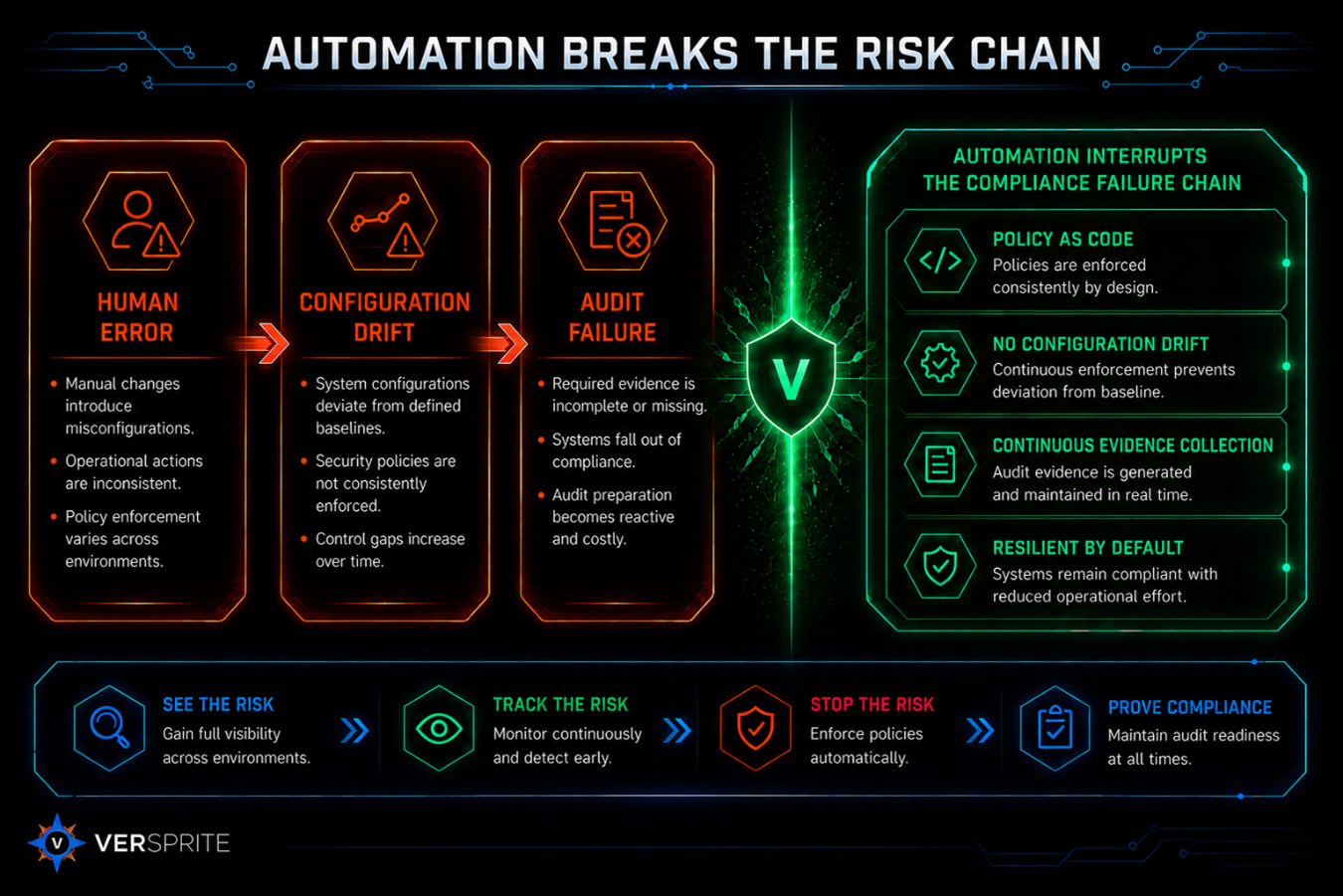
Configuration drift collapses. When the pipeline is the source of truth, the running environment cannot diverge from policy without that divergence being immediately visible. The gap between what the policy says and what production actually does, the gap threat actors operate in, closes. Every undocumented deviation from a security baseline is a potential opening. Automation collapses that opening by making the deployment itself the enforcement act.
Human error stops being a control variable. Misconfigured storage buckets, over-permissive network security group rules, and databases left publicly accessible during a rushed deployment, these are the leading causes of cloud-based incidents, and they are all manual-process failures. Automated controls either pass or fail. There is no intermediate state where a human forgot.
Evidence becomes a byproduct, not a project. Version-controlled configuration, immutable audit logs, and continuous posture monitoring mean compliance evidence accumulates as a natural consequence of normal operations. Investigations have a paper trail. Security leadership can report progress with numbers, not adjectives. When an auditor asks, the evidence already exists.
Infrastructure as Code: Compliance Baked Into Every Deployment
Infrastructure as Code (IaC) is not a concept security teams can observe from a distance. It is a direct mechanism for embedding security policy into every resource provisioned in your environment, making compliance a continuous enforcement state rather than a periodic review. Native cloud tooling makes this accessible without exotic technology stacks. The gap for most organizations is not the availability of the tools. It is the absence of a connecting layer that puts them to work.
Every organization operates within a different combination of cloud providers and compliance obligations. The examples below cover typical automation approaches for the most common scenarios we encounter in practice.
Azure and PCI DSS: A Worked Example
Payment card environments carry a specific and unforgiving set of requirements: strict network segmentation, encryption in transit and at rest, exhaustive audit logging, and continuous evidence that every control held across the full audit period. The team described at the opening of this post had all of those controls documented. What they lacked was a system that collected evidence without human intervention. Every source system existed in isolation and pulling them together before each audit cycle fell to whoever had time. That is how three engineers end up doing nothing else for three weeks, while the rest of the organization runs on a seven-figure AI platform that cannot tell you what your firewall rules looked like in March.
What makes Azure environments particularly well-suited to automation is the density of native tooling available within a single ecosystem. Entra ID manages identity and access centrally. Azure PIM governs privileged access grants and maintains approval logs. Microsoft Sentinel captures and retains log data across the environment. Microsoft Defender covers endpoint and server protection. Azure Firewall enforces and documents network segmentation rules. Each of these systems holds evidence that PCI DSS auditors will ask for. In a manual-driven compliance program, collecting it means touching every system individually and hoping nothing changed between collection and audit.
The automated version looks different. Identity and access policy lives in Entra ID and is enforced at authentication. Privileged grants flow through Azure PIM with the approval chain captured immutably. Network segmentation, encryption, and logging baselines are defined as code; a non-compliant resource never gets created because the pipeline blocks it before provisioning completes. Sentinel ingests the full audit trail continuously.
VerSprite’s automation engine can connect each source system into a single evidence stream: password policy state, MFA enforcement coverage, PIM approval logs, firewall rule exports, log retention attestations, SDLC access controls from GitHub. The evidence deposits continuously into a centralized repository ready for auditor consumption at any point. No pre-audit scramble. No twelve-month reconstruction. That connection layer is where the actual work is, and it is where custom automation makes the difference. No two client environments are identical, and the specific combination of source systems, compliance requirements, and existing architecture determines what the automation needs to do.
The Same Pattern, Different Stacks
The same logic generalizes: CloudFormation plus AWS Config for FedRAMP, Organization Policy plus Cloud Audit Logs for SOC 2 on GCP, provider-agnostic IaC and configuration management tooling for hybrid HIPAA estates. The mechanism is identical across all of them. The source systems change.
Visibility Across the Stack: The Role of CSPM
IaC operates at the deployment layer. It prevents non-compliant resources from being created in the first place. But deployment-time enforcement reaches its limit the moment a resource is running. Exceptions get made. Permissions get elevated and forgotten. Shadow infrastructure shows up outside the approved pipeline. This is where a Cloud Security Posture Management tool covers the runtime layer, providing continuous visibility that deployment-time enforcement alone cannot.
A CSPM continuously scans your cloud environment against defined security policies and compliance benchmarks, CIS, NIST, PCI DSS, HIPAA, SOC 2, FedRAMP and others, and surfaces misconfiguration, policy violations, and compliance drift in real time. For organizations managing multiple regulatory frameworks simultaneously, it also provides cross-framework control mapping, identifying where a single technical control satisfies requirements across PCI DSS, HIPAA, and SOC 2 at once. Deployment-time IaC and runtime CSPM are not alternatives. They are the two halves of the same control.
VerSprite’s Cloud Security practice incorporates CSPM tooling as part of a broader compliance monitoring strategy, so what gets deployed compliant stays compliant in production, not just on paper.
What This Means for Your Organization Right Now
If your current compliance posture relies on periodic manual reviews, spreadsheet-based evidence collection, or ad-hoc cloud configuration, no amount of AI security tooling stacked on top of it will hold. The audit gap will persist. The drift will continue. And when an incident occurs, the post-mortem will read like every other post-mortem, a chain of manual processes that automation would have eliminated five steps earlier.
A useful self-test: walk through your last audit cycle and count the percentage of evidence that was collected manually, pulled from a console, exported to a spreadsheet, screenshotted, or reconstructed from memory. If that number is above 40%, the foundation is the problem, and nothing built above it will compensate.
VerSprite’s Builders team, where Integrated Risk Management and DevSecOps work as one, runs an automation posture assessment that maps your current evidence-collection process against the controls you are being audited on. We identify where automation will compound value and build the connecting layer between the systems you already own. If more than 40% of your evidence is collected manually, that is where we start. Our Virtual CISO offering provides strategic oversight to drive that program without the overhead of a full-time executive hire.
AI security tooling will change how programs detect threats and prioritize risk. It will not arrive for organizations that cannot enforce a baseline today. The foundation has to exist before anything stands on it.
FAQ
What is compliance automation in cybersecurity?
Compliance automation is the use of technology to continuously enforce, monitor, and document security controls across an organization’s environment. Instead of manually collecting screenshots, exports, and spreadsheets before an audit, automated systems collect evidence continuously from identity platforms, cloud infrastructure, logging tools, and security systems.
Why does manual compliance evidence collection create security risk?
Manual evidence collection creates security risk because it often happens after the fact. If evidence is collected only during audit cycles, configuration drift, access control changes, logging gaps, and undocumented exceptions can go unnoticed for months. Those gaps are not just compliance issues; they can become attack surface.
How does compliance automation support AI security?
Compliance automation supports AI security by creating a reliable control foundation. AI security platforms depend on accurate baselines, enforceable policies, and trustworthy evidence. If compliance controls are manual or inconsistent, AI-driven security investments may add complexity without improving resilience.
What role does Infrastructure as Code play in compliance automation?
Infrastructure as Code helps enforce compliance during deployment. Security requirements such as encryption, logging, access controls, and network segmentation can be built directly into deployment pipelines. This prevents non-compliant resources from being created and makes evidence easier to track.
What is CSPM and why does it matter for compliance?
Cloud Security Posture Management, or CSPM, continuously monitors cloud environments for misconfigurations, compliance drift, and policy violations. While Infrastructure as Code helps prevent non-compliant deployments, CSPM helps detect problems that appear after resources are running.
How can organizations reduce audit preparation time?
Organizations can reduce audit preparation time by automating evidence collection from systems such as identity platforms, privileged access tools, firewalls, cloud logs, source code repositories, and security monitoring platforms. This makes audit evidence available continuously instead of requiring teams to reconstruct it manually.
When should a company consider compliance automation?
A company should consider compliance automation when audit preparation depends heavily on manual exports, screenshots, spreadsheets, or console reviews. If more than 40% of evidence from the last audit cycle was collected manually, automation should be a priority.
Strengthen the Foundation Before Scaling AI Security
AI security tools are only as effective as the controls, evidence, and cloud security foundation beneath them. VerSprite helps organizations identify where manual compliance processes create risk, then builds automation across cloud, DevSecOps, and Integrated Risk Management workflows.