Banking Threat Modeling Services for Compliance
Date
Authors
Tony UcedaVélez
Follow Us


Financial institutions do not need another checkbox security exercise. They need a defensible way to understand which threats matter, how those threats could affect business operations, and what controls will reduce the most risk.
That is where VerSprite threat modeling services bring value.
VerSprite approaches banking application security through a risk-driven, adversary-informed lens. Our work connects the technical reality of applications, APIs, cloud services, identity workflows, payment flows, and third-party integrations to the business impact that matters most to financial institutions: customer trust, transaction integrity, operational resilience, regulatory confidence, and reduced exposure.
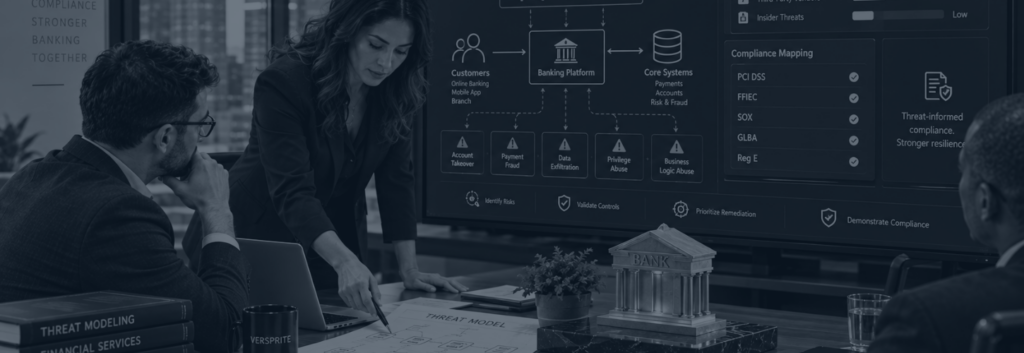
For banks, credit unions, fintechs, payment providers, and other regulated financial organizations, threat modeling for financial institutions should do more than produce diagrams. It should help security leaders make better decisions, prove that risk was evaluated, and guide engineering teams toward practical remediation.
What Is Threat Modeling for Financial Institutions?
Threat modeling for financial institutions is the structured process of identifying how banking applications, systems, data flows, and business processes could be attacked, misused, or disrupted.
A strong threat model evaluates:
- Critical assets such as customer data, payment data, account credentials, transaction records, and internal banking systems
- Application architecture, APIs, integrations, cloud services, and trust boundaries
- Threat actors, abuse cases, fraud paths, and attacker objectives
- Business impact tied to confidentiality, integrity, availability, privacy, and regulatory exposure
- Security controls, compensating controls, and remediation priorities
In banking, the goal is not simply to ask, “What vulnerabilities exist?” The better question is, “Which attack paths create the most material risk to the institution, its customers, and its compliance obligations?”
Why Banking Compliance Needs Risk-Driven Threat Modeling
Financial institutions operate in an environment where applications are interconnected, customer expectations are high, and regulatory scrutiny is constant. Mobile banking, open banking APIs, payment ecosystems, SaaS platforms, cloud-native development, third-party vendors, and AI-enabled workflows have expanded the attack surface.
Compliance programs often require evidence that the organization has considered risk, implemented reasonable safeguards, tested controls, and improved security over time. Threat modeling supports that expectation by creating a structured record of security decision-making.
A well-executed threat model can help financial institutions:
- Identify security requirements earlier in the software development lifecycle
- Prioritize remediation based on business impact
- Align security work with compliance and audit expectations
- Reduce costly late-stage findings before production release
- Improve communication between security, engineering, risk, compliance, and executive teams
- Strengthen secure-by-design application development
VerSprite’s threat modeling services are built for this kind of decision-making. They help financial institutions move from reactive vulnerability management to proactive risk reduction.
Ranked Banking Threat Modeling Services for Compliance
Below is a ranked view of the banking threat modeling services that deliver the most value for financial institution security leaders.
1. Risk-Based Application Threat Modeling
Risk-based application threat modeling is the highest-value service for financial institutions because it connects application security findings to business impact.
Banking applications are not all equal. A public marketing page, an internal reporting dashboard, a wire transfer workflow, and a mobile authentication system do not carry the same risk. Risk-based threat modeling helps determine where the institution should focus first.
VerSprite uses a business-aligned approach that evaluates how application architecture, data sensitivity, attack paths, and operational impact intersect. This is especially important for financial institutions that must defend security investments to auditors, risk committees, and executive leadership.
Best fit for:
- Digital banking platforms
- Mobile banking applications
- Payment applications
- Loan origination systems
- Customer portals
- Treasury management applications
- High-risk internal banking applications
Compliance value:
Risk-based application threat modeling helps financial institutions show that security controls were selected based on a structured understanding of risk, not guesswork. It creates traceable evidence of threats, attack scenarios, risk ratings, assumptions, mitigation plans, and residual risk decisions.
2. PASTA Threat Modeling for Banking Applications
PASTA, the Process for Attack Simulation and Threat Analysis, is a risk-centric threat modeling methodology that aligns business objectives, technical architecture, threat intelligence, attack simulation, and risk analysis.
For financial institutions, this matters because banking risk is not purely technical. A vulnerability in an authentication flow, payment API, or account recovery process can translate into fraud exposure, privacy impact, regulatory concern, customer harm, and reputational damage.
VerSprite’s PASTA-based approach helps security leaders evaluate threats through a realistic attacker perspective while still grounding the work in business context.
Best fit for:
- Applications with high business impact
- Systems processing sensitive financial data
- Platforms undergoing major modernization
- Cloud migration initiatives
- Applications subject to audit or regulatory review
- Systems with complex user roles or transaction workflows
Compliance value:
PASTA threat modeling can help financial institutions document why specific controls were prioritized, how threats were evaluated, and how remediation decisions map to business risk. This is useful for audit readiness, control validation, and governance reporting.
3. Compliance-Ready Threat Model Documentation
A threat model is only as useful as the decisions it supports. For banking teams, documentation must be clear enough for engineering teams to act on and structured enough for risk and compliance stakeholders to understand.
VerSprite threat modeling deliverables can help financial institutions capture:
- Application scope and business objectives
- Architecture and data flow analysis
- Trust boundaries and attack surfaces
- Threat scenarios and abuse cases
- Risk ratings and business impact
- Recommended mitigations
- Remediation priorities
- Residual risk considerations
- Evidence of secure design review
This documentation gives security leaders a stronger narrative for compliance conversations. It shows that the institution has evaluated threats before release, considered the impact of design decisions, and prioritized mitigation based on risk.
Best fit for:
- Audit-driven application security programs
- Institutions preparing for regulatory examinations
- Teams that need evidence of secure SDLC activity
- Security leaders reporting to risk committees
- Organizations formalizing application risk governance
Compliance value:
Compliance-ready documentation helps turn application security work into defensible evidence. It supports the ability to explain what was reviewed, what risks were identified, which controls were recommended, and how decisions were made.
4. Threat Modeling as a Service for Financial Institutions
Many financial institutions know they need threat modeling, but they do not always have enough internal capacity to perform it consistently across the application portfolio.
Threat Modeling as a Service gives banking security teams access to structured expertise without forcing them to build the entire program alone. VerSprite can support recurring threat modeling activities, high-priority application reviews, product security initiatives, and program maturity efforts.
This model is especially useful when development velocity outpaces security review capacity. Instead of treating threat modeling as a one-time workshop, financial institutions can operationalize it across product teams and release cycles.
Best fit for:
- Security teams with limited threat modeling capacity
- Product security programs scaling across multiple applications
- Banks modernizing legacy systems
- Fintechs growing quickly under compliance pressure
- Institutions that need repeatable secure design reviews
Compliance value:
Threat Modeling as a Service helps institutions demonstrate that threat modeling is not an isolated activity. It becomes part of the application security program, supporting continuous risk management and secure development practices.
5. API and Open Banking Threat Modeling
APIs are now central to financial services. They enable mobile banking, partner integrations, payment processing, account aggregation, internal microservices, and open banking ecosystems. They also create high-value attack paths.
API threat modeling evaluates how attackers could abuse identity, authorization, data exposure, rate limits, business logic, payment flows, and third-party integrations.
For banking environments, API threat modeling should consider:
- Broken object-level authorization
- Excessive data exposure
- Weak authentication flows
- Token theft and session abuse
- Payment manipulation
- Account takeover paths
- Partner integration risk
- Fraud and transaction abuse cases
- Logging and monitoring gaps
- Third-party dependency exposure
Best fit for:
- Open banking APIs
- Partner and vendor integrations
- Payment APIs
- Internal microservice architectures
- Mobile application backends
- Customer identity and access management systems
Compliance value:
API threat modeling supports stronger control design around sensitive financial data, customer authentication, authorization, transaction integrity, and third-party connectivity. It also helps security leaders identify business logic flaws that automated scanners often miss.
6. Cloud and SaaS Banking Application Threat Modeling
Financial institutions increasingly rely on cloud platforms, SaaS applications, and hybrid architectures. These environments require a clear understanding of shared responsibility, identity boundaries, service configurations, data flows, and third-party risk.
Cloud threat modeling helps banks evaluate how cloud-native applications and platforms could be attacked or misconfigured. It also helps teams identify where preventive, detective, and corrective controls should be placed.
Key areas include:
- Cloud identity and privilege escalation
- Data storage and encryption boundaries
- Internet-facing services
- Secrets management
- CI/CD pipeline exposure
- Cloud logging and monitoring
- Multi-account or multi-tenant segmentation
- SaaS integrations and delegated access
- Disaster recovery and operational resilience
Best fit for:
- Cloud migration projects
- Banking SaaS integrations
- Cloud-native application development
- Data analytics platforms
- Digital banking modernization programs
- Hybrid infrastructure environments
Compliance value:
Cloud threat modeling helps financial institutions validate that cloud architecture decisions are aligned with risk management expectations, security control requirements, and operational resilience goals.
7. Secure SDLC Threat Modeling Enablement
Threat modeling delivers the most value when it becomes part of the secure software development lifecycle.
VerSprite can help financial institutions integrate threat modeling into existing engineering and security workflows so teams can identify design-level risk before code reaches production. This includes defining when threat modeling should occur, what applications require deeper review, how outputs should be tracked, and how remediation should move into engineering backlogs.
Best fit for:
- Product security teams
- DevSecOps programs
- Application security leaders
- Engineering organizations building secure-by-design practices
- Institutions improving secure development maturity
Compliance value:
Secure SDLC threat modeling helps demonstrate that security is built into development rather than added at the end. It supports governance expectations around secure design, risk assessment, testing, remediation, and continuous improvement.
8. Threat Modeling for Third-Party and Vendor Risk
Financial institutions depend on service providers, fintech partners, SaaS platforms, payment processors, data aggregators, and technology vendors. These relationships introduce risk that may not be visible through standard vendor questionnaires alone.
Threat modeling can strengthen third-party risk management by evaluating how vendor integrations affect application architecture, data flows, access control, monitoring, and incident response.
Best fit for:
- Vendor-connected applications
- Payment processor integrations
- Banking-as-a-service ecosystems
- Embedded finance platforms
- Data sharing arrangements
- Third-party authentication or identity services
Compliance value:
Third-party threat modeling helps security and risk teams understand how external dependencies affect customer data, transaction flows, and control ownership. It also gives financial institutions stronger evidence for vendor risk decisions.
9. Remediation Roadmapping and Risk Prioritization
Threat modeling should not end with a list of issues. Financial institutions need a clear path from threat identification to measurable risk reduction.
VerSprite helps translate threat model findings into practical remediation plans. This includes ranking recommendations based on likelihood, impact, exploitability, compensating controls, and business priority.
A remediation roadmap may include:
- Architecture changes
- Security control enhancements
- Authentication and authorization improvements
- Logging and detection requirements
- Secure coding requirements
- Additional testing recommendations
- Risk acceptance considerations
- Backlog-ready engineering tickets
Best fit for:
- Security leaders managing limited remediation capacity
- Application owners balancing release timelines
- Risk teams needing decision-ready recommendations
- Institutions with audit findings tied to application security
Compliance value:
A prioritized remediation roadmap helps demonstrate that identified risks are not merely documented. They are owned, tracked, and managed according to impact.
10. Executive and Audit-Focused Threat Modeling Briefings
Security leaders in banking must communicate technical risk to non-technical stakeholders. Executive and audit-focused briefings help translate threat modeling outcomes into language that boards, risk committees, compliance teams, and regulators can understand.
These briefings can explain:
- The business context of the application
- The highest-risk attack scenarios
- The likely impact of successful compromise
- The recommended mitigation strategy
- The residual risk position
- The program-level lessons learned
Best fit for:
- CISOs
- Application security directors
- Risk and compliance leaders
- Audit preparation teams
- Board and executive reporting
Compliance value:
Executive-ready reporting helps financial institutions show that application risk is understood, governed, and communicated at the right levels of the organization.
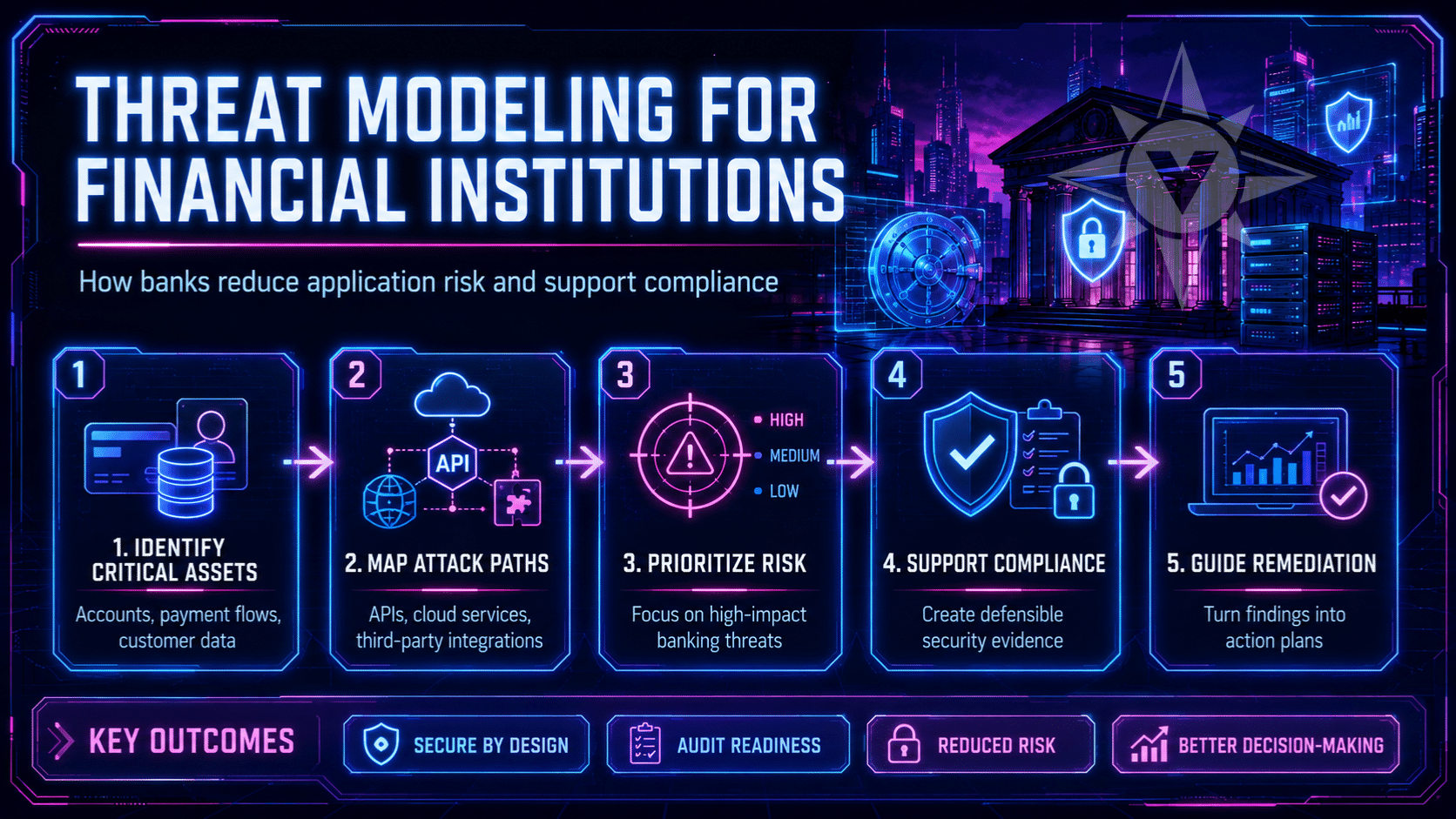
Where Threat Modeling Fits in a Banking Security Program
Threat modeling should be performed at key points in the application lifecycle, including:
- Before building a new banking application
- During major architecture changes
- Before launching new customer-facing features
- During cloud migration or modernization
- Before integrating with vendors or partners
- After significant security incidents or control failures
- Before high-risk production releases
- As part of secure SDLC governance
For financial institutions, threat modeling is especially valuable when applications involve sensitive data, privileged access, payment processing, customer authentication, transaction workflows, regulatory obligations, or third-party connectivity.
What Banking Leaders Should Expect From a Threat Modeling Engagement
A threat modeling engagement typically helps financial institutions answer five essential questions:
- What are we protecting?
- Who could attack or abuse it?
- How could they compromise it?
- What would the business impact be?
- What should we do first to reduce risk?
The result is a practical, risk-ranked view of application security. Instead of overwhelming teams with generic findings, it helps identify the threats that matter most and the mitigation steps that can reduce exposure.
Threat Modeling for Financial Institutions: Compliance Benefits
Threat modeling supports compliance by helping financial institutions demonstrate a structured approach to risk management and secure application development.
Key compliance benefits include:
- Evidence of secure design review
- Documentation of application risk analysis
- Traceability between threats, controls, and remediation
- Better prioritization of security investments
- Support for secure SDLC expectations
- Improved audit and governance communication
- Stronger alignment between security, risk, and engineering teams
- Reduced likelihood of late-stage findings before release
This is why threat modeling for financial institutions should be treated as a strategic capability, not a one-time security artifact.
Common Banking Use Cases for Threat Modeling
Threat modeling services are especially relevant for:
- Mobile banking applications
- Online banking portals
- Payment processing workflows
- Account opening systems
- Loan application platforms
- Fraud detection systems
- Customer identity and access management
- Open banking APIs
- Treasury and commercial banking systems
- Cloud-native banking platforms
- Vendor and fintech integrations
- AI-enabled financial workflows
Each of these environments contains different trust boundaries, abuse cases, and business impacts. A risk-driven model helps security leaders prioritize appropriately.
Why Threat Modeling Beats Checkbox Compliance
Checkbox compliance can confirm that a requirement was reviewed. It does not always confirm that a realistic attack path was understood.
Threat modeling gives financial institutions a stronger way to evaluate risk because it focuses on how systems can fail, how attackers can behave, and how business impact should guide security decisions.
For banking security leaders, this distinction matters. The most damaging risks are often not isolated vulnerabilities. They are combinations of design assumptions, identity weaknesses, integration gaps, monitoring blind spots, and business logic flaws.
Threat modeling brings those risks into view before they become incidents.
Final Takeaway
Financial institutions need security programs that can withstand regulatory scrutiny, adversarial pressure, and business transformation. Threat modeling helps meet that need by giving security leaders a structured, risk-driven way to evaluate applications before attackers do.
FAQ
What is threat modeling for financial institutions?
Threat modeling for financial institutions is a structured security process used to identify threats, attack paths, business impact, and mitigation priorities across banking applications, APIs, cloud systems, payment workflows, and sensitive data environments.
Why do banks need threat modeling?
Banks need threat modeling because financial applications handle sensitive customer data, payments, identity workflows, and high-value transactions. Threat modeling helps identify design-level risks early, prioritize remediation, and support compliance-ready security decisions.
How does threat modeling support banking compliance?
Threat modeling supports banking compliance by documenting how application risks were identified, evaluated, prioritized, and mitigated. It creates evidence of secure design review, risk-based decision-making, and control alignment.
What makes VerSprite threat modeling different?
VerSprite uses a risk-driven, attacker-informed approach that connects technical threats to business impact. VerSprite’s PASTA-based methodology helps financial institutions prioritize the threats that matter most and make defensible security decisions.
Which banking applications should be threat modeled?
Financial institutions should prioritize threat modeling for mobile banking apps, online banking portals, payment systems, open banking APIs, customer identity platforms, loan origination systems, treasury applications, and high-risk cloud or vendor-connected systems.
When should a financial institution perform threat modeling?
Threat modeling should occur before major releases, during architecture changes, before cloud migration, when integrating third parties, when launching high-risk features, and as part of the secure software development lifecycle.
Is threat modeling only for new applications?
No. Threat modeling is valuable for both new and existing applications. Existing banking systems often benefit from threat modeling when they are modernized, integrated with new services, moved to the cloud, or exposed to new users and APIs.
How does threat modeling help reduce audit risk?
Threat modeling helps reduce audit risk by creating clear documentation of application security review, identified threats, mitigation decisions, control gaps, and remediation priorities. This gives security and compliance teams stronger evidence of risk management.
