7 Threat Modeling Services for Risk-Based Remediation
Date
Authors
Tony UcedaVélez
Follow Us


What Are Advanced Threat Modeling Services?
Advanced threat modeling services help security leaders identify how real-world attackers could compromise critical systems, then prioritize remediation based on business impact instead of generic checklist severity.
For regulated organizations, this matters because not every vulnerability, design gap, or control weakness creates the same level of risk. A missing control in a low-value workflow is not equivalent to an exploitable path into payment data, patient records, operational technology, or privileged administrative systems.
At VerSprite, we view threat modeling as a strategic risk discipline, not a diagramming exercise. Mature application security programs need more than findings. They need defensible prioritization, executive-ready risk narratives, and remediation plans that align security work to business outcomes.
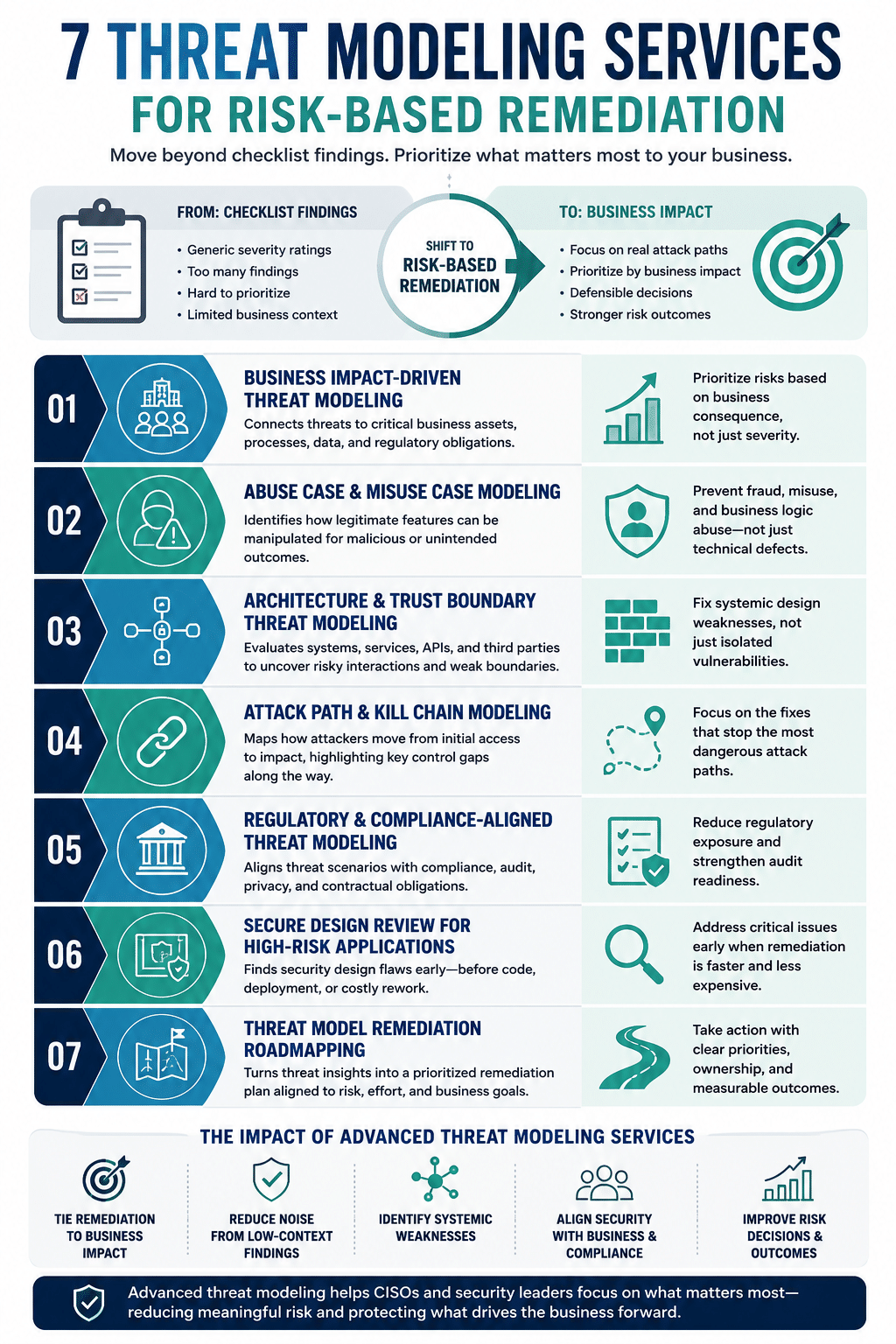
Below are seven advanced threat modeling services that help CISOs and security leaders move from checklist-driven remediation to risk-based decision-making.
1. Business Impact-Driven Threat Modeling
Business impact-driven threat modeling connects technical attack paths to the business processes, data, users, and regulatory obligations they could affect.
This is the foundation of risk-based remediation. Instead of asking only, “What vulnerabilities exist?” this service asks, “What business consequence could occur if this system fails, is abused, or is compromised?”
For regulated organizations, that may include:
- Exposure of protected health information
- Unauthorized financial transactions
- Loss of payment card data
- Disruption of critical business operations
- Privilege abuse across customer or employee environments
- Regulatory reporting obligations
- Contractual or third-party risk exposure
This approach improves risk assessment programs because remediation is prioritized by consequence. A medium-severity design issue that enables fraud, data leakage, or lateral movement may deserve more attention than a high-severity scanner finding with limited exploitability or business impact.
Why it ranks first: CISOs need to explain risk in business language. Business impact-driven threat modeling gives security teams the evidence to justify what should be fixed first and why.
2. Abuse Case and Misuse Case Modeling
Abuse case and misuse case modeling examines how legitimate system functionality can be manipulated for malicious or unintended outcomes.
Traditional security testing often focuses on broken controls. Abuse case modeling looks deeper. It evaluates how an attacker, malicious insider, compromised account, or automated adversary could use intended features in harmful ways.
Examples include:
- Manipulating approval workflows
- Circumventing business logic
- Creating fraudulent transactions
- Enumerating sensitive records
- Abusing account recovery flows
- Exploiting role-based access gaps
- Automating actions at scale
This is especially valuable for financial services, healthcare, SaaS, insurance, and other regulated environments where business logic flaws can create material risk without appearing as obvious technical vulnerabilities.
A checklist might confirm that authentication exists. Abuse case modeling asks whether the authenticated user can perform actions that violate trust boundaries, compliance expectations, or business rules.
Risk-based remediation value: It helps security teams prioritize fixes that prevent fraud, misuse, and unauthorized business outcomes, not just technical defects.
3. Architecture and Trust Boundary Threat Modeling
Architecture and trust boundary threat modeling evaluates how systems, services, users, data stores, APIs, and third parties interact across security boundaries.
Modern organizations operate complex environments. Applications depend on cloud services, identity providers, APIs, data pipelines, SaaS integrations, CI/CD workflows, and external partners. Risk often appears at the seams.
This service identifies:
- Unclear trust boundaries
- Over-privileged services
- Weak identity and access assumptions
- Insecure data flows
- Excessive dependency trust
- Missing segmentation
- Insufficient logging or monitoring points
- Third-party integration risk
For CISOs, this creates a clearer view of how design decisions affect enterprise risk. Instead of treating each finding as isolated, architecture threat modeling shows how weaknesses combine into attack paths.
For example, a weak API authorization pattern may become far more serious when paired with sensitive data access, insufficient monitoring, and a privileged downstream service.
Risk-based remediation value: It helps teams remediate systemic architectural risk rather than repeatedly fixing symptoms at the application layer.
4. Attack Path and Kill Chain Modeling
Attack path and kill chain modeling identifies how adversaries could move from initial access to business impact.
This service is particularly valuable when security leaders need to distinguish theoretical risk from plausible operational risk. It maps the steps an attacker would need to take, the controls that could stop them, and the business assets that could be affected.
A mature attack path model may include:
- Initial access points
- Credential theft or session abuse
- Privilege escalation opportunities
- Lateral movement paths
- Data access points
- Control bypasses
- Detection gaps
- Business impact scenarios
This supports better remediation decisions because teams can focus on the controls that break the most dangerous attack paths. In many cases, one well-placed remediation can reduce more risk than fixing several isolated findings.
For example, improving service-to-service authorization, enforcing stronger identity boundaries, or adding detection at a key control point may reduce exposure across multiple applications.
Risk-based remediation value: It helps security leaders prioritize the fixes that interrupt the most realistic and damaging attacker workflows.
5. Regulatory and Compliance-Aligned Threat Modeling
Regulatory and compliance-aligned threat modeling maps threat scenarios to obligations such as data protection, privacy, auditability, access control, incident response, and operational resilience.
Regulated organizations cannot treat security risk as purely technical. Security decisions must also consider legal, regulatory, contractual, and audit expectations.
This service helps answer questions such as:
- Which threat scenarios could create reportable incidents?
- Which controls support compliance obligations?
- Where do audit gaps overlap with real attack paths?
- Which remediation items reduce both security and regulatory exposure?
- Which risks require compensating controls or formal acceptance?
The key is to avoid reducing threat modeling to a compliance checklist. Instead, regulatory alignment should enhance risk prioritization. A finding becomes more urgent when it affects critical data, regulated workflows, customer commitments, or evidence required during an audit.
Risk-based remediation value: It helps CISOs justify remediation by connecting technical risk to governance, audit, and regulatory consequences.
6. Secure Design Review for High-Risk Applications
Secure design review is an advanced threat modeling service focused on applications, platforms, or workflows where the cost of failure is high.
This is most useful before major releases, cloud migrations, platform redesigns, product launches, or integration of sensitive data. It helps teams identify security design flaws before they become expensive production issues.
A secure design review may evaluate:
- Authentication and authorization design
- Sensitive data handling
- API exposure
- Administrative functionality
- Multi-tenant isolation
- Logging and monitoring coverage
- Encryption and key management
- Third-party dependencies
- Resilience and failure modes
For regulated organizations, this service can be a force multiplier. It helps product, engineering, security, and compliance teams make informed decisions early, when remediation is faster and less disruptive.
At VerSprite, this is where technical depth and practical business alignment must meet. A strong design review does not simply produce a list of concerns. It produces a ranked set of decisions, tradeoffs, and recommended control improvements.
Risk-based remediation value: It reduces downstream risk by addressing architectural and design-level issues before they become production vulnerabilities.
7. Threat Model Remediation Roadmapping
Threat model remediation roadmapping converts threat modeling outputs into an actionable, prioritized remediation plan.
This is where many programs fall short. A threat model that ends with a long list of findings does not necessarily improve security. CISOs need a roadmap that shows what to fix, what to monitor, what to accept, and what to revisit as the environment changes.
A strong remediation roadmap includes:
- Ranked remediation priorities
- Business impact rationale
- Risk ownership
- Recommended control improvements
- Dependencies and sequencing
- Compensating controls
- Engineering effort considerations
- Regulatory or audit relevance
- Executive-level risk summaries
This service helps security leaders make better tradeoffs. Some issues require immediate remediation. Some require architectural investment. Others may be acceptable with monitoring, compensating controls, or documented risk acceptance.
The goal is not to fix everything at once. The goal is to reduce the most meaningful risk with the resources available.
Risk-based remediation value: It turns threat modeling into measurable program improvement by aligning remediation with business risk, operational feasibility, and executive priorities.
Why Checklist Findings Are Not Enough
Checklist-based security programs create activity, but they do not always create risk reduction.
A checklist can confirm whether a control exists. It may not explain whether that control is effective against the most relevant threat scenarios. It may not show which assets matter most. It may not identify how multiple weaknesses combine into a material attack path.
For CISOs and security leaders, this creates a familiar problem: too many findings, not enough context, and limited ability to defend prioritization decisions to executives, regulators, auditors, and the board.
Advanced threat modeling services solve this problem by adding context:
- What is the attacker trying to accomplish?
- Which systems and data are most important?
- Which weaknesses create the greatest business impact?
- Which remediations reduce the most risk?
- Which risks can be accepted, transferred, monitored, or deferred?
This is how threat modeling becomes a risk assessment accelerator.
How Advanced Threat Modeling Services Improve Risk Assessment Programs
Advanced threat modeling services improve risk assessment programs by making risk more specific, defensible, and actionable.
They help security teams:
- Tie remediation to business impact
- Prioritize based on realistic attack paths
- Reduce noise from low-context findings
- Identify systemic design weaknesses
- Align security work with compliance expectations
- Improve communication between security, engineering, legal, compliance, and executives
- Support risk acceptance with better evidence
- Build a repeatable model for future assessments
The result is a more mature AppSec and cybersecurity program. Instead of reacting to isolated findings, leaders can manage risk through a structured understanding of adversary behavior, system design, and business consequence.
What Should CISOs Look for in an Advanced Threat Modeling Partner?
CISOs should look for a threat modeling partner that can operate across technical, business, and regulatory contexts.
The right partner should be able to:
- Understand application architecture and enterprise risk
- Facilitate discussions with engineering and security teams
- Translate technical scenarios into business impact
- Prioritize findings beyond generic severity ratings
- Support regulated industry requirements
- Produce executive-ready remediation guidance
- Help teams operationalize threat modeling over time
For organizations that need more than compliance artifacts, advanced threat modeling should feel like a strategic advisory function. It should strengthen decision-making, not simply document theoretical threats.
Frequently Asked Questions
What are advanced threat modeling services?
Advanced threat modeling services are structured security assessments that identify realistic threat scenarios, attack paths, design weaknesses, and business impacts across applications, systems, and workflows. They help organizations prioritize remediation based on risk rather than checklist findings.
How do advanced threat modeling services support risk-based remediation?
They support risk-based remediation by connecting technical weaknesses to business consequences such as data exposure, fraud, downtime, regulatory impact, or operational disruption. This helps security leaders decide which issues should be fixed first.
Why is threat modeling important for regulated organizations?
Threat modeling is important for regulated organizations because it helps identify risks that may affect sensitive data, compliance obligations, audit readiness, customer trust, and critical operations. It provides context that traditional vulnerability lists often lack.
How is advanced threat modeling different from a security checklist?
A security checklist verifies whether expected controls are present. Advanced threat modeling evaluates how attackers could exploit system design, business logic, trust boundaries, and control gaps to create real business impact.
When should an organization use advanced threat modeling services?
Organizations should use advanced threat modeling services before major product releases, cloud migrations, architecture changes, compliance reviews, high-risk application launches, or when existing risk assessment programs produce too many low-context findings.
Conclusion: Remediation Should Follow Business Risk
The best security programs do not remediate based only on volume, scanner output, or generic severity. They remediate based on risk.
Advanced threat modeling services give CISOs and security leaders the context needed to make those decisions with confidence. By tying threats to business impact, regulated organizations can focus resources where they matter most, strengthen defensibility, and build application security programs that reduce meaningful risk.
For organizations ready to move beyond checklist findings, advanced threat modeling is not just a technical exercise. It is a business risk capability.