
Red Teaming Services
Threat-Model Driven Red Teaming to Simulate Real-World Attacks and Business Risk
Build a Tailored Engagement or Service Model Today- /
- /
- /
- /
- /
- /
- /
- /
- /
- /
- /
- /
- /
- /
- /
- /
- /
- /
- /
- /
- /
- /
What is Red Teaming?
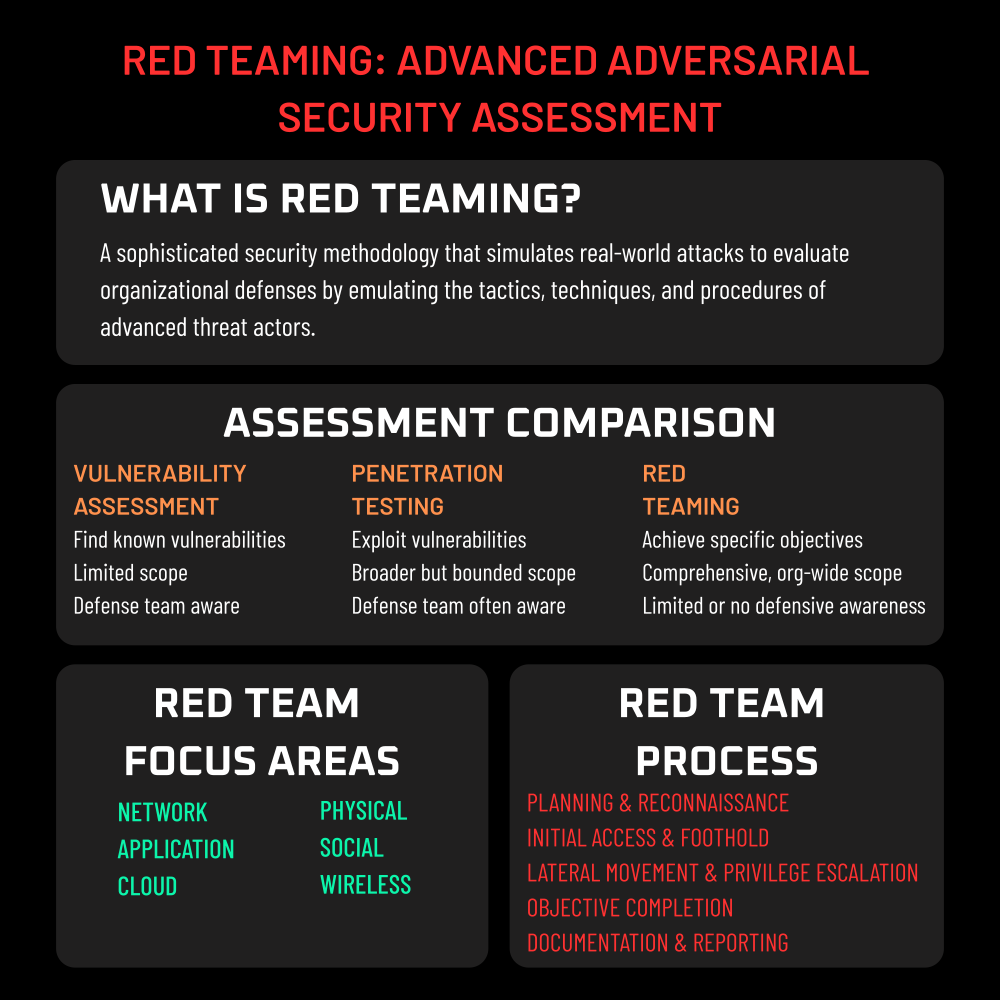
Red Teaming is an advanced cybersecurity assessment approach that simulates real-world attacks to evaluate an organization’s security posture. Unlike traditional security testing, Red Teaming adopts an adversarial mindset, employing the same tactics, techniques, and procedures (TTPs) used by sophisticated threat actors to identify vulnerabilities and security gaps that could be exploited in a genuine attack scenario.
At its core, Red Teaming represents the pinnacle of offensive security assessment. It combines technical expertise, strategic planning, and creative problem-solving to test defenses comprehensively across an organization’s entire attack surface – from digital infrastructure to physical security controls and human elements.
Key Characteristics of Red Team Engagements
- Adversarial Perspective: Red Teams operate from the attacker’s viewpoint, leveraging current threat intelligence to replicate realistic attack scenarios.
- Objective-Driven: Rather than focusing solely on finding vulnerabilities, Red Teams pursue specific objectives that would cause significant impact if achieved by malicious actors.
- Covert Operations: Red Team engagements are typically conducted with minimal knowledge among the target organization’s security team, preventing defenders from implementing temporary security enhancements.
- Multi-Vector Approach: Attacks may leverage technical exploits, social engineering, physical security breaches, or combinations thereof to achieve objectives.
Distinguishing Red Teaming from Other Security Assessments
Red Teaming differs significantly from vulnerability assessments and penetration testing:
| Assessment Type | Primary Focus | Scope | Defensive Team Awareness |
|---|---|---|---|
| Vulnerability Assessment | Identify and catalog vulnerabilities | Limited, focused on specific systems | Full awareness |
| Penetration Testing | Exploit vulnerabilities to demonstrate impact | Broader but still bounded | Often aware |
| Red Teaming | Achieve specific objectives using any viable means | Comprehensive, organization-wide | Limited or no awareness |
Benefits of Red Team Engagements
- Provides realistic validation of security controls and detection capabilities
- Evaluates the effectiveness of incident response procedures under pressure
- Identifies complex attack paths that might be missed by traditional security assessments
- Reveals gaps in security awareness and highlights potential process improvements
- Delivers actionable intelligence for hardening security posture against sophisticated threats
Effective Implementation
For maximum value, Red Team engagements should:
- Establish clear objectives and rules of engagement
- Utilize trained professionals with diverse skill sets
- Document findings thoroughly with actionable remediation steps
- Include proper follow-up assessment to validate improvements
- Feed results into continuous security improvement processes
Red Teaming represents the most comprehensive form of security assessment available, providing organizations with invaluable insights into their security resilience against determined adversaries. By systematically challenging defenses through realistic attack scenarios, Red Teams help strengthen organizational security posture in ways that other assessment methodologies cannot match.
- /
- /
- /
- /
- /
- /
- /
- /
- /
- /
- /
- /
- /
- /
- /
- /
- /
- /
- /
- /
- /
- /
As a company focused on simulating realistic attack patterns, VerSprite doesn’t negate the physical possibilities of intrusion. Offering both traditional red teaming exercises and a new variant called Organizational Threat Modeling exercises, we took traditional red teaming and leveraged the PASTA threat modeling framework to deliver attack simulations against organizations who wish to know the resiliency of their company from all angles. Whether you have a targeted need that is best served by a traditional red team, or would like a cyberthreat exercise that simulates the likely threat motives and underlying attack patterns against employees, vendors, physical locations, self-managed logical networks, and Cloud based services. More detail around both services is presented below.
Red Teaming
OSINT? Check. Smishing? You got it. Spoofed domains w/ TLS certs? Like a boss. Human hacking via Impersonation? Hold our beer. If you’re looking to extend beyond robo phishing emails and non-imaginative red team engagements, come talk to us. We custom a menu of red teaming engagements based upon a realistic threat model for your industry, industry sub-segment, and business model. More importantly, we strategically align red teaming goals to both security awareness objectives as well as corporate security governance controls to provide the integrated approach that defines us. Learn how VerSprite’s Red Teaming exercises can align to both corporate governance reinforcement opportunities as well as measuring the real security awareness of company officials.
Organizational Threat Model
Organizational Threat Models – a service that simulates real world attacks based upon evidence supported threat motives – was created after VerSprite received client requests on how the PASTA application threat modeling approach could help simulate multi-faceted, threat based attacks against target organizations.
Each organizational threat model begins with an examination of threat motives. We examine high impact targets for a target organization and correlate to scenarios such as extortion, IP theft, sabotage, data exfiltration, persistence for malware propagation, and much more. A custom threat library per client is mapped to identified business impact scenarios for a target organization.
Once a model has been established, our team launches attack patterns that support threat objectives from modern day syndicates, corporate mercenaries, opportunistic hackers, insiders, and more. Ensuing attack simulations center around one or several threat scenarios, each focused on realizing high impact situations.
As a risk centric approach, organizational threat models can help depict where a security program for an organization is weakest. For this reason, organizational threat models help to define a very effective roadmap for a security program as it illustrates consequences if identified gaps are not remediated. Deliverables and results from these engagements message better to senior management officials since the context of threats, threat viability, and effectiveness of security mitigators are well reflected by the organizational threat model.
- /
- /
- /
- /
- /
- /
- /
- /
- /
- /
- /
- /
- /
- /
- /
- /
- /
- /
- /
- /
- /
- /
Industries We Serve
VerSprite delivers Red Teaming across industries where security failures translate directly to financial loss, safety risk, or regulatory exposure.
Financial Services & FinTech
-
Simulate real-world threat actor campaigns targeting online banking, payment platforms, and trading systems
-
Emulate advanced fraud, account takeover, and lateral movement scenarios
-
Test detection and response capabilities across cloud, API, and hybrid environments
-
Validate resilience against targeted attacks impacting sensitive financial data and operations
Healthcare & Life Sciences
-
Emulate ransomware and data extortion campaigns targeting clinical and research environments
-
Identify exploitable paths to ePHI, medical devices, and critical care systems
-
Test incident detection and response under realistic adversary conditions
-
Assess operational resilience against attacks that could disrupt patient care
SaaS & Technology Providers
-
Conduct full-scope adversary emulation against cloud-native and multi-tenant environments
-
Test authentication systems, APIs, and tenant isolation controls under active attack scenarios
-
Simulate targeted attacks against production and staging environments
-
Validate security monitoring and response effectiveness to support enterprise customer trust
Retail & E-Commerce
-
Simulate credential stuffing, payment fraud, and supply chain compromise scenarios
-
Test defenses protecting payment systems, customer accounts, and loyalty platforms
-
Emulate ransomware and data theft campaigns targeting high-traffic environments
-
Assess detection and response readiness during peak business operations
Manufacturing & Critical Infrastructure
-
Emulate targeted attacks against converged IT/OT environments
-
Identify attack paths capable of disrupting production or operational technology
-
Test segmentation controls between enterprise and industrial networks
-
Validate organizational readiness against advanced persistent threats and nation-state tactics
Frequently Asked Questions
- /
- /
- /
- /
- /
- /
- /
- /
- /
- /
- /
- /
- /
- /
- /
- /
- /
- /
- /
- /
- /
- /
VerSprite Resources




We’re Not a Vendor
We’re Your Security Partner
- Risk-centric security
- True extension of your team
- Executive-level experience
