What Is Penetration Testing as a Service?
Date
Authors
Tony UcedaVélez
Follow Us


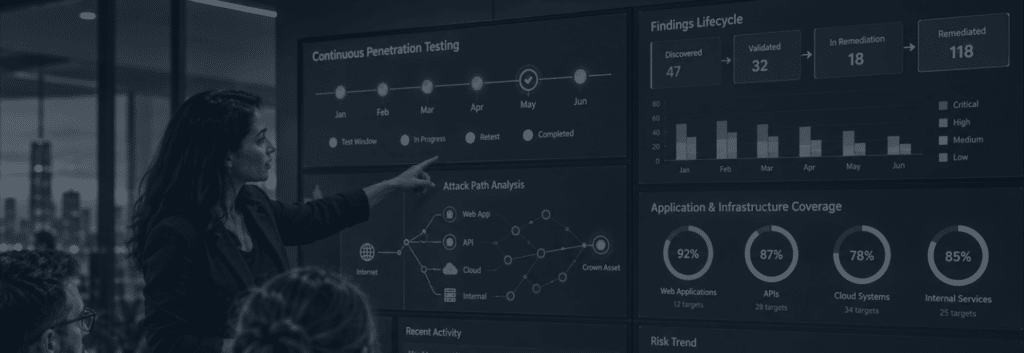
Penetration Testing as a Service, often called PTaaS, is a continuous model for offensive security testing that gives organizations recurring and on-demand access to penetration testing expertise.
Instead of treating penetration testing as a once-a-year event, PTaaS helps security teams test more frequently, validate fixes faster, and maintain better visibility into how risk changes over time.
That distinction matters.
Modern organizations do not operate on static infrastructure. Applications change. APIs expand. Cloud environments shift. New integrations are introduced. Development teams release updates at a pace that traditional point-in-time testing was never designed to fully support.
A single penetration test can still provide important value, but it only captures a defined moment in time. PTaaS extends that value by creating an ongoing testing program that keeps pace with change.
At VerSprite, PTaaS is not positioned as more testing for the sake of more testing. It is a way to help organizations identify, validate, prioritize, and remediate real-world risk throughout the year.
What Does Penetration Testing as a Service Mean?
Penetration Testing as a Service is an ongoing security testing model that combines expert-led penetration testing with the flexibility of a recurring service.
A traditional penetration test usually follows a defined path: scope the environment, conduct the assessment, deliver findings, and close the engagement with a report. That model remains useful for compliance, major releases, customer assurance, and security validation.
PTaaS builds on that foundation by adding continuity.
With PTaaS, organizations can test on a recurring schedule, request testing around major changes, validate remediation, and track trends across applications, APIs, cloud environments, networks, and internal systems.
This creates a more practical model for organizations that need security testing to align with how their business and technology environments actually operate.
Why Traditional Penetration Testing Alone Is No Longer Enough
Traditional penetration testing is valuable, but modern security programs often need more than a point-in-time assessment.
Security gaps can emerge after a code push, configuration change, new integration, cloud update, or authentication change. If testing only happens once a year, those gaps may remain undiscovered for months.
PTaaS helps reduce that exposure window.
It allows organizations to test closer to the moment of change, validate fixes while engineering context is still fresh, and identify recurring weaknesses before they become systemic risk.
This does not mean annual penetration testing is obsolete. It means annual testing should be part of a broader security validation strategy.
The difference is simple:
A traditional penetration test answers, “What did we find during this assessment?”
PTaaS helps answer, “How is our risk changing over time?”
How PTaaS Works
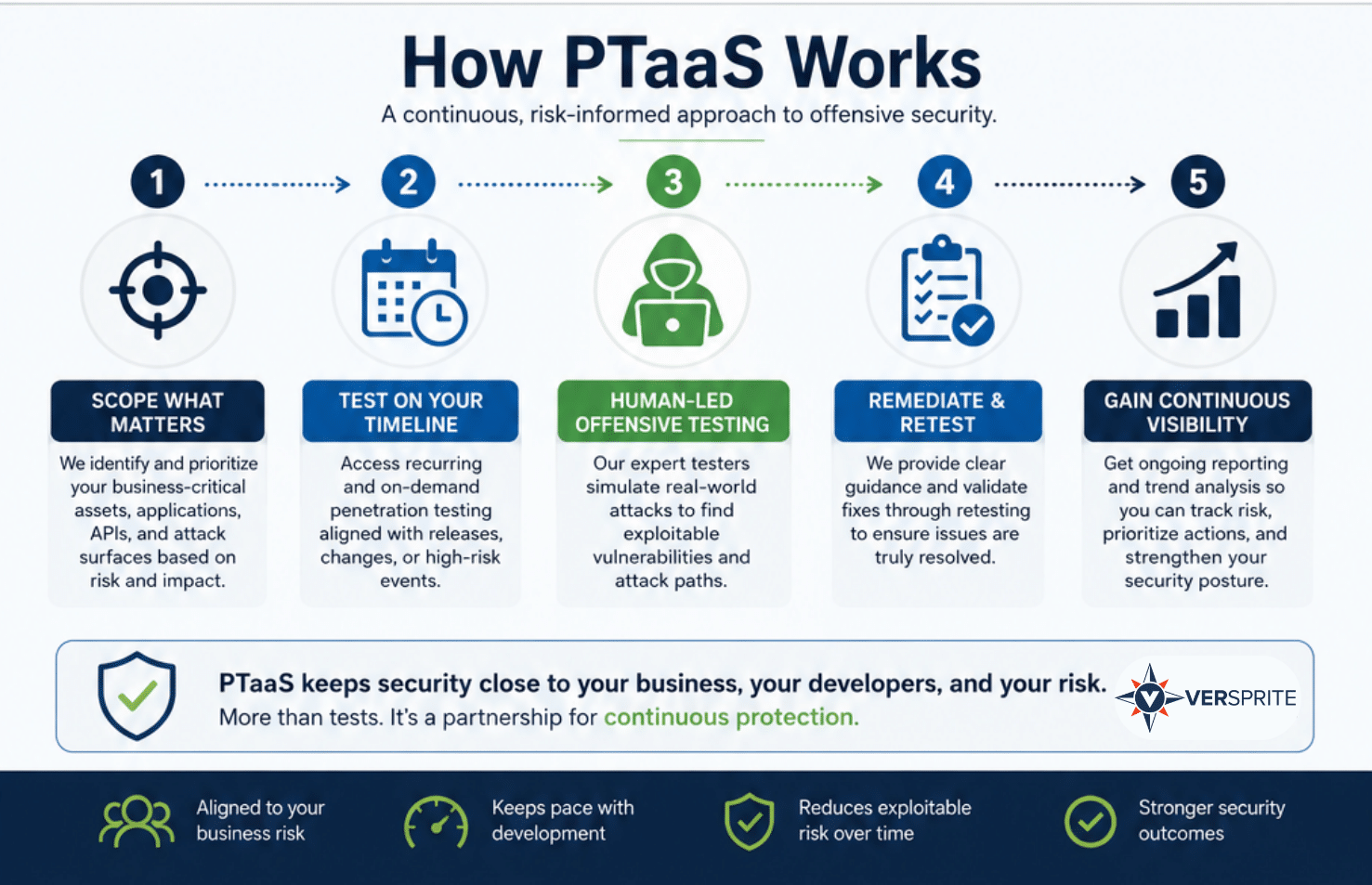
A mature PTaaS program gives organizations a structured way to test continuously, prioritize risk, and improve remediation outcomes.
1. Scope What Matters Most
Effective PTaaS starts with understanding which assets carry the greatest risk.
Not every application, API, or system has the same business impact. PTaaS helps prioritize testing around the environments that matter most, such as customer-facing applications, sensitive data systems, cloud infrastructure, authentication flows, payment systems, internal platforms, and high-value APIs.
This helps security teams focus resources where testing can produce the greatest risk reduction.
2. Test Continuously and On Demand
PTaaS supports both scheduled and on-demand penetration testing.
Scheduled testing creates consistency. On-demand testing gives teams flexibility when new releases, major changes, incidents, or business priorities require faster validation.
This model is especially useful for organizations with agile development cycles, expanding digital footprints, cloud-native systems, or frequent application changes.
3. Use Human-Led Offensive Security Testing
PTaaS should not be confused with automated vulnerability scanning.
Automation can help identify known issues, but penetration testing requires human judgment. Skilled testers can evaluate exploitability, chain weaknesses, test business logic, validate impact, and understand how an attacker would move through an environment.
This human-led approach is essential because many meaningful risks are not discovered by tools alone.
4. Prioritize Risk Based on Business Impact
A strong PTaaS program does not simply produce a long list of vulnerabilities.
It helps organizations understand which findings matter most, why they matter, and how they could affect the business.
That means looking beyond technical severity alone and considering exploitability, asset value, data sensitivity, exposure, likelihood, and potential impact.
This is where VerSprite’s risk-based approach is especially important. The goal is not to overwhelm teams with findings. The goal is to help them make better security decisions.
5. Remediate, Retest, and Measure Improvement
Finding a vulnerability is only part of the work.
PTaaS helps close the loop by supporting remediation guidance, retesting, and trend analysis. Teams can validate that fixes are effective, track progress over time, and identify whether the same types of weaknesses continue to appear across different systems.
This turns penetration testing from a static report into an ongoing improvement cycle.
PTaaS vs. Traditional Penetration Testing
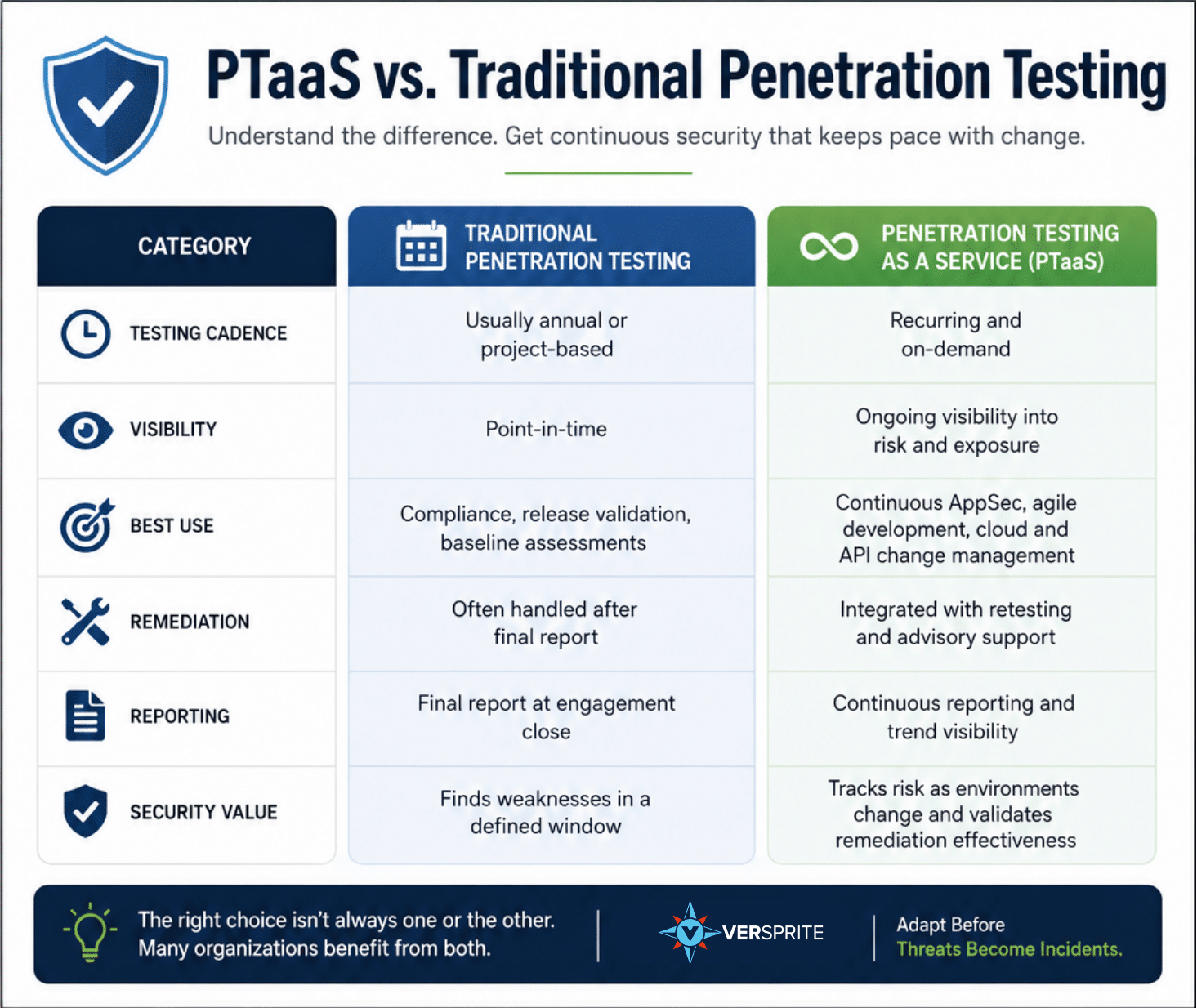
| Category | Traditional Penetration Testing | Penetration Testing as a Service |
|---|---|---|
| Cadence | Periodic or annual | Recurring and on demand |
| Visibility | Point-in-time | Continuous |
| Scope | Fixed for one engagement | Flexible as environments change |
| Remediation | Often handled after the report | Supported through guidance and retesting |
| Reporting | Final report | Ongoing findings, trends, and insights |
| Best Use | Compliance, release validation, baseline testing | Continuous AppSec, cloud, API, and risk validation |
| Value | Identifies issues in a defined window | Tracks and reduces risk over time |
Why PTaaS Matters for Application Security
Application security is no longer limited to a single application or annual test.
Modern AppSec programs must account for APIs, cloud services, identity providers, third-party integrations, mobile applications, internal systems, CI/CD pipelines, and rapidly changing release cycles.
PTaaS helps security teams keep pace with that complexity.
It allows testing to align more closely with development and business activity. It also gives engineering teams clearer remediation guidance while giving leadership a better view of where risk is improving, recurring, or expanding.
For organizations that manage sensitive data, regulated environments, or customer-facing platforms, this level of continuity can strengthen both security posture and stakeholder trust.
PTaaS and Threat Modeling Work Better Together
Threat modeling and PTaaS are strongest when they work together.
Threat modeling helps identify what could go wrong. PTaaS helps validate whether those risks can be exploited in practice.
This creates a powerful feedback loop.
Threat modeling can help define critical assets, abuse cases, trust boundaries, likely attack paths, and areas of business impact. PTaaS can then test those assumptions through offensive security techniques.
The results from PTaaS can also inform future threat models, architecture decisions, secure development practices, and remediation priorities.
Together, they help organizations move from reactive testing to proactive risk management.
VerSprite’s New Addition to PTaaS: Tavola
VerSprite is expanding its PTaaS offering with Tavola, an adversarial operations platform designed to make penetration testing output more actionable after the report is delivered.
A traditional pentest often ends with a PDF. Tavola helps carry the work forward by giving teams a live view of findings, remediation status, retesting activity, recurring vulnerability patterns, and executive-level risk trends.
Instead of managing post-test work through scattered tickets, emails, and spreadsheets, teams can work from a shared operational view.
For SecOps, Tavola makes findings easier to investigate and validate.
For program managers, it helps track engagement progress and retest windows.
For executives, it highlights patterns across testing activity so leaders can see where risk is improving, recurring, or becoming systemic.
This addition strengthens VerSprite’s PTaaS model by moving beyond static reporting and toward continuous adversarial insight.
The goal is not just to find vulnerabilities. The goal is to help organizations manage, measure, and reduce risk over time.
What Types of Testing Can PTaaS Include?
PTaaS can include several forms of offensive security testing depending on the organization’s environment and risk profile.
Common PTaaS coverage areas include:
- Web application penetration testing
- API penetration testing
- Cloud security testing
- Network penetration testing
- Mobile application security testing
- Authentication and authorization testing
- Business logic testing
- Internal system testing
- Retesting and remediation validation
- Threat-informed testing based on known attack paths
The right scope should reflect the organization’s actual attack surface.
For many modern businesses, that means going beyond a single web application and testing the systems, workflows, and integrations that support critical operations.
Who Should Consider PTaaS?
PTaaS is a strong fit for organizations that need security testing to keep pace with business and technology change.
It is especially useful for organizations that:
- Release software frequently
- Operate in cloud or hybrid environments
- Manage sensitive data
- Support customer-facing applications
- Need recurring assurance for customers or regulators
- Want to mature their offensive security program
- Have multiple applications or business units to test
- Need retesting and remediation validation throughout the year
PTaaS can also help organizations that have outgrown one-off testing but are not ready to build every offensive security capability internally.
What to Look for in a PTaaS Provider
A PTaaS provider should bring more than tools and reports.
The right partner should provide human-led testing, clear communication, risk-based prioritization, remediation support, and the ability to help internal teams improve over time.
When evaluating a PTaaS provider, look for:
- Expert-led penetration testing
- Testing aligned to business risk
- Coverage across applications, APIs, cloud, networks, and internal systems
- Clear remediation guidance
- Retesting to validate fixes
- Trend analysis and reporting over time
- Flexible testing cadence
- Collaboration with security and engineering teams
- Ability to support compliance and customer assurance
- A methodology focused on real-world attacker behavior
The best PTaaS partner does not simply identify weaknesses. It helps the organization understand which weaknesses matter, what to fix first, and how to reduce risk over time.
Common Misconceptions About PTaaS
PTaaS is not just automated scanning
PTaaS should include human-led offensive testing. Scanners may support parts of the process, but they cannot replace expert validation, business logic testing, exploit chaining, or risk interpretation.
PTaaS does not eliminate traditional penetration testing
Traditional penetration tests still have value. PTaaS extends that value by adding continuity, retesting, and ongoing visibility throughout the year.
PTaaS is not only for compliance
PTaaS can support compliance and customer assurance, but its greatest value is risk reduction. It helps organizations identify, prioritize, remediate, and validate security issues more consistently.
PTaaS is not one-size-fits-all
The scope, cadence, and focus of PTaaS should be tailored to the organization’s environment, business priorities, regulatory needs, and risk profile.
How PTaaS Supports Executive Risk Visibility
Security leaders need more than vulnerability counts.
They need to understand whether risk is increasing or decreasing, whether remediation is working, and whether recurring issues point to deeper program gaps.
PTaaS can support executive visibility by showing:
- Risk trends over time
- Recurring vulnerability categories
- Remediation progress
- Aging findings
- High-risk assets
- Retest outcomes
- Security maturity indicators
- Areas requiring additional investment
This helps shift the conversation from individual findings to measurable improvement.
For executives and board-level stakeholders, that distinction matters. The question is not only, “Did we complete a penetration test?” The better question is, “Are we reducing exploitable risk across the organization?”
Conclusion: PTaaS Turns Penetration Testing Into a Continuous Security Program
Penetration Testing as a Service helps organizations move beyond one-time assessments and toward continuous, risk-informed security validation.
Traditional penetration testing remains important, but modern environments need a model that can keep pace with frequent releases, cloud changes, expanding APIs, and evolving threats.
PTaaS provides that model.
It combines expert-led testing, flexible scheduling, remediation guidance, retesting, and trend visibility into an ongoing program. For organizations that want to strengthen application security, improve resilience, support compliance, and build greater trust, PTaaS offers a more practical way forward.
At VerSprite, PTaaS reflects a larger belief: security testing should not end with a report.
It should help organizations understand risk, act with confidence, and improve continuously.
PTaaS FAQ
What is Penetration Testing as a Service?
Penetration Testing as a Service is an ongoing offensive security model that gives organizations recurring and on-demand access to penetration testing. It helps teams test continuously, validate fixes, and reduce real-world risk over time.
How is PTaaS different from traditional penetration testing?
Traditional penetration testing is usually a point-in-time assessment. PTaaS provides recurring testing, ongoing visibility, remediation support, retesting, and trend analysis across the security program.
Is PTaaS the same as vulnerability scanning?
No. PTaaS should include human-led penetration testing, not automated scanning alone. It focuses on exploitability, attacker behavior, business impact, and actionable remediation.
What environments can PTaaS cover?
PTaaS can cover web applications, APIs, cloud environments, networks, mobile applications, internal systems, authentication flows, and other business-critical assets.
Who should use PTaaS?
PTaaS is useful for organizations that release software frequently, operate in cloud or hybrid environments, manage sensitive data, need ongoing assurance, or want to mature their offensive security program.
Does PTaaS help with compliance?
Yes. PTaaS can support compliance and customer assurance by providing recurring testing, remediation validation, and evidence of ongoing security improvement.
What makes VerSprite’s PTaaS different?
VerSprite’s PTaaS is risk-based, human-led, and designed to help organizations understand which vulnerabilities matter most. It focuses on real-world risk reduction, remediation guidance, retesting, and continuous security visibility.