What Is PASTA Threat Modeling? 7 Stages Explained for Modern Security
Date
Authors
Tony UV
Follow Us


PASTA is a risk-centric threat modeling framework used to identify and mitigate application security threats.
- Focuses on real-world attack scenarios
- Aligns security with business risk
- Uses a 7-stage methodology
- Helps organizations prioritize threats effectively
Modern applications face increasingly complex and evolving threats.
Traditional threat modeling approaches often fail to align security efforts with real business risk.
The PASTA framework (Process for Attack Simulation and Threat Analysis) solves this by taking a risk-centric approach to identifying, analyzing, and mitigating threats.
This article explains what PASTA threat modeling is, how its 7 stages work, and why it is widely used in modern application security.
PASTA Threat Modeling Stage 1
What Is PASTA Threat Modeling?
PASTA (Process for Attack Simulation and Threat Analysis) is a risk-driven threat modeling methodology designed to identify and prioritize security threats in applications.
Unlike traditional models, PASTA focuses on:
- Real-world attack scenarios
- Business impact and risk
- End-to-end system analysis
It helps organizations move beyond theoretical threats to practical, actionable security insights.
The 7 Stages of PASTA Threat Modeling
Stage 1: Define Business Objectives
Identify business goals, compliance requirements, and risk tolerance.
Stage 2: Define the Technical Scope
Map applications, infrastructure, APIs, and system components.
Stage 3: Application Decomposition
Break down the application architecture and data flows.
Stage 4: Threat Analysis
Identify potential threats using threat intelligence and attack patterns.
Stage 5: Vulnerability Analysis
Assess weaknesses in the system that could be exploited.
Stage 6: Attack Simulation
Simulate real-world attack scenarios to validate risks.
Stage 7: Risk Analysis and Mitigation
Prioritize threats and define remediation strategies.
Why Use PASTA for Threat Modeling?
PASTA is widely used because it:
- Aligns security with business risk
- Provides a structured, repeatable methodology
- Focuses on real attack scenarios
- Improves prioritization of vulnerabilities
It enables organizations to make informed security decisions.
PASTA vs Other Threat Modeling Frameworks
PASTA
- Risk-driven
- Business-focused
- Simulation-based
STRIDE
- Threat classification model
- Focuses on types of attacks
DREAD
- Risk scoring methodology
- Used to prioritize vulnerabilities
PASTA provides a more comprehensive and realistic approach compared to traditional models.
When to Use PASTA Threat Modeling
PASTA is ideal for:
- Complex applications and APIs
- High-risk environments
- Regulated industries
- DevSecOps and secure SDLC
It is especially effective when security must align with business impact.
VerSprite’s PASTA Threat Modeling Solution: Stages 1-4
PASTA (Process for Attack Simulation & Threat Analyses)splits all the software development lifecycle processes and business operations into seven cohesive stages designed to shield assets against cyber threats.
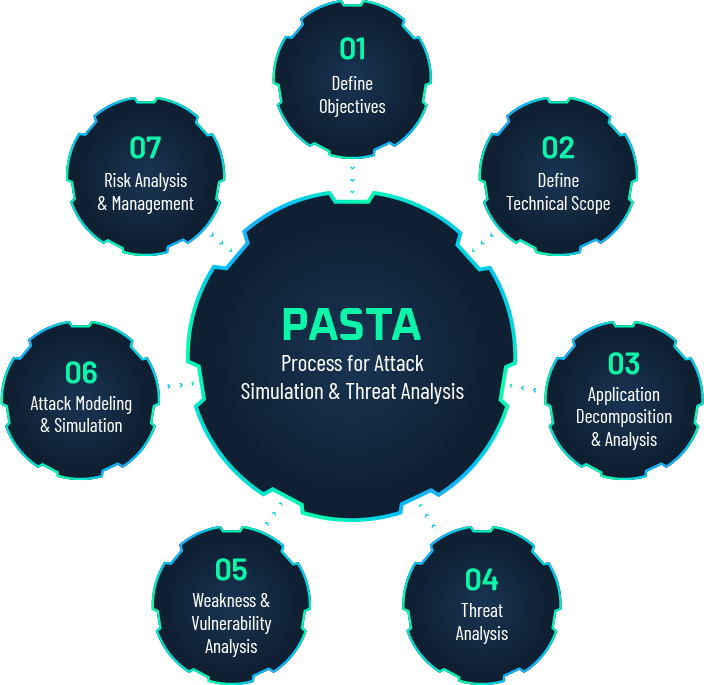
Stage 1. DEFINING OBJECTIVES:
- Defines principal business objectives of the application
- Gives an understanding of the impact of the application and functional features on the business
- Produces a risk profile for the application
Stage I helps drive governance efforts that need to be followed through security-related generalizations and a deeper understanding of their interconnectedness with business objectives.
Stage 2. DEFINING TECHNICAL SCOPE:
- Identifies all the assets in the application environment
- enumerates all software and hardware components
- Helps build a baseline of security controls aimed at reducing the attack surface for each asset
With Stage II, you achieve a clear understanding of underlying technologies and related dependencies. It helps determine potential exploits of vulnerabilities.
Stage 3. APPLICATION DECOMPOSITION AND ANALYSIS:
- Enumeration of all application use cases
- Building a clear data flow diagram (DFD) and trust boundaries
- Discovering where new security measures must be introduced
- RACI participant model to ensure the roles within the organization are clear, distributed, and assigned
Stage III helps determine where abuse cases can lead to data-focused attacks, authentication bypasses, data integrity violations, or platform persistence opportunities.
Stage 4. THREAT ANALYSIS:
- Revision of all credible diverse sources of threat data (security incidents, log and alert data)
- Cataloging likely threat agents for a given threat
- Identification of the likely threats to the application
- Attack tree development
This stage focuses on major threat targets (data, downtime, or human life) and helps identify which aspect of the application can become a potential target.
VerSprite’s PASTA Threat Modeling Solution: Stages 5-7
Stage 5. VULNERABILITY AND WEAKNESS ANALYSIS:
- Identification of weaknesses in design and architecture
- Connection of the potential threats and identified software vulnerabilities and design flaws
- Performance of targeted vulnerability testing
- Contextual risk analysis
Stage V helps strengthen application security by identifying vulnerabilities and weaknesses that are present within the application environment. By mapping them back to the attack tree, potential threats can be prioritized and remediated.
Stage 6. ATTACK MODELING AND SIMULATION:
- Gaining a better understanding of the attack surface
- Assessment of the probability and impact of the possible attack scenarios
- Testing existing countermeasures and conducting security tests centered around the contextualized risks to the application
At the heart of the risk-centric PASTA methodology, this stage allows us to perform evidence-based tests to estimate the possible impact and adjust remediation and countermeasures.
Stage 7. RESIDUAL RISK ANALYSIS AND MANAGEMENT:
- Provides calculation of risk of probable threats
- Allows establishment of reasonable risk mitigation strategies that secure business and don’t burden the budget
- Gives a clear understanding of impacts on business objectives
- Aids in maturing of the security program
This stage provides cost-effective countermeasures and recommended risk mitigation options.
How to Implement PASTA Threat Modeling
To implement PASTA:
- Identify business and security stakeholders
- Map system architecture and data flows
- Use threat intelligence to identify risks
- Simulate attack scenarios
- Prioritize remediation based on risk
Implementation requires collaboration across security, engineering, and business teams.
What Are the Benefits of PASTA Threat Modeling?
PASTA helps organizations:
- Identify real-world attack scenarios
- Prioritize high-impact risks
- Improve application security posture
- Align security with business objectives
It provides a practical, risk-based approach to threat modeling.
Is PASTA Threat Modeling Effective?
Yes.
PASTA is considered one of the most effective threat modeling frameworks because it focuses on real-world attack scenarios and business risk.
It enables organizations to move beyond theoretical threats and prioritize actionable security improvements.
Protect Your Business with VerSprite’s Cybersecurity Services
Our PASTA threat modeling solution goes beyond a security framework. It provides scalable resolutions to organizations looking to protect their data assets and applications and ensure business continuity in this turbulent cybersecurity landscape.
Being risk-centric, PASTA focuses on evidence-based threats and their probable impact on applications and organizations as a whole. It is a way to break down complex security tasks and mature the cybersecurity program to fit the needs of evolving business objectives and regulations.
For more detailed information on PASTA threat modeling, download our FREE eBook here.
Enhance your cybersecurity strategy with VerSprite’s PASTA threat modeling solution – risk-centric, comprehensive, and tailored to safeguard your digital assets.
Contact us today to safeguard your business with cybersecurity professionals.
FAQs About PASTA Threat Modeling
What is PASTA threat modeling?
PASTA is a risk-driven framework used to identify, analyze, and mitigate application security threats.
How many stages are in PASTA?
PASTA consists of 7 stages, from defining business objectives to risk analysis and mitigation.
What makes PASTA different from STRIDE?
PASTA focuses on business risk and attack simulation, while STRIDE focuses on categorizing threats.
Is PASTA suitable for DevSecOps?
Yes, PASTA aligns well with DevSecOps by integrating threat modeling into the development lifecycle.