AI-Powered MDR With Google SecOps: Reduce Breach Risk

Date
Authors
Defenders Team
Follow Us


Introduction: A New Era in Threat Detection and Response
Modern cyber threats move faster than traditional SOC teams can respond. Organizations relying on legacy SIEM tools often struggle with alert fatigue, slow detection, and fragmented visibility.
AI-powered Managed Detection and Response (MDR) changes this equation. By combining Google SecOps with VerSprite’s detection engineering and automation, organizations can reduce breach risk by up to 70% while dramatically improving detection and response times.
This article explains how AI-driven MDR works, why Google SecOps is redefining SIEM, and how enterprises can operationalize faster, smarter security outcomes.
What is AI-Powered MDR?
AI-powered Managed Detection and Response (MDR) is a cybersecurity service that uses artificial intelligence, automation, and threat intelligence to detect, investigate, and respond to threats in real time.
Key capabilities include:
- Automated threat detection using behavioral analytics
- AI-assisted investigation and alert triage
- Integrated threat intelligence from sources like Mandiant and VirusTotal
- Automated response workflows (SOAR)
Key Results of VerSprite MDR + Google SecOps
Organizations using this model achieve:
- Mean Time to Detect (MTTD): reduced from days to under 8 hours
- Mean Time to Respond (MTTR): improved by 50%
- False positives: reduced below 10%
- Analyst productivity: increased by 35%
- Breach risk: reduced by up to 70%
Why Google SecOps is Transforming MDR
Google SecOps modernizes SIEM and SOAR by combining:
- Massive-scale search and analytics from Google Cloud
- Threat intelligence from Mandiant and VirusTotal
- AI-powered investigation via Gemini
- Built-in automation for response orchestration
This eliminates traditional SIEM challenges like complexity, lack of context, and analyst fatigue.
Why VerSprite Chose Google SecOps
We don’t settle for “good enough.” Our MDR is built on platforms that drive measurable performance gains, and Google SecOps aligns perfectly with that vision.
According to the SANS Institute report, “Google SecOps: The SIEM’s Third Act,” the platform addresses long-standing challenges in the SIEM space: complexity, context, and analyst fatigue — delivering streamlined automation, curated detections, and AI-assisted investigations.
“Google SecOps successfully combines Google’s large-scale search performance, world-class security expertise from Mandiant and VirusTotal, and artificial intelligence via the Gemini model in a streamlined detection and response platform.”
— Mark Orlando, SANS Institute
At VerSprite, we go further — tuning Google SecOps to our clients’ risk models, integrating it with our proprietary detection engineering, threat intel, and automation workflows.
How VerSprite Enhances Google SecOps
VerSprite extends Google SecOps with:
- Custom detection engineering aligned to business risk
- Behavioral analytics and correlation logic
- Continuous threat hunting
- Automated playbooks for containment and remediation
- Outcome-based reporting tied to business KPIs
The result is not just visibility, but measurable security outcomes.
A Platform That Multiplies MDR Efficiency
Google SecOps delivers scalability, automation, and speed — and VerSprite turns that into measurable business outcomes.
Impact KPIs
| Metric | Before MDR Optimization | After VerSprite MDR + Google SecOps | ||
|---|---|---|---|---|
| Mean Time to Detect (MTTD) | 2–3 days | Under 8 hours | ||
| Mean Time to Respond (MTTR) | 10–12 hours | 50% faster | ||
| False Positive Rate | 25–30% | Below 10% | ||
| Analyst Productivity | Baseline | +35% efficiency via automation | ||
| Breach Risk & Impact | High | Up to 70% reduction |
Through assistive automation, risk-based analytics, and AI-assisted investigation, we help SOC teams focus on decisions — not just data.
The Power Behind the Platform
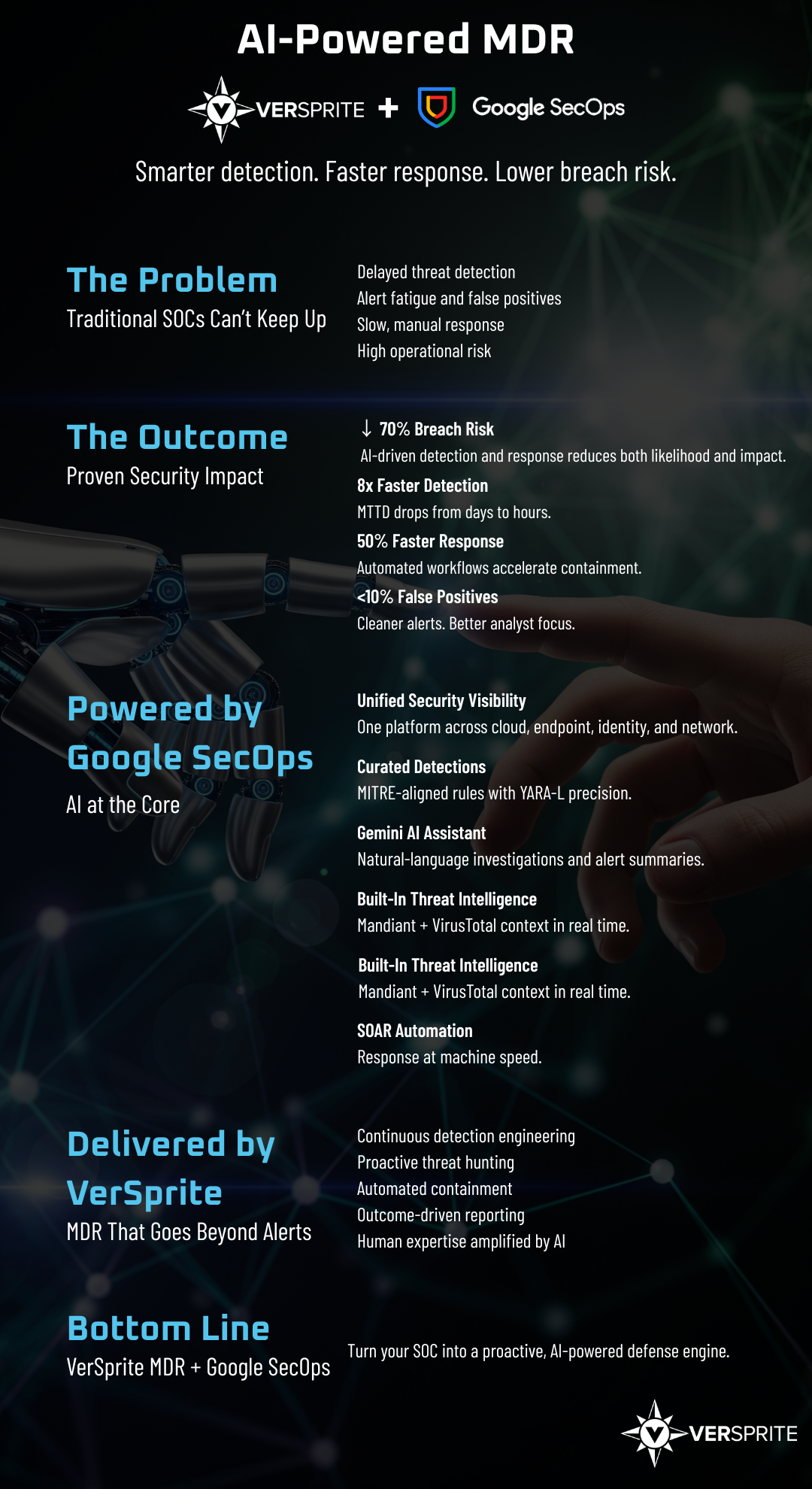
Google SecOps delivers key capabilities that boost VerSprite’s MDR service:
- Unified Visibility
A single view across hybrid/multi-cloud environments via the Unified Data Model (UDM). - Curated Detections & YARA-L Rules
Thousands of prebuilt detections aligned to MITRE ATT&CK for faster coverage. - Gemini AI Assistant
Natural-language queries, alert summarization, and auto-generation of detection logic. - Integrated Threat Intelligence
Real-time insights from Mandiant and VirusTotal to enrich triage and validation. - SOAR Capabilities
Automation workflows (inherited from Siemplify) enable rapid response at scale.
Combined with VerSprite’s custom correlation logic, behavioral analytics, and tailored playbooks, these tools transform Google SecOps into a predictive MDR engine.
VerSprite’s Approach: Human Expertise Meets Machine Intelligence
Technology doesn’t solve security problems — people do. At VerSprite, our global MDR team uses Google SecOps as a force multiplier for analyst capability.
Our MDR Methodology Includes:
- Continuous Detection Engineering
Custom rules based on each client’s unique threat model. - Proactive Threat Hunting & Enrichment
Using UDM, YARA-L, and Gemini AI for deeper insight. - SOAR-Driven Response
Automated containment and remediation across EDR, identity, and cloud. - Outcome-Based Reporting
Real-time visibility into MTTD, MTTR, detection coverage, and risk reduction.
This is where Google’s technology meets VerSprite’s expertise — accelerating action and delivering clear security value.
Why Gartner’s Recognition Matters
Gartner’s 2025 Magic Quadrant places Google SecOps highest in “Completeness of Vision”, especially for AI and workflow automation — directly aligning with the outcomes we deliver.
“Use of AI is a core competency for Google and its SecOps platform offers strong AI functionality throughout many of the common activities and functions associated with SIEM operations. Its well-integrated automation capabilities add to this overall strength.”
For VerSprite clients, this means:
- Faster MDR results
- Smarter threat detection
- More cost-effective security outcomes
All backed by a recognized industry
Conclusion: The Future of MDR Is Intelligence-Driven
At VerSprite, we believe the SOC of the future is agentic — where AI and automation augment human analysts to anticipate threats, not just react to them.
By combining Google SecOps with our MDR methodology, we’re not just keeping pace — we’re leading.
Our Clients Gain:
- Improved KPIs across detection & response
- 24/7 threat hunting powered by intelligence
- Automated containment and recovery
- Strategic insights mapped to business risk
VerSprite MDR, powered by Google SecOps, transforms data into defense — and defense into confidence.
About VerSprite
VerSprite is a global cybersecurity firm specializing in:
Our MDR service integrates leading platforms like Google SecOps with advanced detection engineering, risk modeling, and automation to deliver unmatched visibility, response speed, and business value.
FAQs About AI-Powered MDR
How does AI reduce breach risk?
AI reduces breach risk by detecting threats earlier, automating investigation, and enabling faster response—minimizing attacker dwell time.
What is the difference between MDR and SIEM?
SIEM collects and analyzes logs, while MDR provides active monitoring, threat hunting, and response services.
Why is Google SecOps different from traditional SIEM?
Google SecOps integrates AI, automation, and threat intelligence into a single platform, reducing complexity and improving response speed.
What industries benefit most from MDR?
Healthcare, finance, retail, and critical infrastructure benefit most due to high threat exposure and regulatory requirements.
Share
- /
- /
- /
- /
- /
- /
- /
- /
- /
- /
- /
- /
- /
- /
- /
- /
- /
- /
- /
- /
- /
- /