
VerSprite
Cybersecurity Services
Providing Customized Security and Compliance
Services Delivered by Industry Leaders
Builders / Breakers / Defenders
Serving Our Clients via Niche Security Engagements

Builders
Whether your delivery environment is self-hosted, in the Cloud, uses containers, operates server-less or uses any other common methodology, we can provide automation tools and expertise to help you deliver efficiently and securely.
- PASTA Threat Modeling
- Continuous Threat Modeling with Fork
- Threat Modeling as a Service (TMaaS)
- Enterprise Threat Modeling at Scale
- CI/CD Security
- Cloud Security Assessments
- Environment Hardening
- Interim/Virtual CISO Services
- Data Privacy Services
- Security Awareness Training Services
- Vendor Risk Assessments & Management Services
- Enterprise & Targeted Risk Assessment Services
- Regulatory Compliance Services


- /
- /
- /
- /
- /
- /
- /
- /
- /
- /
- /
- /
- /
- /
- /
- /
- /
- /
- /
- /
- /
- /
What Cybersecurity Consulting Services Actually Cover
“Cybersecurity consulting” gets used to describe everything from a single penetration test to a multi-year risk program, which makes it hard to know what you’re actually buying. At VerSprite, consulting engagements are built around a simple premise: security work should be prioritized by the business impact of a credible threat, not by a generic checklist of controls. That’s the thinking behind PASTA (Process for Attack Simulation and Threat Analysis), the risk-centric methodology our CEO Tony UcedaVélez co-developed, and it shapes how we scope every engagement — from a focused application assessment to an enterprise-wide security program.
Where Consulting Fits Across the Security Lifecycle
Most organizations don’t need one service — they need the right sequence of services at the right time. Our Builders, Breakers, and Defenders groups map to that lifecycle:
- Before code ships or infrastructure goes live: Builders integrate threat modeling, cloud security, and CI/CD security into development so vulnerabilities get caught before they’re expensive to fix.
- Once systems are live: Breakers validate what’s actually exploitable through penetration testing, red teaming, and adversary simulation — testing assumptions rather than just scanning for known issues.
- On an ongoing basis: Defenders provide the monitoring, detection, and threat intelligence layer that catches what prevention missed, backed by digital forensics and incident response when something does happen.
Consulting engagements can start anywhere in that sequence depending on where an organization’s risk actually sits — a company shipping new features weekly has different priorities than one managing a decade of legacy infrastructure.
Assessment, Advisory, and Managed Engagement Models
Engagements generally take one of three shapes. Assessment-based work — penetration testing, red teaming, risk assessments, compromise assessments — answers a specific question about current exposure at a point in time. Advisory work — virtual CISO services, regulatory compliance support, vendor risk programs — provides ongoing strategic guidance without embedding a full-time hire. Managed services — MDR, continuous vulnerability management, security automation — hand off day-to-day security operations so internal teams can focus on the business.
Many clients combine all three: a risk assessment identifies priorities, advisory work builds the program to address them, and managed services sustain it. The methodology stays consistent across all of it — every engagement traces back to a defined threat model, not an abstract compliance framework.
Who Consulting Engagements Are Built For
Our consulting work concentrates in industries where a security failure has direct financial, safety, or regulatory consequences — financial services, healthcare, SaaS, retail, and manufacturing among them. That concentration matters: a threat model for a payment platform looks nothing like one for a hospital network or an industrial control system, and 16 years of engagements across those sectors informs how we scope new ones. Whether the immediate need is a single assessment or a long-term program, the starting point is the same conversation: what’s the credible threat, and what’s the actual business impact if it materializes.
- /
- /
- /
- /
- /
- /
- /
- /
- /
- /
- /
- /
- /
- /
- /
- /
- /
- /
- /
- /
- /
- /
Financial Services, Healthcare, SaaS, Retail, Manufacturing
VerSprite delivers Security Services across industries where security failures translate directly to financial loss, safety risk, or regulatory exposure.
Financial Services & FinTech
-
Simulate advanced fraud, account takeover, and adversary campaigns targeting banking and payment ecosystems
-
Protect cloud, API, and transaction environments through offensive testing and continuous monitoring
-
Align security programs with GLBA, PCI DSS, FFIEC, and evolving financial regulations
-
Deliver executive-level risk visibility to reduce financial, operational, and regulatory exposure
Healthcare & Life Sciences
-
Protect ePHI, clinical systems, and research environments through offensive, defensive, and advisory services
-
Detect and respond to ransomware and targeted threat activity impacting patient care
-
Align security and privacy programs with HIPAA, HITECH, and healthcare regulatory requirements
-
Strengthen operational resilience to safeguard patient safety and continuity of care
SaaS & Technology Providers
-
Secure cloud-native, multi-tenant, and DevSecOps environments across the software lifecycle
-
Conduct red teaming, penetration testing, and AI security assessments to protect product integrity
-
Support SOC 2, ISO 27001, and enterprise customer security requirements
-
Enable scalable security programs that build customer trust and accelerate growth
Retail & E-Commerce
-
Protect payment systems, customer data, and digital commerce platforms
-
Detect and prevent fraud, credential abuse, and supply chain compromise
-
Align privacy and compliance programs with PCI DSS, GDPR, and consumer protection laws
-
Reduce downtime, revenue loss, and reputational risk through continuous defense
Manufacturing & Critical Infrastructure
-
Secure IT/OT convergence and operational technology environments
-
Simulate targeted attacks impacting production systems and supply chains
-
Monitor nation-state and advanced threat activity affecting industrial sectors
-
Strengthen governance and resilience to protect uptime, safety, and national security alignment
Cooking with PASTA: The Secret Ingredient Behind Our Services
PASTA Threat Modeling:
7 Stages for Simulating Cyber Attacks
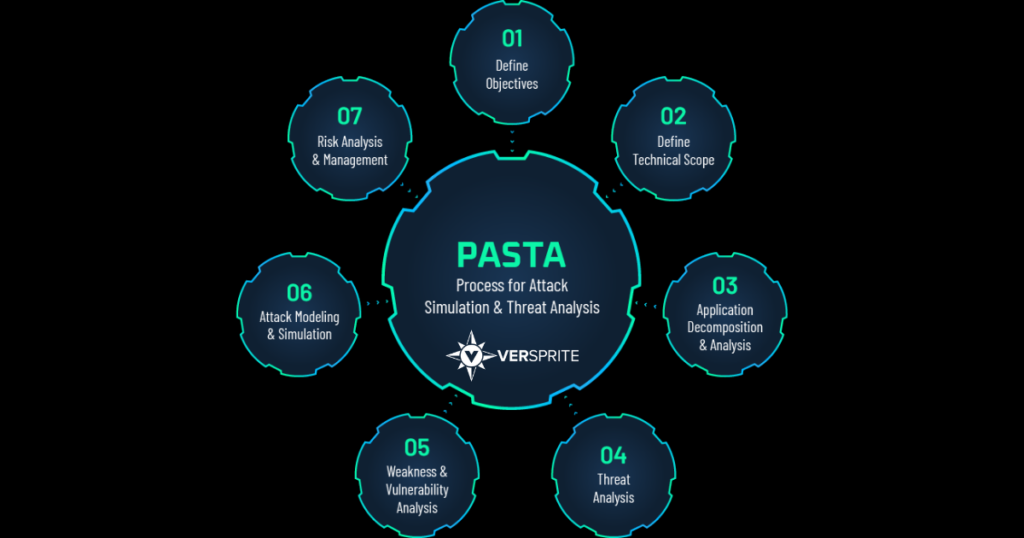
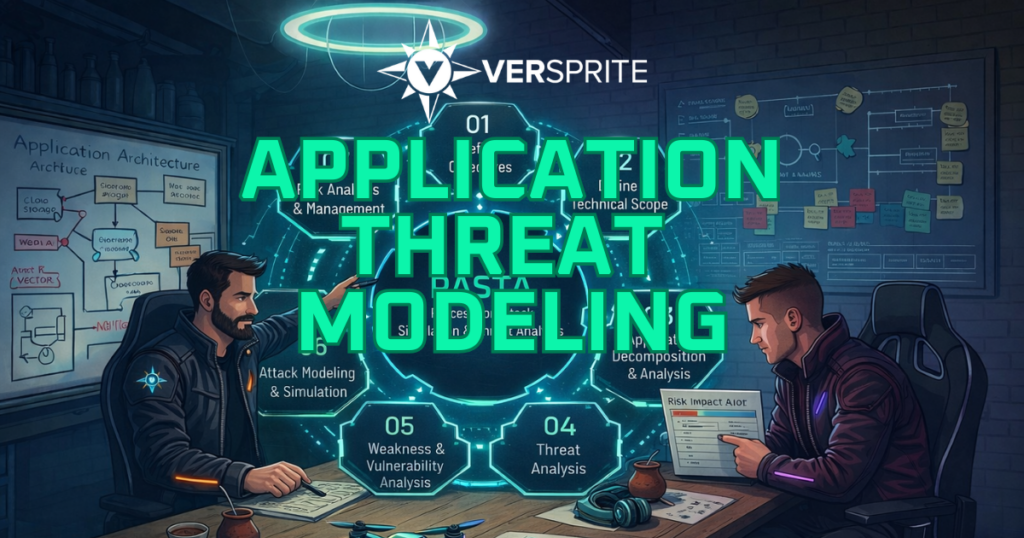
Our risk-based threat modeling methodology consists of 7 stages for simulating cyber attacks and analyzing threats to the organization and application. This allows our pentesters, redteamers, and cybersecurity analysts to help your organization identify critical vulnerabilities and minimize real-world risks associated business impact.
-
Define Business Context of Application
This considers the inherent application risk profile and address other business impact considerations early in the SDLC or for given Sprint under Scrum activities.
-
Technology Enumeration
You can’t protect what you don’t know is the philosophy behind this stage. It’s intended to decompose the technology stack that supports the application components that realize the business objectives identified from Stage 1.
-
Application Decomposition
Focuses on understanding the data flows amongst application components and services in the application threat model.
-
Threat Analysis
Reviews threat assertions from data within the environment as well as industry threat intelligence that is relevant to service, data, and deployment model.
-
Weakness / Vulnerability Identification
Identifies the vulnerabilities and weaknesses within the application design and code and correlates to see if it supports the threat assertions from the prior stage.
-
Attack Simulation
This stage focuses on emulating attacks that could exploit identified weaknesses/vulnerabilities from the prior stage. It helps to also determine the threat viability via attack patterns.
-
Residual Risk Analysis
This stage centers around remediating vulnerabilities or weaknesses in code or design that can facilitate threats and underlying attack patterns. It may warrant some risk acceptance by broader application owners or development managers.
what we do
VerSprite Cybersecurity Consulting Services: Trusted by Clients from All Industries
VerSprite’s cybersecurity experts are passionate about helping our clients accomplish both their security and business objectives. We developed a risk-based PASTA threat modeling methodology aimed at applying security countermeasures that are commensurate to the possible impact that could be sustained from defined threat models, vulnerabilities, weaknesses, and attack patterns.






- /
- /
- /
- /
- /
- /
- /
- /
- /
- /
- /
- /
- /
- /
- /
- /
- /
- /
- /
- /
- /
- /
Frequently Asked Questions
What cybersecurity services does VerSprite offer?
VerSprite provides cybersecurity consulting across three areas: offensive security (Breakers), DevSecOps and secure development (Builders), and managed detection and threat intelligence (Defenders). Services include penetration testing, red teaming, application and organizational threat modeling, MDR, vulnerability management, virtual CISO, and risk and compliance support.
What do Builders, Breakers, and Defenders mean at VerSprite?
VerSprite organizes its services into three teams. Builders integrate security into development and cloud environments through threat modeling, automation, and CI/CD security. Breakers emulate real-world attacks through penetration testing, red teaming, and adversary simulation. Defenders detect and respond to threats using managed detection and response, threat intelligence, and open-source intelligence.
What is PASTA threat modeling?
PASTA (Process for Attack Simulation and Threat Analysis) is a risk-centric, seven-stage threat modeling methodology co-created by VerSprite CEO Tony UcedaVélez. It aligns security with business impact and real-world attack scenarios, prioritizing threats based on the magnitude of impact they could cause rather than technical severity alone.
What are the seven stages of PASTA threat modeling?
The seven stages are: define the business context of the application, technology enumeration, application decomposition, threat analysis, weakness and vulnerability identification, attack simulation, and residual risk analysis.
How does VerSprite differ from other cybersecurity firms?
VerSprite takes a risk-based rather than compliance-driven approach, examining credible threats to measure potential business impact instead of only assessing security controls. With over 16 years of experience and as developers of the PASTA methodology, VerSprite tailors each engagement to a client’s specific environment, assets, and business priorities.
What industries does VerSprite serve?
VerSprite serves industries where security failures translate directly to financial loss, safety risk, or regulatory exposure, including financial services and FinTech, healthcare and life sciences, SaaS and technology providers, retail and e-commerce, and manufacturing and critical infrastructure.
Is VerSprite CREST accredited?
Yes. VerSprite holds CREST accreditation for web and mobile application security testing, alongside team certifications including CISSP, CISA, CISM, and GIAC.
- /
- /
- /
- /
- /
- /
- /
- /
- /
- /
- /
- /
- /
- /
- /
- /
- /
- /
- /
- /
- /
- /
Why VerSprite
VerSprite has 19+ years of experience as a leader in risk-driven cybersecurity consulting, integrated security automation, and PASTA threat modeling. VerSprite helps companies create evolved security solutions that thread security into their company DNA. VerSprite’s offensive approach goes beyond assessing security controls to examine credible threats to understand and measure the magnitude of the business impact.
Certifications








- /
- /
- /
- /
- /
- /
- /
- /
- /
- /
- /
- /
- /
- /
- /
- /
- /
- /
- /
- /
- /
- /
Discover How Others Have Improved Their Security
Discover How Others Have Improved Their Security

A Geopolitical Perspective on Supply Chain Risks and Opportunities
What are the geopolitical risks of physical and digital supply chain attacks to your organization? Join VerSprite and CLASS-LLC in a webinar on the top risks and mitigation strategies to use in 2020.
Read More
Abusing Insecure Windows Communication Foundation (WCF) Endpoints
A trend that the VerSprite Research team noticed in .NET services is the exposure of dangerous methods through insecure WCF endpoints. Download this presentation for a high-level overview of the WCF terminals and receive a practical analysis.
Read More
Apparel Manufacturing Client Assessing M&A Target
A geopolitical risk assessment was conducted on a potential foreign M&A target for an apparel manufacturing client looking to establish a presence in Thailand.
Read More
Addressing Cybercrime via PASTA Threat Modeling
VerSprite’s CEO, Tony UcedaVélez addresses combatting cybercrime via a risk centric approach with PASTA Threat Modeling methodology. This risk based approach led to the mantra behind VerSprite Security as well as the Process for Attack Simulation for Threat Analysis, a co-developed risk based threat modeling methodology that Tony co-authored along with accompanying book (Risk Centric Threat Modeling, Wiley 2015).
Read More
Application Security in the Time of Remote Working
Watch the video to gain insight into the stages of the SDLC (Software Development Life Cycle), discover why security testing in the SDLC is important, and learn the key steps to effectively build secure software. This cybersecurity discussion is relevant to all types of businesses, including those with and without a full in-house software development division.
Read More