Organizational Threat Modeling Service
Simulate Real-World Attacks Against Your Enterprise and Quantify Business Risk
Build a Tailored Engagement or Service Model Today- /
- /
- /
- /
- /
- /
- /
- /
- /
- /
- /
- /
- /
- /
- /
- /
- /
- /
- /
- /
- /
- /
Most security assessments examine one system at a time. Organizational threat modeling takes the opposite view — it looks at your entire business ecosystem and asks how a determined adversary would move across interconnected assets, people, vendors, and processes to cause real damage. VerSprite builds these models on evidence-supported threat motives and the PASTA methodology, so you see where your security program is actually weakest and what to fix first.
- /
- /
- /
- /
- /
- /
- /
- /
- /
- /
- /
- /
- /
- /
- /
- /
- /
- /
- /
- /
- /
- /
What Is Organizational Threat Modeling?
Organizational threat modeling is a structured methodology for identifying, quantifying, and prioritizing security risks across an entire enterprise — not just a single application or system. It takes a holistic view of the business, examining how threats could propagate across interconnected assets, processes, and dependencies, and prioritizes risk by likelihood and business impact so security resources go where they matter most. Unlike a point-in-time assessment, effective organizational threat modeling is iterative: it evolves with the business, drives security requirements, validates control effectiveness, and informs strategic security investment.
- /
- /
- /
- /
- /
- /
- /
- /
- /
- /
- /
- /
- /
- /
- /
- /
- /
- /
- /
- /
- /
- /
Organizational vs. Application Threat Modeling
Application threat modeling focuses on a single system or application — its architecture, data flows, and trust boundaries. Organizational threat modeling zooms out to the whole enterprise, modeling how threats move between systems, through people and third parties, and across business processes. Application threat modeling answers “how could this application be attacked?” Organizational threat modeling answers “how could this business be attacked, and where would it hurt most?” The two are complementary: VerSprite uses the same PASTA foundation for both, applied at different scopes.
- /
- /
- /
- /
- /
- /
- /
- /
- /
- /
- /
- /
- /
- /
- /
- /
- /
- /
- /
- /
- /
- /
Our Organizational Threat Modeling Approach
Asset Identification & Valuation
Effective threat modeling starts with a thorough inventory of organizational assets and their business value: information assets (databases, intellectual property, customer data), technical infrastructure (networks, servers, endpoints, cloud resources), personnel and their access privileges, and business processes and operational dependencies. Each asset is assessed for criticality, confidentiality, integrity, and availability.
Threat Identification
We systematically identify threats from multiple perspectives: external threats (nation-state actors, cybercriminals, hacktivists), internal threats (malicious insiders, negligent employees, compromised accounts), environmental threats (natural disasters, power and physical infrastructure failures), and supply chain threats (third-party vendors, service providers, software dependencies). Threat intelligence keeps the model aligned with techniques observed in the wild.
Vulnerability Assessment
We evaluate where the organization is most exposed: technical vulnerabilities across systems and applications, procedural weaknesses in business processes, architectural flaws in design and integration points, gaps in security controls, and human factors and social-engineering susceptibility.
Risk Analysis
We combine threat likelihood with potential impact to prioritize mitigation — determining likelihood from threat-actor capability, motivation, and past patterns; assessing business, financial, regulatory, and reputational impact; scoring risk quantitatively or qualitatively; and defining risk-acceptance thresholds.
Control Selection & Implementation
Based on the risk analysis, we recommend preventive, detective, corrective, and deterrent controls, mapped to frameworks like NIST CSF, ISO 27001, and CIS Controls and tailored to your specific threat landscape.
- /
- /
- /
- /
- /
- /
- /
- /
- /
- /
- /
- /
- /
- /
- /
- /
- /
- /
- /
- /
- /
- /
The PASTA Methodology Applied to Organizational Threat Modeling
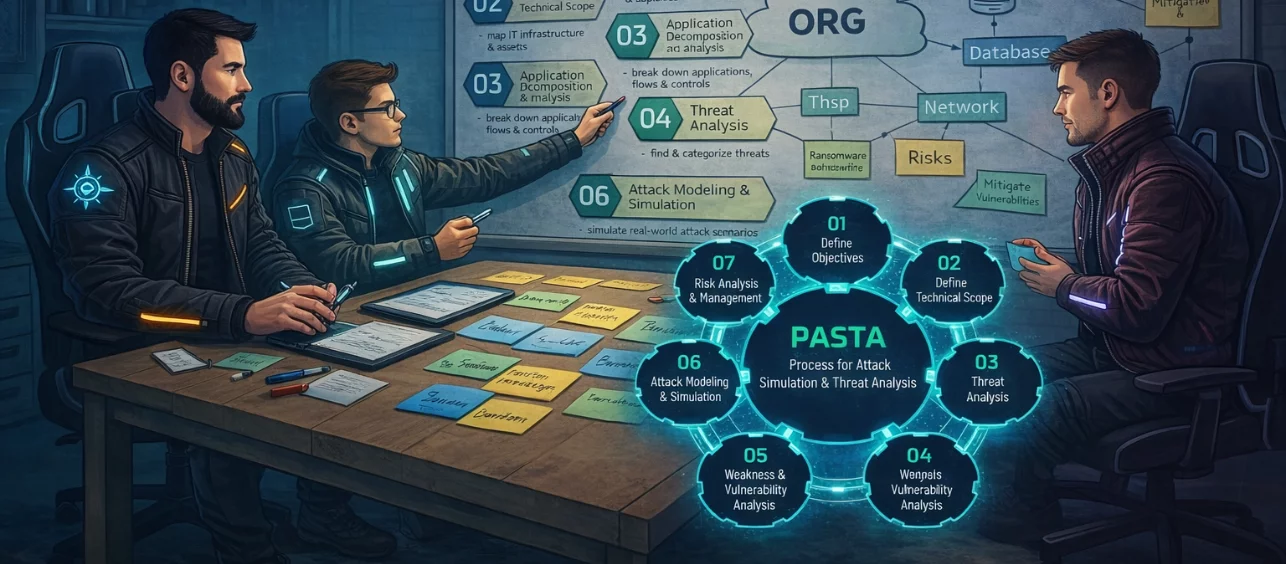
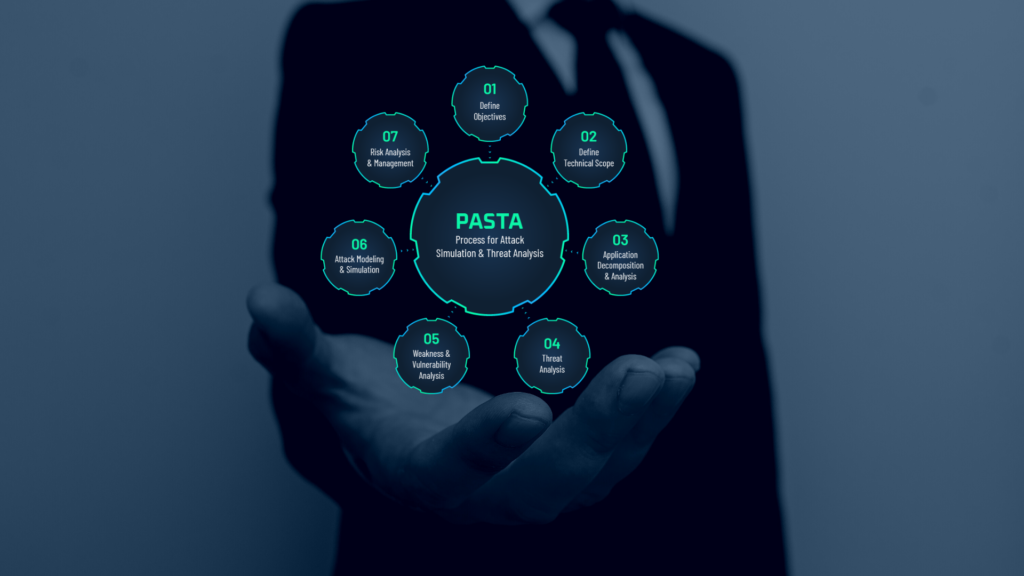
VerSprite applies PASTA (Process for Attack Simulation and Threat Analysis) — the risk-centric methodology co-created by VerSprite CEO Tony UcedaVélez and Marco M. Morana — across its seven stages:
- Define Objectives — establish business and security objectives and the organization’s risk profile.
- Define Technical Scope — map the technology, infrastructure, and attack surface in scope.
- Application Decomposition — identify assets, data flows, trust boundaries, and dependencies across the environment.
- Threat Analysis — develop threat assertions from environmental data and relevant threat intelligence.
- Vulnerability & Weakness Analysis — identify weaknesses and correlate them to the threat assertions.
- Attack Modeling — emulate attacks via attack patterns and attack trees to confirm viability.
Simulating Realistic Attack Patterns
VerSprite doesn’t ignore the physical dimensions of intrusion. We took traditional red teaming and layered the PASTA threat modeling framework on top to deliver evidence-based attack simulations. By offering both red teaming exercises and organizational threat modeling, we help organizations understand their resilience from every angle.
Examination of Threat Motives
Every organizational threat model begins with an examination of threat motives. We identify high-impact targets and correlate them to scenarios such as extortion, IP theft, sabotage, data exfiltration, and persistence for malware propagation. A custom threat library is built per client and mapped to that organization’s business-impact scenarios.
Once the model is established, our team launches attack patterns reflecting modern adversaries — organized syndicates, corporate mercenaries, opportunistic attackers, and insiders — each simulation centered on one or more high-impact threat scenarios.
Because the approach is risk-centric, the resulting model shows exactly where a security program is weakest, producing an effective security-program roadmap that illustrates the consequences of leaving identified gaps unremediated. The deliverables communicate clearly to senior leadership, because threat context, threat viability, and the effectiveness of existing mitigations are all reflected in the model.
- /
- /
- /
- /
- /
- /
- /
- /
- /
- /
- /
- /
- /
- /
- /
- /
- /
- /
- /
- /
- /
- /
Industries We Serve
VerSprite delivers organizational threat modeling across industries where security failures translate directly into financial loss, safety risk, or regulatory exposure:
Financial Services & FinTech
Model enterprise-wide fraud operations, insider threats, and third-party compromise across subsidiaries, vendors, and cloud providers.
Healthcare & Life Sciences
Model ransomware, data extortion, and supply chain attacks across providers, insurers, partners, and managed services.
SaaS & Technology Providers
Model insider risk, tenant compromise, and cloud misconfiguration, and assess third-party and open-source dependencies.
Retail & E-Commerce
Model fraud campaigns, supply chain compromise, and large-scale breach scenarios across payment and logistics ecosystems.
Manufacturing & Critical Infrastructure
Model targeted attacks from criminal groups and nation-state actors across IT/OT, vendors, and remote access providers.
- /
- /
- /
- /
- /
- /
- /
- /
- /
- /
- /
- /
- /
- /
- /
- /
- /
- /
- /
- /
- /
- /
Benefits of Organizational Threat Modeling
When implemented effectively, organizational threat modeling delivers a proactive security posture (addressing threats before they manifest), resource optimization (investing where risk reduction is greatest), improved data-driven decision-making aligned to business priorities, support for regulatory compliance and due diligence, fewer security incidents through systematic remediation, and stronger response readiness for threats that can’t be fully mitigated.
- /
- /
- /
- /
- /
- /
- /
- /
- /
- /
- /
- /
- /
- /
- /
- /
- /
- /
- /
- /
- /
- /
Threat Modeling with Reliable Data: OWASP Switzerland by Tony UV, CEO and Founder of VerSprite
Frequently Asked Questions
- /
- /
- /
- /
- /
- /
- /
- /
- /
- /
- /
- /
- /
- /
- /
- /
- /
- /
- /
- /
- /
- /
VerSprite Resources



We’re Not a Vendor
We’re Your Security Partner
- Risk-centric security
- True extension of your team
- Executive-level experience
