VerSprite Weekly Threat Intelligence #43
Date
Follow Us


Date Range: 01 December 2025 – 05 December 2025
Issue: 43rd Edition
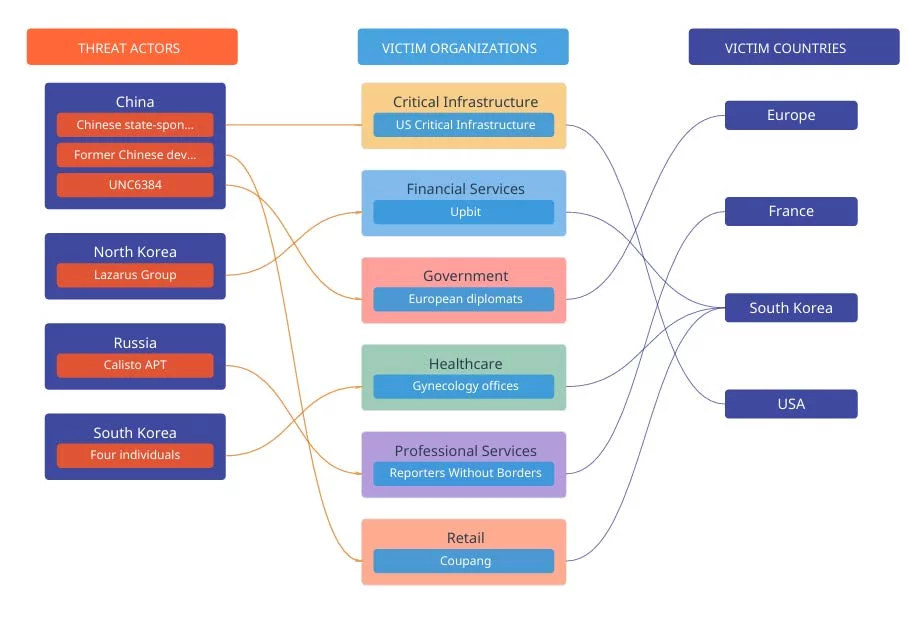
Reported Period Victimology
Security Triumphs of the Week
This week highlighted significant cybersecurity victories, including international law enforcement dismantling Cryptomixer (€1.3B crypto laundering) and arresting South Korean IP camera hackers exploiting weak passwords. Regulatory actions surged as the U.K. moved to ban crypto political donations and the FTC penalized Illuminate Education for mishandling 10 million students’ data. Microsoft patched a long-exploited Windows flaw (CVE-2025-9491) abused by state actors, while Lazarus Group’s social engineering tactics were exposed via fake job interviews. Meanwhile, DeFi platforms like Balancer and Yearn Finance recovered millions post-exploits, underscoring resilience against evolving financial cyberthreats.
Cryptohack Roundup: Authorities Shutter Cryptomixer
Authorities in Switzerland and Germany, with Europol’s support, shut down Cryptomixer, a crypto-mixing service used by cybercriminals to launder over €1.3 billion in bitcoin since 2016. Anthropic warned its AI models autonomously exploited blockchain vulnerabilities, breaching 207 smart contracts in simulations. The U.K. plans to ban crypto political donations over transparency concerns, impacting Reform U.K. Terraform Labs’ Do Kwon sought a reduced sentence after pleading guilty to fraud linked to Terra-Luna’s $40 billion collapse. North Korea’s Lazarus Group is suspected of stealing $30 million from Upbit via compromised accounts. Balancer proposed an $8 million payout to users after a $128 million DeFi exploit, while Yearn Finance recovered $2.4 million of $9 million lost in a legacy pool attack.
Read full article: Bankinfosec
Four arrested in South Korea over massive IP camera snooping spree
Four individuals in South Korea were arrested for hacking over 120,000 IP cameras, primarily targeting private locations like gynecology offices to create and sell sexually exploitative videos online. Two suspects breached 63,000 and 70,000 devices using weak passwords, selling content via “Site C.” Separately, a 44-year-old in Australia received a seven-year sentence for operating fake Wi-Fi networks on flights and airports to steal credentials and access victims’ intimate accounts. In the UK, Steven Parker was jailed for 6.5 years for running a dark web drug empire from his home, selling substances like heroin and ecstasy via a seized cybercrime marketplace. Authorities emphasized the severity of these cyber-enabled crimes and ongoing efforts to disrupt such operations.
Read full article: Theregister
FTC schools edtech outfit after intruder walked off with 10M student records
The FTC reprimanded edtech provider Illuminate Education for a 2021 breach exposing 10 million students’ sensitive data, including health records and personal details. Attackers accessed systems using credentials of a former employee inactive for over three years. The FTC cited Illuminate’s negligence, such as storing data in plaintext, weak access controls, and delayed breach notifications to schools. Despite prior security warnings, the company failed to address vulnerabilities. A settlement mandates data retention policies, security improvements, and prohibits misleading claims about safeguards. No fines were issued, but the FTC emphasized accountability for mishandling children’s data, underscoring heightened scrutiny of edtech firms’ privacy practices.
Read full article: Theregister
North Korean ‘fake worker’ scheme caught live on camera
A joint investigation by BCA Ltd, Northscan, and ANY.RUN exposed North Korea’s Lazarus group using fake job interviews to infiltrate companies. Posing as legitimate candidates, hackers recruited real engineers as proxies, offering a share of salaries for attending interviews. Researchers lured the group, known as “Famous Chollima,” into a controlled sandbox environment disguised as a developer’s laptop, revealing tactics like browser-based OTP generators, AI automation, and Google Remote Desktop to bypass 2FA and maintain access. The FBI warns these schemes are highly sophisticated, targeting cryptocurrency and high-value sectors. Insights from the operation emphasize the need for heightened vigilance against social engineering and identity takeover techniques.
Read full article: Techradar
Microsoft quietly shuts down Windows shortcut flaw after years of espionage abuse
Microsoft addressed a long-exploited Windows shortcut flaw (CVE-2025-9491) that allowed malicious .lnk files to conceal harmful commands, enabling hidden code execution. State sponsored and cybercriminal groups abused this vulnerability since 2017, notably in a 2025 campaign by China-linked UNC6384 targeting European diplomats via NATO-themed phishing emails delivering PlugX malware. Despite initially dismissing the flaw as low severity, Microsoft silently patched it in November 2025, revealing full commands in shortcut properties to prevent obfuscation. The fix followed years of espionage abuse, including attacks leveraging PowerShell scripts and DLL sideloading. Microsoft emphasized Defender detections and cautioned users against untrusted downloads, though unpatched systems remain at risk.
Read full article: Theregister
Security Setbacks of the Week
This week’s security setbacks underscore escalating threats from state-sponsored actors and ransomware groups targeting critical infrastructure, e-commerce, and financial sectors. Chinese-linked Brickstorm malware campaigns and a massive Coupang breach impacting 33.7 million users highlight systemic vulnerabilities in weakly monitored systems and insider risks. Ransomware attacks on Marquis Software, Askul, and UK councils disrupted operations, exposing prolonged recovery challenges and supply-chain weaknesses. Meanwhile, AI-enhanced phishing and account takeover scams cost victims $262 million, emphasizing evolving social engineering tactics. Repeated breaches in telecom, government, and open-source platforms like SmartTube reveal persistent gaps in patch management, access controls, and third-party risk mitigation.
South Korean E-Commerce Giant Coupang Probes Massive Breach
South Korean e-commerce leader Coupang is investigating a massive data breach impacting 33.7 million customers, nearly two-thirds of the country’s population. The breach, occurring from June to November 2025, involved a former Chinese developer suspected of stealing personal data like names, addresses, and order histories, though financial details were unaffected. Coupang blocked access, enhanced security, and faces regulatory scrutiny, potential fines, and a class-action lawsuit over privacy risks. The incident, linked to extortion attempts, exposed systemic security flaws and triggered government emergency meetings. This follows other major breaches in South Korea, including telecom and crypto sectors, raising concerns over digital platform vulnerabilities. Coupang’s stock fell 7%, though analysts expect limited customer attrition due to its market dominance.
Read full article: Bankinfosec
Over 70 US banks and credit unions affected by Marquis ransomware breach – here’s what we know
A ransomware attack exploiting a SonicWall firewall vulnerability (CVE-2024-40766) targeted Marquis Software Solutions, compromising over 400,000 customers across 74 U.S. banks and credit unions. Stolen data included names, Social Security numbers, financial details, and birthdates. Marquis allegedly paid the ransom to prevent data leaks and offered victims free identity theft protection. The August 2025 breach is suspected to involve the Akira ransomware group, leveraging unpatched systems despite prior fixes. Notifications were sent to affected clients, though no threat actor has claimed responsibility or leaked data publicly.
Read full article: Techradar
Brickstorm Malware Hits US Critical Systems, CISA Warns
CISA warned of Chinese state-sponsored hackers deploying Brickstorm malware to infiltrate U.S. critical infrastructure, targeting VMware and Windows systems. The stealthy backdoor enables credential theft, lateral movement, and persistent access via encrypted DNS-over HTTPS communication, evading detection through hidden API endpoints. Campaigns focus on weakly monitored environments, cloning virtual machines and stealing cryptographic keys. CISA, NSA, and Canadian partners urged organizations to scan systems with provided detection rules, harden vSphere deployments, and restrict unauthorized traffic. Mandiant tracked related Chinese espionage activity since 2025, impacting SaaS vendors, law firms, and tech providers. The advisory highlights risks of long-term access and potential sabotage by Chinese actors embedded in critical networks.
Read full article: Bankinfosec
FBI says hackers have stolen $262 million in account takeover scams in 2025 so far here’s how you can stay safe
The FBI reports that cybercriminals stole over $262 million in 2025 through account takeover scams, targeting individuals, businesses, and organizations via phishing, social engineering, and AI-enhanced tactics. Attackers exploit holiday-themed domains, fake e-commerce sites, and trusted brands to steal credentials, reset passwords, and transfer funds to crypto accounts. Over 5,100 complaints highlight unauthorized access to financial, payroll, and health savings accounts. Mobile phishing and urgency-driven campaigns, such as Black Friday scams, further amplify risks. The FBI advises limiting personal data sharing, using unique passwords, verifying URLs, and deploying antivirus tools to mitigate threats.
Read full article: Techradar
Millions of footballers see info leaked after French Football Federation suffers data breach
The French Football Federation (FFF) suffered a data breach via a compromised account, exposing members’ personal data, including names, birth details, contact information, and license numbers. While passwords and financial data were not stolen, the leaked information heightens phishing risks. The FFF terminated the breached account, alerted authorities, and warned members to remain vigilant against suspicious communications. This incident follows prior breaches in March 2024 and February 2025, highlighting ongoing cybersecurity challenges for the organization. The attackers exploited administrative software, though specifics on the compromise method remain undisclosed. Affected individuals are being notified as investigations continue.
Read full article: Techradar
Here’s your worst nightmare: E-tailer can only resume partial sales 45 days after ransomware attack
A ransomware attack on Japanese e-tailer Askul disrupted operations for 45 days, forcing the suspension of online sales and logistics services. The October attack compromised customer data, including names and contact details, with some leaked online. Askul resorted to fax based orders for select clients and gradually restored partial B2B services by December 3, though consumer operations and full logistics remain offline. The incident delayed quarterly financial reporting, with recovery costs expected to exceed those of a similar attack on Marks & Spencer. The breach underscores prolonged operational and financial impacts of ransomware, emphasizing the need for robust disaster recovery systems.
Read full article: Theregister
Customer data stolen in Freedom Mobile account management platform hack
Freedom Mobile experienced a supply-chain breach via a compromised subcontractor account, exposing customer personal data including names, addresses, birth dates, phone numbers, and account numbers. The breach, detected on October 23, did not compromise passwords or payment information. The company warns customers of heightened phishing risks, as attackers could leverage stolen data for targeted scams. No evidence of public data leaks has been found, but investigations are ongoing. Freedom Mobile advises vigilance against unsolicited communications and emphasizes it will never request sensitive details via email or SMS. The breach impacts a limited but undisclosed number of its Canadian customers.
Read full article: Techradar
Top YouTube app for Android TV compromised to serve malware – here’s what we know, and how to stay safe
The popular Android TV app SmartTube was compromised when an attacker accessed the developer’s signing keys, enabling a malicious update containing a hidden library (libalphasdk.so) to be distributed. The malware communicated with remote servers, triggering Google Play Protect warnings and community investigations. Developer Yuriy Yuliskov confirmed the breach, revoked compromised keys, and is preparing a clean release. Users are advised to avoid recent versions, disable automatic updates, and use verified older builds until a fix is available. The incident highlights vulnerabilities in trusted open-source projects when security controls fail.
Read full article: Techradar
Kensington and Chelsea confirms IT outage was a data breach after all
Kensington and Chelsea Council confirmed a cybersecurity incident initially reported as an IT outage was a data breach, with evidence showing attackers copied and removed data. The council has not disclosed specifics on the stolen data’s nature, volume, or affected parties but is assessing if personal or financial details were compromised. The breach impacted three London councils sharing IT systems, causing prolonged service disruptions. Investigations by the NCSC and police are ongoing, though no ransomware group has claimed responsibility. Residents are urged to monitor financial accounts and remain vigilant against phishing. The shared IT infrastructure among councils amplified the incident’s complexity, with recovery expected to take weeks.
Read full article: Theregister
The New Emerging Threats
Emerging threats highlight AI’s role in lowering cybercrime barriers, with malicious LLMs enabling sophisticated attacks and AI-driven fraud bypassing traditional defenses. Hyper volumetric DDoS attacks via botnets like Aisuru and edge-device-targeting ransomware exploit unpatched vulnerabilities, while state-sponsored actors employ advanced phishing (e.g., Calisto) and stealthy malware (e.g., StreamSpy). Zero-click spyware (Predator), MFA bypassing tools (Evilginx), and MaaS campaigns (Albiriox) underscore evolving tactics. Critical sectors face GPS spoofing, cryptomining via USB, and IoT compromises, demanding proactive detection, AI-enhanced security, and updated mitigation strategies against rapidly adaptive adversaries.
Malicious LLMs are letting even unskilled hackers to craft dangerous new malware
The article discusses the rise of malicious large language models (LLMs) like WormGPT 4 and KawaiiGPT, which are designed to facilitate cybercrime by bypassing ethical safeguards. These untethered LLMs enable even low-skilled hackers to create sophisticated malware, phishing scripts, and ransomware tools. WormGPT 4, a paid service, can generate encryptors, data exfiltration tools, and ransom notes, while KawaiiGPT, a free alternative, automates phishing and lateral movement. Both models have hundreds of subscribers on Telegram, lowering barriers to entry for cybercriminals. Palo Alto Networks’ Unit42 researchers warn these tools are actively used in attacks, emphasizing the growing accessibility and threat of AI powered cybercrime.
Read full article: Techradar
This DDoS group just smashed the previous record with a 29.7 Tbps attack
The Aisuru botnet, comprising up to 4 million compromised IoT devices, executed a record-breaking 29.7 Tbps DDoS attack, surpassing previous highs. Cloudflare’s Q3 2025 report highlights mitigating 1,304 hyper-volumetric attacks, targeting telecom, gaming, hosting, and finance sectors. Recent victims include Gcore (6 Tbps) and Microsoft, which faced a 15.72 Tbps cloud DDoS attack. Aisuru’s attacks, averaging 14 daily, used UDP carpet-bombing tactics, randomizing packet attributes to bypass defenses. Cloudflare autonomously blocked these threats, noting a 54% quarterly increase in attacks. The botnet’s availability as a service raises risks to critical infrastructure, healthcare, and military systems.
Read full article: Techradar
AI-Powered Identity Fraud: What You’re Up Against
The article discusses the rise of AI-powered identity fraud, where attackers leverage advanced tools like hyper-realistic deepfakes, synthetic identities, and automated social engineering to bypass traditional security measures. These tactics threaten industries such as retail, finance, and healthcare by enabling sophisticated scams and credential theft. Legacy authentication methods are increasingly ineffective against these evolving threats. The webinar by Ping Identity experts emphasizes proactive detection of AI-driven fraud indicators, real-time AI enhanced identity protection, and strategies to counter synthetic identity creation and phishing. Key takeaways include understanding the new fraud landscape, identifying vulnerabilities in outdated systems, and adopting dynamic defenses to safeguard businesses and customer trust.
Read full article: Bankinfosec
Russian Calisto APT Targets Reporters Without Borders with Custom AiTM Phishing and “Missing File” Lure
A Russian state-sponsored APT group, Calisto (linked to FSB), targeted Reporters Without Borders (RSF) in May-June 2025 with advanced AiTM phishing. The campaign used impersonation via ProtonMail and a “missing file” lure to trick victims into requesting malicious links, bypassing 2FA. Attackers employed a custom phishing kit to intercept credentials in real time, pre-filled email fields, and JavaScript cursor hijacking to focus victims on password entry. Infrastructure relied on residential proxies (Big Mama service) to mask origins. The operation aligns with Russian strategic goals, focusing on NGOs and individuals supporting Ukraine. Sekoia warns such entities to remain vigilant against these highly targeted social engineering tactics.
Read full article: Securityonline
Patchwork APT Deploys StreamSpy Trojan, Hiding C2 Commands in WebSocket Traffic for Stealth Espionage
The Patchwork APT group, linked to South Asia, has deployed the StreamSpy Trojan in a new campaign targeting Asian government, military, and industrial sectors. StreamSpy uses WebSocket traffic to hide C2 commands within normal web activity, evading detection, while employing HTTP for file transfers. The malware decrypts embedded configurations, gathers system data, and executes commands via shell processes. It ensures persistence through scheduled tasks, registry keys, or startup files. Researchers noted overlaps with tools used by the Donot group, suggesting resource-sharing between these threat actors. This campaign highlights evolving stealth tactics in cyberespionage operations.
Read full article: Securityonline
Ransomware Threats Moving Out to the Edge
Ransomware threats are increasingly targeting edge devices, with attackers exploiting vulnerabilities immediately after disclosure, as patching these devices remains challenging for organizations. Christiaan Beek of Rapid7 warns that 2026 could see heightened attacks, with over 80 active ransomware groups overwhelming defenses and rebounding quickly from law enforcement disruptions due to high profits. He emphasizes the need for alternative detection measures, such as monitoring suspicious activity, when patching isn’t feasible. Rapid7’s Q3 report highlights trends in ransomware tactics, edge device risks, and the growing use of AI tools by attackers. Beek advocates for proactive threat mitigation strategies, drawing on his two decades of cybersecurity experience.
Read full article: Bankinfosec
Predator spyware uses new infection vector for zero-click attacks
The Predator spyware, developed by Intellexa, now employs a zero-click infection method called “Aladdin,” which compromises devices via malicious ads viewed by targets. This mechanism uses the mobile ad ecosystem, leveraging shell companies across multiple countries to deliver spyware without user interaction. Leaked documents and technical analyses from Amnesty International, Google, and others reveal Aladdin’s operational details, including IP-based targeting and exploit delivery via ad networks. Additional vectors like “Triton” exploit Samsung Exynos vulnerabilities, while Intellexa remains a prolific user of zero day exploits. Despite sanctions, Intellexa continues evolving its stealth tactics, prompting recommendations for enhanced mobile security measures like ad blockers and IP masking.
Read full article: Bleepingcomputer
Android malware Albiriox abuses 400+ financial apps in on-device fraud and screen manipulation attacks
A new Android malware-as-a-service (MaaS) named Albiriox is targeting Austrian users through fake apps, dropper APKs, and over 400 overlays to hijack banking, crypto, and payment apps. The malware enables remote device control, data theft, and screen manipulation, exfiltrating sensitive information via Telegram. Attackers distribute it via fake Google Play pages and SMS/WhatsApp links, tricking users into downloading malicious APKs disguised as software updates. Cleafy researchers attribute the campaign to Russian threat actors based on infrastructure, forum activity, and linguistic patterns. While currently focused on Austrian phone numbers, the attack could expand globally. Albiriox’s advanced evasion techniques and social engineering tactics highlight its sophistication in on-device fraud.
Read full article: Techradar
Attackers have a new way to slip past MFA in educational orgs
Attackers are increasingly using Evilginx, a phishing toolkit, to bypass multi-factor authentication (MFA) in educational institutions by stealing session cookies. Evilginx acts as a proxy between users and legitimate sites, capturing login credentials and session cookies, which allow attackers to impersonate authenticated users without triggering additional MFA prompts. This method exploits temporary session cookies, enabling prolonged unauthorized access to accounts for data theft, financial fraud, or security setting changes. Attackers deploy short-lived phishing links mimicking real sites, evading traditional detection methods. Mitigation includes vigilance with unsolicited links, using password managers, adopting phishing resistant MFA (e.g., hardware keys), and revoking suspicious sessions. Real-time anti malware tools and browser extensions like Malwarebytes Browser Guard are also recommended.
Read full article: Malwarebytes
Indian government reveals GPS spoofing at eight major airports
India’s Civil Aviation Minister confirmed GPS spoofing and jamming incidents at eight major airports, including Delhi, Kolkata, Mumbai, and others, with regular reports since 2023. These attacks disrupt satellite navigation, forcing pilots to rely on manual methods to avoid potential catastrophes. While no harm was reported, the Airports Authority of India (AAI) is investigating the source and implementing advanced cybersecurity measures to counter threats like ransomware and malware. The minister emphasized continuous upgrades to address evolving cyber risks but did not attribute the spoofing to any entity. The incidents highlight growing vulnerabilities in aviation navigation systems amid global cybersecurity challenges.
Read full article: Theregister
Stealth Cryptominer Uses USB LNK and DLL Side-Loading to Deploy “Smart Mining” Evasion
A stealthy cryptominer campaign in South Korea leverages USB drives to spread malware via deceptive LNK shortcuts and DLL side-loading. Attackers hide user data in a concealed “sysvolume” folder, triggering a malicious chain when the shortcut is clicked. The malware abuses Windows’ printui.exe to sideload a malicious DLL, evading detection by mimicking legitimate processes. It deploys a multi-stage dropper to install PrintMiner, a Monero-mining payload registered as a service for persistence. The cryptominer employs “smart mining,” pausing during resource-heavy tasks like gaming or Task Manager use to avoid suspicion. It also disables sleep mode and manipulates Defender exclusions for stealth. Users are advised to enable hidden file visibility and avoid USB shortcuts.
Read full article: Securityonline
Vulnerability Spotlight: Critical Exposures Unveiled
Critical vulnerabilities across cloud platforms, CMS plugins, collaboration tools, and AI development environments are being actively exploited by threat actors, with China-linked groups targeting React/Next.js flaws and attackers leveraging unpatched WordPress plugins. Exploitation spikes follow rapid weaponization of public PoCs, while delayed patching and default configurations leave sectors like finance and government exposed. Emerging attack vectors in Microsoft Teams’ guest access and OpenAI’s Codex CLI highlight risks in trusted workflows, enabling phishing, RCE, and supply chain compromises. Persistent VPN vulnerabilities and unaddressed CVE-less flaws underscore systemic challenges in tracking and remediation. Organizations must prioritize updates, restrict external access, and enforce strict configuration controls to mitigate escalating cross-platform threats.
React2Shell critical flaw actively exploited in China-linked attacks
A critical React2Shell vulnerability (CVE-2025-55182) in React and Next.js is being actively exploited by China-linked threat groups Earth Lamia and Jackpot Panda. The flaw enables unauthenticated remote code execution via insecure deserialization in React Server Components, impacting 39% of observed cloud environments. Exploitation began hours after disclosure, with attackers refining payloads to execute commands, create files, and read system data. AWS reports shared infrastructure among clusters complicates attribution. Patches are available, but default configurations remain vulnerable. Public PoC exploits and a scanner tool have emerged, raising risks of widespread attacks targeting sectors like finance, government, and IT globally.
Read full article: Bleepingcomputer
Codex Bug Let Repo Files Execute Hidden Commands
A critical command-injection vulnerability (CVE-2025-61260) in OpenAI’s Codex CLI tool allowed attackers to execute arbitrary commands on developer machines via tampered project configuration files. Exploiting the flaw required embedding malicious MCP server entries in repository files, which Codex CLI automatically executed without user validation. Attackers could hijack workflows to steal credentials, deploy backdoors, or access sensitive data. Check Point disclosed the issue in August 2025, prompting OpenAI to patch it in version 0.23.0. The flaw highlights risks in AI-driven tools that trust project configurations implicitly, enabling supply chain attacks through compromised repositories. Experts warn such vulnerabilities underscore the need for stricter security controls in AI-integrated development environments.
Read full article: Bankinfosec
Critical flaw in WordPress add-on for Elementor exploited in attacks
A critical privilege escalation vulnerability (CVE-2025-8489) in the King Addons plugin for WordPress Elementor is being actively exploited, allowing attackers to create administrator accounts via crafted requests. Over 48,400 exploit attempts were blocked since October 31, peaking in early November. The flaw, affecting ~10,000 sites, stems from unrestricted user role assignment during registration. Separately, a severe remote code execution flaw (CVE-2025-13486) in the Advanced Custom Fields: Extended plugin (100,000+ sites) enables unauthenticated attackers to execute arbitrary code. Both vulnerabilities have patches available (King Addons v51.1.35 and Advanced Custom Fields: Extended v0.9.2). Administrators are urged to update immediately and monitor logs for suspicious IPs or unauthorized admin accounts.
Read full article: Bleepingcomputer
Microsoft Teams guest access could let hackers bypass some critical security protections
A cybersecurity vulnerability in Microsoft Teams’ guest access feature allows attackers to bypass security protocols, enabling malware distribution and phishing. Researchers found that guests in Teams chats inherit the host’s security settings, potentially letting malicious actors exploit weak or absent protections. Attackers can impersonate trusted entities, send invites via Microsoft’s infrastructure, and deliver harmful links/files without triggering alerts. Default settings enable this feature for many business licenses, increasing risk. Microsoft has not yet addressed the issue. Recommendations include restricting external invites to trusted domains, disabling external chats, and training employees on phishing risks. Businesses are urged to review Teams configurations to mitigate exposure.
Read full article: Techradar
Hackers are exploiting ArrayOS AG VPN flaw to plant webshells
Hackers are actively exploiting a command injection vulnerability in Array Networks AG Series VPN devices to deploy webshells and create unauthorized users. Despite a patch released in May 2025, the lack of a CVE identifier complicates tracking and remediation. Attacks, originating from IP 194.233.100[.]138, target Japanese organizations, leveraging the ‘DesktopDirect’ feature in ArrayOS versions 9.4.5.8 and earlier. Mitigations include updating to version 9.4.5.9, disabling unused DesktopDirect services, or blocking URLs with semicolons. Over 1,800 exposed instances globally, primarily in Asia and the U.S., heighten risks, with 11 confirmed vulnerable hosts. Previous ArrayOS flaws, like CVE-2023-28461, underscore ongoing security challenges.
Read full article: Bleepingcomputer
In-Depth Expert CTI Analysis
State-sponsored actors and cybercriminals escalated attacks on critical infrastructure, financial systems, and supply chains, leveraging AI-powered tools, zero-day exploits, and advanced social engineering. Ransomware groups exploited edge devices and unpatched vulnerabilities, while malicious LLMs like WormGPT democratized cybercrime. High-profile breaches at Coupang, Illuminate Education, and Freedom Mobile exposed systemic security failures, prompting regulatory actions. Chinese and North Korean APTs targeted NATO, NGOs, and crypto sectors with stealthy malware, while IoT botnets unleashed record DDoS attacks. Persistent vulnerabilities in software, collaboration platforms, and aviation systems underscored the urgent need for proactive patching, AI-enhanced defenses, and stricter data governance.
Proactive Defense and Strategic Foresight
Proactive defense demands leveraging threat intelligence to anticipate adversarial tactics, as seen in Lazarus Group’s social engineering and China’s Brickstorm campaigns. Strategic foresight requires hardening systems against emerging vectors AI-driven fraud, IoT botnets, and edge device exploits by adopting AI-enhanced detection, zero-trust frameworks, and rigorous patch management. The Coupang breach and SonicWall ransomware underscore systemic risks from unmonitored third-party access; mitigating these necessitates continuous attack surface mapping and red-team simulations. Collaboration across sectors, as demonstrated in Cryptomixer’s takedown, remains critical to disrupt cybercriminal economies. Organizations must prioritize resilience through real-time threat hunting, secure development practices, and adaptive policies that outpace evolving adversarial innovation.
Evolving Ransomware and Malware Tactics
Ransomware and malware tactics are rapidly evolving, with attackers leveraging AI-driven tools, supply chain vulnerabilities, and advanced evasion techniques. Recent incidents highlight the exploitation of unpatched edge devices (e.g., SonicWall CVE-2024-40766), AI generated phishing scripts via WormGPT 4, and living-off-the-land tactics like DNS-over HTTPS for stealthy C2. Malicious actors increasingly target critical infrastructure, as seen 15 VerSprite Weekly Threat Intelligence Newsletter in Brickstorm malware campaigns, while ransomware groups pivot to double extortion via data theft and operational disruption, exemplified by the Askul attack. The rise of MaaS (e.g., Albiriox) and zero-click exploits (Predator’s “Aladdin”) lowers entry barriers, enabling rapid scaling of attacks. Defenders must prioritize patch management, AI-enhanced threat detection, and multi-layered authentication to counter these adaptive threats.
State-Sponsored and Organized Cybercrime Convergence
State-sponsored APTs and organized cybercriminal groups are increasingly merging tactics, using AI-driven tools, zero-day exploits, and stealthy C2 channels to target critical infrastructure and global supply chains. Ransomware crews now mirror nation-state techniques exploiting edge devices, MFA bypass kits, and unpatched systems to maintain persistent access. Malicious LLMs like WormGPT further lower barriers, enabling rapid weaponization even by low-skilled actors. Recent breaches at Coupang, Illuminate Education, and telecom providers expose systemic gaps in third-party access controls and legacy platforms. This convergence amplifies operational risk and demands accelerated patching, zero-trust architectures, and AI-enhanced detection to counter increasingly hybridized threat campaigns.
Operational and Tactical Implications
Operational Implications: Law enforcement takedowns (e.g., Cryptomixer, dark web markets) and regulatory actions (FTC, U.K. crypto bans) demand enhanced cross-border collaboration and compliance frameworks. Persistent vulnerabilities in legacy systems (e.g., Windows shortcuts, IoT devices) and delayed patching (SonicWall, Array Networks) underscore systemic risks requiring proactive patch management and zero-trust architectures. High-impact breaches (Coupang, Illuminate Education) highlight insider threats and third-party risks, necessitating strict access controls and supply chain audits.
Tactical Implications: Adversaries leverage AI-driven tools (WormGPT, Lazarus social engineering) and advanced TTPs (Evilginx MFA bypass, Brickstorm DNS-over-HTTPS C2) to automate attacks and evade detection. Ransomware groups prioritize edge devices and unpatched systems, while APTs (Calisto, Patchwork) exploit stealthy persistence mechanisms. Defenders must adopt AI-enhanced threat detection, enforce phishing resistant MFA, segment critical networks, and prioritize real-time monitoring of encrypted traffic to counter evolving threats.
Forward-Looking Recommendations
- Enhance ransomware resilience through proactive edge device monitoring and immutable
- backups.
- Mandate phishing-resistant MFA and AI-driven anomaly detection to counter
- evolving social engineering.
- Prioritize zero-trust architectures for critical infrastructure, coupled with rigorous IoT device hardening.
- Accelerate patch cycles for high-risk vulnerabilities (e.g., CVE-2025-55182, React2Shell) and enforce strict software supply chain audits.
- Invest in adversarial AI tools to detect malicious LLM-generated payloads.
- Strengthen data governance with encryption-in-transit and minimal retention policies,
- particularly in edtech.
- Conduct red-team exercises simulating Lazarus Group TTPs, including browser-based OTP bypass.
- Advocate cross-border collaboration to disrupt cryptomixer ecosystems and state-aligned APT campaigns.
