VerSprite Weekly Threat Intelligence #39
Date
Follow Us


Date Range 03 November 2025 – 07 November 2025
Issue: 39th Edition
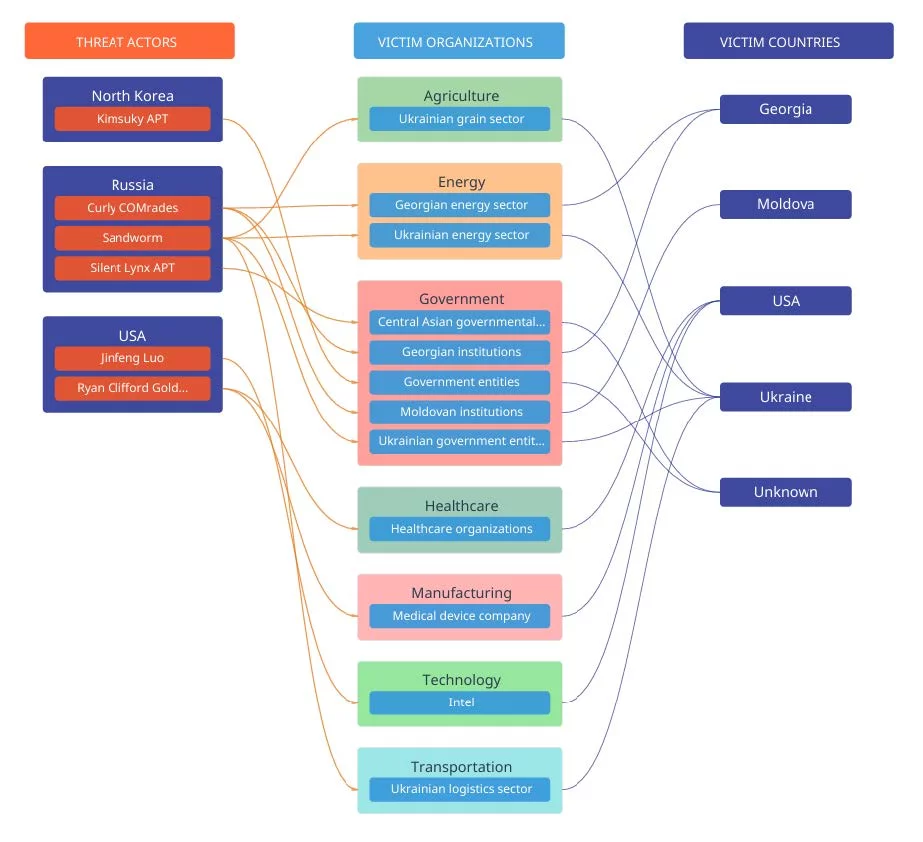
Reported Period Victimology
Security Triumphs of the Week
This week saw significant global cybersecurity victories, including Europol dismantling a €600M cryptocurrency fraud network and a multinational operation disrupting a €300M credit card fraud scheme. U.S. authorities indicted former cybersecurity professionals for deploying BlackCat ransomware and extradited a Conti ransomware affiliate, underscoring insider threat risks. Australia’s AN0M app collaboration with the FBI led to 55 arrests, while Russia arrested Meduza infostealer developers, signaling shifting cybercrime governance. These cases highlight intensified cross-border cooperation and evolving strategies to combat financial fraud, ransomware, and organized cybercrime.
Cryptohack Roundup: Europol Busts 600M Euro Fraud Network
Europol dismantled a 600-million-euro cryptocurrency fraud network, arresting nine individuals across Europe for operating fake investment platforms that used social media ads and fake endorsements to steal funds, seizing significant assets. Sam Bankman-Fried appealed his 2023 fraud conviction, arguing excluded legal advice evidence impacted his trial. PHP vulnerabilities (CVE-2022-47945, CVE-2012-1823) were exploited in coordinated cryptomining campaigns, leveraging cloud infrastructure for automated attacks. U.S. prosecutors sought five-year sentences for Samourai Wallet founders, who admitted to facilitating $237 million in illicit transactions through their crypto-mixing service, with sentencing scheduled for late 2025.
Read full article: Bankinfosec
Authorities Dismantle Large-Scale Credit Card Fraud Scheme Affecting 4.3 Million Users
Authorities from nine countries dismantled a major credit card fraud network, Operation Chargeback, led by German prosecutors. The scheme defrauded 4.3 million users via fake online subscriptions (pornography, dating, streaming) with low monthly charges to evade detection. Criminals exploited German payment providers, using shell companies in the UK and Cyprus to process transactions and reduce chargeback risks. Over 18 arrests, 60 searches, and €35 million in asset seizures occurred, with damages exceeding €300 million. The operation highlighted cross-border cooperation, involving Europol and Eurojust, to disrupt the network’s infrastructure. It underscores the role of international collaboration in combating large-scale cybercrime.
Read full article: Gbhackers
2 Ex-Cyber Specialists Indicted for Alleged BlackCat Attacks
The U.S. Department of Justice indicted two former cybersecurity professionals, Ryan Clifford Goldberg and Kevin Tyler Martin, for allegedly deploying BlackCat ransomware against five U.S. companies, including three healthcare organizations. The attacks, occurring between May and November 2023, targeted a medical device firm, a pharmaceutical company, a medical practice, an engineering firm, and a drone manufacturer, getting a $1.3 million ransom from one victim. Goldberg and Martin, previously employed at cybersecurity firms Sygnia and DigitalMint, exploited their insider expertise to breach networks, encrypt data, and extort payments. A third unnamed co-conspirator, also linked to DigitalMint, remains at large. Both defendants face up to 50 years in prison if convicted. Their former employers denied involvement, stating the actions occurred outside company oversight. The case highlights risks of insider threats in cybersecurity roles.
Read full article: Bankinfosec
Conti Ransomware Operator Extradited to the United States
A Ukrainian national involved in the Conti ransomware group, Oleksii Lytvynenko, was extradited from Ireland to the U.S. to face charges for his role in global attacks from 2020 to 2022. The Conti campaign targeted over 1,000 victims, including critical infrastructure, extorting $150 million in ransoms. Lytvynenko allegedly controlled stolen data, crafted ransom notes, and remained active until his 2023 arrest. He faces up to 25 years for computer and wire fraud conspiracies. This case is part of a broader U.S. effort to dismantle Conti, with four others indicted in 2023. Authorities emphasize global pursuit of ransomware operators and urge organizations to report incidents promptly.
Read full article: Gbhackers
AN0M, the backdoored ‘secure’ messaging app for criminals, is still producing arrests after four years
Australian authorities, collaborating with the FBI, continue to make arrests using evidence from the backdoored AN0M messaging app, designed to infiltrate criminal networks. Launched after the takedown of Phantom Secure in 2018, AN0M’s hidden backdoor allowed law enforcement to monitor encrypted criminal communications. Recent raids in South Australia resulted in 55 arrests and $17 million in seized assets, linked to ongoing “Operation Ironside.” AN0M’s legality was upheld in 2022 by Australia’s High Court, ruling it a closed system exempt from telecom interception laws. Despite discontinuing AN0M due to overwhelming evidence volume, Australian police advocate for “accountable encryption” to enable lawful access to encrypted platforms. The operation underscores sustained global efforts to combat organized crime via compromised communication tools.
Read full article: Theregister
Russia finally bites the cybercrooks it raised, arresting suspected Meduza infostealer devs
Russia’s Interior Ministry arrested three suspected developers of the Meduza infostealer malware, seizing devices and evidence in Moscow. Meduza, active since 2023, steals authentication data, browser info, cryptocurrency wallets, and system data. The arrests reflect Russia’s evolving approach to cybercrime, shifting from tolerating attacks on foreign targets to actively managing cybercriminal groups. Analysts note a “reciprocal arrangement” where criminals avoid prosecution by aiding state interests, though enforcement varies based on political and strategic value. Recent crackdowns, including Operation Endgame, highlight harsher penalties for financial crimes versus leniency for ransomware groups like REvil. This signals Russia’s selective governance of cybercrime to balance international pressure and domestic control.
Read full article: Theregister
Security Setbacks of the Week
Russian state-backed actors intensified disruptive cyber campaigns against Ukraine and Western allies, targeting critical infrastructure, government data, and economic sectors, while hacktivists exploited industrial control systems in Canada and the UK. High-impact breaches at the U.S. CBO, SonicWall, Hyundai, and Sweden’s Miljödata exposed systemic vulnerabilities in cloud, automotive, and public sector security, with ransomware (e.g., Akira, Scattered Spider) causing economic harm, including Jaguar Land Rover’s $2.5 billion loss affecting UK GDP. DeFi protocols like Balancer faced sophisticated exploits leveraging mathematical flaws, underscoring risks in under-tested systems. Geopolitical tensions and criminal collaboration amplified attacks on energy, water, and finance, demanding urgent infrastructure hardening and threat modeling to mitigate cascading national and economic risks.
Swedish IT Company Data Breach Exposes Personal Details of 1.5 Million Users
A significant data breach at Swedish IT company Miljödata exposed personal details of 1.5 million users, prompting an investigation by Sweden’s Data Protection Authority (IMY) under GDPR regulations. The August attack leaked sensitive data on the Darknet, impacting municipalities and regional entities using Miljödata’s services. IMY is auditing Miljödata for technical security flaws and assessing data management practices at Gothenburg City, Älmhult Municipality, and Region Västmanland. High-risk data categories, including identity details, former employee records, and children’s information, are under scrutiny due to inadequate protections. The breach highlights systemic vulnerabilities in Sweden’s digital infrastructure, urging organizations to bolster security frameworks and incident response protocols. IMY’s actions signal stricter enforcement of data protection standards to prevent future incidents.
Read full article: Gbhackers
Canadian government claims hacktivists are attacking water and energy facilities
The Canadian government reported hacktivist attacks targeting Industrial Control Systems (ICS) in critical sectors, including water, oil, and agriculture. Incidents involved tampering with water pressure valves, manipulating oil facility sensors, and altering grain silo conditions, risking service disruptions and safety hazards. Vulnerabilities stem from unclear roles, poor asset protection, and exposed internet-connected ICS. Pro-Russian hacktivists exploit these weaknesses to disrupt infrastructure, attract media attention, and damage Canada’s reputation. Authorities recommend securing ICS through VPNs, two-factor authentication, threat detection systems, and improved collaboration to address security gaps. Regular penetration testing and vulnerability management are also advised to mitigate risks.
Read full article: Techradar
SonicWall blames state hackers for the damaging data breach
SonicWall confirmed a September 2025 breach by state-sponsored hackers who accessed cloud backups via an API, initially downplaying the incident before revealing global customer impact. The attackers targeted MySonicWall, compromising firewall configuration files containing credentials, VPN settings, and network rules. While products, firmware, and source code remained unaffected, stolen data could enable targeted attacks by exploiting network insights. Mandiant assisted in remediation, though the threat actor remains unnamed. The breach, unrelated to recent Akira ransomware incidents, underscores risks to cloud infrastructure. SonicWall urged password resets and infrastructure hardening post-investigation.
Read full article: Techradar
Russia’s Destructive Wiper Attacks on Ukraine Rise Again
Russian state-backed hackers, notably the Sandworm group (APT44), have intensified destructive wiper attacks against Ukraine in 2025, targeting government, energy, logistics, and grain sectors to weaken the economy. These attacks, using malware like “Sting” and “ZeroLot,” leverage Active Directory policies and coordinated operations with cyberespionage teams like UAC-0099. Collaboration among Russian APT groups, including Gamaredon (FSBlinked) and Turla, has increased, with shared tactics like phishing, zero-day exploits (e.g., WinRAR), and malware loaders. Despite a prior shift to espionage, Russia has resumed disruptive cyber campaigns, aligning with military objectives. Concurrently, hacktivist proxies amplify psychological operations, though their impact remains minimal. Ukraine continues to face persistent, evolving cyber threats from Russian state actors.
Read full article: Bankinfosec
U.S. Congressional Budget Office Hit by Cyberattack, Sensitive Data Compromised
The U.S. Congressional Budget Office (CBO) suffered a cyberattack by suspected foreign actors, compromising sensitive financial research and economic data critical to legislative decision-making. The breach, confirmed by the CBO, exposed budget projections, cost analyses, and economic models used to shape fiscal policies and evaluate proposed laws. While the full scope remains unclear, the incident risks giving adversaries insights into U.S. fiscal strategies. Federal cybersecurity teams are investigating the attack’s origin and impact, though details on the perpetrators remain undisclosed. This breach underscores persistent vulnerabilities in government infrastructure amid rising state-sponsored cyber threats, prompting calls for enhanced security measures and funding to safeguard critical data.
Read full article: Gbhackers
Nation-State, Cyber and Hacktivist Threats Pummel Europe
Nation-state actors, cybercriminals, and hacktivists are intensifying attacks on European organizations, driven by geopolitical tensions and financial motives. Russia’s invasion of Ukraine and collaborations with North Korea have fueled disruptive operations like DDoS attacks and data leaks, while China remains a dominant threat, targeting sectors like aerospace and energy for intelligence. Iranian-aligned groups focus on stealthy cyberespionage against European entities tied to sanctions. Ransomware persists, with European firms comprising over 20% of victims on leak sites, exemplified by Scattered Spider’s $2.5 billion attack on Jaguar Land Rover. Adversaries increasingly exploit identity and cloud vulnerabilities, shifting tactics as endpoint defenses improve. Law enforcement disrupts forums like Exploit and Telegram, but new platforms emerge, sustaining the cybercrime ecosystem.
Read full article: Bankinfosec
Experts warn the UK’s basic infrastructure is at risk after hackers target drinking water suppliers
The article reports that UK drinking water suppliers faced five cyberattacks since January 2024, revealed via Freedom of Information requests. While safe water supply remained unaffected, the attacks disrupted critical infrastructure, signaling heightened risks amid geopolitical instability. Both financially motivated ransomware groups (e.g., Southern Water attack demanding £3m) and hacktivists are targeting sectors like water, energy, and agriculture, posing potential life-threatening disruptions. Experts warn that even less sophisticated attacks test infrastructure vulnerabilities, urging preparedness against simultaneous large-scale threats. The incidents underscore the urgent need to prioritize cybersecurity for critical services to prevent public harm and systemic collapse.
Read full article: Techradar
Bank of England says JLR’s cyberattack contributed to the UK’s unexpectedly slower GDP growth
The Bank of England attributed the UK’s slower-than-expected Q3 GDP growth (0.2% vs. 0.3% forecast) partly to a cyberattack on Jaguar Land Rover (JLR), marking the first instance of a cyber incident causing material national economic harm. The attack, classified as a Category 3 systemic event, halted JLR’s production for a month, disrupted supply chains, and required government financial support, with losses exceeding £2 billion. Concurrently, major UK retailers like M&S faced costly cyberattacks, with M&S reporting £136 million in cleanup costs. The NCSC reported a surge in nationally significant cyberattacks (204 in 2023 vs. 89 in 2022), urging businesses to prioritize defenses amid escalating threats to national resilience and economic stability.
Read full article: Theregister
Hyundai AutoEver Confirms Data Breach Exposing Personal Data, Including SSNs and License Info
Hyundai AutoEver America confirmed a data breach exposing sensitive customer information, including names, Social Security numbers, and driver’s license details. The breach occurred between February 22 and March 2, 2025, with attackers accessing systems for nine days. The company terminated unauthorized access, engaged cybersecurity experts, and implemented enhanced security measures. Affected individuals are offered two years of complimentary credit monitoring and identity protection via Epiq Privacy Solutions. Customers are advised to monitor accounts, report suspicious activity, and consider credit freezes or fraud alerts. Hyundai AutoEver emphasized ongoing efforts to secure systems and prevent future incidents.
Read full article: Gbhackers
Checkpoint Analysis: Dissecting the $128M Balancer Pool Drain in Under 30 Minutes
In early November 2025, attackers exploited a critical arithmetic vulnerability in Balancer V2’s ComposableStablePool contracts, draining $128.64 million across six blockchains in under 30 minutes. The flaw stemmed from precision errors in the upscale Array function, where repeated micro-swaps near minimum token values (8–9 wei) compounded rounding inaccuracies, distorting pool pricing logic. Attackers automated 65 batched swaps via a contract, manipulating BPT prices downward, then arbitrage undervalued tokens for profit. Stolen assets were first accumulated internally via Balancer’s Vault before external withdrawal. The incident underscores DeFi’s vulnerability to adversarial exploitation of mathematical edge cases, emphasizing the need for security models that anticipate automated, scaled attacks beyond routine testing.
Read full article: Gbhackers
Akira Ransomware Strikes Apache OpenOffice, Allegedly Exfiltrates 23GB of Data
The Akira ransomware group claimed a cyberattack on Apache OpenOffice on October 29, 2025, allegedly exfiltrating 23GB of sensitive data, including employee personal information, financial records, and internal documents. The group threatened to leak the data unless a ransom is paid, targeting a non-profit organization critical to millions globally. The Apache Software Foundation has not yet confirmed the breach, leaving the claims unverified. Akira, active since 2023, employs double-extortion tactics, compromising systems across multiple regions. The incident underscores vulnerabilities in volunteer-driven open-source projects, urging enhanced security measures. Users are advised to monitor systems and secure backups while awaiting official updates.
Read full article: Gbhackers
The New Emerging Threats
Emerging threats showcase escalating sophistication through AI-driven malware (PROMPTFLUX), collaborative cybercriminal alliances (SLH), and MaaS models (Fantasy Hub), enabling adaptive attacks across mobile, cloud, and supply chains. Iranian and Russian actors exploit geopolitical tensions via social engineering, while Silent Lynx and FIN7 refine stealth via GitHub payloads and SSH backdoors. Critical AD vulnerabilities and npm repository compromises highlight systemic risks in overlooked infrastructure. Ransomware cartels (DragonForce) and botnets (RondoDox) weaponize legacy flaws and BYOVD tactics, underscoring the need for proactive patching, behavioral monitoring, and AI-integrated defenses to counter evolving hybrid threats.
DragonForce Cartel Surfaces from Leaked Conti v3 Ransomware Source Code
The DragonForce ransomware group has rebranded as a cartel, leveraging leaked Conti v3 and LockBit 3.0 code to enhance its encryptors. It employs vulnerable drivers (truesight.sys, rentdrv2.sys) in BYOVD attacks to disable security tools and improved encryption to address flaws exposed in Akira ransomware. Offering affiliates 80% profits and customizable tools, DragonForce attracts partners like Scattered Spider, targeting global enterprises such as Marks & Spencer. Over 200 victims across sectors have been listed since 2023, with ties to groups like LAPSUS$ and ShinyHunters. The cartel model strengthens its influence, enabling infrastructure control and rival defacements.
Read full article: Gbhackers
Silent Lynx APT New Attack Targeting Governmental Employees Posing as Officials
Silent Lynx APT, a threat group linked to aliases like YoroTrooper, continues targeting Central Asian governmental and diplomatic entities through spear-phishing campaigns, notably Operation Peek-A-Baku. The group impersonates officials, deploying malicious RAR archives with decoy documents (e.g., Russia-Azerbaijan strategic cooperation files) containing PowerShell-based LNK shortcuts. These download scripts from GitHub repositories, establishing reverse shells to command-and-control servers. Recent tactics include shifting payload hosting to GitHub to evade detection, leveraging tools like Ligolo-ng for tunneling, and reusing infrastructure in Russia/Netherlands. Focused on geopolitical intelligence (e.g., bilateral summits, infrastructure projects), Silent Lynx shows adaptability to security research, maintaining persistence via scheduled tasks and incremental malware updates. Future campaigns may target India-Central Asia diplomatic engagements.
Read full article: Gbhackers
New Android Malware ‘Fantasy Hub’ Spies on Users’ Calls, Contacts, and Messages
A new Android Remote Access Trojan (RAT) dubbed “Fantasy Hub” is being distributed via Telegram-based Malware-as-a-Service (MaaS) by Russian threat actors, targeting financial institutions and users globally. The spyware, sold via subscription tiers, enables attackers to steal SMS, contacts, call logs, media, and credentials through phishing overlays mimicking banking apps like Alfa-Bank and Sber. It employs advanced evasion tactics, including encrypted payloads decrypted at runtime, WebRTC-based real-time audio/video streaming, and abuse of default SMS handler permissions to bypass security checks. The MaaS model offers customization via a Telegram bot, lowering entry barriers for attackers with automated tools and tutorials. Fantasy Hub’s C2 panel provides device monitoring, subscription management, and data exfiltration, emphasizing risks to BYOD environments and mobile security. Researchers warn that this threat highlights the growing sophistication and accessibility of mobile-focused cybercrime ecosystems.
Read full article: Gbhackers
Russian hackers hit Windows machines via Linux VMs with new custom malware
Russian hackers known as Curly COMrades targeted Georgian and Moldovan institutions by deploying custom malware via Alpine Linux virtual machines (VMs) on Windows systems. The group used Hyper-V virtualization to conceal malicious activity, routing VM traffic through the host’s IP to bypass EDR detection and mask communications. Malware tools like CurlyShell and CurlCat enabled reverse-shell access, remote authentication, and command execution. Campaigns, active since July 2025, align with Russian geopolitical interests, focusing on government, judicial, and energy sectors. Bitdefender linked the operations to Russian strategic goals but found no direct ties to known APT groups. The tactics highlight evolving methods to exploit cross-platform environments for stealthy attacks.
Read full article: Techradar
Attackers Exploit Active Directory Sites to Escalate Privileges and Compromise the Domain
Security researchers identified a critical vulnerability in Active Directory (AD) Sites, enabling attackers to exploit misconfigured access control lists (ACLs) for privilege escalation and domain compromise. Attackers manipulate AD Sites’ cross-domain relationships and Group Policy Objects (GPOs) to bypass security controls like SID filtering, facilitating stealthy lateral movement across domains. This risk is amplified as organizations often overlook site configurations as security priorities. Updated BloodHound tools now help detect these attack paths by mapping risky site permissions. Organizations are urged to audit AD Site ACLs, prioritize geographically dispersed environments, and integrate site-based threats into threat models. The findings underscore the need to treat physical network components as critical security assets.
Read full article: Gbhackers
Three Infamous Hacker Groups Join Forces as the ‘Scattered LAPSUS$ Hunters
Three notorious hacker groups Scattered Spider, ShinyHunters, and LAPSUS$ merged in August 2025 to form Scattered LAPSUS$ Hunters (SLH), a sophisticated cybercriminal collective. The alliance combines reputational influence with structured operations, targeting high-value enterprises like Salesforce via AI-driven phishing, cloud exploits, and zero-day vulnerabilities. SLH leverages Telegram for coordinated attacks, psychological intimidation, and marketing breaches, while adopting an Extortion-as-a-Service model to recruit affiliates. Core members, including “shinycorp” and “yuka,” demonstrate advanced technical capabilities, such as exploit development linked to tools like BlackLotus. The group’s resilience against platform takedowns and strategic consolidation signals a shift toward hybrid criminal models blending technical prowess with narrative control, likely inspiring future cybercrime alliances.
Read full article: Gbhackers
FIN7 Hackers Leverage Windows SSH Backdoor for Stealthy Remote Access and Persistence
The FIN7 cybercrime group continues using a Windows SSH backdoor infrastructure with minimal changes since 2022, deploying an install.bat script and modified OpenSSH tools to establish stealthy reverse SSH/SFTP connections. This enables persistent remote access, encrypted data exfiltration, and evasion of traditional detection methods by blending malicious activity into legitimate SSH traffic. The group’s reliance on proven techniques, including outbound reverse tunnels bypassing firewalls, highlights operational efficiency and confidence in their low-forensic-footprint approach. FIN7 targets sectors like retail and finance, leveraging encrypted SFTP transfers to mask data theft. Defenders should monitor SSH authentication anomalies, restrict SSH access, and deploy behavioral analysis to detect reverse tunneling.
Read full article: Gbhackers
Iranian Hackers Exploit RMM Tools to Target Academics and Foreign-Policy Experts
A previously unknown Iranian threat actor, UNK_SmudgedSerpent, targeted academics and foreign-policy experts from June to August 2025 using phishing, social engineering, and remote monitoring tools. The group impersonated high-profile figures like Brookings Institution’s Suzanne Maloney via spoofed emails, luring targets with discussions on Iranian political issues before redirecting them to credential-harvesting pages. Attackers adapted tactics when suspicions arose, deploying legitimate RMM tools like PDQConnect and ISL Online to maintain access. Campaigns overlapped with tactics of established Iranian groups (TA453, TA455, TA450), complicating attribution. The operation focused on gathering intelligence on foreign perspectives regarding Iran’s military and geopolitical activities, reflecting state-aligned priorities. Proofpoint highlights Iran’s evolving cyber sophistication and persistent targeting of policy experts.
Read full article: Gbhackers
Over 15 Malicious npm Packages Exploiting Windows to Deploy Vidar Malware
Datadog researchers identified a coordinated npm supply chain attack involving 17 malicious packages delivering Vidar malware via postinstall scripts. These packages, posing as legitimate SDKs and libraries, were downloaded over 2,240 times before removal. The attack chain involved downloading encrypted payloads from external domains, decrypting them, and executing Vidar, a Go-based infostealer targeting credentials, wallets, and system data. The malware dynamically retrieved active command-and-control servers via hardcoded Telegram/ Steam profiles, enabling infrastructure rotation. Threat actors used newly created npm accounts to publish weaponized packages, exploiting the ecosystem’s trust. The campaign highlights ongoing risks in open-source repositories and underscores the need for proactive supply chain defenses.
Read full article: Gbhackers
Google Warns of PROMPTFLUX Malware That Uses Gemini API for Self-Rewriting Attacks
Google researchers identified PROMPTFLUX, a novel malware using Google’s Gemini API to dynamically rewrite its own code during attacks, evading detection. Written in VBScript, it employs a “Thinking Robot” module to query Gemini for obfuscation techniques, ensuring persistence via system Startup folders. This marks the first confirmed case of malware leveraging LLMs for real-time self-modification, signaling a shift toward autonomous, AI-driven threats. While experimental, PROMPTFLUX highlights advanced AI integration in cyberattacks, alongside other AI-powered tools like ransomware and credential stealers. Statelinked actors are increasingly exploiting AI for reconnaissance, deepfakes, and social engineering, underscoring the urgent need for evolved defensive strategies against adaptive, AI-enhanced threats.
Read full article: Gbhackers
RondoDox Botnet Swells Its Arsenal 650% Jump in Enterprise-Focused Exploits
The RondoDox botnet has evolved into a major enterprise threat, expanding its exploits by 650% to target vulnerabilities across IoT devices, enterprise systems, and critical infrastructure. Discovered on October 30, 2025, the v2 variant employs 75 exploitation vectors, including recent CVEs (e.g., TOTOLINK CVE-2025-1829) and decade-old flaws like ShellShock (CVE-2014-6271). It uses advanced evasion tactics, multi-architecture compatibility, and anti-analysis techniques, while disabling security tools like SELinux. The botnet’s C&C infrastructure now spans multiple IPs, complicating takedowns. It mimics legitimate traffic (e.g., OpenVPN, gaming) for DDoS attacks and targets enterprise applications like WebLogic and QNAP systems. Organizations must prioritize patching and restrict C&C communications.
Read full article: Gbhackers
Vulnerability Spotlight: Critical Exposures Unveiled
Critical vulnerabilities across network infrastructure, enterprise software, and open-source tools were actively exploited by ransomware groups and state-sponsored actors, enabling ransomware deployment, data exfiltration, and espionage. Clop targeted Oracle ERP systems, Chinese APTs leveraged zero-days in Windows and Lanscope for diplomatic espionage, while Cisco, UniFi, and WordPress plugins faced RCE attacks. CISA mandated patching for Linux kernel and VMware flaws tied to Chinese campaigns, emphasizing systemic risks from unpatched systems. Exploits increasingly combined credential theft, phishing, and supply chain weaknesses, with AI platforms like ChatGPT exposing novel data leakage vectors. Immediate updates and network segmentation remain critical defenses against these coordinated, cross-sector threats.
NVIDIA NVApp for Windows Vulnerability Let Attackers Execute Malicious Code
A critical vulnerability (CVE-2025-23358) in NVIDIA App for Windows allowed local attackers to execute arbitrary code and escalate privileges via a search path flaw in the installer (CWE-427). With a CVSS score of 8.2, the high-severity flaw required user interaction but enabled full system control if exploited. Versions prior to 11.0.5.260 were vulnerable, posing risks in multi-user environments. NVIDIA patched the issue in version 11.0.5.260, urging immediate updates to mitigate exploitation risks. The incident highlights the importance of timely third-party software updates, particularly for installer components with elevated privileges. Organizations should prioritize deploying the patch across affected systems.
Read full article: Cybernews
APT ‘Bronze Butler’ Exploits Zero-Day to Root Japan Orgs
The Chinese APT group Bronze Butler exploited a critical zero-day vulnerability (CVE-2025-61932) in Japan’s widely used Lanscope endpoint management tool, compromising organizations since mid-2025. The flaw allowed unauthenticated attackers to execute arbitrary code with system-level privileges, enabling extensive network control. Bronze Butler deployed backdoors like Gokcpdoor and Havoc, leveraging tools like 7-Zip and LimeWire for data exfiltration. Motex, Lanscope’s developer, patched the vulnerability, which primarily affected on-premises servers. The campaign aligns with China’s history of targeting Japanese entities for espionage and intellectual property theft. JPCERT/CC and Sophos linked the activity to ongoing regional cyber threats driven by geopolitical tensions.
Read full article: Darkreading
Cisco Confirms Active Exploitation of Secure ASA and FTD RCE Vulnerability
Cisco confirmed active exploitation of a critical remote code execution (RCE) vulnerability (CVE-2025-20333) in its Secure Firewall ASA and FTD software. The buffer overflow flaw in the VPN web server allows authenticated attackers to execute arbitrary code with root privileges, risking full device compromise. A new attack variant discovered in early November 2025 causes unpatched systems to reload, leading to denial-of-service conditions. Exploitation requires valid VPN credentials, which attackers may obtain via phishing or credential theft. Cisco urges immediate patching, as no workarounds exist, and recommends using its Software Checker tool to identify vulnerable systems. Organizations should also review VPN threat-detection configurations post-patching to mitigate similar attacks.
Read full article: Gbhackers
Clop Ransomware Group Exploits New 0-Day Vulnerabilities in Active Attacks
The Clop ransomware group is actively exploiting a critical zero-day vulnerability (CVE-2025-61882) in Oracle E-Business Suite, enabling attacks on enterprise resource planning systems. Known for technical sophistication, Clop has extorted over $500 million from 1,025+ victims since 2019, avoiding CIS countries, likely due to Russian origins. Recent infrastructure analysis linked 41 IPs to their 2023 MOVEit campaign (CVE-2023-34362), with overlapping SSL certificates and subnet patterns indicating persistent, compartmentalized infrastructure. Geographic data shows diversified IPs (Germany, Brazil, Panama) to evade regional blocks, while U.S.-linked IPs dominate historical clusters. Clop’s reuse of infrastructure underscores operational continuity despite detection efforts.
Read full article: Gbhackers
Critical WordPress Post SMTP Plugin Vulnerability Puts 400,000 Sites at Risk of Account Takeover
A critical vulnerability (CVE-2025-11833, CVSS 9.8) in the Post SMTP WordPress plugin (versions ≤3.6.0) exposes over 400,000 sites to account takeover. Unauthenticated attackers can access email logs, including password reset links, enabling full administrative control. Over 4,500 exploitation attempts were recorded since November 1, 2025. The flaw stems from missing authorization checks in the email logging feature. A patch (version 3.6.1) was released on October 29, 2025. Immediate updates are critical, as attackers actively target unpatched systems. Wordfence provided firewall protections for paid users starting October 15, with free users receiving updates by November 14.
Read full article: Gbhackers
Critical UniFi OS Flaw Enables Remote Code Execution
A critical unauthenticated Remote Code Execution (RCE) vulnerability (CVE-2025-52665) was discovered in Ubiquiti’s UniFi OS, allowing attackers to take full control of devices without credentials. The flaw stemmed from a misconfigured backup API endpoint (port 9780) that improperly passed user-supplied input to shell commands, enabling command injection via malicious JSON payloads. Exploitation permits arbitrary code execution, data exfiltration (e.g., /etc/passwd), and reverse shell access. Attackers could also manipulate UniFi Access systems, compromising physical security controls like door systems. Additional unauthenticated API endpoints exposed NFC credential management, including private keys for Apple and Google authentication. The vulnerability underscores severe risks for organizations using UniFi infrastructure.
Read full article: Gbhackers
CISA Alerts on Linux Kernel Vulnerability Exploited in Ransomware Attacks
CISA flagged a critical Linux kernel vulnerability (CVE-2024-1086) as actively exploited in ransomware attacks. The use-after-free flaw in the netfilter component allows local privilege escalation, enabling attackers to gain root access, disable security tools, and deploy ransomware. Threat actors leverage this after initial access via phishing or credential theft. CISA urges immediate patching, emphasizing federal agencies’ mandated compliance under Binding Operational Directive 22-01. Organizations should prioritize updates, monitor for privilege escalation attempts, and apply network segmentation. The vulnerability’s inclusion in CISA’s Known Exploited Vulnerabilities catalog highlights its severe risk to global Linux systems.
Read full article: Gbhackers
Chinese hackers target European diplomats with Windows zero-day flaw
Chinese state-sponsored hackers, Mustang Panda (UNC6384), exploited a Windows zero-day vulnerability (CVE-2025-9491) to target European diplomats via phishing emails containing malicious .LNK files. The flaw in Windows Shell Link allowed execution of hidden commands, deploying PlugX RAT for persistent access, data exfiltration, and surveillance. Attacks focused on diplomats in Hungary, Belgium, Serbia, Italy, and the Netherlands, including Chinese allies like Hungary and Serbia. Campaigns leveraged themes like NATO defense workshops to trick victims. Researchers linked the activity to long-running Chinese espionage operations, with infrastructure and tooling overlaps tracing back to 2017. Arctic Wolf Labs attributed the attacks with high confidence to Mustang Panda, highlighting China’s continued cyber-espionage against strategic targets.
Read full article: Techradar
Millions of developers could be open to attack after a critical flaw was exploited – here’s what we know
A critical vulnerability (CVE-2025-11953, severity 9.8/10) in the React Native CLI npm package (@react-native-community/cli) allows unauthenticated attackers to execute arbitrary OS commands via the Metro Development Server. Affected versions (4.8.0–20.0.0-alpha.2) are patched in version 20.0.0. The flaw enables command injection through a vulnerable endpoint, with full control on Windows and limited parameter control on Linux/macOS. While no confirmed exploitation exists, users must update immediately or restrict Metro server network exposure. The package, with 2 million weekly downloads, highlights risks in third-party code dependencies. Security teams are urged to prioritize automated supply chain scanning to mitigate such threats.
Read full article: Techradar
Chinese state hackers may be using VMWare Tools flaw to hack US systems – so patch now, CISA warns
CISA mandated federal agencies to patch a high-severity VMware Tools vulnerability (CVE-2025-41244) by November 20 after adding it to the Known Exploited Vulnerabilities catalog. The flaw allows local privilege escalation via VMware Tools with SDMP enabled, enabling attackers to gain root access. Chinese state-sponsored group UNC5174 exploited this vulnerability since mid-2024 for espionage targeting US defense contractors, UK government agencies, and Asian institutions. UNC5174, linked to China’s Ministry of State Security, shares similarities with another group, Houken, which targeted French entities via Ivanti zero-days. Patches are available for Windows and Linux systems.
Read full article: Techradar
Multiple ChatGPT Security Bugs Allow Rampant Data Theft
Researchers uncovered seven vulnerabilities in OpenAI’s ChatGPT, enabling attackers to steal private user data via manipulated web interactions. Exploits include indirect prompt injection through poisoned websites, one-click malicious links, and abuse of ChatGPT’s trust in Bing domains. These flaws allow data exfiltration, phishing, and bypassing safety filters, impacting millions of users. Tenable highlighted risks for non-technical users, as zero-click attacks require no action beyond routine queries. Advanced threat actors could chain these vulnerabilities to launch large-scale campaigns. Despite reporting to OpenAI in April, some issues remain unresolved, emphasizing the critical need for enhanced LLM security in enterprise integrations.
Read full article: Darkreading
Critical Cisco UCCX flaw lets attackers run commands as root
A critical vulnerability (CVE-2025-20354) in Cisco Unified Contact Center Express (UCCX) allows unauthenticated attackers to execute arbitrary commands with root privileges via the Java RMI process. Cisco released patches to address this flaw, which stems from improper authentication mechanisms. A separate critical flaw in the UCCX CCX Editor enables authentication bypass, letting attackers execute admin-level scripts. Cisco also fixed a highseverity denial-of-service vulnerability (CVE-2025-20343) in its Identity Services Engine (ISE) and four other flaws in Contact Center products allowing privilege escalation or data access. No active exploitation or public exploit code has been observed. Admins are urged to apply updates immediately.
Read full article: Bleepingcomputer
In-Depth Expert CTI Analysis
Global law enforcement disrupted major cybercriminal operations, including cryptocurrency fraud networks and ransomware groups, through cross-border collaboration like Europol’s Operation Chargeback. State-sponsored actors, notably Russian and Chinese APTs, intensified attacks on critical infrastructure and diplomatic targets, exploiting vulnerabilities in software (PHP, Active Directory, npm) and cloud services. Insider threats emerged as former cybersecurity professionals leveraged expertise for ransomware attacks, while hacktivists targeted industrial control systems, risking physical disruptions. Critical vulnerabilities in widely used platforms (WordPress, React Native, UniFi) were weaponized, underscoring systemic supply chain risks. The evolving threat landscape demands enhanced international cooperation, proactive patching, and security frameworks to mitigate escalating cyber risks to economic stability and public safety.
Proactive Defense and Strategic Foresight
Proactive defense demands leveraging threat intelligence to preempt emerging attack vectors, as seen in coordinated cryptomining campaigns exploiting PHP vulnerabilities and npm supply chain attacks. Strategic foresight requires anticipating adversarial innovation, exemplified by AI-driven malware (PROMPTFLUX) and ransomware cartels merging tactics. International collaboration, like Operation Chargeback and AN0M’s legal intercepts, underscores collective resilience against cross-border threats. Critical infrastructure attacks (UK water, Canadian ICS) highlight urgent need for robust incident response and secureby-design principles. Organizations must prioritize patching, zero-trust frameworks, and continuous monitoring to counter state-aligned APTs, insider threats, and adaptive criminal alliances exploiting cloud, identity, and geopolitical chaos.
Evolving Ransomware and Malware Tactics
Ransomware and malware tactics are rapidly evolving, marked by increased collaboration between cybercriminals and state-aligned actors, leveraging insider expertise and AI-driven tools. Groups like BlackCat and Conti demonstrate sophisticated double-extortion strategies, while rebranded cartels (e.g., DragonForce) exploit leaked code to enhance encryption and BYOVD attacks. Malware-as-a-Service models, such as Fantasy Hub, lower entry barriers, enabling global financial theft via Telegram. APTs like Sandworm and In-Depth Expert CTI Analysis VerSprite Weekly Threat Intelligence Newsletter 21 Mustang Panda target critical infrastructure with wipers and zero-days, aligning cyberattacks with geopolitical objectives. Cloud vulnerabilities, supply chain compromises, and AI-powered self-modifying malware (e.g., PROMPTFLUX) underscore the need for proactive defense, international cooperation, and hardened infrastructure to counter these adaptive threats.
State-Sponsored and Organized Cybercrime Convergence
The convergence of state-sponsored and organized cybercrime is accelerating, evidenced by Russian APT44/Sandworm’s disruptive attacks on Ukrainian infrastructure, leveraging ransomware-like wipers (Sting, ZeroLot) alongside cyberespionage. State actors increasingly adopt criminal tactics, while groups like Conti and BlackCat blur lines through ransomware-for-hire models and insider expertise. Russia’s selective prosecution of cybercriminals (Meduza infostealer arrests) reflects a symbiotic relationship, tolerating attacks on foreign targets in exchange for intelligence or operational support. Chinese APTs (Mustang Panda) exploit zero-days for geopolitical espionage, mirroring financially motivated campaigns. Collaboration between nation-states and criminal collectives (Scattered LAPSUS$ Hunters) amplifies threats, merging technical sophistication with state-grade resources. This nexus demands enhanced cross-border intelligence sharing and adaptive defense frameworks to counter hybrid adversaries.
Operational and Tactical Implications
The surge in ransomware cartels, state-aligned APTs, and AI-driven malware underscores the need for proactive defense strategies. Organizations must prioritize patch management for high-risk vulnerabilities (e.g., PHP, Active Directory, UniFi), enforce strict access controls, and adopt behavioral analytics to counter insider threats. Cross-border collaboration remains critical to disrupt cybercrime networks, while securing cloud APIs and third-party dependencies mitigates supply chain risks. Critical infrastructure operators must harden ICS/OT systems against hacktivist and nation-state attacks. The rise of AI-enhanced threats and criminal alliances demands investment in adaptive detection frameworks, zero-trust architectures, and encrypted traffic analysis to counter evolving TTPs.
Forward-Looking Recommendations
- Prioritize proactive patching of high-risk vulnerabilities (e.g., PHP, Active Directory, IoT/ ICS) and enforce zero-trust principles to mitigate supply chain and insider threats.
- Strengthen international collaboration frameworks to disrupt cross-border cybercrime networks and ransomware cartels through shared intelligence and coordinated takedowns.
- Invest in AI-driven threat detection to counter adaptive malware leveraging generative AI and autonomous code modification.
- Mandate rigorous security audits for critical infrastructure (e.g., water, energy) and enforce redundancy protocols to prevent life-threatening disruptions.
- Expand lawful access mechanisms for encrypted platforms while balancing privacy, ensuring rapid response to criminal exploitation of secure communication tools.
- Accelerate adoption of post-quantum encryption standards to preempt future attacks on cryptographic systems amid rising state-sponsored threats.
- Implement adversarial simulation exercises for high-value targets (e.g., government, finance) to identify gaps in defense against APT tradecraft and novel TTPs.
