VerSprite Weekly Threat Intelligence #36

Date
Follow Us


Date Range: 13 October 2025 – 17 October 2025
Issue: 36th Edition
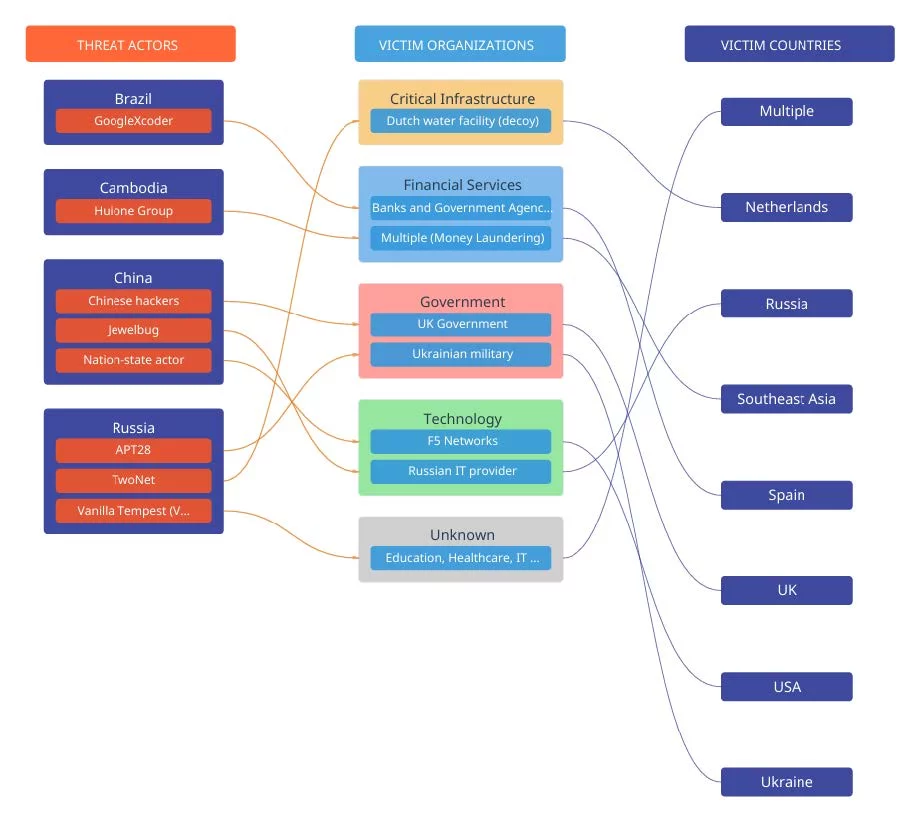
Reported Period Victimology
Security Triumphs of the Week
This week marked powerful victories in the global cyber defense arena. Microsoft struck a decisive blow against the Rhysida ransomware operation, revoking over 200 malicious certificates and shutting down fake Teams installers used to spread the Oyster backdoor. In Spain, law enforcement dismantled the AI-driven phishing empire of “GoogleXcoder,” ending a Crime-as-a-Service scheme that fueled widespread credential theft. Across the Pacific, the U.S. Treasury sanctioned Cambodia’s Huione Group for laundering billions through crypto scams linked to North Korean hackers. From corporate takedowns to criminal arrests, coordinated global action sent a clear message, cybercrime has nowhere to hide.
Microsoft disrupts ransomware attacks targeting Teams users
Microsoft disrupted Rhysida ransomware attacks in early October by revoking 200+ malicious certificates used to sign fake Teams installers. The threat actor Vanilla Tempest (aka Vice Society) employed malvertising and SEO poisoning to distribute malicious “MSTeamsSetup.exe” files via spoofed domains, deploying the Oyster backdoor. This granted remote access for data theft, command execution, and Rhysida ransomware deployment. The group leveraged Trusted Signing and code signing services to spread Oyster malware, previously linked to IT tool impersonation. Vanilla Tempest, active since 2021, targets education, healthcare, and IT sectors, using multiple ransomware strains like BlackCat and Zeppelin. Microsoft’s certificate revocation effectively halted this campaign.
Read full article: Bleepingcomputer
Spanish Authorities Dismantle Advanced AI Phishing Operation GoogleXcoder
Spanish authorities dismantled an AI-driven phishing network and arrested its developer, “GoogleXcoder,” who sold phishing kits via Telegram to criminals targeting banks and government agencies. Operating under a Crime-as-a-Service model since 2023, the kits cloned legitimate websites, enabling large-scale credential theft and financial losses. The mastermind, a 25-year-old Brazilian in Spain, used spoofed identities and cryptocurrency to evade detection. A cross-border operation involving Spanish police, Brazilian authorities, and cybersecurity experts led to his arrest in Cantabria, with devices and funds seized. Raids across Spain uncovered evidence linking six suspects, while Telegram channels were shut down. Further arrests are anticipated as investigations continue.
Read full article: Gbhackers
US Blacklists Huione Group for Money Laundering
The U.S. Treasury Department blacklisted Cambodia’s Huione Group, a key player in Southeast Asian cybercrime, for laundering over $4 billion (2021–2025), including $300 million in crypto scams. The group operated an illicit marketplace, money laundering services, and a crypto platform, facilitating transactions for North Korea’s Reconnaissance General Bureau, converting stolen crypto (e.g., $35 million from Lazarus Group) into fiat currency. Despite lacking direct U.S. ties, Huione accessed dollar systems via foreign accounts. Concurrently, the U.S. sanctioned a Cambodian conglomerate for “pig butchering” scams. Huione Pay, a subsidiary, denied links to the group but dissolved after regulatory scrutiny. The action aims to disrupt elite-driven Cambodian scam networks.
Read full article: Bankinfosec
Security Setbacks of the Week
This week delivered a surge of major cybersecurity setbacks across the globe. Allegations surfaced of Chinese hackers infiltrating classified UK government systems for over a decade, while F5 Networks confirmed a nation-state breach that exposed BIG-IP source code and vulnerability data. In India, Netcore Cloud leaked a staggering 40 billion unencrypted mail logs, and SonicWall faced fallout after stolen firewall backups fueled targeted VPN attacks. The healthcare sector took another hit as Medusa ransomware compromised 1.2 million SimonMed Imaging patient records. Meanwhile, cloud and Web3 firms Invoicely and Huddle01 suffered severe data exposures. Collectively, these incidents underscore how state actors, ransomware groups, and poor configurations continue to threaten global digital resilience.
Secret information and classified UK government servers potentially accessed by Chinese hackers for over a decade
Dominic Cummings, former chief adviser to Boris Johnson, alleged Chinese hackers infiltrated UK government systems for years, accessing highly classified “Strap” data and sensitive intelligence. The Cabinet Office and cybersecurity experts, including ex-NCSC head Ciaran Martin, denied any breach occurred, calling the claims “categorically untrue.” Cummings asserted he and Johnson were briefed about the compromise in 2020, sparking political debate. The Spectator reported an investigation into a potential breach linked to a Chinese owned data hub used by Whitehall. Skepticism persists, with officials emphasizing the security of bespoke systems. Cummings offered to testify if Parliament launches an inquiry, while experts reiterated China’s cyber threat but disputed specific penetration claims.
Read full article: Techradar
Hackers leak medical reports after huge breach impacts 1.2 million patient records
SimonMed Imaging suffered a ransomware attack by the Medusa group, compromising 1.2 million patient records, including medical reports, ID scans, and payment details. The attackers demanded $1 million to delete 212GB of stolen data and $10,000 daily extensions to avoid leaks. The breach occurred between January 21 and February 5, 2025, after a vendor alerted SimonMed to suspicious activity. The company responded by resetting passwords, enabling 2FA, and cutting third-party access. While SimonMed’s removal from Medusa’s leak site suggests a possible ransom payment, this remains unconfirmed. Affected individuals are offered free credit monitoring and identity theft protection via Experian.
Read full article: Techradar
Hackers Breach F5 and Stole BIG-IP Source Code and Undisclosed Vulnerability Data
A nation-state threat actor breached F5 Networks, stealing BIG-IP source code and confidential vulnerability data from its development environments starting in August 2025. While critical remote-code-execution flaws were not confirmed in the stolen data, some customer-specific configuration details were compromised. Third-party audits verified the integrity of F5’s software supply chain and unaffected platforms. F5 released urgent updates for multiple products and hardening guidance, including threat-hunting tools and SIEM integration steps. The company enhanced security controls, rotated credentials, and partnered with CrowdStrike for extended endpoint detection. Affected customers are being notified directly as F5 prioritizes transparency and ongoing vulnerability remediation.
Read full article: Gbhackers
Massive Exposure: 40 Billion Records (13 TB) of Unencrypted Mail Logs Leaked by Netcore Cloud
A massive data leak exposed 40 billion records (13.41 TB) of unencrypted mail logs from Netcore Cloud, a Mumbai-based marketing firm. Discovered by researcher Jeremiah Fowler, the unprotected database contained sensitive data like email addresses, IPs, SMTP details, partial bank account numbers, healthcare notifications, and confidential transaction records. The exposure risked phishing, spoofing, and social engineering attacks, compounded by 89 open network ports increasing potential attack vectors. While the database was secured post disclosure, the duration of exposure and third-party involvement remain unclear. No evidence of malicious access exists, but the breach highlights critical privacy and infrastructure vulnerabilities.
Read full article: Securityonline
Mysterious Elephant APT Breach: Hackers Infiltrate Organization to Steal Sensitive Data
The Mysterious Elephant APT group has targeted government and foreign policy agencies in the Asia-Pacific region since early 2025, using spear phishing with diplomatic-themed lures to deploy custom malware. Their toolkit includes BabShell (a reverse shell), MemLoader variants for stealthy payload execution, and modules like Uplo/Stom Exfiltrator to steal WhatsApp data, documents, and certificates. The group employs dynamic DNS and multiple VPS providers to evade detection, while leveraging obfuscation and in-memory attacks. Focused on Pakistan, Bangladesh, and neighboring nations, their campaigns exploit regional political contexts. Mitigation requires patch management, network monitoring for DNS anomalies, and enhanced phishing awareness. Collaboration among regional cybersecurity teams is critical to counter evolving TTPs.
Read full article: Gbhackers
SonicWall SSLVPN Targeted After Hackers Breach All Customer Firewall Backups
A widespread, coordinated attack campaign targeting SonicWall SSL-VPN devices has compromised over 100 accounts since early October, leveraging valid credentials rather than brute-force methods. Attacks originated from a single IP (202.155.8.73), suggesting centralized control, and included reconnaissance and post-exploitation activities like network scanning. The campaign coincides with SonicWall’s disclosure that unauthorized actors accessed encrypted firewall configuration backups via its MySonicWall platform, potentially enabling credential decryption. While SonicWall hasn’t confirmed a direct link, the timing raises concerns about exploitation of stolen backup data. Customers are urged to reset credentials, disable vulnerable services, enforce multi-factor authentication, and monitor for suspicious activity. Huntress continues tracking the campaign, emphasizing immediate remediation to prevent further breaches.
Read full article: Gbhackers
BlackSuit Ransomware Breaches Corporate Network Using Single Compromised VPN Credential
A manufacturing company was compromised by the BlackSuit ransomware gang (Ignoble Scorpius) after attackers stole VPN credentials via a voice phishing call. Using the credentials, they escalated privileges, executed a DCSync attack to harvest domain admin credentials, and deployed network scanning tools, AnyDesk, and a custom RAT. Over 400 GB of data was exfiltrated via a modified rclone utility before encrypting hundreds of VMs using Ansible, halting operations. Unit42 responders recommended firewall upgrades, network segmentation, MFA enforcement, and service account restrictions, enabling the company to reject the $20M ransom. The attack underscores the criticality of layered defenses, including robust authentication and proactive threat containment.
Read full article: Gbhackers
178,000+ Invoices Expose Customer Data from Invoicely Platform
A significant data breach at Invoicely, a cloud-based invoicing platform, exposed over 178,000 files containing sensitive customer data, including names, addresses, tax IDs, bank details, and medical records. The unsecured database, discovered by researcher Jeremiah Fowler, lacked encryption or password protection, making it publicly accessible. Affected data spanned invoices, scanned checks with routing/account numbers, health insurance documents, and ride-sharing receipts. Invoicely, operated by Vienna-based Stack Holdings GmbH, secured the database hours after disclosure but provided no official response. The incident raises concerns about invoice fraud and identity theft risks, exacerbated by unclear exposure duration and potential third-party involvement. This breach highlights critical vulnerabilities in cloud platforms handling financial and personal data globally.
Read full article: Gbhackers
Video call app Huddle01 exposed 600K+ user logs
The video conferencing app Huddle01 exposed over 621,000 user logs via an unprotected Kafka broker, leaking sensitive data like real names, email addresses, crypto wallet details, and call activity logs. The misconfigured server lacked authentication, enabling unauthorized access to real-time user data for at least 13 days. Despite responsible disclosure attempts by researchers, Huddle01 failed to secure the server for a month, risking user anonymity and enabling targeted phishing or social engineering attacks. Crypto users are particularly vulnerable, as wallet addresses could be linked to identifiable information. Affected users are advised to update passwords, enable 2FA, and monitor for suspicious communications. The exposure highlights critical security lapses in handling decentralized communication platforms.
Read full article: Malwarebytes
Salesforce Extortion Group Leaks Data After FBI Disruption
A cybercrime group, Scattered Lapsus$ Hunters, leaked data from six organizations, including Qantas and Vietnam Airlines, after the FBI disrupted their extortion sites. The group exploited Salesforce instances via social engineering and a breached GitHub repository, stealing customer data like emails, loyalty program details, and personal information. U.S. and French authorities seized their BreachForums platforms, but the group restored darknet versions. They declared their extortion campaign over, though leaked data accessibility remains unclear. Internal disputes arose over unfulfilled leaks for other victims, while the group shifted focus to targeting Australian firms and clashed with the Clop ransomware group. Law enforcement retains seized databases, complicating future operations.
Read full article: Bankinfosec
The New Emerging Threats
This week underscored the rise of stealthy, state-backed cyber campaigns. The ClickFix phishing kit automated fake browser checks to harvest Microsoft 365 credentials, while APT28 embedded steganographic payloads in weaponized Office files for covert espionage. The LinkPro eBPF rootkit burrowed into Linux systems, concealing malicious kernel-level activity. North Korea’s Famous Chollima deployed the BeaverTail–OtterCookie combo for keylogging and data theft, and Operation Silk Lure used résumé-themed lures to target Chinese FinTech firms with ValleyRAT. Meanwhile, the Qilin ransomware gang and PhantomVAI Loader expanded their global reach, highlighting a new era of automated, adaptive, and geopolitically driven cyber warfare.
Fresh Phishing Kit Innovation: Automated ClickFix Attacks
A new phishing kit called IUAM ClickFix Generator automates “ClickFix” attacks, which trick users into manually executing malicious code disguised as browser verification challenges. Targeting Microsoft 365 credentials, the kit adapts to victims’ operating systems, deploying Windows PowerShell scripts or macOS Terminal commands. These attacks, linked to DeerStealer and Odyssey malware, exploit compromised sites and phishing-as-a-service toolkits. Meanwhile, kits like Whisper 2FA use AJAX to stealthily steal multi-factor authentication (MFA) tokens via real-time loops, bypassing expired codes. Experts emphasize deploying phishing-resistant MFA (e.g., FIDO keys) over relying solely on user training, as attackers increasingly monetize these automated, evasive techniques.
Read full article: Bankinfosec
APT28 Deploys BeardShell and Covenant Modules via Weaponized Office Documents
APT28, a Russian state-linked threat group, targeted Ukrainian military personnel via weaponized Office documents distributed through Signal Desktop, exploiting its lack of Mark of the Web (MOTW) security to bypass macro execution warnings. The campaign deployed steganographic payloads hidden in PNG files, delivering Covenant framework modules and the BeardShell backdoor for persistent access. Attackers used Koofr and Icedrive cloud services for command-and-control, enabling encrypted data exfiltration and task execution. The malware employed advanced obfuscation, including registry hijacking and hybrid encryption, to evade detection. APT28 reused these tactics in August 2025 against Filen cloud infrastructure, highlighting ongoing adaptation. The operation underscores APT28’s focus on intelligence-gathering related to Ukrainian military operations and supply chains.
Read full article: Gbhackers
LinkPro: An eBPF-Based Rootkit Hiding Malicious Activity on GNU/Linux
Security researchers discovered LinkPro, an advanced Linux rootkit using eBPF to hide malicious activity. The attack began via a compromised Jenkins server (CVE-2024-23897), deploying a malicious Docker image on Amazon EKS clusters. LinkPro employs dual eBPF modules: one hides files, processes, and its own eBPF programs by intercepting system calls, while another enables stealthy communication via magic packet-triggered port redirection. It persists by mimicking the systemd-resolved service and supports multiple C2 protocols for remote access, command execution, and data exfiltration. Traditional detection tools are evaded through kernel-level manipulation and file timestamp forgery, highlighting its sophistication in cloud-targeting attacks.
Read full article: Gbhackers
North Korean Hackers Deploy BeaverTail–OtterCookie Combo for Keylogging Attacks
North Korean hackers from the Famous Chollima subgroup (Lazarus) used blended JavaScript tools, BeaverTail and OtterCookie, in a campaign involving stealthy keylogging, screenshot capture, and data theft. Attackers delivered malware via a trojanized Node.js project (ChessFi) under a fake job offer, leveraging malicious npm dependencies to deploy obfuscated payloads. OtterCookie’s newly observed module logs keystrokes, captures screenshots, and exfiltrates data to C2 servers via ports 1478/1418, while a malicious VS Code extension targets developers. BeaverTail evolved to blend Python and JavaScript components, bypassing runtime dependencies. Mitigations include application whitelisting, monitoring npm packages, endpoint protection, and network traffic analysis for known C2 ports.
Read full article: Gbhackers
Operation Silk Lure: Weaponizing Windows Scheduled Tasks for ValleyRAT Delivery
Operation Silk Lure is a cyber-espionage campaign targeting Chinese FinTech and cryptocurrency firms via spear-phishing emails disguised as job applications. Attackers deploy malicious .LNK shortcuts embedded in fake résumé PDFs, triggering a PowerShell script to download payloads, including the ValleyRAT backdoor. Persistence is achieved through a scheduled task (“Security”) executing daily, leveraging DLL side-loading to decrypt and run malware in memory. ValleyRAT conducts extensive reconnaissance, evades sandboxes, disables security software, and exfiltrates sensitive data to C2 servers hosted on. work domains. The campaign employs advanced techniques like RC4 encryption, VM detection, and COM-based task termination to avoid detection. Defenders should monitor for related IoCs, block C2 IPs, and restrict unsigned script execution.
Read full article: Gbhackers
Qilin Ransomware Leverages Ghost Bulletproof Hosting for Global Attacks
Qilin ransomware, a Ransomware-as-a-Service (RaaS) operation, has escalated global attacks using bulletproof hosting (BPH) providers in jurisdictions like Hong Kong and Russia to evade law enforcement. The group crippled Japan’s Asahi Group in 2025 via insecure remote access, causing production halts, data theft, and a $10 million ransom demand. Qilin offers affiliates user-friendly tools, spear-phishing kits, and double-extortion tactics, retaining 15–20% of ransom payments. Its infrastructure links to BPH networks like Cat Technologies and Red Bytes LLC, enabling attacks on critical sectors worldwide, including healthcare, municipalities, and supply chains. The operation’s resilience highlights the need for international coordination to dismantle BPH ecosystems fueling high-impact ransomware campaigns.
Read full article: Gbhackers
PhantomVAI Loader Launches Global Campaign to Distribute AsyncRAT, XWorm, FormBook, and DCRat
PhantomVAI Loader, a multi-stage .NET malware loader, is distributing AsyncRAT, XWorm, FormBook, and DCRat via global phishing campaigns. Initially linked to Katz Stealer, it now employs obfuscated scripts, steganography, and virtual-machine detection to evade security tools. Targeting sectors like manufacturing, healthcare, and government, the loader operates through a three-stage chain: phishing emails with malicious attachments, steganographic PowerShell scripts, and final payload injection into legitimate processes. Sold as malware-as a-service, it enables low-skilled attackers to deploy advanced threats. Defenses include email security, multi-factor authentication, and behavioral analysis tools. Palo Alto Networks’ solutions detect and mitigate these attacks.
Read full article: Gbhackers
Vulnerability Spotlight: Critical Exposures Unveiled
This week revealed a string of high-impact vulnerabilities affecting critical enterprise and infrastructure systems. ConnectWise Automate flaws allowed malicious update hijacking, while Cisco SNMP exploits in “Operation Zero Disco” deployed stealthy Linux rootkits. Rapid7 Velociraptor weaknesses are being leveraged in active ransomware campaigns, and a Microsoft IIS bug enables unauthenticated remote code execution. Over 200,000 laptops faced UEFI Secure Boot bypasses, and a Windows zero-day allowed SYSTEM-level privilege escalation. A critical Oracle E-Business Suite flaw further exposed sensitive data and remote execution risks. Immediate patching, access controls, and vigilant monitoring remain essential as attackers actively exploit these flaws across cloud, endpoint, and enterprise environments.
ConnectWise Flaws Let Attackers Deliver Malicious Software Updates
ConnectWise addressed critical vulnerabilities in its Automate platform that allowed attackers to intercept and tamper with software updates via unsecured HTTP channels. Exploiting these flaws (CVE-2025-11492 and CVE-2025-11493), adversaries could inject malicious payloads into update processes, enabling unauthorized code execution. The risks primarily affected premises deployments with weak encryption, exposing sensitive communications to interception. ConnectWise Automate 2025.9, released October 16, 2025, enforces HTTPS and TLS 1.2+ to secure agent-server traffic. Organizations must urgently update to this version and verify HTTPS enforcement to prevent exploitation. Cloud instances were auto-patched, while on-premises users must manually apply fixes and reconfigure settings.
Read full article: Gbhackers
Cisco SNMP Vulnerability Actively Exploited to Install Linux Rootkits
A critical Cisco SNMP vulnerability (CVE-2025-20352) is being actively exploited in “Operation Zero Disco” to deploy Linux rootkits on older switch models (9400, 9300, 3750G). Attackers use malicious SNMP packets for remote code execution, installing rootkits that establish a universal “disco”-based password and inject fileless backdoors into memory. The rootkits evade detection by hiding malicious processes, disabling logging, and concealing configuration changes. Spoofed IP/MAC addresses and ARP spoofing tools aid in bypassing firewalls and redirecting traffic. While newer Cisco devices with ASLR resist exploitation, repeated attacks can still succeed. Cisco advises organizations to contact TAC immediately if compromised.
Read full article: Gbhackers
CISA Alerts on Rapid7 Velociraptor Flaw Exploited in Ransomware Campaigns
CISA has flagged a critical vulnerability (CVE-2025-6264) in Rapid7 Velociraptor, a digital forensics tool, due to its active exploitation in ransomware campaigns. The flaw stems from incorrect default permissions, enabling attackers with initial access to execute commands, take control of endpoints, and deploy ransomware or exfiltrate data. Threat actors target such security tools to disable defenses, manipulate logs, and evade detection. Federal agencies must apply mitigations by November 4, 2025, per CISA’s directive. Organizations are urged to review deployments for compromise indicators and follow vendor or BOD 22-01 guidance. Discontinuing use is advised if mitigations are unfeasible.
Read full article: Gbhackers
Microsoft IIS Exploit Allows Unauthenticated Attackers to Run Arbitrary Code
A critical remote code execution vulnerability (CVE-2025-59282) in Microsoft IIS Inbox COM Objects was disclosed on October 14, 2025. Exploiting improper synchronization (CWE-362) and use-after-free (CWE-416) flaws, unauthenticated attackers can execute arbitrary code via crafted requests, compromising system confidentiality, integrity, and availability. Rated “Important” with a CVSS 7.0 score, the flaw allows full control over affected servers. Microsoft released patches and advises immediate updates, network access restrictions to ports 80/443, and monitoring for suspicious IIS activity. Mitigation includes privilege minimization and firewall rules to limit exposure until patching.
Read full article: Gbhackers
UEFI Shell Flaws Let Hackers Disable Secure Boot on Over 200,000 Laptops
Critical vulnerabilities in signed UEFI shells have exposed over 200,000 Framework laptops to Secure Boot bypass, enabling attackers to disable firmware-level security via the “mm” command. This memory manipulation tool allows altering security protocols before OS boot, permitting undetectable malware like bootkits. Exploits leverage legitimate Microsoft-signed components, enabling persistent attacks through startup scripts. Framework is rolling out fixes, including restricted shells and revocation list updates. Similar flaws in Ubuntu’s EDK2 and recovery tools highlight systemic risks, with ransomware groups and hackers already exploiting such weaknesses. Mitigation requires DBX updates, BIOS passwords, and firmware analysis to counter pre-OS threats.
Read full article: Gbhackers
Hackers Exploit Windows Remote Access Connection Manager 0-Day in Ongoing Attacks
Microsoft confirmed active exploitation of a critical zero-day vulnerability (CVE-2025-59230) in the Windows Remote Access Connection Manager, enabling attackers with local system access to escalate privileges to SYSTEM level. The flaw, rated “Important” with CVSS scores of 7.8 (base) and 7.2 (temporal), allows full system control, data manipulation, and persistent access. Exploitation requires low attack complexity and no user interaction, posing significant risks to unpatched systems. Microsoft detected real-world attacks before patching, indicating threat actors independently developed or acquired the exploit. Organizations must prioritize applying updates, monitor for privilege escalation attempts, and audit system logs to mitigate compromise risks across affected Windows versions.
Read full article: Gbhackers
Oracle E-Business Suite Flaw Enables Remote Code Execution and Data Theft
Oracle issued a critical alert for a high-severity vulnerability (CVE-2025-61884) in its E Business Suite, enabling unauthenticated attackers to execute remote code and steal sensitive data. The flaw affects the Oracle Configurator Runtime UI component in versions 12.2.3–12.2.14, with a CVSS score of 7.5. Exploitable via HTTP, it bypasses authentication, posing significant confidentiality risks. Oracle released emergency patches and urges immediate deployment to prevent unauthorized access. Organizations should prioritize patching and consider network segmentation or monitoring as interim measures. The alert underscores urgency due to the flaw’s ease of exploitation and potential for widespread enterprise impact.
Read full article: Gbhackers
In-Depth Expert CTI Analysis
This week’s intelligence underscores the fusion of law enforcement disruption, AI-enabled cybercrime, and geopolitical exploitation. Microsoft’s neutralization of Rhysida’s Teams-based ransomware campaign and Spain’s takedown of the “GoogleXcoder” phishing network reflect growing global agility in countering hybrid cyber threats. Meanwhile, U.S. sanctions on Cambodia’s Huione Group expose the financial underpinnings of transnational cybercrime linked to North Korean laundering. Yet, widespread breaches across healthcare, manufacturing, and legal sectors reveal persistent vulnerabilities in identity management, third-party security, and digital trust chains. The evolving threat landscape is defined by AI weaponization, cross-border laundering, and state-criminal collusion.
Proactive Defense and Strategic Foresight
Proactive defense must evolve to address the exploitation of trusted digital ecosystems. Microsoft’s revocation of over 200 malicious certificates highlights the necessity of dynamic certificate monitoring and code-signing oversight. Enterprises should integrate AI-driven anomaly detection into CI/CD pipelines and authentication workflows to detect malicious updates or phishing automation. Strategic foresight requires recognizing that threat actors increasingly blend AI, deception, and cloud abuse to bypass human and technical controls. Future defense must hinge on predictive analytics, real-time telemetry sharing, and joint cybercrime–espionage disruption models coordinated across sectors and jurisdictions.
Evolving Ransomware and Malware Tactics
Ransomware operations like Rhysida and BlackSuit demonstrate a shift toward credential abuse and trusted service exploitation instead of direct intrusion. Malvertising, SEO poisoning, and voice phishing now deliver modular backdoors like Oyster and RATs tailored for data theft and lateral movement. AI-assisted phishing kits such as ClickFix automate infection and privilege escalation, significantly reducing adversary dwell time. These developments mark the rise of autonomous, trust-abusing malware that blends social engineering with technical stealth. Defenders must reinforce authentication, enforce strict privilege controls, and deploy endpoint AI capable of detecting context-aware malware behavior.
State-Sponsored and Organized Cybercrime Convergence
State-linked operations and financially motivated actors are increasingly interdependent. North Korea’s use of Huione Group’s infrastructure to launder stolen cryptocurrency exemplifies the convergence of cyber espionage and organized financial crime. Simultaneously, Russian hacktivists’ failed honeypot breach reveals both intent and operational immaturity within hybrid networks targeting Western ICS environments. This interlinkage of geopolitical and profit-driven operations transforms cyberspace into a fluid arena where criminal infrastructure supports nation-state agendas. Intelligence sharing between financial regulators, cybersecurity agencies, and private threat hunters remains crucial to dismantling such cross-domain alliances.
Operational and Tactical Implications
Organizations must expand their security posture beyond patching toward continuous validation and trust analytics. Validate all digital certificates and signed software, implement strict MFA and privileged account monitoring, and isolate legacy assets from production networks. Deploy deception systems to study adversary tactics safely, emulate honeypot strategies used by researchers, and enrich detection baselines. Enhanced telemetry from endpoint, identity, and financial systems should feed unified threat-hunting frameworks. The key tactical imperative is agility rapid containment, visibility into AI-assisted intrusion attempts, and adaptive response orchestration.
Forward-Looking Recommendations
- Implement continuous validation of code-signing certificates, monitor developer environments for anomalous signing activities, and enforce vendor attestation to mitigate trust abuse by threat actors like Vanilla Tempest.
- Deploy advanced detection models that can identify AI-generated phishing, adaptive malware, and autonomous intrusion attempts, ensuring behavioral analysis supplements signature-based defense.
- Prioritize rapid patch deployment for actively exploited vulnerabilities in Cisco, Oracle, and Microsoft products, incorporating automated remediation workflows to reduce exposure windows.
- Segment networks, enforce strict identity verification, and continuously validate user and device trust levels to limit lateral movement from ransomware and insider threats.
- Collaborate with law enforcement and financial regulators to track laundering networks like Huione Group, disrupting crypto-enabled cybercrime funding and sanctions evasion.
- Employ honeypots, sandbox telemetry, and decoy environments to gather intelligence on adversary TTPs, replicating successful counterintelligence models used against pro-Russian hacktivists.
- Mandate phishing-resistant MFA, privileged access monitoring, and credential vaulting to prevent exploitation of stolen VPN or cloud credentials used in BlackSuit and Rhysida attacks.
- Audit configuration baselines, enforce least privilege in multi-tenant environments, and enable continuous monitoring of API behavior to prevent third-party exposure events.
